
| 1 | Highland eyelash viper |
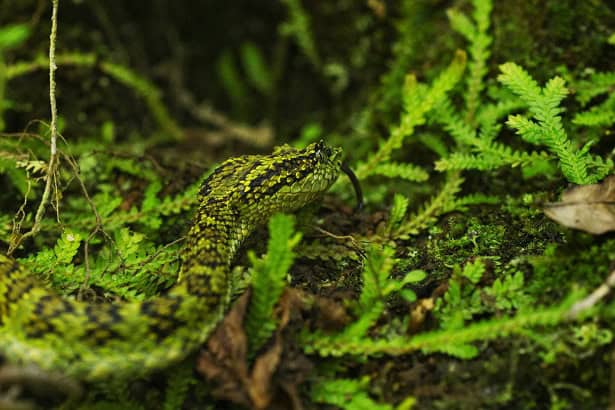
Maximum length: 96.9cm.
The highland eyelash viper (Bothriechis schlegelii) is a dangerously venomous species found exclusively in Colombia, in the Central Cordillera mountain range. It’s a tree-dwelling species which prefers branches 1-3 metres high, and appears in various habitats, including untouched forests, coffee plantations and occasionally rural gardens.
Like other eyelash viper members, this species is an exclusive ambush predator. Over millions of years, evolution has forced it down the path of greater and greater camouflage, until it became barely distinguishable from nearby vegetation.
Like the best camouflaged snakes, this species isn’t just green, but has finely tuned patterns to blend in at a microscopic level. The viper above seems to be perfectly mimicking the exact shape of the leaves on the forest plant it is slithering through.
The highland eyelash viper causes around 5-10% of snakebite cases in areas of Colombia where it lives, a large percentage of whom are coffee plantation workers. This is a fairly dangerous species, though not commonly fatal. Bites typically involve painful swelling, and are treatable with antivenom.
| 2 | South American bushmaster |
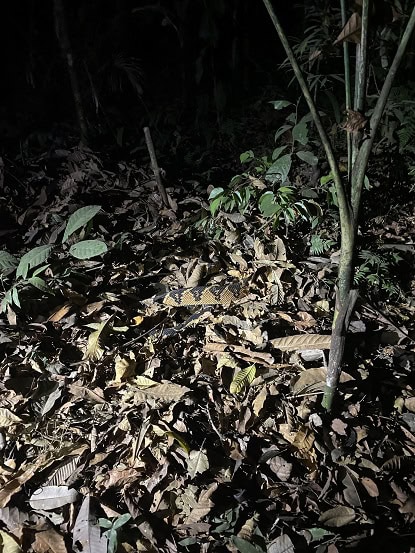
Maximum length: 3.65 metres.
The largest venomous snake in South America, but not a particularly active one, or even aggressive one. The South American bushmaster ranges from Colombia to Brazil to Bolivia, and regularly exceeds 3 metres in length, with a reasonably thick body.
The South American bushmaster is an ambush predator, and its scales come with the usual ambush characteristics: the ability to completely disappear in certain rainforest substrates. The South American bushmaster’s speciality is forests, rather than open grassland or villages. This species prefers untouched jungle areas, and despite being widespread, isn’t encountered often by human beings.
On one hand, this species is far larger than the highland eyelash viper, presenting a large target for your eyes to rove over. On the other hand, this species sticks almost exclusively to the ground rather than ascending branches, allowing it to hide in the shadows below. Coupled with scales which perfectly mimic fallen laves, your chances of spotting the South American bushmaster are very low indeed.
| 3 | Southern green parrot snake |
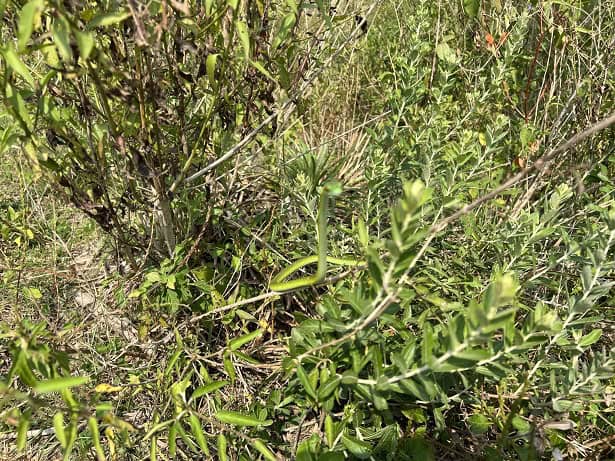
Maximum length: 158.5cm.
A mildly venomous species, which is a close relative of the giant parrot snake, found all over South America. The difference with this species is a smaller maximum size and a more southerly distribution, inhabiting southern Brazil, northern Argentina and most of Paraguay.
This is a fast-moving species, which skirts effortlessly over thin branches, with an excellent sense of agility. It has the colours to match as well, as the southern green parrot snake can completely disappear when in the middle of a bright green bush. Its colours consist almost entirely of green, except for a thin netting of black, and a bluish inner mouth lining.
This species has immense camouflage, but fortunately, this poses no threat to random passers-by. The southern green parrot snake possesses a venom, which even contains three finger toxins, the same neurotoxic class wielded by black mambas. However, a study found that this venom had little effect on mammals, and therefore humans. Most of this species’ diet consists of amphibians and lizards.
| 4 | Cutlass |
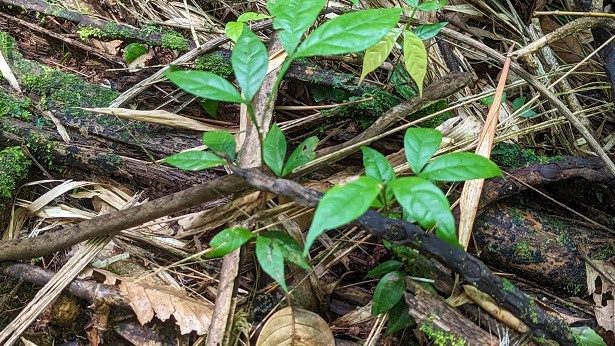
Maximum length: 180.6cm.
There are many forms of camouflaged snakes in South America, from bright green to mimic leaves, to orange-brown to mimic older, fallen leaves. Another option is mimicking fallen branches or twigs, and this is one the cutlass (Phrynonax sexcarinatus) has seized with full force.
The cutlass is a mildly venomous species found in the Amazonian region, appearing in northwest Brazil, eastern Ecuador and Peru, and northern Bolivia. It’s also abundant in French Guiana and Trinidad. Wherever it lives, it enjoys the best of both worlds, with an agile and energetic nature, but also the ability to blend with the forest and disappear. The cutlass has the power to almost become a tree branch, causing people to walk right past it. This can apply while on the ground, or on the thick arm of a tree.
Cutlasses even have green tinges sometimes, allowing them to blend with foliage as well as old branches. This species mainly hunts birds, and poses no threat to humanity.
| 5 | Wagler’s snake |
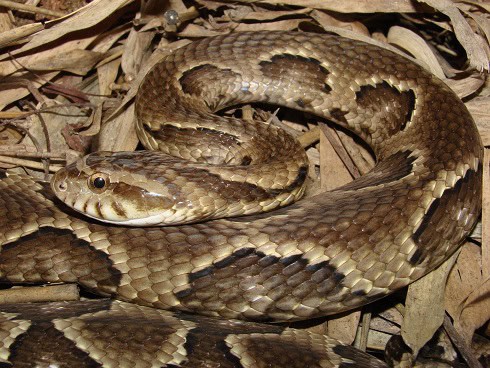
Maximum length: 127.5cm.
A mildly venomous species of southeastern Brazil, Paraguay, Bolivia and northern Argentina. This is a species which cannot defend itself with an overwhelming, shock and awe venom, but instead possesses various more subtle skills. The first is the ability to eat poisonous toads, without its heart rate slowing down to fatal levels.
The second ability is being an accomplished viper mimic, copying species such as the painted lancehead and jararaca. Finally, Wagler’s snake has excellent camouflage, particularly in fallen leaves. Its alternating beige and brown patterns mimic old, dried-out leaves perfectly, as well as dry areas of soil and old branches.
Wagler’s snake has flexible habitats, and in a grassy field, its camouflage is much weaker. But in the right areas, this species can absorb into its surroundings with ease, preventing larger animals from recognising its presence unless they happen to glance at precisely the correct spot. Wagler’s snake is a very common species in South America, but avoids the Amazon rainforest, only appearing further south.
| 6 | Green vine snake |
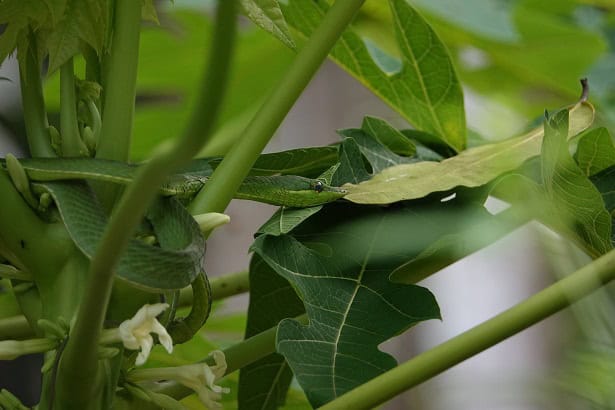
Maximum length: 216cm.
A moderately venomous species, which produces a unique neurotoxin called fulgimotoxin. This species is one of the most widespread in the entire Western Hemisphere, ranging from southern Mexico through the whole of Central America to central Brazil.
Green vine snakes are agile and nimble, with a strong ability to catch birds out of the sky, and lizards running along tree branches. This is one reason for their success, but another is their all-consuming camouflage, which allows them to not just blend into greenery, but almost fuse with it. This species even has the ability to dangle itself from a tree branch like a vine, and kink its body at various points to complete the impression.
This species poses no threat to humans, but has a demented and intimating defensive display, gaping its mouth widely. Like the southern parrot snake, its venom is particularly weak against mammals, and therefore humans.
| 7 | St Marta’s ground snake |
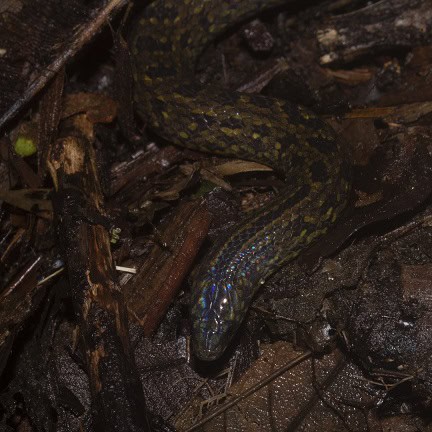
Maximum length: 71cm.
A poorly researched species, which has a very small range in South America, appearing only in far northern Colombia. St Marta’s ground snake is an inhabitant of cloud forests, where it sticks to the ground. It appears at high altitudes only, with an elevational range of 1200-2500 metres.
St Marta’s ground snake (Atractus sanctaemartae) is a dull brown species, overlaid with subtler darker stripes. Another characteristic of this snake is a slight iridescent sheen, which is just visible above. All this is perfect for blending into the moist, humid forest floor, amid the accumulated debris of a thousand rainforest seasons.
While the diet of this species is a mystery, Atractus members generally feed on earthworms. The Atractus genus has over 150 members, making it the largest snake group on Earth. None of these are remotely dangerous to humans, and that almost certainly applies to St Marta’s ground snake, despite the huge gaps in the data. Most Atractus members have small mouths as well, explaining why they must feed on small grubs.
| 8 | Olive forest racer |
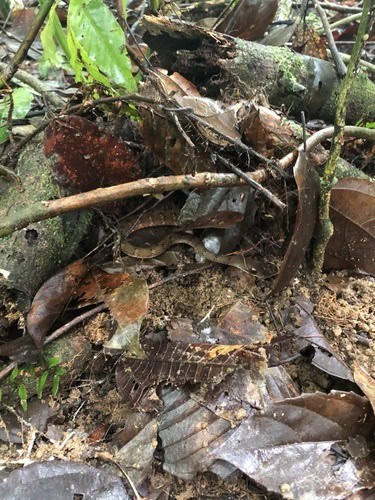
Maximum length: 118.3cm.
A fairly common species in the Amazon regions of South America. The olive forest racer (Dendrophidion dendrophis) inhabits northwest Brazil, eastern Peru and Ecuador, Colombia and more, and is mildly venomous, posing zero threat to human beings. Encounters with this species are only semi-regular, but they’d probably be more common if it wasn’t for this species’ excellent camouflage when winding along the forest floor.
In snakes, being a solid colour like grey or brown can actually be detrimental for camouflage. The ideal is having a subtle pattern, which contrasts moderately against the underlying colour, to break up the vision of predators and blend even more completely with a complex backdrop. The olive forest racer fulfills this characteristic, as it usually possesses a grey or brown backdrop, overlaid with rounded blotches with a bright outline, at fairly regular intervals.
This species preys heavily on frogs, which it seeks out in small forest pools. Olive forest racers have large eyes, and can also weave along branches, but generally stick to the ground.
| 9 | Painted lancehead |
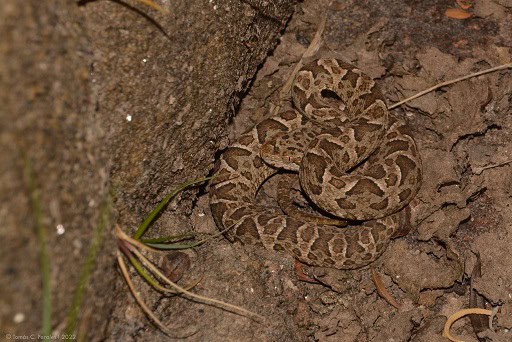
Maximum length: 110cm.
The painted lancehead (Bothrops diporus) is the most widespread venomous snake in Argentina, occupying a huge area of the north and centre, and also spilling into far southern Brazil. It’s a flexible species in habitat, but it’s one tendency is to inhabit relatively open, dry areas, rather than rainforests. Hence, this species has evolved a beige-brown colour pattern, allowing it to disappear into a variety of microhabitats.
Park, village, woodland trail – this species is able to vanish in all. The painted lancehead is a dangerous camouflage species as well, with a powerful venom capable of causing kidney failure. In a study comparing it to various other Bothrops lanceheads, the painted lancehead had the most powerfully haemorrhagic venom. It also possesses several unique toxins, including BdipTX, a powerful swelling agent.
Always keep an eye out for the painted lancehead when exploring northern Argentina. Note – this species nearly always appears on the ground rather than on branches.
| 10 | Lichtenstein’s green racer |
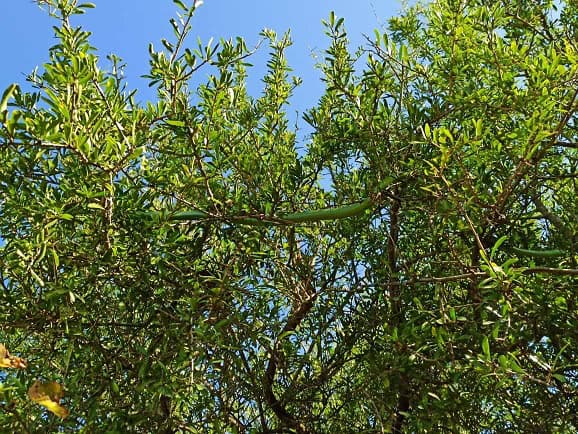
Maximum length: 147.6cm.
A common species in eastern and southern Brazil, Paraguay and Bolivia. This species avoids the Amazon rainforest, instead inhabiting mixed open areas of alternating fields and woodlands. This is a fast-moving, effortless climbing species, which is cloaked in green from head to toe, with the exception of a jet black eye stripe.
Unlike other species, Lichtenstein’s green racer doesn’t live by the code of camouflage nonstop. It’s a highly active and energetic species, exploring villages and crossing tarmac roads without hesitation. But when it enters green foliage, or the upper reaches of a tree, this species disappears with ease. On a windy day, it would probably be difficult to spot even when moving.
Compared to the parrot snake or green vine snake, this species is much less reliant on trees, but still climbs them regularly in order to snatch nestling birds. Lichtenstein’s green racer is moderately dangerous, with the ability to cause swelling, and even death, with a young child being the sole confirmed fatality on record.
| 11 | Northern eyelash boa |
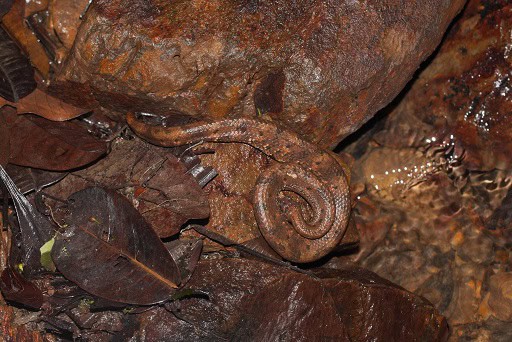
Maximum length: 35cm.
An utterly harmless species, which rarely exceeds 30cm, and has some of the weirdest attributes of a boa around. The northern eyelash boa inhabits two countries: western Colombia and western Ecuador, where it’s fairly abundant, though difficult to find. The first weird feature of this species is the ridges above each eye, which explain the eyelash name.
The second unusual feature is a bright tail, used for caudal luring, the strategy of luring in hungry prey using a bright dot which they mistake for insects. Finally, the northern eyelash boa has exceptional camouflage. Its strategy isn’t to blend with leaves or bushes, but the muddy floors of rainforests, with small pools of water accumulating between old logs and embedded rocks. This species lives in high rainfall areas receiving thousands of millimetres of precipitation per year, and it has the camouflage to match.
Northern eyelash boas lack any form of venom. Finding one is a harmless experience, even a magical one – but something you probably won’t get to experience, even if you walk right past one.