
| 1 | Philippine temple pitviper |
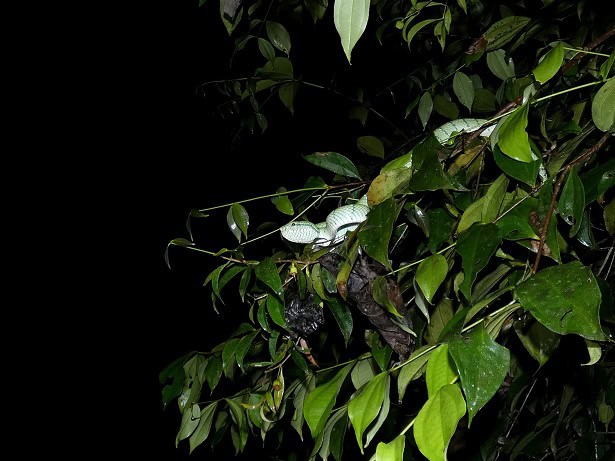
Maximum length: 96.3cm.
The main branch-dwelling pitviper of Borneo, the island split between East Malaysia, Indonesia and the small kingdom of Brunei. The Philippine temple pitviper (Tropidolaemus subannulatus) is a venomous species which has a sharp difference in colour between the sexes, with males being leafy green and females more of a minty blue-green.
The Philippine temple pitviper can exist in three areas; the ground, around 1-3 metres at eye height, or many metres above your head, at a level you might not even notice. Factors that determine its location include the scent of prey, the scent of females of the same species, and perhaps pockets of warmer or cooler air. Wherever the Philippine temple pitviper wishes to be, it climbs with ease, moving up even the most unstable branches almost effortlessly.
Coiling around a thin branch is second nature to the Philippine temple pitviper as well. This species is venomous, but was found in a 2015-2021 study to be relatively mild compared to other pitvipers, with little risk of causing death, and with surprisingly weak blood clotting disrupting abilities.
| 2 | Red-tailed green ratsnake |
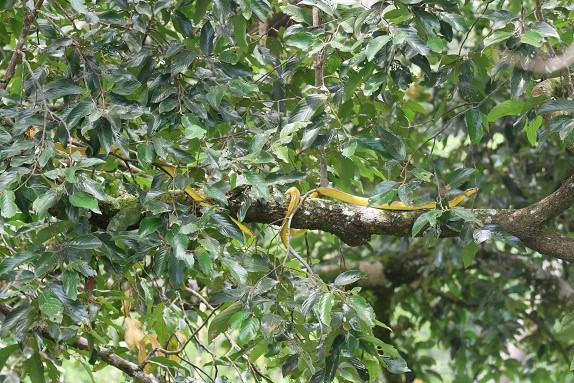
Maximum length: 240cm.
A widespread species in southeast Asia, covering the majority of Thailand, Malaysia and Indonesia, including the islands of Java and Borneo. This is a hefty species which is capable of moving along the ground, but spends the majority of its time on branches.
Red-tailed green ratsnakes (Gonyosoma oxycephalum) are mildly venomous, but mainly rely on intimidation to stay alive. Their strategies include massively inflating their chest, spreading their scales to reveal bright blue skin between the green. They occasionally reveal a bright blue tongue as well, shocking enemies with a sudden colour flash.
This species is almost unbeatable when it comes to climbing in southeast Asia. The red-tailed green ratsnake can reach branch perches a blood python couldn’t dream of. This includes low branches, and stalks of bamboo outside caves, but also the highest arms of trees, and thin upper perches which seem to defy their weight. The diet of this species consists of tree dwellers as well, including birds such as white-billed woodpeckers, and even squirrels.
| 3 | Mangrove pitviper |
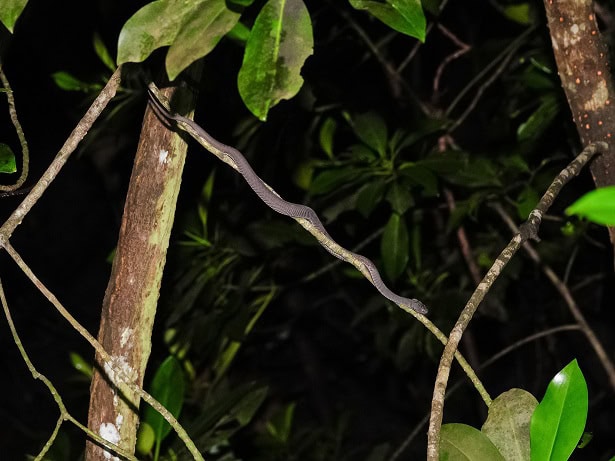
Maximum length: 107cm.
The mangrove pitviper (Trimeresurus purpureomaculatus) is a dangerously venomous species of southern Thailand, peninsular Malaysia and Singapore, which rarely kills anyone, but has a powerful venom capable of causing haemorrhaging and swelling all the way up the arm. This is a species of restricted habitats, appearing only in tree clumps near wetland areas.
Mangrove pitvipers rarely appear in urban areas, but can be present in popular tourist areas such as the Sungei Buloh wetlands of Singapore, and even the Wild Wild Wet waterpark. Like other Trimeresurus pitvipers, this species ascends tree branches with ease, barely hesitating before moving vertically up a trunk, reaching many metres up in the air.
To the mangrove pitviper, the thin arm of a tree is about as accommodating and easy to navigate as the Golden Gate Bridge. This species weaves along branches relatively slowly, but with complete confidence, and virtually no chance of falling. It’s also skillful at climbing wooden boardwalks, and can strike from tree branches, with a sudden extension of its coiled upper body.
| 4 | Wagler’s pitviper |
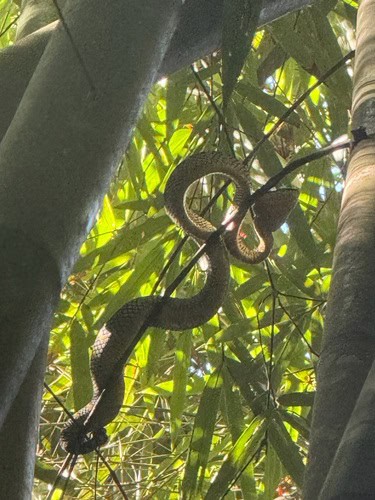
Maximum length: 130cm.
Another moderately dangerous pitviper, with a slightly different habitat. Wagler’s pitviper appears in a similar range to the mangrove pitviper, including southern Thailand, peninsular Malaysia and Singapore, but tends to inhabit standard tropical forests and rainforests rather than tree clumps near wetlands. This is a fairly mild viper, which causes decent numbers of bites, but doesn’t even cause swelling consistently.
Wagler’s pitvipers are bright leafy green, and blue-yellow in females, with females also being far larger. This is another effortless climbing snake, climbing thin branches as easily as a sturdy steel stepladder. These can range from thick, gnarly trunks to thin, spindly branches that a human being would simply fall though, like above.
Wagler’s pitvipers are more than capable of striking from a branch position as well, and if that happens, you may experience mild neurotoxic symptoms, though nothing serious. This is one of the few neurotoxic vipers in southeast Asia, containing the unique waglerin-1, which may cause paresthesia (tingling) and slightly twitching eyelids in victims.
| 5 | Yellow-spotted keelback |
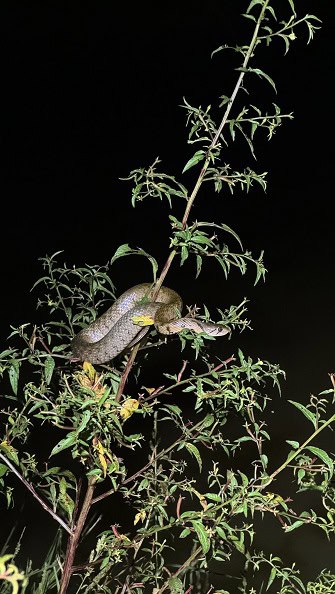
Maximum length: 97.4cm.
A fish-eating snake, which has a painful non-venomous bite, but is fairly disinterested in humanity overall. The yellow-spotted keelback lacks any green on its body, instead being adorned with a rapid series of small black blotches.
This is one of the more surprising climbing snakes in southeast Asia, as yellow-spotted keelbacks are semi-aquatic in nature, preferring lakes and ponds. Unlike most green pitvipers, they’re not natural tree dwellers, but as the image above proves, this species can still ascend to terrifying heights if its unknowable serpent mind deems it necessary. They have the agility and light weight to lurk on even the most fragile tree branches, and weave around them while climbing for support.
This species is a close relative of the checkered keelback, perhaps India’s most abundant snake by overall headcount. The yellow-spotted keelback is slightly less common, but still numerous in its Thai and Vietnamese heartlands. You can find this species near Bangkok and Ho Chi Mingh City alike, with a southern extent of northern peninsular Malaysia.
| 6 | Reticulated python |
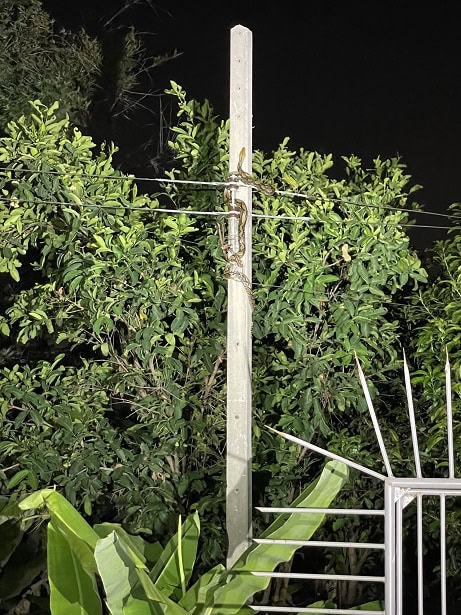
Maximum length: 6.95 metres (in the wild).
There are few snakes on Earth which regularly outstrip a human being’s weight, with some smaller snakes being measured in grams rather than kilograms. The reticulated python is one of the few, being the longest snake on earth, and the 2nd or 3rd heaviest after the green anaconda and African rock python. With a weight of up to 75kg, this is undoubtedly the heftiest brute of a snake in southeast Asia, yet somehow, the reticulated python is still fantastic climber.
As juveniles, reticulated pythons often climb trees overlooking river shores, before dropping into the water when panicked. As adults, they mostly cease this behavior, but then somehow become experts at climbing manmade objects. Reticulated pythons have been found on roofs, in roofs, and even on electricity pylons, perhaps around the high voltage wires themselves.
Being huge doesn’t negate the reticulated python’s innate sense of balance and agility. This skill also opens up the terrifying prospect of a 6 metre snake randomly dropping on your head from a great height.
| 7 | Asian vine snake |
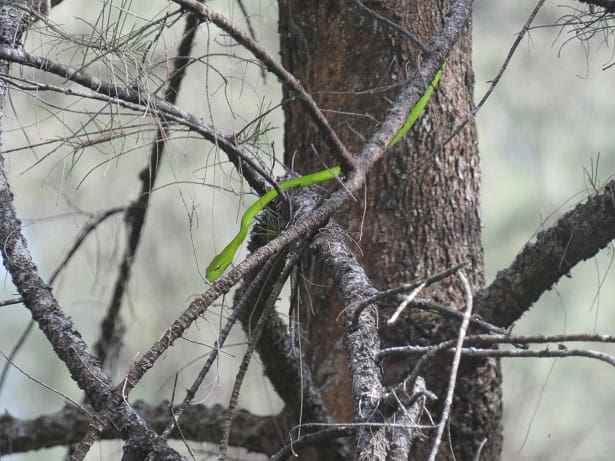
Maximum length: 197cm.
The Asian vine snake (Ahaetulla prasina) is undoubtedly one of the most dominant snakes in all of southeast Asia. This species has a variety of skills, all of which enable it to completely take over.
Firstly, the Asian vine snake is extremely green, allowing it to blend with moist rainforests with ease. It’s also relatively flexible in habitat, appearing in villages and spacious woodlands as well as dense forests, unlike its Malayan whipsnake cousin, which tends to just appear in dense rainforests. Another advantage of this species is its effortless climbing skills.
While most humans live in a world of effortless 3D movement, the Asian vine snake lives in a world of 4D; it possesses the ability to ascend to the skies at any given time, as long as trees are nearby. This species can move up tree trunks and the thinnest, most spindly branches, partly because it’s an extremely thin species itself.
Spotting an Asian vine snake 15 metres up a tree isn’t unusual, nor is spotting one on the ground. This species is extremely common in Thailand, Malaysia, Vietnam, Cambodia, and Indonesia alike.
| 8 | Berdmore’s slug-eating snake |
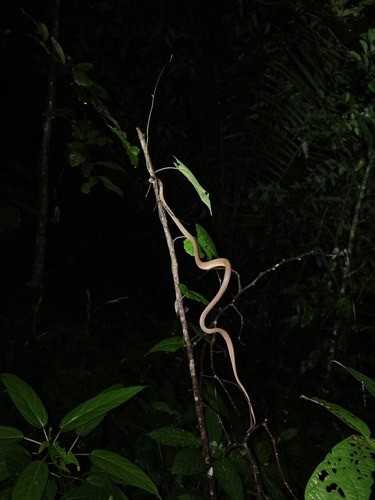
Maximum length: 77cm.
One of the more poorly researched common snakes in Thailand, despite covering a good 50% of the country, as well as much of Vietnam and Cambodia. Berdmore’s slug-eating snake (Pareas berdmorei) averages at around 60-70cm, and is believed to prey on slugs and snails, like most of its relatives, though hard data is tricky to come by.
What we do know is that this species ascends branches with ease. It ascends to gain a higher perch where more bountiful prey supplies exist, or simply to poke its head up and look around, before retreating to lower levels again. Berdmore’s slug-eating snakes climb thick branches and juicy bush foliage to equal effect, and are able to visualise a path through the greenery with their unusually large eyes.
This species is brown in colour, meaning that its camouflage isn’t exceptional against leaves, but is much stronger against a tree branch. Other individuals can look paler, but a consistent physical feature is faint, smudgy blotches, which form the shape of misshapen bands.
| 9 | Banded flying snake |
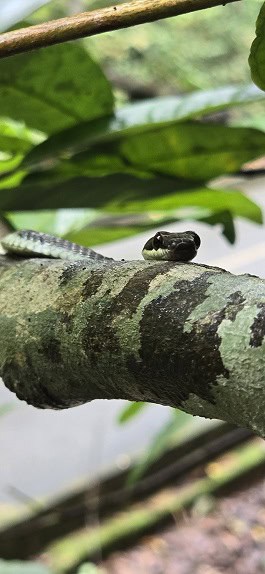
Maximum length: 74cm.
A species which is less intelligent than a human, and less able to wield tools than a human, but unquestionably a far superior tree climber. The banded flying snake (Chrysopelea pelias) is a species of Singapore and Malaysia, which actually glides rather than flies, travelling many metres through the air horizontally. It’s recognisable by its banded patterns, and a colourful red stripe down the spine.
Gliding after prey is impressive already, but this species’ climbing abilities are also next level. A human must carefully examine a tree trunk for handholds and footholds, before laboriously plotting a course upwards, and using all their agility not to fall. The banded flying snake simply slithers up without thinking, moving vertically up a tree, before arriving at a comfortable horizontal branch, from which it scans the forest floor for its favoured reptile prey.
This species is mildly venomous, but poses no threat to humans. Banded flying snakes are common in forests, but aren’t shy about appearing in trees near villages and parks.
| 10 | Gold-ringed catsnake |
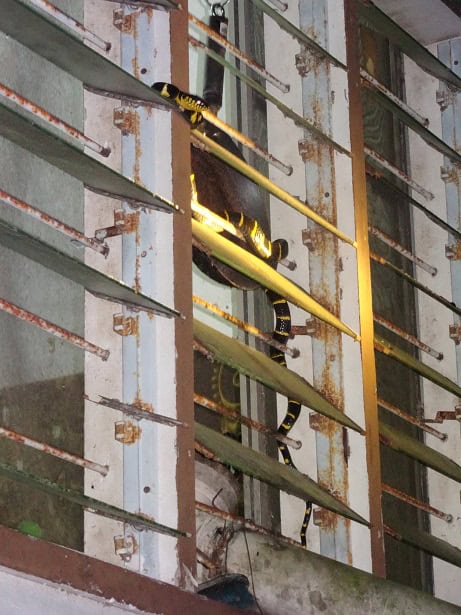
Maximum length: 250cm.
In Borneo or the Philippines, any thick-bodied, yellow-black snake resting above your head on a branch is highly likely to be the gold-ringed catsnake (Boiga dendrophila). This is a highly recognisable species, which has no green or brown on its body, and spends most of its life in forests.
Gold-ringed catsnakes climb trees with ease, moving patiently but remorselessly upwards, before coming to a halt on a comfortable fork of a tree, or a horizontal branch, and resting in the same position for hours. While trees are their main base, they also climb houses in villages occasionally, as shown by the photo above. The gold-ringed catsnake is a master at exploiting any possible weakness in a vertical structure.
This species is moderately venomous, and possesses a neurotoxic venom which may cause fatigue, listlessness and a metallic taste in the mouth, though no deaths are confirmed. This species is even known to eat pitvipers occasionally, possibly including our fellow list entrant the Philippine temple pitviper.
| 11 | Malayan whipsnake |
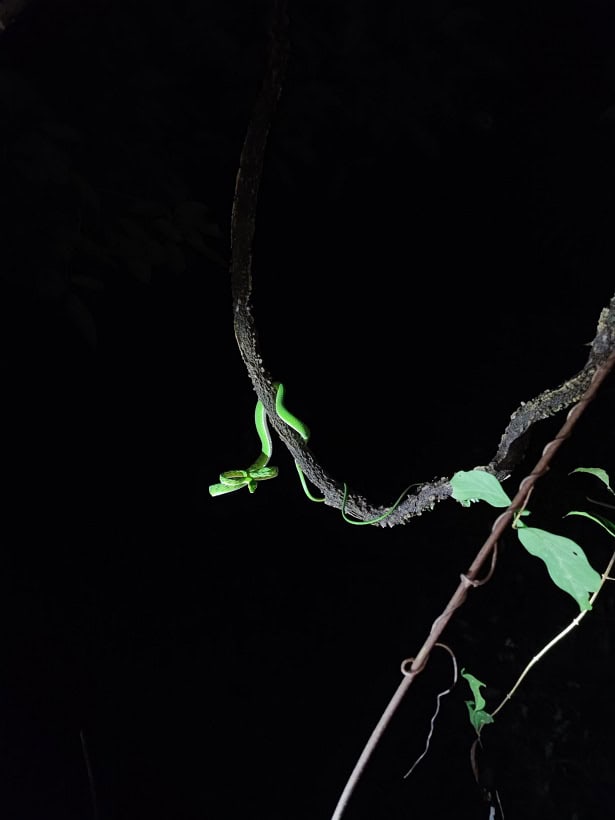
Maximum length: 110cm.
The Asian vine snake’s close relative, which is significantly less common, but equally as skillful at ascending thin branches. The Malayan whipsnake (Ahaetulla mycterizans) seems to float up branches rather than climb, such is its skill at instantly exploiting any piece of a tree it can. This is a mildly venomous species which poses no threat to humans, and is restricted to untouched forests rather than parks or villages.
Malayan whipsnakes are aided in their climbing quests by a thin body. They have large eyes with horizontal pupils, and a green body, with some black speckles appearing at the mid-body section through to the neck.
The Malayan whipsnake might live in the same countries as humans – Singapore, Malaysia, and Thailand – but it effectively lives in a parallel universe, not one of pavements and concrete, but finger-like branches and flimsy branch perches teetering over darkness, where only a scaly tail moving for a split second and the faint croaking of a frog indicate that a meal may be available.