
| 1 | African bush viper |
Maximum length: 79.9cm.
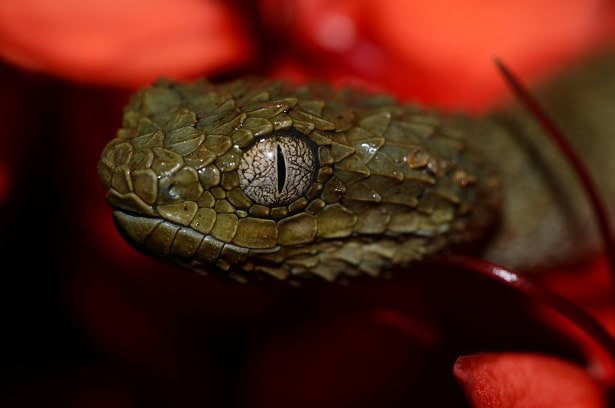
The African bush viper (Atheris squamigera) is a venomous species of central and western Africa, which ranks as perhaps the most common branch-dwelling species of the Congo Rainforest region. This is a moderately venomous species which doesn’t cause scores of bites, but is reported to have killed a victim in Central African Republic 6 days after being bitten.
African bush vipers have large eyes, and detailed ones too, as you can see above. Their pupils are vertical like most vipers, and their scales are particularly rough as well, with each individual scale having a keeled tip. Atheris squamigera is also one of the more variable African vipers. This species can be either green, minty, bright yellow or brown.
African bush vipers are immensely variable in colour, but whatever the morph, the eye colour always matches the scales, to provide an unbroken cloak of camouflage. Countries where you can find Atheris squamigera include DRC, Uganda, Central African Republic, Gabon and Equatorial Guinea. Wherever it lives, this is firmly a species of untouched rainforests.
| 2 | Karoo tiger snake |
Maximum length: 68cm.
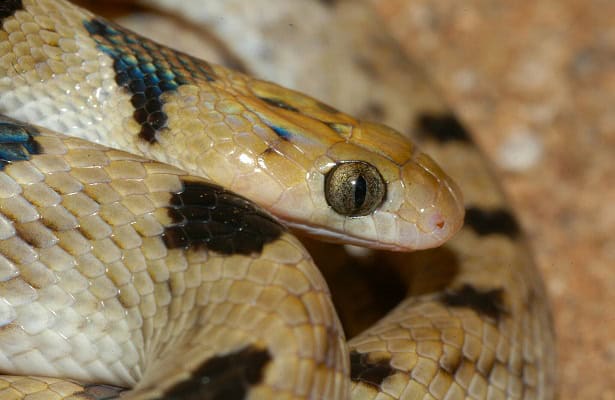
In the arid lands of southern Namibia and far western South Africa, you can find the karoo tiger snake, a completely harmless species which hides among dry rocks and shrubs. This is an easily recognisable species, with sharply contrasting beige scales and rounded black blotches. This species preys mainly on lizards and geckos, and is safe to pick up, though challenging to find.
Something you can notice from a distance with this snake, without needing to pick it up, is its large protruding eyes. Karoo tiger snakes have eyes taking up a large proportion of their head, and these eyes are rich in detail as well, with a sharp, vertical pupil surrounded by fine patterns of granite and sandiness. Unlike the African bush viper, the colour of the eyes usually contrasts sharply with the scales below.
Don’t mistake large eyes for great vision, however; the karoo tiger snake isn’t particularly perceptive, only reacting when humans stray to within a few metres. The black mamba’s eyes aren’t enormous, yet that infamous snake is able to detect human beings from much further away.
| 3 | Uganda house snake |
Maximum length: 87.5cm.
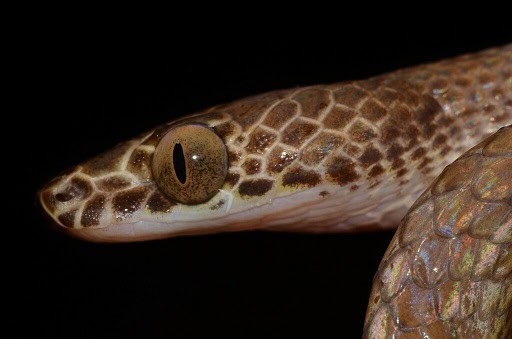
The Uganda house snake (Hormonotus modestus) is a weird offshoot from the main Baeodon group of house snakes, which includes members like the cape house snake of South Africa. The Uganda house snake is the sole member of Hormonotus, and exactly how it differs is mysterious, as this is a very poorly researched species. But one immediately apparent fact is that this species’ eyes are particularly enormous, for no obvious reason.
Ugandan house snakes appear in central and western Africa, ranging from Uganda in the far east (avoiding Kenya and Tanzania), to Guinea Bissau and Sierra Leone in the west. This is mainly a forest species, and its diet is known to include mammals and lizards. A chocolatey tone interspersed with white scale gaps is typical for this species, and so is a large pair of eyes, which are typically chocolate-coloured themselves.
The eyes of this snake are so bulging that they’re easily visible from a bird’s eye view as well (see here). Ugandan house snakes are mainly found on the ground, and forage actively. Whether their large eyes actually grant them superior visual abilities is unknown.
| 4 | Southern vine snake |
Maximum length: 168cm.
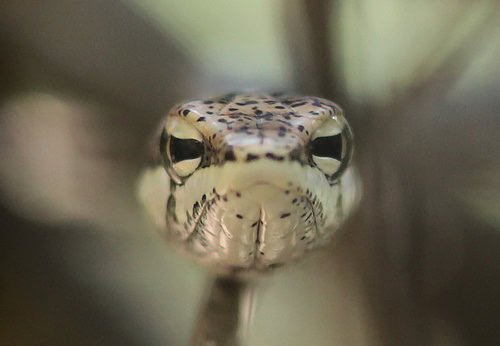
The southern vine snake (Thelotornis capensis) is a species of southern Africa, appearing in eastern South Africa, Zimbabwe, Mozambique, Botswana, Malawi and more. It’s a tree-dwelling snake, which appears not in forests, but mixed areas of villages, fields and standing tree clumps, preferring more open areas to the full claustrophobia of a swarming rainforest.
Vine snakes begin their strange eye parade with an unusually large eye size. The second characteristic is bizarrely shaped pupils, which not only resemble keyholes, but are horizontally orientated. This has a specific purpose – enabling their camouflage, as the keyholes are the bridge in a horizontal dark stripe that passes along the face, through the eyes and the snout. The result is that this species’ disguise isn’t broken whatsoever.
The southern vine snake is moderately venomous, and not to be underestimated. While only 10 proven envenomations have been documented in scientific journals, 2 have proven to be fatal, including one in 1953. The venom is haemotoxic in nature, with procoagulant effects, stimulating the production of fibrinogen so far that none remains for healthy blood clotting.
| 5 | Red-lipped snake |
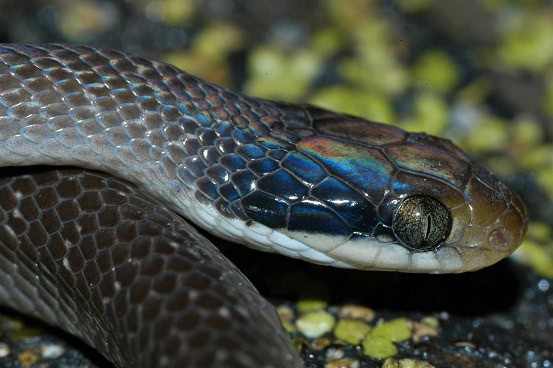
Maximum length: 89.1cm.
The red-lipped snake is one of the top snakes of Africa when it comes to head triangulation, transforming a normally slender skull into a bulky and blocky head in order to mimic a venomous viper. This is a highly widespread species in sub-Saharan Africa, covering dozens of countries from South Africa to Ethiopia to Gambia in the far west.
Red-lipped snakes have a fairly dull grey body, but liven up when it comes to the lip, which is either bright red, or snowy white, as seen above. There’s also a mildly iridescent sheen on the head, and finally the eyes, which are immensely detailed, with a vertical pupil.
The eyes of this species are large and protruding as well, and the red-lipped snake’s harmless nature makes them safe to analyse. You can find this species in moist areas of Africa rather than bone dry deserts. Red-lipped snakes prey heavily on frogs and toads, and hence appear in grassy meadows, vegetation near ponds, and the well-vegetated shores of rivers.
| 6 | Spotted green snake |
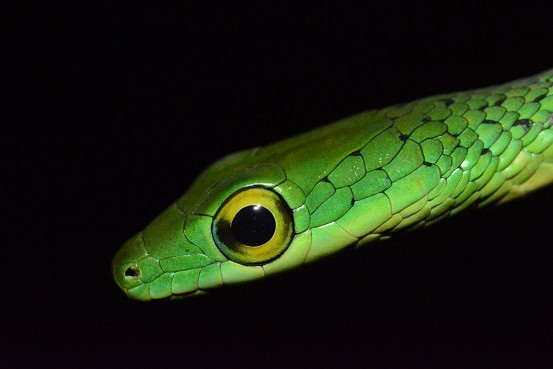
Maximum length: 120cm.
The spotted bush snake (Philothamnus punctatus) is a completely harmless species with a fast-moving, twitchy demeanor, which derives the majority of its calories from lizards. Greenness is a characteristic of this species, but so is a particularly large pair of eyes, which are also emerald green themselves, outside of the round, black pupils.
Spotted bush snakes are mainly found in Kenya and Tanzania, particularly along the east coast, where they’re extremely dense in areas straddling the border. To the north, they have an isolated pocket in Ethiopia, while to the south, they extend to Mozambique, but are sparser in number.
This species is likely to be spotted darting past your feet in a barely perceptible flash of green. In other cases, it might be too far away, but the spotted bush snake’s eyes are so large and protruding that you can easily see them at a distance. The only flaw with this species’ immense greenness is occasionally being mistaken for a green mamba and killed. The black spots are a dead giveaway, as green mambas are a much plainer green; they’re also significantly larger than the spotted green snake.
| 7 | Rhinoceros viper |
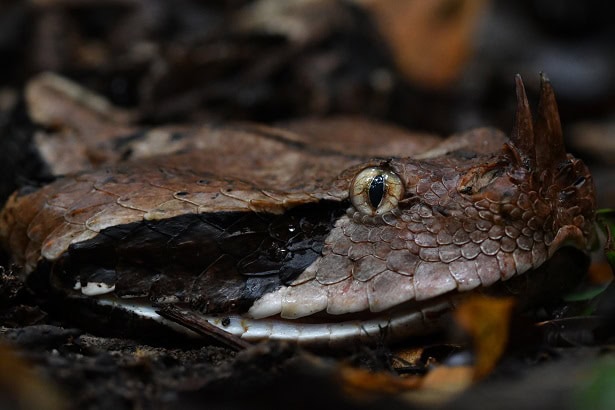
Maximum length: 205cm.
A relatively small pair of eyes for our list, but still a fascinatingly detailed pair. The rhinoceros viper (Bitis rhinoceros) is a species of west Africa, inhabiting Togo, Ghana, Ivory Coast, Liberia and more. It’s a western relative of the gaboon adder, and shares qualities like living on the ground, a tank-like body of immense thickness, and a vast venom volume, injected instantly into an unsuspecting victim.
Rhinoceros vipers are also recognisable by sharply pronged horns on their snout. Their facial patterns consist of alternating beige and black in a triangular formation. Their scales are rough and craggy, which is visible from a distance, but the fascinating thing is that this extends to the eyes. As the image above shows, their eyes have vertical pupils, but the irises maintain the cracked and segmented pattern, in a similar spacing to the actual scales nearby.
The goal of this is to aid with camouflage, which forms the rhinoceros viper’s entire hunting strategy. This is a highly immobile snake, which doesn’t bite scores of humans, but is a constant threat in Ivory Coast and Ghana due to the high risk of accidentally stepping one.
| 8 | Schlegel’s beaked blind snake |
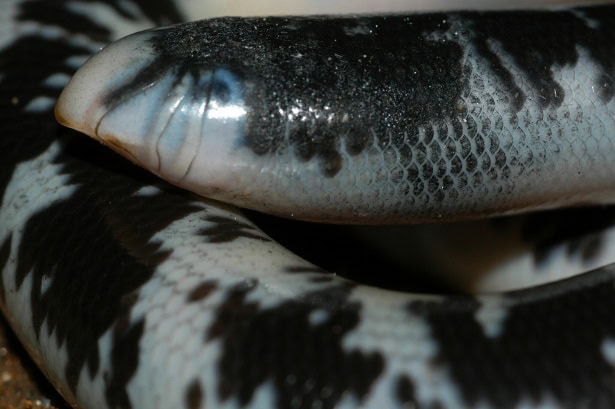
Maximum length: 80.4cm.
One of the weirdest entries of our list. The image above may seem to make no sense at first, but we assure you, it really is a close up of this species’ eyes. The vague, dark circles behind the white scales are the only eyes this species possesses, as Afrotyphlops schlegelii is a blind snake, sensing only the most basic changes of light, such as a sunrise or sunset.
Like other blind snakes, Schlegel’s beaked blind snake has eyes, but only severely rudimentary ones, which have shrunk over millions of years due to an ancient decision to live underground. This species feeds heavily on termites, and has even been seen burrowing furiously into the sides of large termite mounds, causing a strange liquid to leak out.
Many blind snakes appear to have visible eyes, such as the black dots of the European worm snake, but they’re nearly always encased behind semi-transparent scales. Afrotyphlops schlegelii is no different, and over the next few millions of years, it’s possible that they will shrink further. You can find this species in northeastern South Africa, where it reaches high concentrations, as well as Zimbabwe, Botswana, and northern Namibia.
| 9 | Diamondback night stalker |
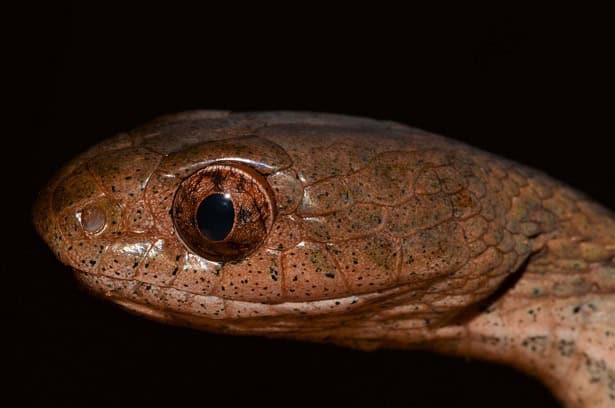
Maximum length: 122.5cm.
A poorly researched species, but a fairly common one, covering a large area of central and west Africa. This species’ domain is the Congo Rainforest, explaining the lack of data concerning its lifestyle. You can find the diamondback night stalker (Toxicodryas adamantea) in DRC, Congo, Uganda, Equatorial Guinea, Cameroon, Gabon and southeast Nigeria.
This species varies from brown to grey to even pinkish. From a distance, its patterns aren’t complex, consisting of thin, faint, bar-shaped markings. Up close, extra details appear, such as a sprinkling of black pepper markings, as shown above. Its richly coloured eyes also become apparent close up, with all the detail of a parched piece of a wood. Poking this snake in the eye would probably leave your finger covered in tree sap, if you managed to get close enough without it darting away.
Despite the evil-sounding name, this species is only slightly venomous, and poses no threat to humans. Its most memorable feature is enlarging its neck – not sideways like a cobra, but forwards and backwards, so that its neck becomes thinner from a forward-facing view.
| 10 | Emerald snake |
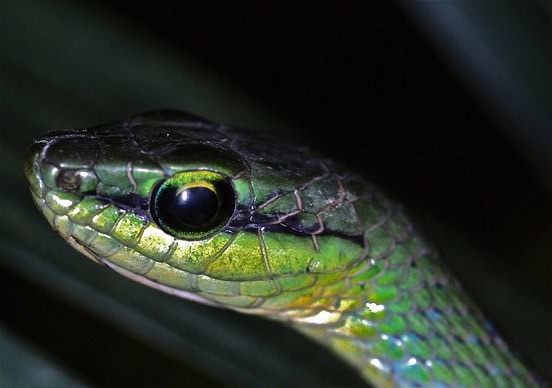
Maximum length: 119.1cm.
A common species of western and central Africa. The emerald snake (Hapsidophrys smaragdina) ranges from the Atlantic nation of Guinea-Bissau in the far west, to Uganda in the far east. It’s a harmless species, which feeds heavily on frogs and lizards, and moves stealthily through overgrown greenery in order to get them.
More than any other, the eyes of this snake look like ancient emerald jewels, inserted into a living creature for incomprehensible reasons. The Philothamnus genus possesses green irises, like the spotted green snake, but the emerald snake has them beaten for sheer richness.
Its body is rich as well, not a clean pastel green, but adorned with subtle black markings, and a constantly shifting, shimmering shade of green. Between each scale lies blue skin, which becomes more noticeable from certain angles. This is one of the more beautiful snakes of central Africa, yet also one of the more mysterious. A black stripe through the eye is another way to distinguish this species from other green snakes.
| 11 | Roman’s saw-scaled viper |
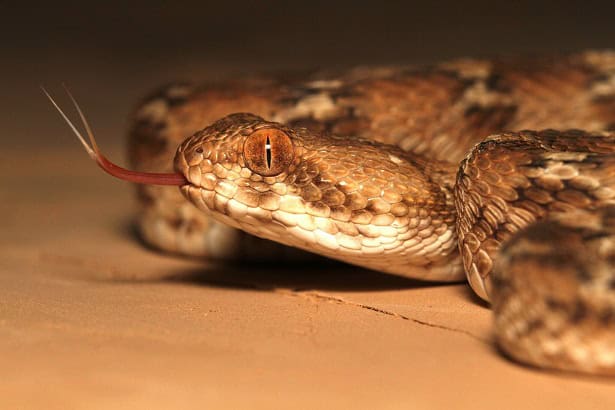
Maximum length: 71.5cm.
A species of Nigeria, which inhabits the parched, relatively arid north, as opposed to the greener south. Roman’s saw-scaled viper (Echis romani) belongs to the same genus as the lethal saw-scaled viper of India, one of the most dangerous snakes on Earth. This version is also potentially lethal, with a severe effect on blood clotting.
Roman’s carpet viper is a beige snake, blending with its equally beige environment. The same is true for its eyes, which feature vertical pupils like most vipers, surrounded by a mixture of beige and orange, with fine details which only emerge as you get up close. There’s even a slight galactic look to this species’ eyes – like a large stellar object distinguishable in a high-powered telescope, but only partially lit by the nearest star.
Despite its high population, Nigeria isn’t well researched when it comes to snakebite statistics. Nevertheless, a 2021-2022 survey revealed that Roman’s carpet viper envenomates thousands of Nigerians per year, with 5467 cases over the two year period. The redeeming feature was that antivenom was highly effective – the tough task in arid northern Nigeria is often getting to hospital in time.