
| 1 | Montpellier snake |
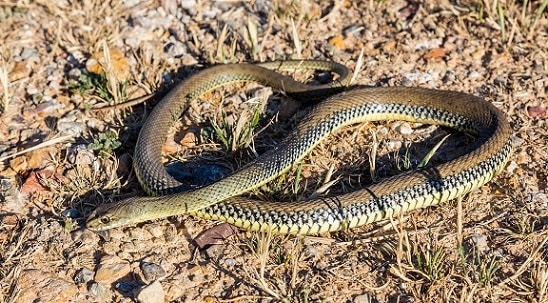
Maximum length: 216.2cm.
The Montpellier snake lives in Spain, Portugal and North Africa, reaches 2 metres, and has a consistently olive-coloured body. This snake isn’t just energetic, but unrelenting and fearless in everything it does. When hunting, it simply charges down its rodent prey and grabs hold, skipping unnecessary steps like constriction.
Montpellier snakes can pick up scents of a rat colony on the wind and slither 500 metres just to see what’s there. They’re also completely unbothered by human settlements, and will continue to zoom around as though they haven’t seen anything.
Montpellier snakes hunt using active foraging, and their diet consists of 50% reptiles and 35% mammals. Top species include the wood mouse and Algerian sand racer. Montpellier snakes are hunted themselves by short-toed eagles, which is doubtlessly another reason why their speed has accelerated over time.
Thankfully, their speed doesn’t make them dangerous to humans, as this species has a neurotoxic venom, but only a tiny mouth, which makes biting people almost impossible. Montpellier snakes also have an eastern species which lives in the Balkans, including Greece and Albania.
| 2 | Green whipsnake |
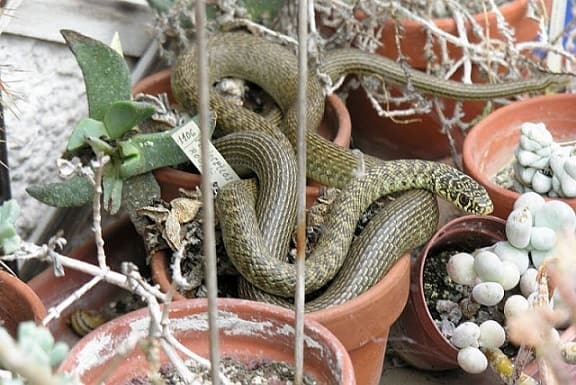
Maximum length: just under 2 metres.
The green whipsnake (Hierophis viridiflavus) lives in southern Europe, particularly in Italy, where it’s the most commonly sighted snake overall. This is because of its personality, as the green whipsnake is a bold, brash species which slithers around wherever it pleases, in a constant rush.
The green whipsnake has been recorded to travel 881 metres in a single day. It dislikes dark forests, but appears abundantly in mixed open areas, where it can slither over walls and leap casually from tree branches to its hearts content.
Green whipsnakes are so energetic that they’ve invented a special looping system. The first loop lasts 24 hours and has the purpose of sun exposure, warming their cold-blooded bodies. The second loop lasts 2 days or more, and involves exploration and finding more bountiful food supplies. Loop 3 is a mating loop where they search for females, lasting 30 days. Each of these exploration loops travels in a wider arch than the next, with the last covering 3km.
Green whipsnakes have several defensive moves, but always prefer action to cowering in fear. If the way is clear, they’ll speed off down a footpath. If cornered, they’ll lunge while hissing fiercely and bite without hesitation.
| 3 | Red-bellied black snake |
Maximum length: 254cm.
The red-bellied black snake is easily one of Australia’s most relentlessly active serpents. This dangerously venomous species doesn’t hold back in anything it does, whether it’s swimming through lakebeds to flush out prey, speeding through car parks, or motoring along dirt tracks.
Red-bellied black snakes are very active in winter compared to other Australian snakes, and barely seem to stop moving all day. Males have been witnessed travelling 1.22km in a single day, particularly those fuelled by their yearly obsession with female pheromones. Ordinary Australians often encounter them on roads, in gardens near water bodies, or even in swimming pools.
One reason behind their adventurous ways is their taste for frogs, including the emerald spotted tree frog. Frogs tend to congregate in certain swamps, meaning that there’s always a bountiful new food supply somewhere out there to find.
Rather than a stealthy ambusher, this species is exclusively an active forager. The red-bellied black snake would go crazy if it followed the lifestyle of the broad-headed snake, which sticks to one bushrock outcrop and nearby forest all its life.
| 4 | Lichtenstein’s green racer |
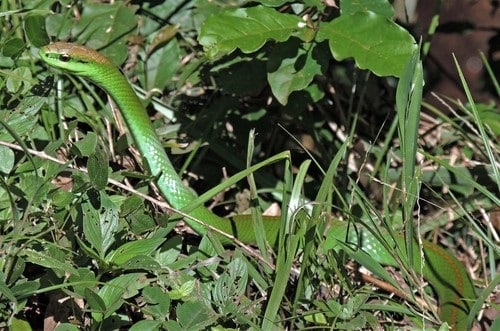
Maximum length: 147.6cm.
Out of all common snakes in South America, this is one of the least famous. Lichtenstein’s green racer (Philodryas olfersii) is found in virtually all of Brazil, from the Amazon rainforest in the centre to the Atlantic coast of the east. As long as there’s some trees, this species can thrive almost anywhere.
Lichtenstein’s green racer spends its life zipping up branches and charging between ancient, thick trunks to find its next meal. This snake also has extremely fast reactions, which are used to pounce on prey. It produces a rear-ranged venom which has never killed an adult, but may cause nasty, painful swelling, based on similar venoms in other species.
Rather than one sudden lunge, the Lichtenstein’s green racer chews again and again until it’s satisfied that enough has been injected. Then it slithers off to complete its next task, whether it’s investigating a bush or climbing a tall tree to raid a bird’s nest.
Lichtenstein’s green racers are pure green with a bronze cap on their head, and belong to the same Philodryas genus as Chile’s most common snake, the Chilean long-tailed snake, another rapidly-moving species.
| 5 | Rhombic skaapsteker |
Maximum length: 150cm.
The rhombic skaapsteker is the resident speed specialist of South Africa, a mildly venomous 80cm snake which appears in various habitats. If you see a distant dust cloud on the horizon, it could be a car, but it could also be a rhombic skaapsteker.
This species is common in dry shrubland with plenty of thorny bushes to weave through, as well as moist savannahs. It commonly takes advantage of dusty paths and trails, as these are simple to zip along. Rhombic skaapstekers eat mammals first and lizards second, including rock elephant shrews and montane speckled skinks.
Rhombic skaapstekers grind to a halt almost as quickly as they start, freezing still as though their power supply has been disconnected. Their speed likely evolved to help them catch fast-moving meals, although they can still miss by a few centimetres, even with their fast, twitchy movements. It’s possible that evolution will push rhombic skaapstekers to get even faster over the next 10,000 years.
Rhombic skaapstekers are mostly restricted to South Africa, but are very abundant where they do appear. This is a restless snake which is never content to cling to one comfy branch all day.
| 6 | Black mamba |
Maximum length: 425cm.
The black mamba’s speed is legendary, as according to village folklore, it can outrun a fully grown man or even a car. While this is clearly exaggerated, there’s no doubt that this savannah species is disturbingly fast. The black mamba’s venom can paralyse a grown man in 10 minutes, and it has the ability to slither at high speeds with up to 50% of its upper body raised into the air, which only adds to the horror.
At over 4 metres, the black mamba is the second longest venomous snake worldwide. It’s probably the most energetic snake relative to size, as the longest snakes worldwide are mainly stealthy constrictors, with the exception of the king cobra, which isn’t particularly hyper.
An oft-cited statistic is that black mambas can slither at 12.5mph, versus an average human jogging speed of 8mph. There’s no doubt that a black mamba could charge at you across a field if inclined, but they tend to flee if humans approach to within just 20 metres.
A possible evolutionary explanation for this speed is the mongoose, the black mamba’s nemesis. This furry mammal is immune to neurotoxins, and battles black mambas with speedy, darting movements, weaving between their venomous strikes. These mammal predators have probably forced the black mamba to get even faster over the years.
| 7 | Coachwhip |
Maximum length: 259.1cm.
A species of the dry southern US, which is legendary for its energy levels. Coachwhips are surrounded by endless pieces of folklore, including legends of chasing after humans on dusty plains, after which they apply a tight set of coils and stick their tail up the victim’s nose to check if they’re still breathing.
The coachwhip is an active forager rather than an ambusher. Its diet consists of 60-70% lizards, and it uses this speed to hunt them down, forgoing venom for crazed and relentless pursuit. Officially, coachwhips reach a maximum speed of 4mph (5.8km/h), yet this is debatable, as they look far faster in the scores of YouTube videos uploaded by locals.
The coachwhip’s speed is also used for escape, as it has many terrifying predators. When targeted by a bird, the coachwhip dashes into a dark mammal burrow, flips around, and immediately starts biting the bird’s talons. The one thing that coachwhips aren’t great at is swimming, although they can paddle through small streams if necessary.
Coachwhips range from Florida in the east to California in the west. They have 7 subspecies, including Nevada’s red racer, but all are equally manic and fast.
| 8 | Western Galapagos racer |
Maximum length: 128.5cm.
A manic snake of the Galapagos Islands, which favours open habitats with clear uninhibited views ahead. Western Galapagos racers appear in grassy areas, volcanic rock formations, and along rocky shorelines, where they often hunt for fish. Galapagos racers dislike thick forests, and this is probably related to their extreme speed, as they dislike any location where they’re hemmed in and unable to charge.
The western Galapagos racer (Pseudalsophis occidentalis) could probably outrun any human being, with the exception of a prime Usain Bolt. As it speeds forward, the Galapagos racer constantly wriggles its body, propelling itself forward with dozens of subtle muscle manoeuvres. A snake already has movements a human couldn’t dream of (try moving without using your limbs), but western Galapagos racers are even more fine-tuned, like an enhanced next generation model.
Western Galapagos racers were discovered in 1912, but became particularly famous in 2016, when a BBC documentary (Planet Earth II) showed over a dozen trying to hunt the same iguana and failing. At times, the iguana was in their clutches, yet eventually managed to wriggle free, showing that a firm grip is just as important as lightning speed.
| 9 | Oriental ratsnake |
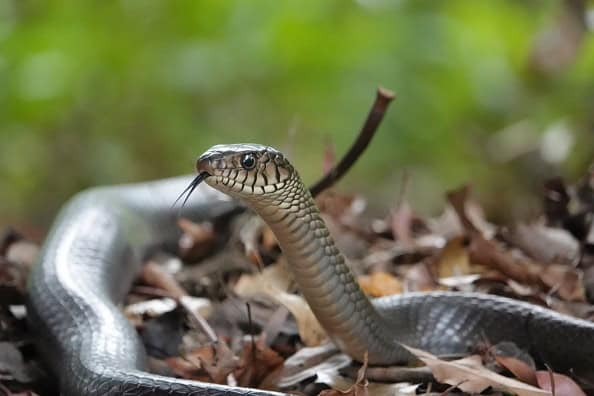
Maximum length: 3.7 metres.
The oriental ratsnake (Ptyas mucosa) is a species of southeast Asia, which eats amphibians first and mammals second, including Asian common toads and Boie’s wart frogs. This is Thailand’s 5th longest snake, exceeding 3 metres regularly, but its body is thin, which generally correlates with high speeds, which this species more than possesses.
Another ID sign is that oriental ratsnakes are constantly prowling around, whether in a field or village street. They’re always on the move, seemingly aimlessly at times. Favourite activities include crossing between overlapping branches, blocking bridges, and threading through gaps in metal fences just for the sake of it.
Because they’re so curious, oriental ratsnakes are encountered often by toiling villagers, or even kids walking to school. Most Thai people are used to their manic ways, and go about their lives in peace, having learnt long ago to coexist with them.
If cornered, then oriental ratsnakes tend to hiss and make a series of frenzied mock lunges. Despite their size, they’re sometimes swallowed by their dreaded neighbour snake, the king cobra. Oriental ratsnakes are non-venomous and safe to pick up, but catching one is a lot harder than a boa constrictor.
| 10 | Golden tree snake |
Maximum length: 140cm.
The golden tree snake (Chrysopelea ornata) is a harmless species, and another one familiar to all Thai villagers. This species is commonly seen sitting on low branches, resting calmly amid the greenery, but when in motion, it slithers frantically as though its life depends on it.
Golden tree snakes are extremely common, ranging from Singapore in the south to southern India in the far west. They have the ability to extend their vertebrae outwards, creating an air cavity beneath their body which allows them to glide from one tree branch to the next.
They perform these moves at extreme speeds, and indeed, speed is essential to their hunting. Golden tree snakes mainly prey on reptiles, particularly the Tokay gecko, their favourite foodstuff. They leap at these geckos from a high branch perch, glide steadily, and instantly grab them when making contact. If they weren’t extremely fast and twitchy, then their hunting exploits would fail.
Golden tree snakes are also nervous around humans. They stay calm until you reach a few metres away, then dart away rapidly into bushes. Nobody is sure why golden tree snakes stray so close to villages if they’re so frightened of people, yet they never seem to learn their lesson.
This species measures 100cm on average, and is clearly recognisable by its vividly alternating green and black colours. In their northwestern territories like India, golden tree snakes sometimes have bright red patches too.