
| 1 | Berg adder |
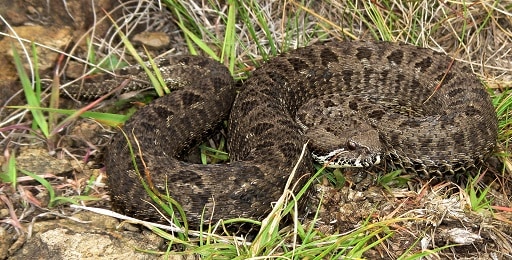
Maximum length: 60cm.
A small but dangerous viper, which averages at 30-40cm and lives in a narrow slice of territory. This is a high altitude viper, rarely appearing below 1500 metres, and sometimes reaching heights of 3000 metres. Berg adders (Bitis atropos) are found in relatively cool areas of South Africa, with high annual precipitation. They’re mostly confined to South Africa, but also have a small pocket straddling the border of Zimbabwe and Mozambique.
Berg adders are the exact opposite of a cobra in their lifestyle. Instead of being manic and energetic, they prefer to wait patiently in the undergrowth, barely moving, and with a constant menacing expression. Berg adders are inactive ambush predators, and this is exactly why they’re so dangerous. In the mountains where they live, almost any grassy, rocky field could host an explosive berg adder mine, just waiting to be detonated.
So far, this species has caused no confirmed deaths, but the toxin profile is potentially lethal. Berg adders are highly neurotoxic, with one 42 year old man remaining in hospital for 114 days. 13 out of 14 victims experienced systemic symptoms according to a 1987-2003 study, which included drooping eyelids, altered taste and swallowing difficulties. Victims may end up on a ventilator, as their lungs become incapable of sucking in enough oxygen unaided.
Berg adders can be violent and vicious if disturbed. They might be lazy, but they’re not cowardly. Making matters worse, no antivenom is available for this obscure mountainous viper.
| 2 | Spotted harlequin snake |
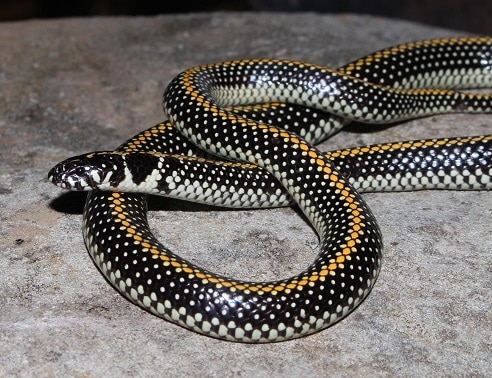
Maximum length: 65cm.
One of the funkier-looking snakes roaming the wilds of South Africa. This small species is only mildly venomous, and mainly coexists peacefully with human beings.
Spotted harlequin snakes (Homoroselaps lacteus) are found mainly in South Africa, as well as the tiny nations of Lesotho and Eswatini. They skip Zimbabwe, Botswana, or anywhere further north, but within South Africa, this funky species is very common. Spotted harlequin snakes are often found lurking under old termite mounds or rock piles. They occasionally appear near buildings under rubble and debris as well. Reptiles are their primary food source, including legless skinks, other snakes and small lizards.
With an average length of 40-50cm, spotted harlequin snakes are highly effective at staying hidden. Their dazzling colours are actually a survival strategy, as when uncovered, they use them to shock predators, which assume them to be venomous based on their resemblance to lethal coral snakes.
Spotted harlequin snakes are always colourful, but vary based on region. Their venom is relatively mild, causing swelling and minor necrotic lesions. At the most extreme, bites can dissolve the membranes of capillaries, causing minor blood leakage, but only 7 spotted harlequin snake bites have been recorded over the last 70 years. Rather than biting, this species prefers to wrestle furiously if picked up.
| 3 | Bibron’s stiletto snake |
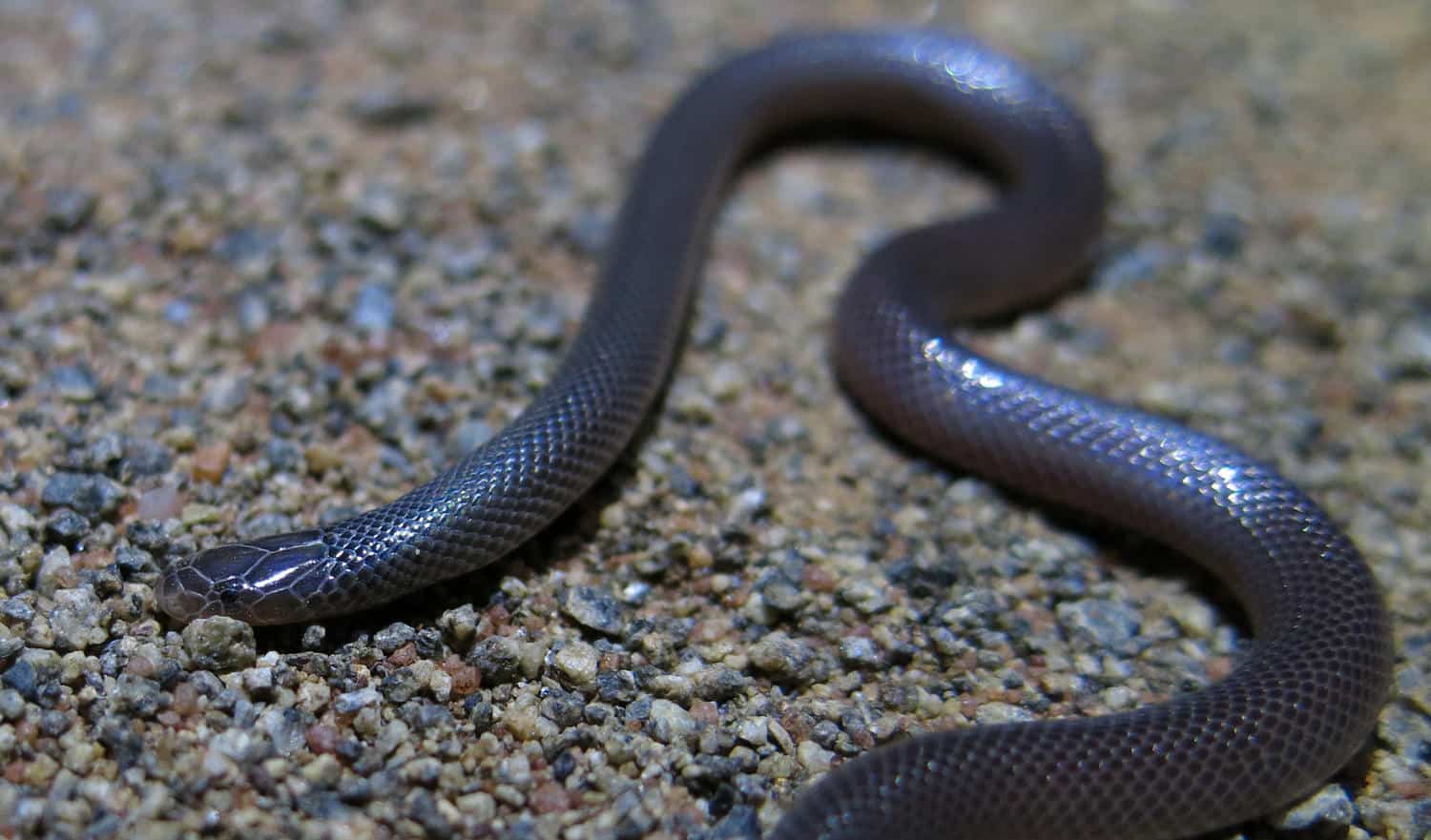
Maximum length: 70cm.
Perhaps the sneakiest dangerous snake in South Africa. Bibron’s stiletto snake (Atractaspis bibronii) is infamous for its weird fang formation, with a singular fang which juts sideways from its mouth, allowing it to swipe at victims even when its mouth is fully closed. Bibron’s stiletto snake is quietly responsible for a large chunk of South African snakebites, alongside the cape cobra.
This species is mainly an underground dweller, burrowing in surface layers of soil and emerging immediately after heavy rains. With oily black scales, and virtually no patterns, Bibron’s stiletto snakes bear a close resemblance to harmless underground blind snakes. There’s no iconic neck flare to alert people as with cobras, and this is partly why they’re so dangerous. A large proportion of South Africans are bitten while carrying this snake away from gardens, after mistaking it for a harmless species.
Making matters worse, Bibron’s stiletto snakes are relaxed about biting, and will do so if they feel even the slightest concern. All it takes is for an animal larger than themselves to get within touching distance, whether it’s a human being or hyena.
Their venom is moderately dangerous, delivering intense pain, swelling, and possibly necrosis. One patient suffered an amputated fingertip, and other symptoms include hoarseness, painful eyes when moved, headaches, and a dry mouth.
The saving grace with Bibron’s stiletto snake is that the venom arrives in small quantities, like the boomslang. On the other hand, its fangs are unusually long, hence the stiletto name, which references the stiletto daggers wielded by assassins.
| 4 | Cape sand snake |
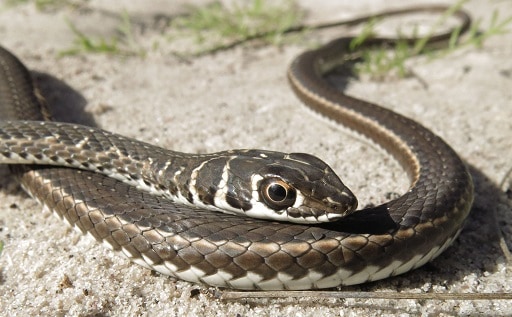
Maximum length: 100cm.
One of South Africa’s faster, whippier snakes. The cape sand snake is mildly venomous, and is found in most of South Africa (except the northeast), plus Namibia and Botswana. This is a thin, twig-like species, which averages at 50-80cm, and poses no threat to human beings.
Unlike an African rock python, cape sand snakes (Psammophis leightoni) have no power to knock over a gazelle in a single brutish lunge. Instead, they have the gift of speed and agility, allowing them to zip though the savannah effortlessly, escaping predators with ease. This species is almost impossible to capture for a photo op, slipping through your fingers at the very last second.
Cape sand snakes are common in sandy areas along coastlines, and especially in areas rich in dry shrubs, which they often take shelter beneath. They hunt by day, and like the black mamba, they have the power to slither forward with the entire upper third of their body raised off the ground.
This species belongs to the large 33-member Psammophis genus, and has the usual pattern layout. Rather than encircling bands, cape sand snakes have parallel brown-black stripes stretching down their entire body. They have a particularly long tail, which only adds to their agility.
| 5 | Eastern tiger snake |
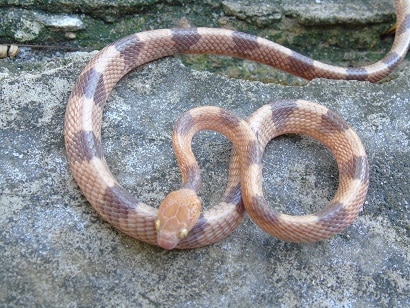
Maximum length: 105cm.
A slightly venomous, but almost completely harmless snake. This 75cm species has no relation to the feared tiger snakes of Australia. Instead, the name originates from its striking pattern of black bands over orange scales.
Eastern tiger snakes, AKA common tiger snakes, are found in a variety of habitats, ranging from spacious forests and savannah, to rocky plains and shrubland. They’re excellent tree climbers, and often wedge themselves beneath peeling strips of bark on trees. This is a common species in South Africa, as well as Tanzania, Zimbabwe, Mozambique and Malawi further north.
Eastern tiger snakes (Telescopus semiannulatus) are completely harmless, but can still be intimidating to serpent newbies. When cornered, they flare their necks wildly, gape their mouths open with an insane expression, and leap forward to deliver a thudding bash. Fortunately, all this is just an elaborate ruse. Their diet mainly consists of lizards, supplemented with small mammals and nestling birds. In captivity, they’re said to swallow geckos happily.
For normal people, eastern tiger snakes are most commonly spotted while crossing roads. Their patterns and bulging eyes make them one of South Africa’s easiest snakes to identify, even for an amateur. South Africa is also home to the karoo tiger snake, but this species lives in the west, while common tiger snakes cover the centre, north and east of the country.
| 6 | Red-lipped snake |
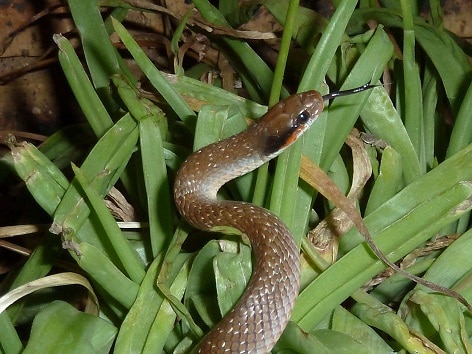
Maximum length: 89.1cm.
A simple South African snake to identify, due to a combination of the namesake red lip, an oily black tongue, and a jet black patch below each eye. Red-lipped snakes (Crotaphopeltis hotamboeia) reach a confirmed maximum of 89.1cm (a male), and have a mild venom which barely affects humans.
This species is relatively common, appearing across a huge swathe of South Africa, excluding the dry northwest. Compared to most South African snakes, red-lipped snakes are much more attracted to moisture. Their habitats therefore include marshland, moist savannahs, forests, lush grassland, and even suburban backgardens.
Their diet is also a moist one, as red-lipped snakes specialise in slippery, slimy amphibians. Rain frogs are a particular favourite, and they have the power to swallow unusually large toads.
If you see a red-lipped snake heading directly towards you, seconds from pouncing range, there’s little to fear. They have a mild venom which is incapable of killing, and their fangs aren’t especially vicious. However, they have an intimidating defensive display, where they draw their head into a striking position as though preparing to unleash imminent death. Red-lipped snakes can even triangulate their head, by shifting bones in their skull, in order to mimic a viper.
| 7 | Western natal green snake |
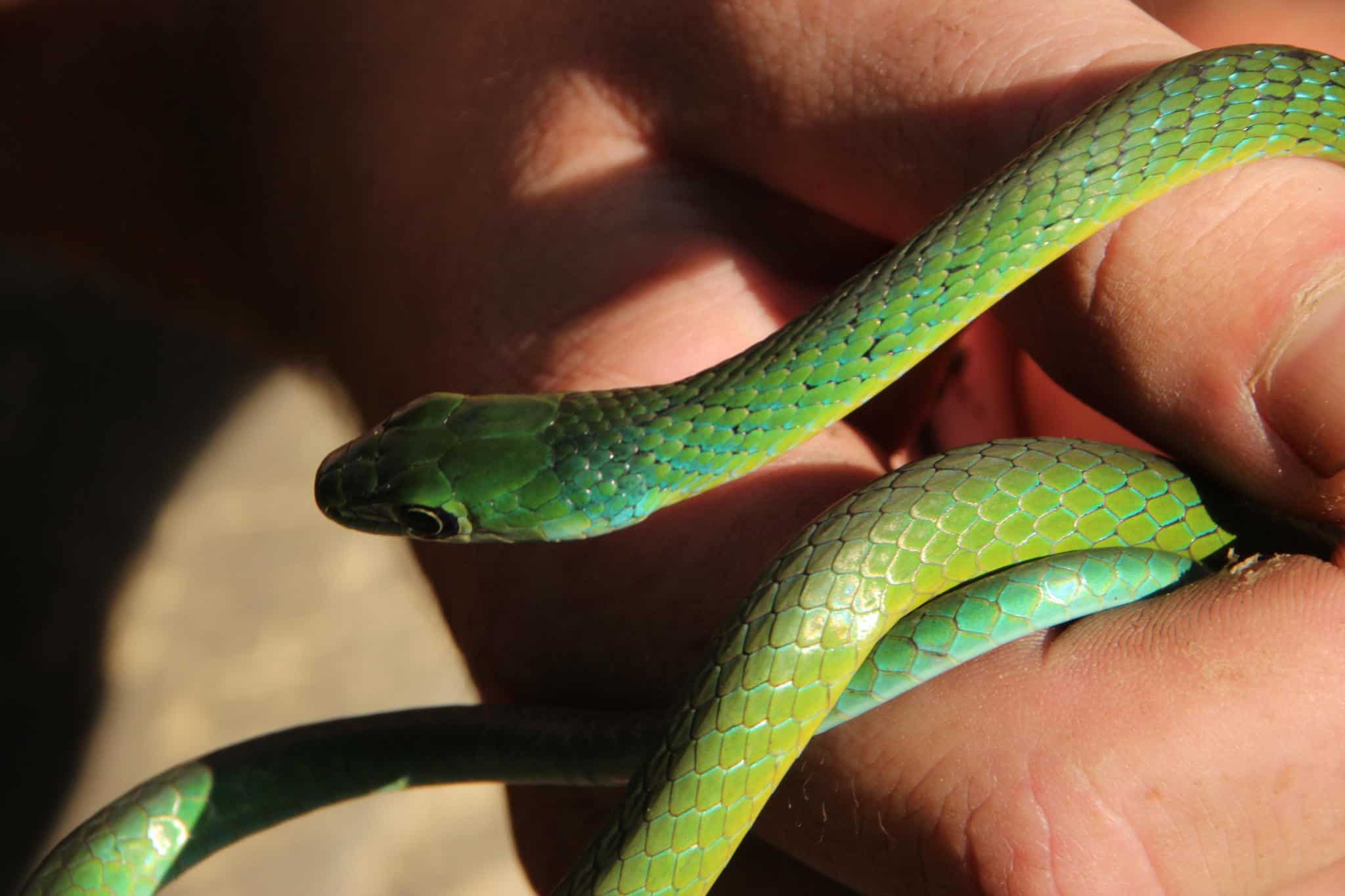
Maximum length: 130cm.
A common species along the coasts of South Africa, especially the southern and eastern coasts. The western natal green snake (Philothamnus occidentalis) is only slightly venomous, and is extremely green with occasional blue tinges. This snake only appears in moister areas of South Africa, especially ponds smothered by reeds and knee length grass. Their camouflage is supreme, and it’s very tricky to see them when they rest motionless in long grass.
Western natal green snakes are strong swimmers, but mostly stick to the water’s edge, along streams and ponds, where they like to climb onto low branches. Instead of fleeing, they use one of the most time-tested survival strategies of the animal kingdom: blending into thick greenery. As long as green foliage grows, there’ll always be an ecological niche for an ultra green snake to appear, and this is South Africa’s version.
Up close, the greenness gets more complex, as almost fluorescent patches appear. There are also black cracks visible between each scale. Western natal green snakes have very large eyes, which are purely black, with a round pupil. They’re quite similar to boomslangs in appearance, and are often killed by locals out of fear, despite being completely harmless.
Being so green, it’s unlikely that you’d spot a western green natal snake from a safari vehicle. It you did, your vehicle would probably drive straight into a pond afterwards.
| 8 | Cape reed snake |
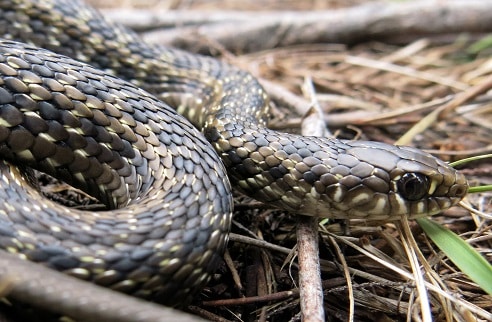
Maximum length: 63cm.
This moderately venomous species is found only in the southern reaches of the African continent, including South Africa, and small areas of Mozambique and Zimbabwe. As the sole member of the Amplorhinus genus, this is an isolated snake on the evolutionary tree, with no close connections to other living snakes.
Many-spotted reed snakes (Amplorhinus multimaculatus) are found in moist environments, rather than parched deserts or rockland. Their favourite areas include riverine vegetation and reed beds, while grasslands and fynbos are also acceptable.
Though not truly dangerous, a bite from a many-spotted reed snake could still ruin your day, with a nasty bout of swelling. Their first move when cornered is to coil into a tight spring, to persuade people to leave. This almost always works, as their viper-esque patterns only add to their intimidation skills.
Many-spotted reed snakes measure 63cm at the most. They have subtle colours, featuring blackish to almost honey brown scales, interspersed with small white dots. This species can be hard to find – they’re common where they live, yet are secretive, and don’t pop up for photo opportunities on request.
| 9 | Fisk’s house snake |
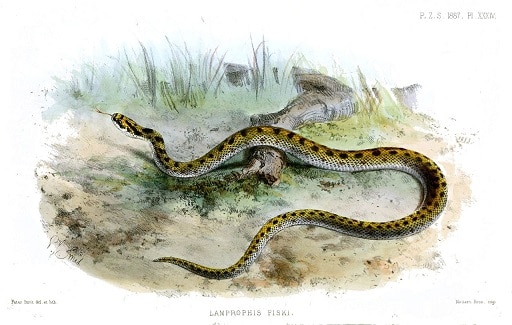
Maximum length: 40cm.
This non-venomous, diminutive species lives in South Africa’s western regions, perhaps crossing into extreme southern Namibia. Fisk’s house snakes (Lamprophis fiskii) are hardly ever seen by humans – hence why we only have an explorer’s sketch for the image. They were first unearthed in 1887, and in 1982, a pair was found near Springbok, the first discovery in nearly a century, although local villagers had probably seen this species over the years and not realised the significance.
Little is known of Fisk’s house snake, but a lizard was found in one individual’s stomach. A few have been raised in captivity, and they mostly ate geckos. Most sightings nowadays are made on lonely dirt roads.
Fisk’s house snakes are also tiny, averaging at just 25-35cm, allowing them to dodge humanity’s vision with ease. On the other hand, they’re one of South Africa’s more colourful species, with orange and black colours contrasting sharply like a totem pole, and finer matrix patterns on their flanks. In fact, this species looks more like a tiger than the eastern tiger snake.
| 10 | Schlegel’s giant blind snake |
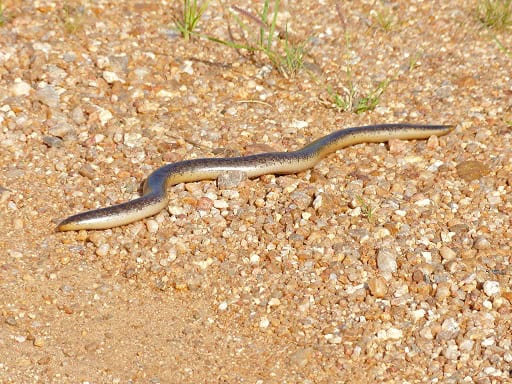
Maximum length: 80.4cm
This South African species is one of the largest blind snakes in the world. The Typhlopidae family of blind snakes has 200 members across Africa, Asia and Australia, and Schlegel’s blind snake (Afrotyphlops schlegelii) is close to the largest, occasionally reaching 80cm.
Like other blind snakes, this species has rudimentary eyes, which can detect slight light intensity changes. However, the eyes are covered with scales, reducing their function to the bare minimum. Schlegel’s blind snakes live in open areas, including parched plains and grasslands. They’re expert burrowers, lurking deep underground, and occasionally being dug up by construction vehicles.
Schlegel’s blind snakes have a bizarre head shape, with a sharpened beak which enables their burrowing activity. This is one of the few snakes worldwide recorded to become obese, as they sometimes gain such large fat reserves for the winter that their bodies grow deformed.
Schlegel’s blind snakes are harmless to humans, and are sometimes preyed on by Mozambique spitting cobras, but they have a few rare skills. One is a particularly relentless burrowing style, which even enables them to burrow into the side of termite mounds.
In an observation in Kruger National Park, a Schlegel’s blind snake forced its way into an active termite mound using sheer determination. Living termites and a strange wet liquid flowed out of the hole, as the blind snake furiously dug its way in. The termites avoided the snake, and finally, the blind snake gained access, completely disappearing from the scientists’ view.
| 11 | Olive snake |
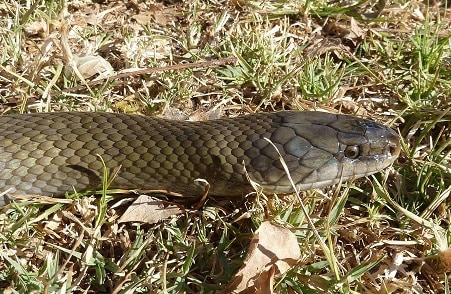
Maximum length: 130cm.
A harmless, lazy species. The olive snake takes no sides in South Africa’s various conflicts, whether it’s park rangers versus poachers or cape cobras versus mongooses. This is a humble snake which is simply trying to survive, hoping to keep quiet so that blundering predators don’t notice them.
Olive snakes (Lycodonomorphus inornatus) are nocturnal, and average at 30-60cm. They’re mainly concentrated along the southern and eastern coasts of South Africa, including within the city of Cape Town. The only other countries they inhabit are Lesotho and Eswatini (formerly known as Swaziland). While not a water snake, olive snakes prefer areas with higher moisture such as fynbos, grassland and bushland, rather than dry savannahs.
Olive snakes are indeed mostly olive, with few noticeable patterns. They have round black eyes, with a small, rusty red iris, which is only noticeable close up. Another ID sign is their shiny, reflective scales, which almost look like they’re coated in extra virgin olive oil.
Olive snakes might be careful and cautious, but this doesn’t always save them. This snake is popular prey with secretary birds and snake eagles, two of Africa’s main snake-eating birds. Olive snakes lack any venom, and choose prey from virtually all food groups. There are also reports of olive snakes from Namibia, but these haven’t been confirmed.
| 12 | Cape file snake |
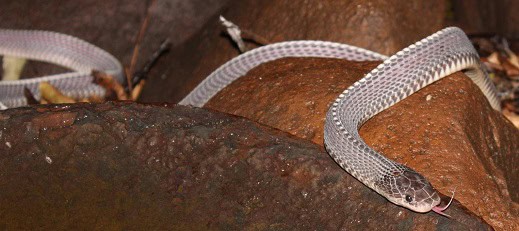
Maximum length: 175cm.
A ground-dwelling species which appears in savannah, grassland and shrubland. The cape file snake (Limaformosa capensis) inhabits eastern South Africa, Mozambique, Zimbabwe and Tanzania, and is non-venomous, but bites aggressively if picked up by an overconfident human.
Cape file snakes are heavily nocturnal, and take shelter during the day, in termite mounds, underground burrows or even holes in walls. When the sun sets, they poke their heads out, and commence the night’s hunting, searching for their mostly serpent prey. Cape file snakes are completely resistant to the venom of fellow snakes, and are even able to swallow deadly puff adders without suffering any ill effects.
The cape file snake is a recognisable species due to three features. The first is its very rough, jagged-looking scales, which explains the file snake name. The second is its immensely triangular body, which peaks with a white stripe running down its entire spine.
Finally, the cape file snake has scales which are unusually far apart. This allows you to easily see the pinkish-white skin beneath. Cape file snakes also have round, almost cute pupils, rather than vertical like the vipers they devour. Their tongue is pinkish, while their underside is whitish.