
| 1 | Brown forest cobra |
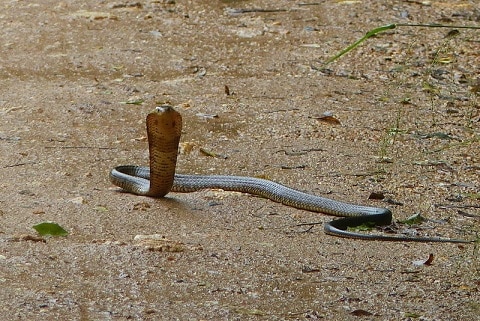
Maximum length: 269cm.
A species found across most of Mozambique, excluding drier portions of the south. This cobra is usually a consistent brown with a few paler markings, darkening gradually as the tail approaches. Like all cobras, this species has the ability to flare a sudden and shocking neck hood, to warn enemies of its presence.
Brown forest cobras (Naja subfulva) can be found roaming savannah, woodlands and forests. Despite their brute size, they’re relatively shy in personality, and tend to flee rather than attack. They move around cautiously and intelligently, and tend to stay away from towns and villages. Unlike the cape cobra, they rarely appear on beaches and cause holidaygoers to scatter.
Brown forest cobras bite people only rarely, though they’re easily capable of triggering mass necrosis. Their venom has neurotoxic qualities, but isn’t anything unique for a cobra, as the standard African cobra antivenom works well against them.
This is also the largest cobra species in southern Africa, with a record length of 269cm. The brown forest cobra is closely related to the main forest cobra (N. melanoleuca), and was originally assigned as one of its subspecies, before being split off in 2018.
| 2 | Eastern stripe-bellied sand snake |
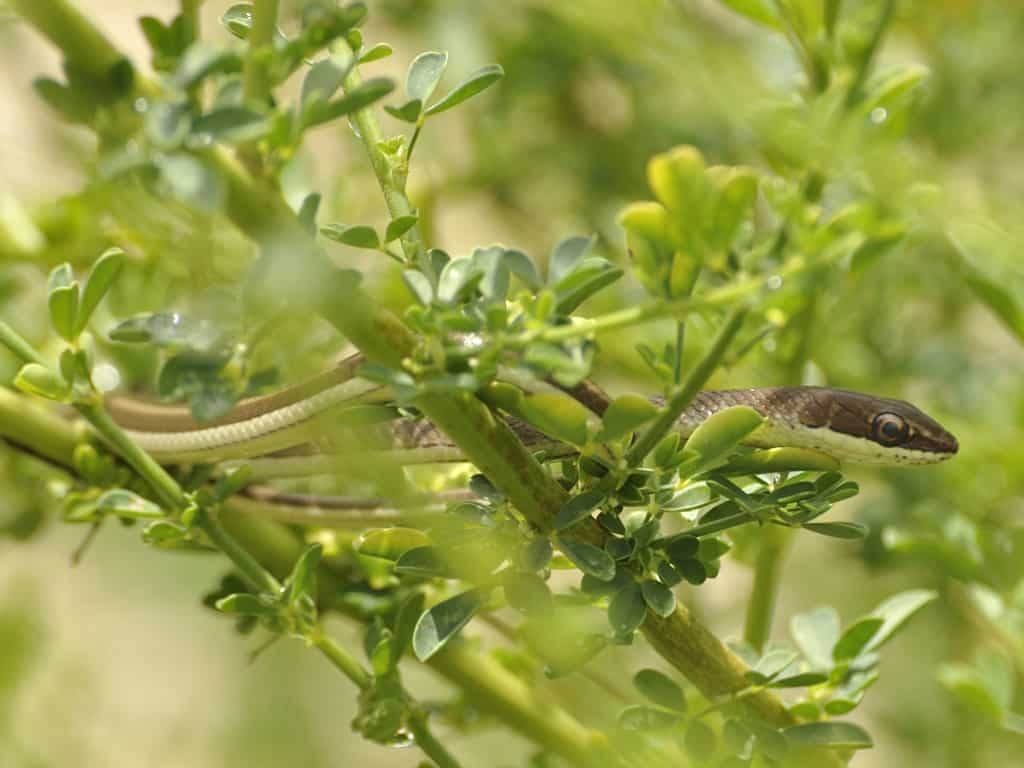
Maximum length: 140cm.
A harmless snake which rarely attacks people, and tends to hide in dry shrubs when concerned for its life. Eastern stripe-bellied sand snakes (Psammophis orientalis) average at 50-80cm, with a fairly thin body. They live in moist savannahs with wide open surroundings, and like other Psammophis members, they’re extremely fast and twitchy.
Eastern stripe-bellied sand snakes secrete a rear-fanged venom, but would struggle to severely damage a human even if they chewed for long periods. Speed and agility are their survival secrets, not all-out assault.
Eastern striped-bellied snakes aren’t especially memorable in colour, but do have a sharp split between a cream/yellow belly and a duller, darker back. You can find this species from southern Mozambique, through Malawi and Tanzania to southern Kenya. The diet of this snake consists heavily of skink lizards, with one confirmed prey being the variable skink. Bird and mammal prey have also been observed.
This snake was originally a mere eastern subspecies of the western yellow-bellied sand snake (P. subtaeniatus), but was declared to be an independent species in 2002. This happened because scientists noticed that the two forms coincided in southern Zimbabwe without interbreeding.
| 3 | Fornasini’s blind snake |
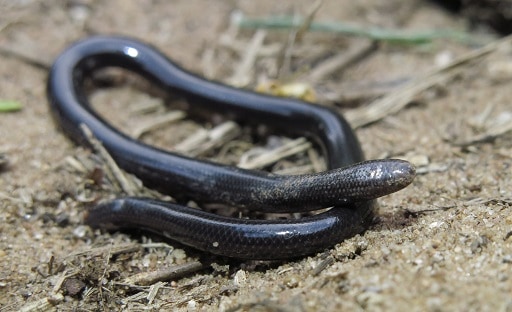
Maximum length: 18.5cm.
A species of southern Mozambique and extreme eastern South Africa. Fornasini’s blind snakes (Afrotyphlops fornasinii) measure just 15cm, making them one of the smallest African snakes. They also have some of the most miniscule dots for eyes of any snake. This is a classic blind snake, a snake whose eyes have become redundant and gradually shrunk over millions of years, due to a mostly underground lifestyle.
Rather than forests, this species prefers to hide in open areas such as savannahs, grassland or sparse bushland. Fornasini’s blind snakes possess virtually no patterns, just a consistent black colour, which makes it easy to confuse them with venomous stiletto snakes.
Fornasini’s blind snakes live alongside many iconic creatures, including elephants, zebras and giraffes, but always out of sight, just below the surface. They’re also one of the shiniest snakes in Africa, reflecting a tourist guide’s torch and a car’s headlights alike.
This species might win a battle with a brown forest cobra, for the simple reason that the cobra would probably lunge and miss the tiny target. Fornasini’s blind snakes are barely researched, but they’re assumed to prey on worms, and possibly ants.
| 4 | Eastern twig snake |
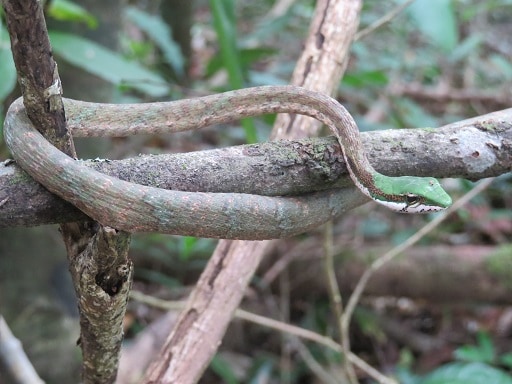
Maximum length: 143.5cm.
A snake which chose to live in branches millions of years ago, and slowly began to resemble a branch itself. The eastern twig snake (Thelotornis mossambicanus) is most common in northern Mozambique and eastern Zimbabwe. Attacks on humans are rare, but its bite is dangerously haemotoxic, and can cause spontaneous, uncontrolled bleeding in serious cases. Finding an eastern twig snake is difficult in Mozambique, not because they’re rare, but because their camouflage is so effective.
Eastern twig snakes measure 100-120cm on average. If you do find one, they’re easy to recognise. Their eyes are particularly amazing, as the pupil is bizarrely shaped, like a keyhole. They have a green skull cap, which contrasts vividly against the parched brown body. This greenness extends to the upper half of the eye untouched, but a brown stripe runs along their flanks, which continues untouched through the centre of the eye.
Eastern vine snakes are also recognisable by an orange tongue. They often engage in warfare with birds, which mob them in a flock of squawking and feathers.
Eastern twig snakes have no grudge against humanity, but will get extremely enraged if you interrupt their favourite activity: resting aimlessly on branches. This species generally prefers low lying shrubs to towering branches 20 metres high.
| 5 | Mozambique shovel snout |

Maximum length: 31cm.
This harmless species mainly lives in southern Mozambique, as well as extreme eastern South Africa. Mozambique shovel snouts (Prosymna janii) are found in coastal forests and moist inland savannah, the unifying feature being soft soils to dig in. This species has been blessed with supreme burrowing skills, which are all thanks to its namesake shovel snout.
Mozambique shovel-snouts are most commonly sighted by ordinary people on roads. They’re attracted to sand, but also thick layers of mulchy leaf litter. Though excellent at digging, they rarely venture far below the surface, instead staying in the loose upper layers.
Mozambique shovel snouts average at 25cm, and are completely non-venomous; they’re not one of those deceptive snakes which hide a savage venom behind a diminutive size. When confronted, they use intimidation tactics, raising their upper body into the air and swaying it back and forth rhythmically, with their mouth hanging open.
Originally, Mozambique shovel snouts (and other Prosymna members) were thought to prey on reptiles. This was repeated so commonly that everyone assumed it was true, not thinking to question it. But one day, scientists decided to investigate old museum remains and their stomach contents. They discovered that snakes of the Prosymna genus overwhelmingly feasted on reptile eggs, mostly soft-shelled, but also harder gecko eggs.
For the Mozambique shovel snout itself, 4 reptile eggs were discovered. Their digging skills probably evolved to help them find these eggs.
| 6 | Marbled tree snake |
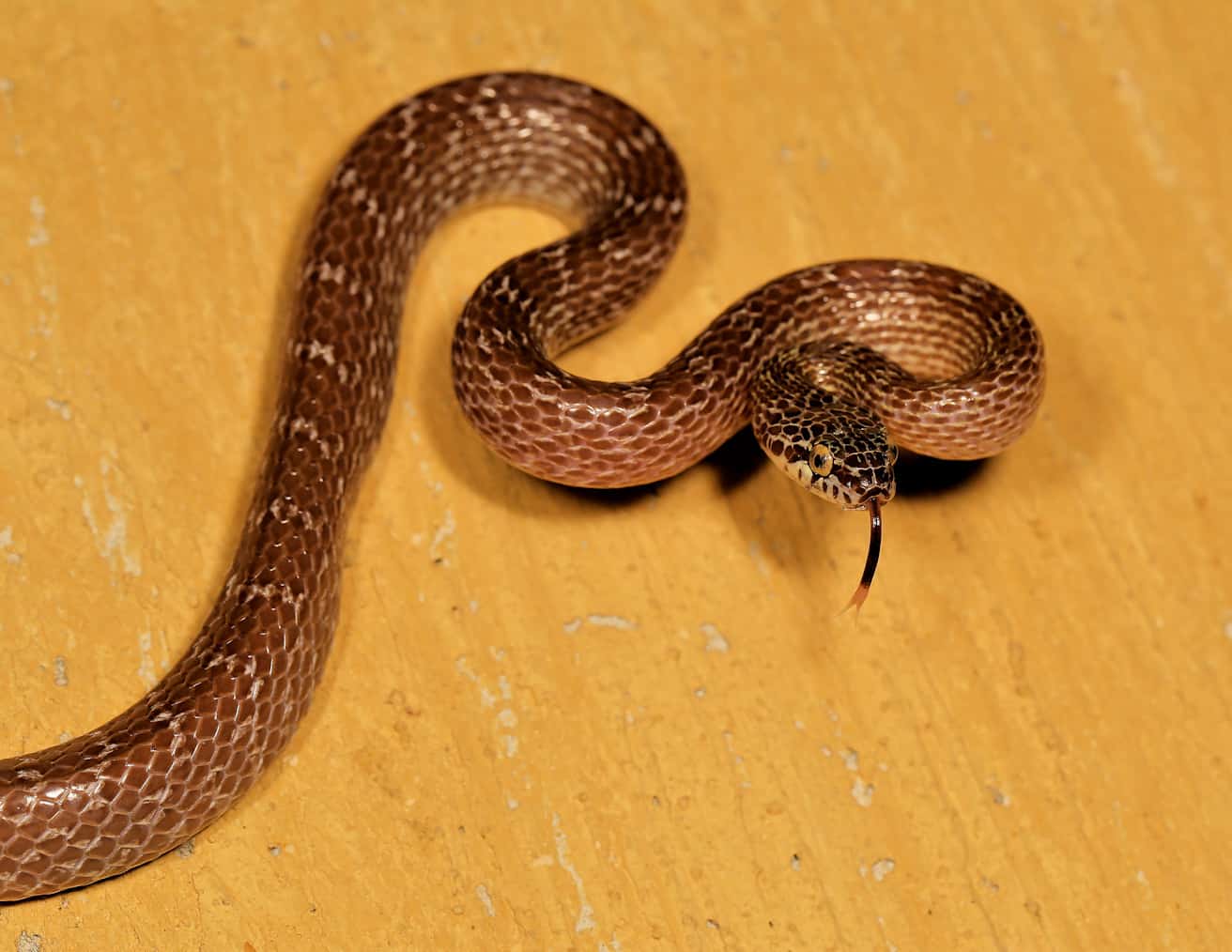
Maximum length: 85cm.
The marbled tree snake (Dipsadoboa aulica) ranges from the extreme east of South Africa, through the vast majority of Mozambique. This is a mildly venomous snake, which mainly appears in moist savannah and lowland forests, including classic safari country.
This species is incapable of killing humans, but somewhere along the way, they’ve learnt to mimic vipers, not in appearance but manner. When cornered, marbled tree snakes throw themselves into an S-shaped coil with their upper body raised up. They then cock their heads at the neck to face their aggressor head on, in an identical manner to rattlesnakes and adders.
Marbled tree snakes don’t have the fastest reflexes, and sometimes end up as roadkill, with a grisly tire mark over their back. They prey on reptiles, with one confirmed species being Setaro’s dwarf chameleon, which they swallow by the tail. Marbled tree snakes are mainly nocturnal, and during the day, they stash themselves in gaps between tree bark. From here, they can watch the savannah go by from safety, with a clearer view than any expensive safari.
Marbled tree snakes are rare for having a clear white tip of the tongue, with the lower half being black. The reasons have never been properly researched, but it’s possible that marbled tree snakes wiggle the end to lure in prey, which greedily mistake it for buzzing insects. This species has many colourful details to pick out. There’s golden eyes with a vertical pupil, while their bodies alternate between snowy white and black, just like their tongue.
| 7 | Puff adder |
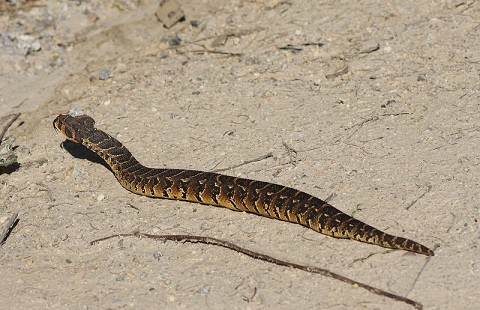
Maximum length: 191cm.
A thick, fat viper which measures up to 191cm, but is generally around 1 metre. Puff adders (Bitis arietans) are the most widespread venomous snake in sub-Saharan Africa, and Mozambique is no exception to this rule. Statistics reveal that this species causes the highest number of snakebites in Mozambique. Its venom has few neurotoxins, but is rich in flesh-destroying cytotoxins.
In 2022, a study finally examined snakebite data from villages all over Mozambique. Before this, the Mozambique snake situation had barely been researched in an actual scientific analysis, just with whispers and rumours.
The study concluded that farmlands were the most likely place to be bitten, and that puff adders were the top culprit, just ahead of stiletto snakes. Black mambas caused far fewer bites on farms, but greater amounts in villages. On the brighter side, most puff adder victims made it to hospital, while the black mamba’s venom acted so rapidly that many Mozambique victims died within one hour.
There was one safe haven from the puff adder: households. Here, the stiletto snake and Mozambique spitting cobra dominated the danger statistics. The latter has a horrific tendency to bite people when sleeping, sneaking into their bedrooms in the dead of night, but puff adders hardly ever invade households. They’re lazy ambushers rather than explorers. Farmland and the outskirts of forests are their main hotspots, even though this is a highly flexible species which has occasionally been spotted on beaches.
Overall, the study reached a dire conclusion: that 319 Mozambique citizens die of snakebite annually, out of 20,000-30,000 across Sub-Saharan Africa.
| 8 | Semiornate snake |
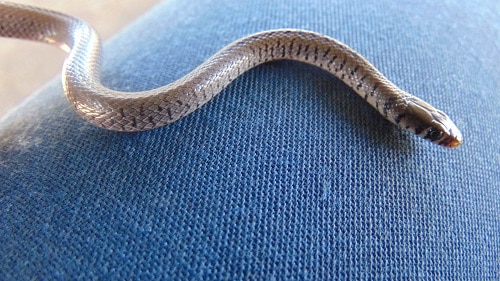
Maximum length: 76.7cm.
A shy snake which is always found in shelter, sometimes near water, at elevations of up to 2500 metres. Semiornate snakes (Meizodon semiornatus) range from extreme northeastern South Africa to southern Kenya, also including Mozambique, Zimbabwe and Tanzania.
Semiornate snakes might not be able to forecast the weather, or spit venom in people’s eyes, but when it comes to detecting places they can disappear into, they’re unbeatable. This species has an amazing nose for shelter, and can be found lurking under logs, stones, vegetation corridors, or thick weeds at the edges of streams. This makes them difficult to find, though they’re not rare or even close to endangered.
Semiornate snakes love cover, and will never be found striding majestically across open plains alongside a herd of zebra. If caught, they tend to flee instantly rather than stand their ground.
The longest semiornate snake ever measured 76.7cm, a female from Tanzania. The longest male measured 61.9cm, also from Tanzania. Semiornate snakes are simple to recognise as younglings, as their black and grey crossbands resemble few other snakes in the southern African region. But with age, these blend together into a monolithic grey blob. Their faces also have white markings which gradually shrink in size.
| 9 | Southern African rock python |

Maximum length: at least 580cm.
The largest snake in Mozambique with ease. The African rock python is capable of swallowing impala, small crocodiles and even hyenas. It’s the 2nd longest snake in the world after the reticulated python, with rumours of 7 metre monstrosities or longer.
The species in Mozambique is actually the southern African rock python (Python natalensis), as opposed to the central African rock python (Python sebae) which lives from Gambia to Tanzania. The two species are extremely similar, with differences in facial markings being the main distinguishing factor. The southern form is slightly smaller, but only slightly.
Compared to many constrictors, African rock pythons are much more active and energetic. They use ambush tactics, but don’t tend to remain in one spot for days and weeks. Its possible to find them openly exploring the Mozambique countryside, particularly after the heavens open and heavy rains drench the land.
The southern African rock python is the only python species in the country. Ball pythons live miles away in central and western Africa (e.g. Nigeria), while the rare Anchieta’s python only lives in Namibia and Angola. There are also no boas on mainland Africa (Madagascar has a few). If you see a giant constrictor slithering your way with a curious (or maybe hungry) expression on its face, it’s guaranteed to be the African rock python.
| 10 | Southern quill-snouted snake |
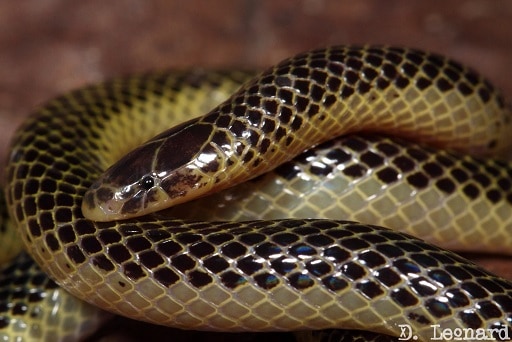
Maximum length: 47cm.
A harmless species recognisable by its pointy snout, which you could probably write letters with if you dabbed it in ink. Southern quill-snouted snakes (Xenocalamus transvaalensis) prefer sandy areas of southern Mozambique, and move slowly and patiently, investigating piles of leaf litter for tiny prey.
This species has tiny black eyes, and averages at just 30cm long. Southern quill-snouted snakes are always yellow and black, but the exact proportions vary. Some individuals are black, shiny yet bland, while in others, the yellow between the scales expands and the black sections shrink to dots.
This snake is believed to feed on reptiles, specifically limbless skinks. In southern Mozambique, they overlap (but don’t interbreed) with another of their family members: the slender quill-snouted snake (Xenocalamus bicolor).
Instead of being a roaring, majestic 600 pound beast, which looks cool but attracts the attention of virtually every killer in the savannah, southern quill-snouted snakes prefer to stay quiet and fly under the radar. This snake would rather be intelligent than crazed and blundering.
Another interesting characteristic of this species is its eggs. Some snakes lay dozens of eggs, as an insurance policy against hungry alligators or eagles. The mud snake of Florida can lay over 100 at once, but quill-snouted snakes lay two large eggs instead, which are elongated and measure 28 x 6mm.
| 11 | Southern vine snake |
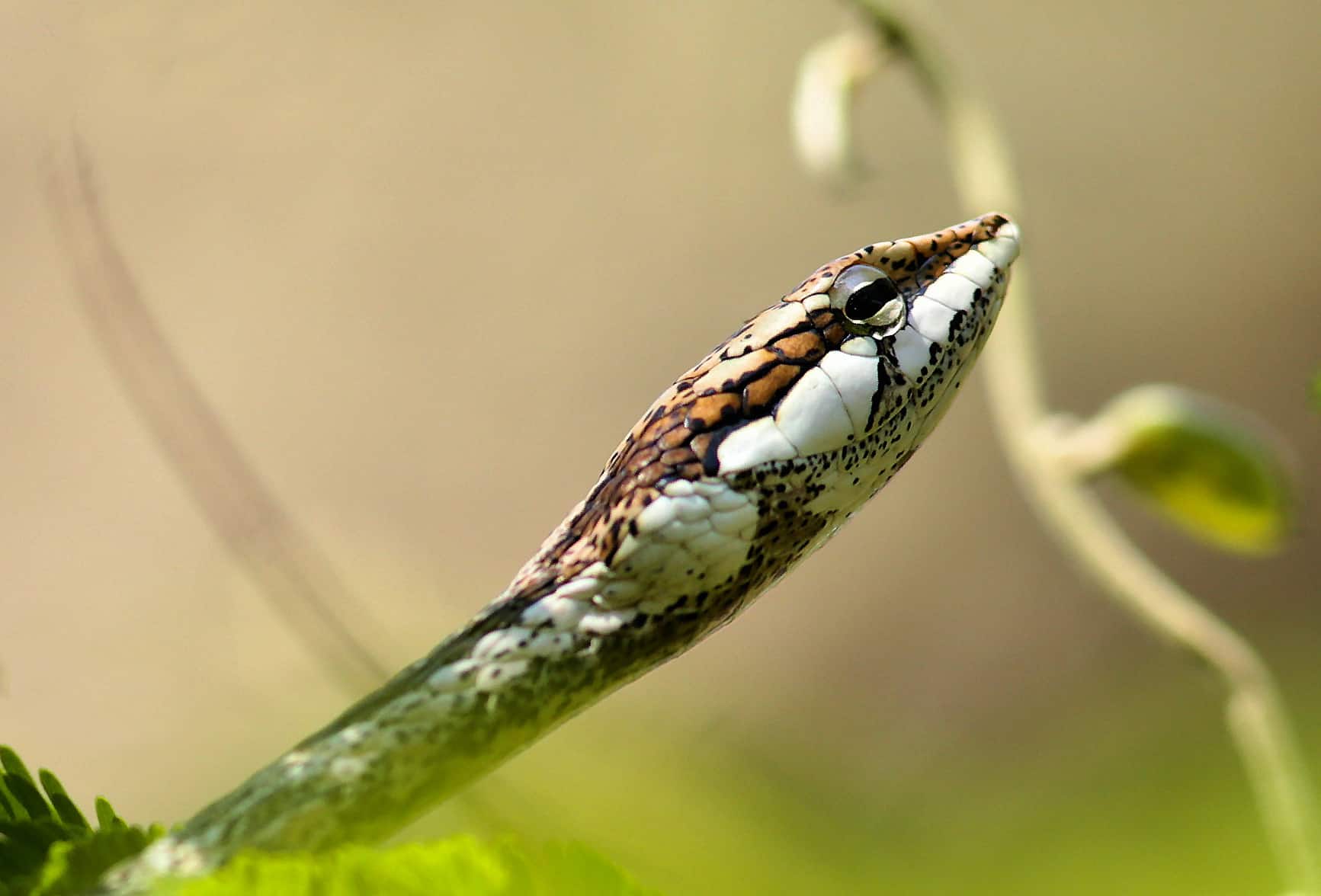
Maximum length: 168cm.
Part of the same Thelotornis genus as the eastern twig snake. The weird keyhole-shaped pupils are identical, as are their branch-loving habits, yet their colouring is significantly different. While both are brown and parched-looking like a tree branch left out in the sun, this species is missing the grassy green head which the eastern twig snake has.
Like its cousin, this species appears in woods and tree clumps intermingling with villages rather than dense rainforests. In terms of territory, the southern twig snake (Thelotornis capensis) lives in South Africa and pushes northwards, while the eastern twig snake ranges from Kenya southwards. The two just meet in the middle, meaning that Mozambique and Zimbabwe contain both species.
The southern vine snake also produces a nasty venom, with a variety of anticoagulant toxins, and no dedicated antivenom in existence. In one study, scientists tried and failed to use boomslang antivenom on a 13 year old victim. This boy wasn’t charged at, but had tried to catch the southern vine snake in his hands, as it slithered smoothly through a bush. Three tiny puncture wounds were visible, and the boy complained of abdominal pain and was hyperventilating.
After 5 hours, his blood was totally incoagulable, with prolonged bleeding, but by 20 hours post bite, this had normalised. The boy was fine at a 6 day follow up, and escaped with no serious injuries.