
| 1 | Lichtenstein’s green racer |
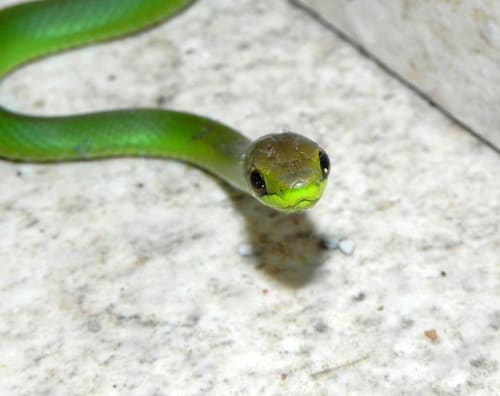
Maximum length: 147.6cm.
A medium-sized friendly-looking snake of South America. Lichtenstein’s green racer (Philodryas olfersii) has round, black eyes, which seem to hold endless secrets, if you only could stare into them for long enough. Be wary though, as this species is one of the more dangerous mid-ranking venomous species of Brazil. It isn’t a deranged killer, but its friendly expressions have zero connection to the actual contents of the snake’s brain.
This species occupies forests, and moves through branches and ground just as effortlessly. It climbs trees as easily as a stepladder, and sometimes returns to the same trees year after year, if they turn out to be profitable bird-hunting sites. Lichtenstein’s green racers have various confirmed meals, including Montevideo tree frogs, house sparrows and even Bothrops pitvipers.
Philodryas olfersii is extremely widespread, appearing over a swathe of eastern and southern Brazil, and easily reaching Paraguay, Argentina and Bolivia to the south. The venom of this species has killed one person on record (an infant), and adults can expect painful swelling, perhaps spreading significantly up the affected limb.
This snake belongs to the 16-member Philodryas genus, and is one of the most common. It’s also one of the greenest members, as some are parched beige and brown instead.
| 2 | Angolan shovel snout |
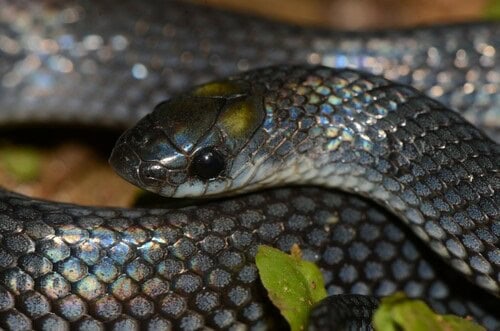
Maximum length: 39.8cm.
A poorly researched species, which is at least confirmed to be harmless to humans. The images we have give us a few strong facts: 1) that this species has the burrowing snout of other Prosymna members, and 2) that this species looks far friendlier and cuter than a puff adder, regardless of its real personality.
Angolan shovel snouts are rarely sighted, but their observations are spread far apart, from Gabon in the west to Uganda in the east. Their scales are grey and shiny, with a slight iridescent sheen, and their eyes are large and pure black. Their tongue is also grey, but with hints of pink.
The diet of this snake is known to contain reptile eggs, including those of snakes and lizards. It generally appears after heavy rains, and has an unusual defensive method: coiling up and rapidly uncoiling. It’s an egg-laying species, which so far has produced clutches containing just 3-5.
The Angolan shovel snout is still the holder of many mysteries, but judging by its photos, it may reveal one or two if you ask it politely. Alternatively, it might lead you deeper into the rainforest into the lair of a banded water cobra.
| 3 | Usambara green snake |
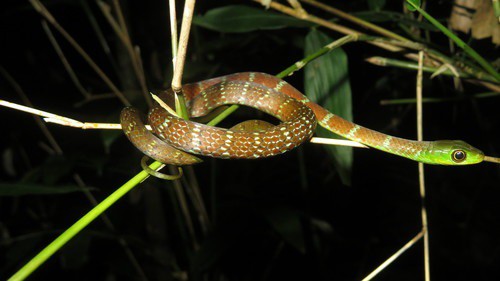
Maximum length: 95cm.
This rare species looks like it would never dream of hurting a human being. Appearances don’t deceive, as the Usambara green snake (Philothamnus macrops) lacks a powerful venom or an aggressive personality.
This harmless snake is mainly found in the Usambara Mountains of Tanzania, a rich biodiversity hotspot which peaks at only 2289 metres, but is drenched in rainfall. Usambara green snakes are relatively flexible, appearing in open grasslands and closed forests alike. They love to rest on tree branches, peering down at explorers below, but aren’t restricted to them. One egg clutch contained 14 eggs, while their diet remains relatively mysterious.
This species also has particularly large eyes, and large green colours with complex patterns. As well as Tanzania, Philothamnus macrops has small colonies in northern Mozambique and extreme southeast Kenya (Shimba Hills).
If you’re trekking through the Usambara Mountains and see this species in the bushes, it might be tempting to make it your new best friend. But your dreams probably won’t come true, as the Usambara green snake is extremely fast, and will just dart away, never to be seen again.
| 4 | Olive sea snake |
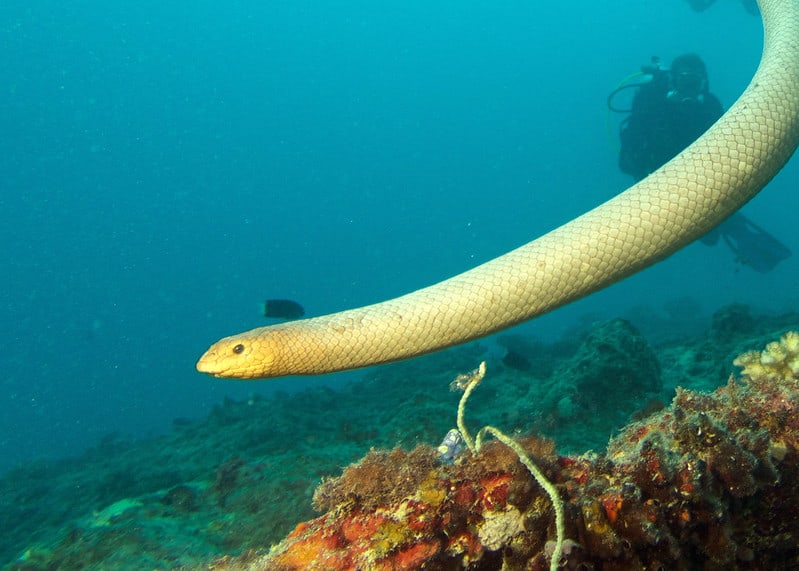
Maximum length: 2 metres.
This species looks like it has a lovely personality, and would do anything for a passing swimmer. The reality isn’t much different, as the olive sea snake is extremely neurotoxic, yet has almost never been recorded to attack a human. The only confirmed victims have been fishermen who accidentally scooped them up in nets.
The olive sea snake is an Australasian species, which is widespread in coral reefs and open waters alike. Up close, it has a peaceful, enlightened expression, as though it holds millions of years of oceanic wisdom.
Olive sea snakes have golden beige scales, which are much more reassuring than a banded sea krait’s black and white. One of their “friendly” tendencies is swimming over to scuba divers and harmlessly wrapping around their legs, without biting. Scientists believe that they’re somehow mistaking these legs for the shadows of females.
Olive sea snakes eat fish exclusively, yet will choose from any category. Their confirmed meals include snappers, gobies, catfish and eels. Their venom is so powerfully neurotoxic that fish die instantly, and the olive sea snake usually waits a few seconds before rearranging and swallowing head first.
Despite its non-aggressive nature, we end with a warning: never, ever touch this powerfully neurotoxic sea snake. Touch is the only thing which reliably triggers an aggressive response in this species.
| 5 | Chiapas burrowing snake |
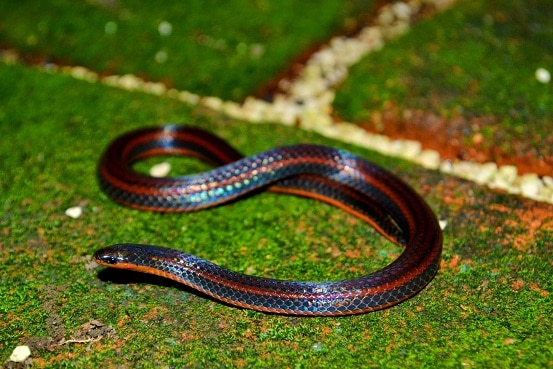
Maximum length: 45.1cm.
This harmless snake lives in the Chiapas highlands of Mexico, and poses no threat to human beings whatsoever. The Chiapas burrowing snake (Adelphicos nigrilatum) has all the essential friendliness requirements, with round black eyes and a slender head. It also has a modified snout to allow for burrowing, although its head is so small that this is difficult to make out.
This species reaches up to 2500 metres above sea level, in the pine-oak forests and cloud forests it calls home. Chiapas burrowing snakes prefer heavily vegetated areas, and have no power to deal out venomous death, or even a painfully swollen hand.
Physical features include a far paler underside, which contrasts against the brown back. Between the two is a thick black stripe. This is the standard morph, but Chiapas burrowing snakes have some variation, with some having far more complex stripes. The paler underside can be yellow or bright orange.
Chiapas burrowing snakes prefer forests, but sometimes get lured to towns by the promise of warm tarmac, including the highland town of San Cristóbal de las Casas (altitude: 2200 metres). Then they forget their way back, and get stuck in the streets where they’re completely incapable of using their burrowing skills. This is a relatively rare species, compared to its common cousin, the Middle American burrowing snake (Adelphicos quadrivirgatum).
| 6 | South American sipo |
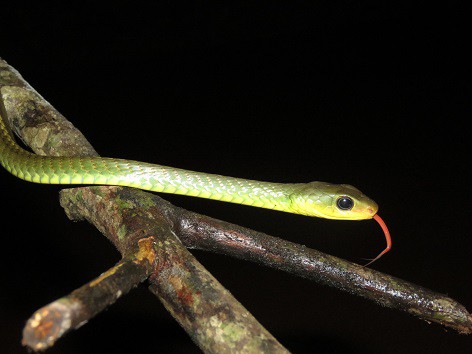
Maximum length: 261.1cm.
This species lives in Brazil, eastern Peru, eastern Ecuador and French Guiana, where it’s one of the friendliest-looking snakes around, whether truthfully or falsely.
South American sipos (Chironius multiventris) live in forests both remote and local, and split their time between the ground and branches. They lack any venom, nor are they considered unusually vicious. They also appear near streams, slithering over boulders, in their determined quest to find frogs, their main prey.
South American sipos are confirmed to eat ocellated treefrogs and Atlantic forest treefrogs. This species varies naturally in appearance, and has a scale of cuteness. Some are bright green, while others are a far denser green contrasting against a dark yellow belly. A completely consistent feature is the round and friendly eyes.
Cuteness is what the South American sipo does best, although it may have chosen differently if offered by the serpent gods. Or maybe it likes being the Bambi of South American snakes; we don’t know. This species looks superficially similar to nearby sipos, but the simplest difference is purely technical – a far higher scale count on the underside (ventral scales). South American sipos reach decent branch heights, having been spotted at 4 metres above ground.
| 7 | Speckled racer |
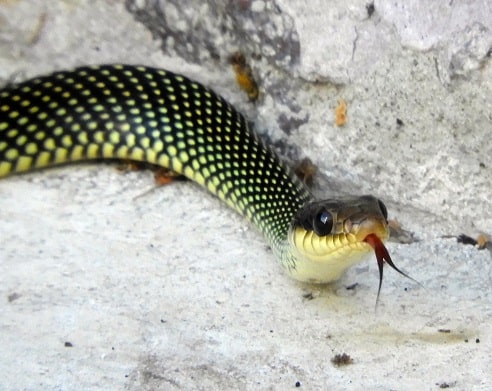
Maximum length: 127cm.
A relative of Costa Rica’s black forest racer, but with the cuteness dialed up even further. Speckled racers (Drymobius margaritiferus) range from southern Mexico to Panama, and lack any venom. They have green scales overlaid with vivid black, which are dazzlingly colourful like disco lights.
This snake lives in varied habitats, from forest to grassland to people’s back gardens. Though barely heard of, the speckled racer is one of Central America’s most common snakes. This species moves almost exclusively by day, rarely venturing forth in moonlight.
In fact, the vast majority of cute snakes on this list are diurnal, AKA day-faring. This isn’t a coincidence, but has a sound explanation: diurnal snakes generally have round pupils, with a few exceptions. Disney knows well that round eyes are an important part of the cuteness equation.
The opposite is also true. Whether logical or not, making a snake’s pupils vertical immediately increases its menace levels 5-fold. Just look at most rattlesnakes. Consider what a human would look like with vertical pupils.
That said, speckled racers may look friendly, but they’re not that peaceful. They have an unpredictable temperament and can rapidly turn bitey if they feel they’re cornered. Their diet consists of 86% frogs and toads, including the Mahony tree frog.
| 8 | California kingsnake |
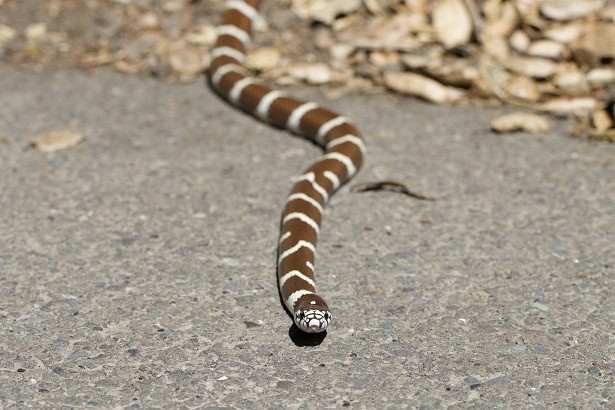
Maximum length: 142.2cm (mainland), 2 metres (islands).
This western US species is a popular captive snake, partly because of its friendly appearance. The California kingsnake (Lampropeltis californiae) is an adventurous species which inhabits fields, grasslands, towns, and dry areas with cacti and rocky canyons. It measures 75-100cm, and looks friendly thanks to round black eyes, a calm expression, and smooth scales.
The reality isn’t much different, as the California kingsnake is completely non-venomous, and lacks a vicious bite. It constricts its prey to death, which includes equal proportions of mammals and fellow snakes, including the likes of gopher snakes and Pacific rattlesnakes.
In captivity, California kingsnakes easily adjust, and can be fed a simple diet of defrosted mice, rarely biting their keepers. If you had to choose a snake to meet in the desert, this would definitely be preferable over a Mojave rattlesnake.
The only non-friendly characteristic of the California kingsnake is its crushing skills. The boa constrictor is superior for raw squeeze force as measured by PSI (pounds per square inch), but the California kingsnake is a stronger constrictor in proportion to its size. It’s incapable of killing, yet might give your wrist the squeezing of a lifetime if it feels like it.
| 9 | Sonoran shovel-nosed snake |
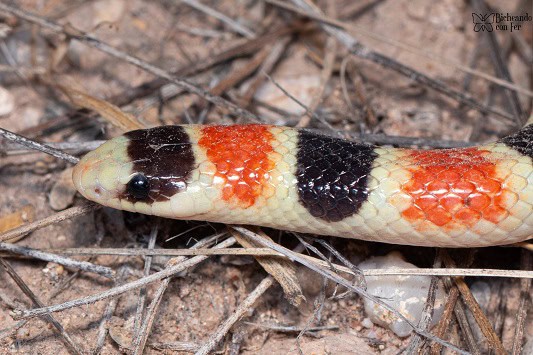
Maximum length: 43.7cm.
The Sonoran shovel-nosed snake (Sonora palarostris) is a slightly venomous species, which inhabits the parched deserts of northern Mexico (Sonora state), and just crosses the border into Arizona. It spends most of its day burrowing through sand, or hiding in shaded areas beneath desert vegetation.
Like the tiger rattlesnake, Sonoran shovel-nosed snakes appear on flat semi-deserts, often among endless slopes of cacti and other drought-resistant plants. However, they’re much less terrifying to meet, both in their appearance and actual personality. Sonora palarostris has round, completely black eyes, and bright colours like a child’s school project. Its expression is one of curiosity rather than aggression.
This species looks just as friendly up close as from a distance. There’s no horrifying effect where you walk steadily closer, only for the cuteness to be replaced by a vicious, terrifying snarl. If frightened, it may perform mock strikes, but its venom is far too weak to have any effect on humans. Sonora members also have tiny mouths, which are too small to bite humans – this species is probably the same.
This species averages at 30cm, and has a dangerous diet – scorpions, spiders and insects.
| 10 | Laotian wolf snake |
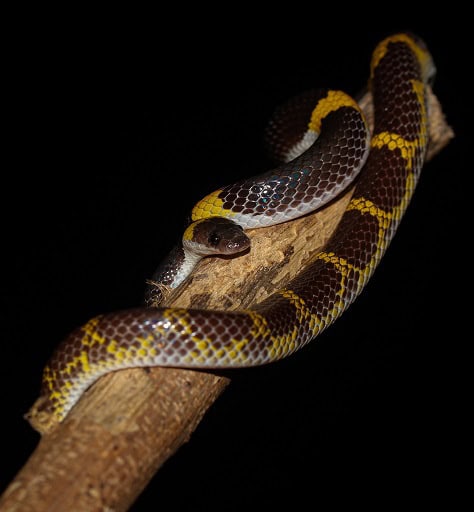
Maximum length: 50cm.
The Laotian wolf snake (Lycodon laoensis) is a widespread species of Thailand, Cambodia, Vietnam, and Laos, where it’s usually found in forests, but occasionally wanders into human households. This snake sticks to the ground, and is completely harmless, with neither a paralysing venom nor ferocious bite.
With its bright eyes and calm facial expression, the Laotian wolf snake looks like a peaceful forest guardian, which would give you helpful directions or maybe a weather forecast if only it could speak. Its mouth is too small to bite humans, while its diet mainly includes geckos.
The Laotian wolf snake has 13-26 light bands on its body, while its black scales (actually dark blue) are highly reflective. The bands vary from bright yellow like above, to pure white. This species is easy to confuse with the lethal banded krait or many-banded krait, so never pick one up, no matter how temptingly cute the image above looks.
Laotian wolf snakes are particularly common in national parks in mountainous or hilly regions, such as Cat Tien National Park in Vietnam.