
| 1 | Indian cobra |
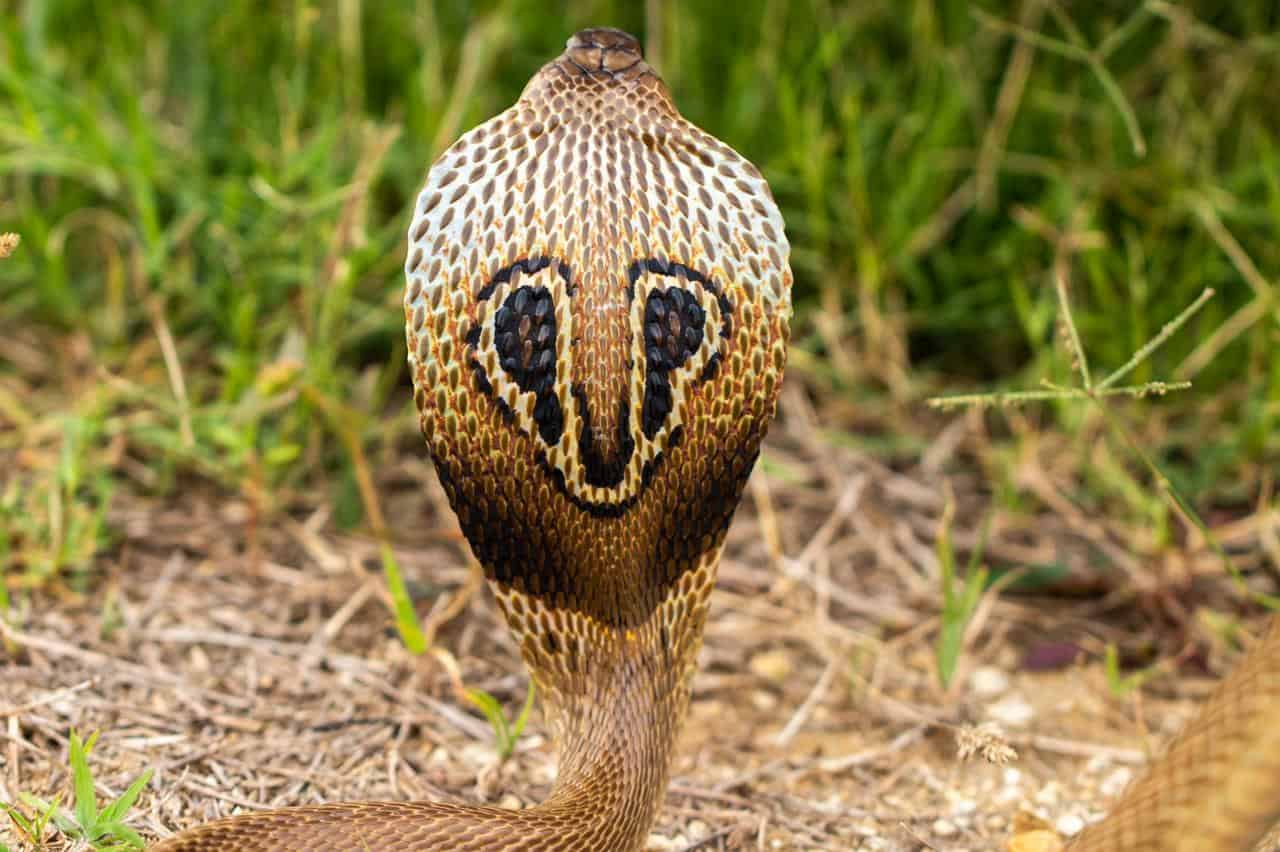
Maximum length: 2.2 metres.
Indian coffee plantations aren’t just places for farmers to grow beans, but a thriving ecosystem. Many creatures flock in without invitation, as the towering coffee canopies are often too thick and shady to resist. This includes Indian wolf snakes, and one that farmers would rather see the back of – the Indian cobra.
This 150-180cm venomous killer occupies most habitats, yet coffee forests are a particular hangout. One reason is the high amount of rodents living in them, darting beneath farmers’ feet. Encounters with the Indian cobra are common, and Indian coffee farmers must be constantly on their guard, even with sacks of beans in their arms.
Indian cobras can be found on the shady ground, or bushy thickets on their edges. The one saving grace is that Indian cobras climb trees only rarely, so they probably won’t drop onto an unsuspecting coffee farmer’s head.
Some believe that Indian coffee tastes different, simply because the plantation ecosystems are so diverse. Perhaps there’s a touch of cobra in the mix as well. Indian coffee farmers can defend themselves with thick leather boots, but if a cobra fang penetrates, then the consequences include extreme swelling and lung failure. Indian cobras have a neurotoxic venom, and belong to the “big 4” of deadly Indian snakes.
| 2 | Smooth-scaled death adder |
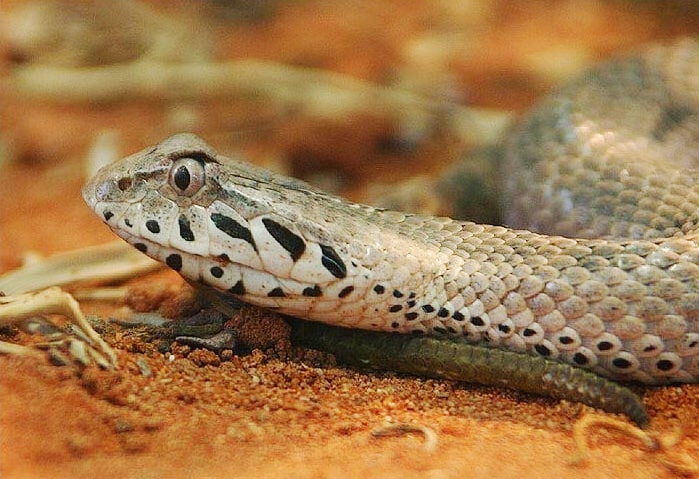
Maximum length: 100cm.
This species is the menace of New Guinea’s coffee plantations, including Indonesia in the west and Papua New Guinea in the eastern half of the island. The smooth-scaled death adder (Acanthophis laevis) is a relative of the common Australian version, and shares the same lazy lifestyle. Its strategy is to search for disguising thickets and bushes, and lurk in them menacingly for days or even weeks, waiting for a small mammal to wander past.
Rodents are a top prey for smooth-scaled death adders, and since coffee plantations are full of them, that’s where they love to lurk. They’re also found in woodlands and forests. Smooth-scaled death adders avoid deserts like the plague. Their greatest fear is a bone dry landscape where there’s no undergrowth to lurk in.
These stealthy ways make the smooth-scaled death adder a nightmare for coffee farmers. A cobra you can see coming, as they’re so energetic, but death adders stay motionless for days.
More positively, smooth-scaled death adders are sometimes so relaxed that they barely react to human presence, even at distances of mere feet. When touched, they react furiously, so stepping on them is the biggest danger for coffee plantation workers.
| 3 | Red coffee snake |
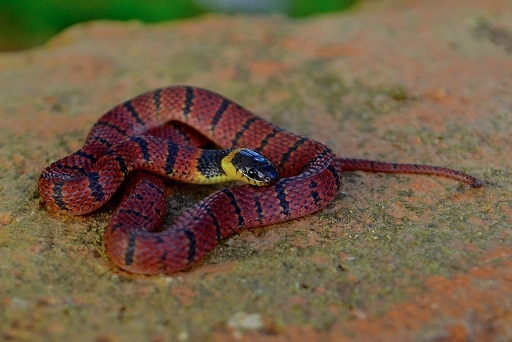
Maximum length: 38.6cm.
A harmless staple of Central American coffee plantations. The red coffee snake (Ninia sebae) averages at 30cm, and is a juicy red mixed with black markings, and a white/yellow neck collar. In a natural world, red coffee snakes would exclusively inhabit forests and woods, but the leagues of coffee plantations created by humans are a dream come true.
Red coffee snakes generally stick to low branches or rest on logs covered in lichen. They watch on as young coffee pickers fill their baskets with beans nervously, wondering why nobody told them about the snake infestation. Fortunately, this species is far safer than the Indian cobra. Red coffee snakes lack any venom, and kill their prey via constriction. Being just 30cm, their bite is nothing to fear.
Forest snakes are a dime a dozen in Central America, yet red coffee snakes (and fellow Ninia members) particularly love coffee plantations for some reason. The exact characteristics responsible are a mystery. Maybe the soil composition differs, or maybe it’s the tasty insects coffee attracts, which farmers are constantly trying to defeat with pesticides. These include coffee berry borers, coffee leaf miners, and red spider mites.
| 4 | Boa constrictor |
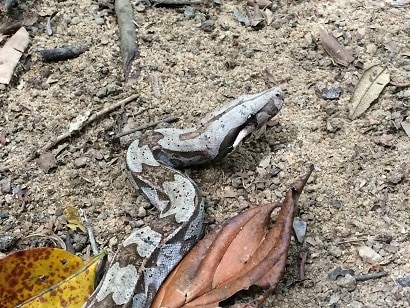
Maximum length: just over 4 metres.
Boa constrictors can occupy virtually any habitat, and coffee plantations are no exception. They’re a hub of activity on the edge of the forest, and boa constrictors can’t resist poking their heads in to see what’s going on. They normally like what they find, from the shady tree corridors to the abundance of rice rats darting around. The boa constrictor then sets up a base, much to the annoyance of plantation workers.
Though a globally feared icon of terror, boa constrictors pose no threat to human beings, and normally coexist with bean pickers in peace. They climb tree branches occasionally, but mainly stick to the ground.
Though they still use ambush tactics, boa constrictors are far more active than the average death adder, and often prowl around slowly in search of scent trails. A coffee plantation worker could conceivably trip over one moving between coffee trees, and fall flat on his face. Great superstition surrounds boa constrictors, and farm workers often club them to death unnecessarily.
Though unnerving, you could have 10 boa constrictors watching you at once as you pick coffee beans, and still not be in any danger. This famous species inhabits a large swathe of South America: Brazil, Venezuela, Paraguay, Colombia, Bolivia and more.
| 5 | Gaboon adder |
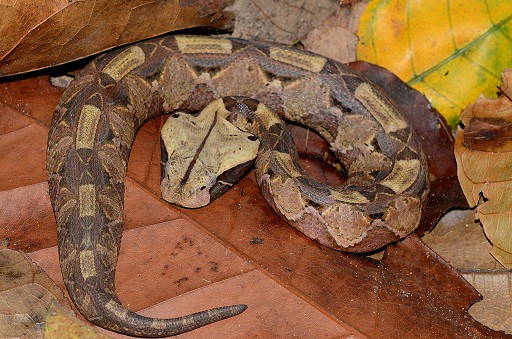
Maximum length: 175cm.
This coffee plantation snake is especially treacherous, as it has some of the greatest serpent camouflage on Earth. It also has the largest serpent fangs (2 inches), and the highest venom yield of any African snake.
Gaboon adders inhabit over a dozen countries in central Africa (Nigeria, DRC), and rely on ambush tactics, staying completely still in the undergrowth like a tank about to set off. They’re mainly found in woods, but not ultra dense rainforests, and coffee plantations fit this requirement.
Gaboon adders can unleash severe swelling and spontaneous bleeding. The next time you drink Ugandan coffee, remember that the beans could have matured just 2 metres from a menacing gaboon adder. Although black-necked spitting cobras invade coffee plantations in Africa, they tend to move on quickly, always seeking the next horizon. The gaboon adder is the most notorious coffee plantation snake of Africa overall. It also appears in cashew and tea plantations.
The only thing that saves gaboon adders from being impossible to spot is their thick body. Fortunately, they rarely attack unless touched, or approached to within several feet.
| 6 | Hoffman’s earth snake |
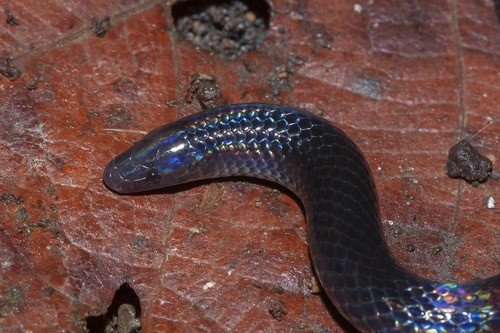
Maximum length: 30cm.
Found in Costa Rica and Panama, this is a coffee plantation snake which lurks in them snugly without anyone knowing. Hoffman’s earth snake is a simple soil dweller which forges tunnels in upper layers, and has a mesmerising iridescent sheen. Forests are its home, in addition to mixed areas like gardens.
For reasons unknown, Hoffman’s earth snakes appear particularly commonly in coffee plantations. The workers have likely never heard of them; they’re most likely to meet one when lifting old vegetation and debris, before getting a nasty shock.
Hoffman’s earth snake has beady eyes and a brown body, which blends well with the soil of a coffee plantation. If Hoffman’s earth snake flipped over, then it would be easier to spot, as it has a white belly, but this species has no wish to make it easy for people.
This is a non-venomous snake which poses no threat to coffee plantation workers, or people visiting the plantations on guided tours. This small snake (30cm) is mainly an earthworm and insect-eater, so it’s possible that swarms of eager coffee pests lure them in.
| 7 | Malayan pitviper |
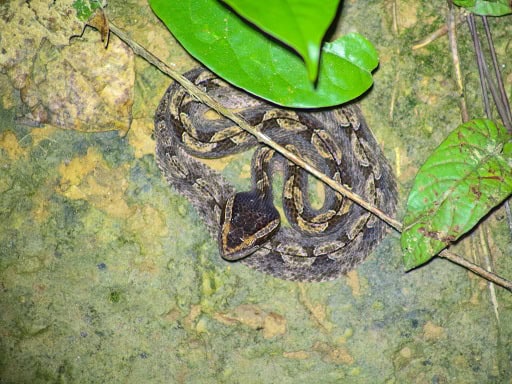
Maximum length: 100cm.
The Malayan pitviper may be the single deadliest creature in Vietnam. It causes the most annual snakebites, while in Thailand it causes 30.5%, according to a 2001-2002 study. Agricultural workers are hardest hit, including in rice, rubber and coffee plantations. The latter is one of this species’ favourite hangouts. Like in India, a Vietnamese coffee field is a whole ecosystem, with wolf snakes, pitvipers and insects which only the most obscure expert could recognise.
Malayan pitvipers measure up to 1 metre, and vary in colour from grey to pink. Rather than fast and adventurous like a cobra, they’re slow and patient, which only makes them more dangerous. Malayan pitvipers don’t care that coffee plantations are privately owned property, and will set up a base in them, regardless of the workers busying all around.
These days, Vietnamese coffee farmers are wising up, wearing protective boots and trousers. Malayan pitvipers stick to the ground, meaning that legs and feet are their most common places to bite.
Being so common in coffee plantations, antivenom has been rushed through development, and at least 3 dedicated species-level serums are now available. Still, Vietnamese workers probably get annoyed when “may involve pitvipers” isn’t listed anywhere in the job description.
| 8 | Salmon-bellied racer |
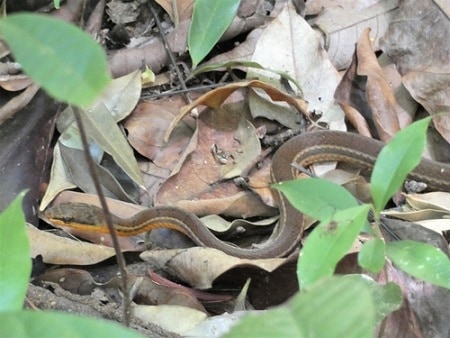
Maximum length: 150cm.
One of the most likely coffee plantation snakes to hiss at you from a tree. Salmon-bellied racers are common in Central America (Nicaragua, Honduras), and are always slithering through coffee plantations as they complete their daily missions. Like a boa constrictor, this snake invades coffee plantations out of pure curiosity, to see if they offer glorious new prey opportunities.
According to a 2008 survey of coffee plantations in San Vito, southwestern Costa Rica, salmon-bellied racers were recorded repeatedly. This is a non-venomous species which could easily coexist with humanity in an idyllic world. Yet salmon-bellied racers have an aggressive personality which often lands them in trouble. They’re quick to bite, typically bringing the full force of a steel shovel down on their heads.
Salmon-bellied racers are officially classified as terrestrial, yet often climb trees to investigate scents in them. A coffee worker might be terrified by a hissing face mere inches from their own, after hastily turning their torch on at midnight. This snake could even land on a coffee worker’s head, if they spooked it while plucking off beans.
| 9 | Red-tailed coral snake |
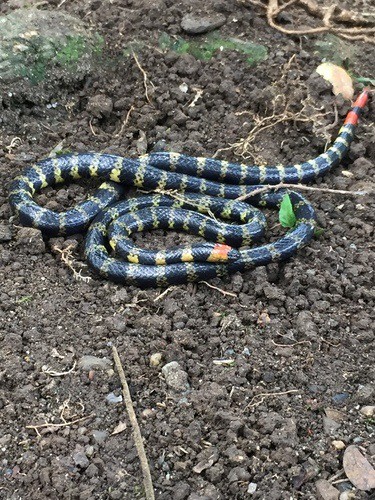
Maximum length: 140.6cm.
This deadly snake is easier to spot in coffee plantations than the gaboon adder, thanks to its bright red tail and head. On the other hand, this species is unadventurous, and very easy to step on while buried in plantation soil.
Red-tailed coral snakes live in the forests of Colombia and Panama, and reach 140cm. Reports from coffee fields are numerous, making them a gentler-looking but actually far deadlier neighbour of the boa constrictor.
Red-tailed coral snakes wield a potent neurotoxic venom, which consists of 60% three finger toxins and causes death by paralysis. Lesser symptoms include drowsiness and clumsiness. Brutal as this may sound, coral snakes cause less than 1% of snakebite deaths in the Americas. They never pursue humans, including coffee farmers, and only bite if handled or brushed against.
Red-tailed coral snakes dine largely on fellow snakes. In Panama, this includes their coffee field compatriot, Hoffman’s earth snake, with a length of 140cm versus 30cm. Micrurus mipartitus sticks to the ground, and will never leap onto a coffee farmer’s head while they harvest beans, or inspect them for ripeness.
| 10 | Common lancehead |
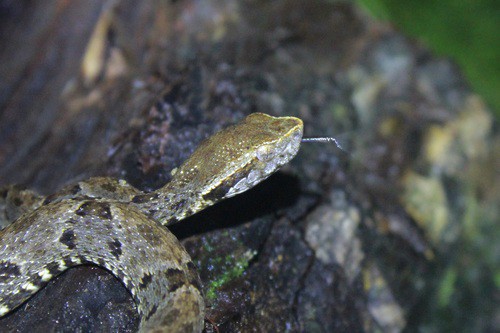
Maximum length: 172.3cm.
Boa constrictors are non-venomous, while red-tailed coral snakes are shy. The common lancehead (Bothrops atrox) is perhaps the biggest danger in South American coffee plantations. This venomous snake inhabits a massive chunk of the continent’s north, including Brazil, Colombia and Venezuela. Its venom lacks neurotoxins, but unleashes swelling, haemorrhaging and necrosis in victims, coffee farmers potentially included.
Common lanceheads prefer forests, but unlike the black-speckled palm pitviper of Costa Rica, they don’t mind a bit of human modification. This brings coffee plantations into play. Common lanceheads are found slithering along the ground, occasionally in trees, sending coffee workers scattering in their wake. They’re not hyperactive, yet search for prey actively, meaning that they often prowl around the bushy plantations for rats.
Antivenom for the common lancehead was developed decades ago, allowing coffee workers to save their lives with a quick injection. The other possibility is that common lanceheads wish to enjoy coffee too, and that nobody has ever given it to them. In frustration, they enter rage mode and start biting. A monthly coffee bean tribute might solve all the problems.
Another threat is that common lanceheads vary wildly in colour, depending on environment. This makes their camouflage all the more effective.