
| 1 | Rainforest hognose pitviper |
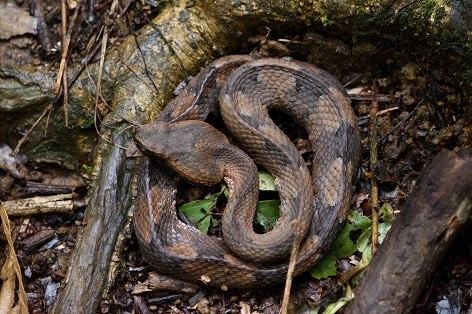
Maximum length: 65.3cm.
The rainforest hognose pitviper (Porthidium nasutum) is a common species, which appears in all 7 nations of Central America. It stretches from Chiapas, southern Mexico all the way to northwest Ecuador, and along the way, it coexists with many other venomous serpents. This species lives alongside fer-de-lances and Mexican jumping pitvipers, yet while those species also have triangular heads, rainforest hognose pitvipers take the feature to the maximum.
The rainforest hognose pitviper mainly sticks to forests, particularly those with a thick coating of leaves and mulch. It likes to rest at the bases of thick trees, waiting in ambush for lizards such as rainbow ameivas. Its venom is relatively mild, with an LD50 toxicity rating of 4.6mg, specialising in agonising pain and swelling rather than death.
Triangular heads are something of a speciality for the viper family, with cobra heads being narrow, and coral snakes barely even having a distinguished head. Porthidium nasutum takes it particularly far even for a viper, as the base of its head is over twice the width of its neck. The mere sight of this bulky head will likely deter predators, and that’s before its intimidating vertical pupils come into play.
| 2 | Chinese green pitviper |
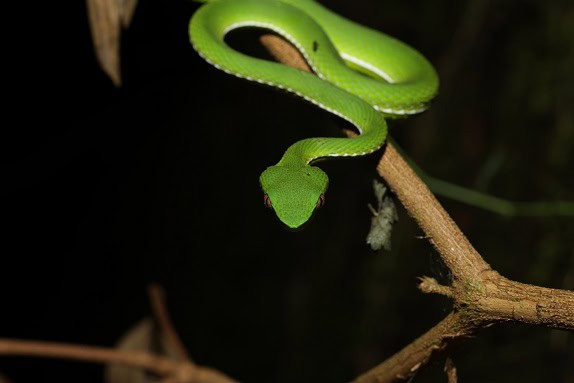
Maximum length: 112cm.
A nocturnal and dangerously venomous species. The Chinese green pitviper (Trimeresurus stejnegeri) is semi-arboreal, splitting its time between the ground and branches 1-2 metres high. This species is perfectly comfortable in human habitation, including Taipei City in Taiwan, and is often spotted slithering down stone pavements at midnight.
This species has two memorable features, the first being its incredibly triangular head, which is the exact opposite of the Chinese cobra’s thin head. Secondly, this species is incredibly green, which grants it superb camouflage in green leafy foliage.
As well as its triangular head, Trimeresurus stejnegeri has orange or even red eyes, another characteristic it uses to effortlessly frighten people. This species has a large empire, with the broadest swathe lying in southern China (including Shanghai). The highest density of sightings is in Taiwan, where the occasional yellow version has been reported.
Chinese green pitvipers are dangerous and not to be underestimated. A 2020 study covered 185 bite victims from Taiwan, of whom 3 were incredibly lucky and suffered no bite symptoms. 182 experienced swelling and pain, while 53 experienced tissue necrosis. 13 experienced blood clotting difficulties, and one patient died. This snake mostly causes local symptoms, but is not to be bargained with.
| 3 | Peringuey’s adder |
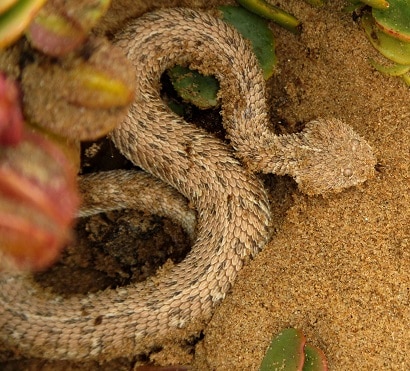
Maximum length: 32cm.
One of the smallest vipers in the world, but with a bulky and triangular head. Peringuey’s adder lives in the harsh deserts of Namibia and preys mainly on barking geckos, which form part of its water supply too.
This species possesses a cytotoxic venom which causes moderate swelling. No human deaths are confirmed, partly because of its liking for remote sand dunes. In order to traverse these vast piles of sand, which are heated to burning levels by the sun’s rays, this is one of the few snakes worldwide to use sidewinding locomotion.
Peringuey’s adder never gets to see forest or grassland. It’s purely a creature of deserts, and only the Namib Desert of Namibia’s southern half, a coastal desert created by anomalies of ocean currents in the southern Atlantic. Peringuey’s adder also has nostrils and eyes pointing upwards, allowing it to spend long periods buried in sand dunes without worry, similarly to a brown watersnake in a Louisiana river.
This snake is an anomaly, as most burrowing snakes have slender heads for threading through smoothly. Its prey capturing method might be involved, as Peringuey’s adders love to burst from dunes in a shower of sand, and a triangular head might provide more propulsive, demolishing force.
Peringuey’s adders produce only small numbers of offspring, with 3-5 being typical. At birth, they weigh an average of just 2 grams.
| 4 | Small-eyed toad-headed pitviper |
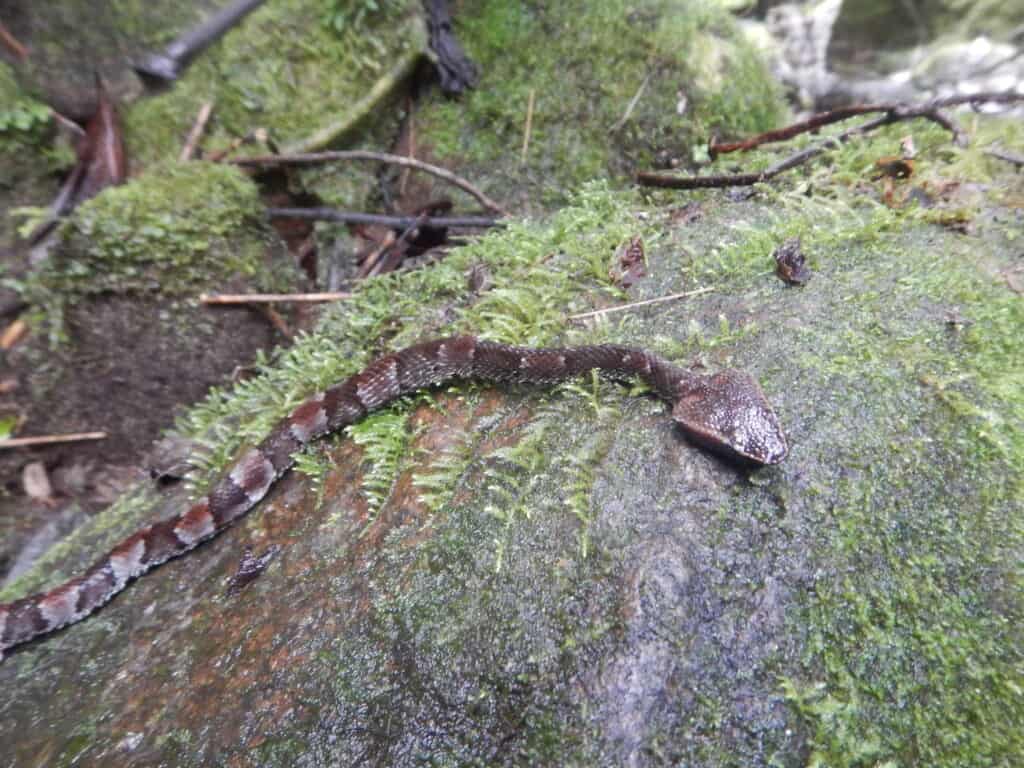
Maximum length: 116.2cm.
This rarely observed snake is found on the eastern slopes of the Andes, including in Ecuador, Colombia and Peru. It reaches altitudes of 2400 metres, hiding in humid rainforests littered with mossy boulders amid a constant downpour. Your chances of seeing this snake are virtually nil unless you wander determinedly into its domain.
The small-eyed toad-headed pitviper (Bothrocophias microphthalmus) might have the closest thing to a perfectly triangular snake head on the planet. It’s mainly a ground-dwelling snake, but can climb to at least 3 metres if the scents of prey prove particularly irresistible. It’s confirmed to prey on brown geckos and tree frogs, with the advantage of a powerful venom, but the disadvantage of not being able to charge at prey through open fields.
Life as a toad-headed pitviper is something of a lottery. As a juvenile, this snake possesses a light-tipped tail which it uses to lure prey, which mistake it for insects (known as caudal luring). In adulthood, this usually darkens to brown like the rest of the body, but a select lucky few keep this bright tail, and therefore the luring ability. In a 2018 survey, 2 out of 9 adults still possessed this light tail.
| 5 | Ridge-nosed rattlesnake |
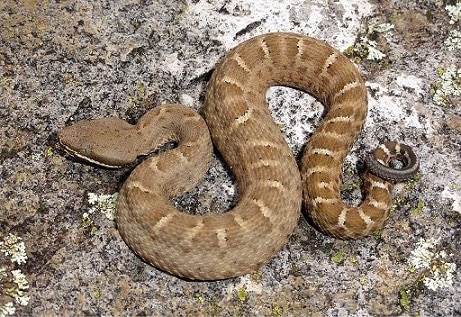
Maximum length: 67cm.
One of the smallest rattlesnakes of the USA, but its head definitely isn’t small. The ridge-nosed rattlesnake (Crotalus willardi) lives in Arizona and northern Mexico, sticking to high altitude sky islands in mountain ranges. It particularly loves well-vegetated canyons, with an abundance of rock cracks to hide in.
Whether it needs it to contain a huge brain with secret intelligence, we don’t know, but the ridge-nosed rattlesnake’s head is particularly thick and triangular. This rattlesnake is distinctive in appearance overall, with a reddish colour overlaid with white, slashing stripes. On its face, the white coalesces into a clear line which runs below the eye.
This rattlesnake doesn’t have one confirmed death to its name. It’s only a small snake, and its venom injection total is correspondingly small. So far, the worst symptom on record was painful swelling in a 57 year old man, which subsided after 3 days. Ridge-nosed rattlesnakes default to fleeing when approached by humans with cameras, although they could probably wreak havoc by swinging their head like a battering ram if they realised it.
The ridge-nosed rattlesnake is also a rare species to look after its young. In 2008, scientists watched as a mother in Arizona stayed within several metres of her vulnerable hatchlings. When she retreated into a dark rock crack, the hatchlings obediently followed her. Meanwhile, a nearby male rattlesnake flecked its tongue, hoping to capture the female’s attention, but failed miserably.
| 6 | Green bush viper |
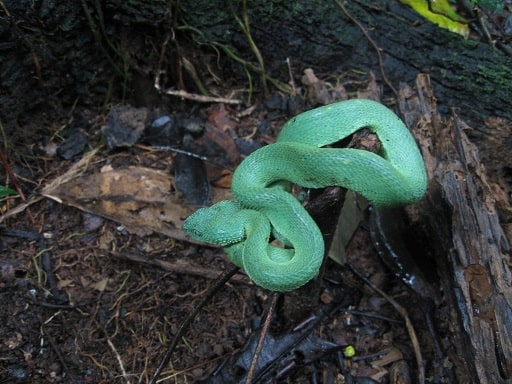
Maximum length: 65cm.
A dangerously venomous snake of West African forests, particularly Ivory Coast and Ghana. This ambushing species is most common on tree branches 1-2 metres above ground, which fortunately for human intruders, is roughly at eye level.
If you never visit the forests of West Africa, then you’ll never meet the green bush viper (Atheris chlorechis), but if you do, then watch your step. This species has no dedicated antivenom, and its venom causes brutal coagulopathy, AKA the disabling of blood clotting.
In 2006, a 26 year old Danish reptile enthusiast was bitten on the forefinger while handling a green bush viper he kept as a pet. This keeper had also been bitten by a Gila monster the previous year. In the first 6 hours in the ICU, he lost 6 litres of blood, while his kidney function was severely impaired. Somehow, he survived.
The green bush viper’s appearance is a double-edged sword. In grass and foliage, it has incredible camouflage, while on boulders and logs, it sticks out like a sore thumb (see above). The greenness even spreads to its eyes, while its pupils are sharply vertical. Atheris chlorechis has rough scales, but nothing in comparison to its hairy bush viper relative.
| 7 | Central Asian pitviper |
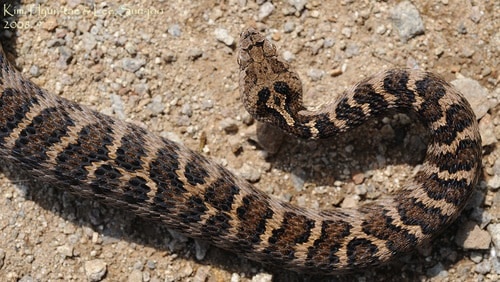
Maximum length: 80cm.
A close relative of the notorious Japanese mamushi. The Central Asian pitviper (Gloydius intermedius) is a widespread species which ranges from Iran to China to South Korea, and sticks to open areas above 400 metres.
This species is most common on wide, sweeping grassy plains with plenty of rocks dotted around, and avoids thick forests. Its venom contains haemorrhagins, but is also rich in unique neurotoxins called gintoxins. A 2015 study found that these were similar in structure to the crotoxins of American rattlesnakes. Consequently, Gloydius intermedius is theorised to be the direct ancestor of those notorious American bogeymen, slithering across the Alaskan land bridge and morphing into something different, eventually growing a rattle.
Central Asian pitvipers never charge humans down, preferring to stay still much of the time. They like to rest amidst rocks and in piles of leaves, waiting for their prey to come to them.
This species primarily eats mammals. With such a huge triangular head, you’d think they could gulp down huge prey, but they stick to small scurrying fare like the common house mouse and royal vole (Craseomys regulus).
| 8 | Egyptian saw-scaled viper |
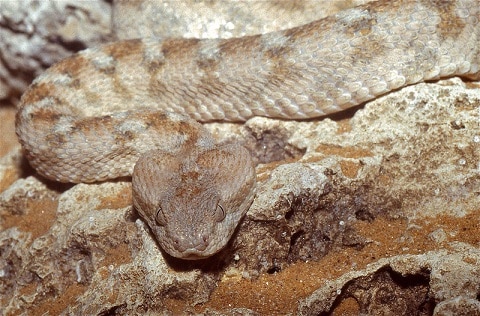
Maximum length: 85cm.
The pyramid saw-scaled viper (Echis pyramidum) inhabits northeastern Africa, including the dry, dusty countries of Egypt, Ethiopia, Eritrea and Somalia. It’s a common snake which is optimised for blending with parched landscapes, and deals out many snakebites to local Africans per year.
Echis pyramidum has a very thin neck, but avoids embarrassment by having an extremely bulky, triangular head. This is reminiscent of most of its viper relatives, yet expanded to a whole new level. Its eyes are beige, slightly darker than its sandy scales, and bulge out of its head sideways.
An angry pyramid viper has a classic C-coil posture. This snake doesn’t appear in true deserts, but semi-deserts, rocky plains and dry savannah. You can find pyramid vipers at altitudes of 0 to 1200 metres – flee higher and you’ll be perfectly safe (until you have to come down again).
Rather than one or two dotted around a sweeping desert, pyramid vipers are abundant in the regions where they live. One study analysed officially recorded snakebites in northwest Ethiopia from 2015 to 2019, and found that the pyramid viper caused the most annual snakebites alongside puff adders.
| 9 | Jararacussu |
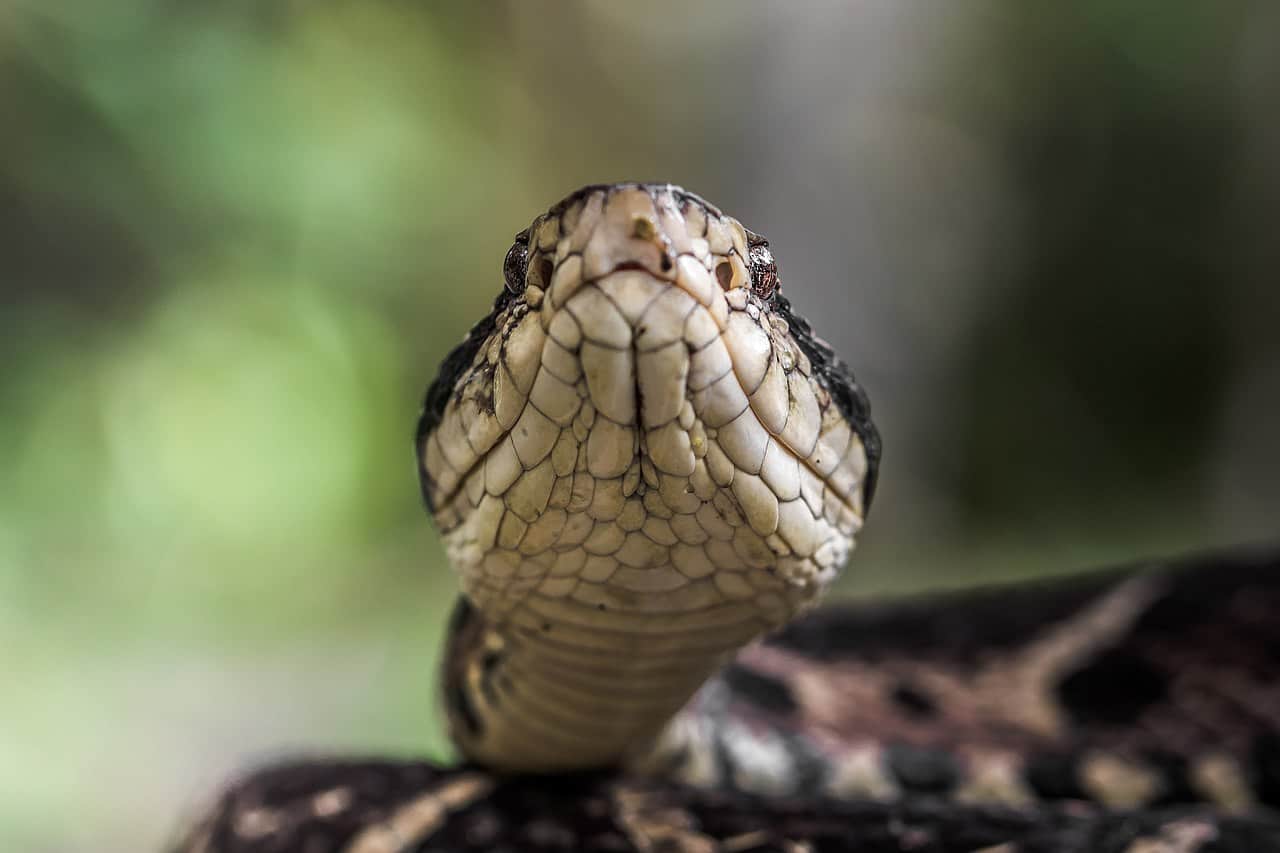
Maximum length: 220cm.
This deadly species lives in southern and eastern Brazil, avoiding the Amazon rainforest, but thriving in the dark, tangled forests of Brazil’s Atlantic coast. Its venom is a swirling soup of toxins, which mainly focus on the kidneys, skipping the lungs. A bite from a jararacussu can leave the victim dependent on haemodialysis for the rest of their life.
Jararacussus are not only the largest Bothrops lancehead in Brazil out of 30 members, but have the largest gender size disparity. Females can be over twice as long as males, and they can produce well over 50 young per batch. Their pupils are viciously vertical, and their bodies are particularly thick, only adding to the impression of size. Their sharply triangular head is the final ingredient of this recipe of fear.
According to a survey from 1906 to 1945, jararacussus caused 657 snakebites of 6601 in Brazil, but just 11 led to death. They’re not especially fast-moving, and a few even play dead rather than attack. Another consolation is that the antivenom for this species is readily available and highly effective.
| 10 | Mangrove pitviper |
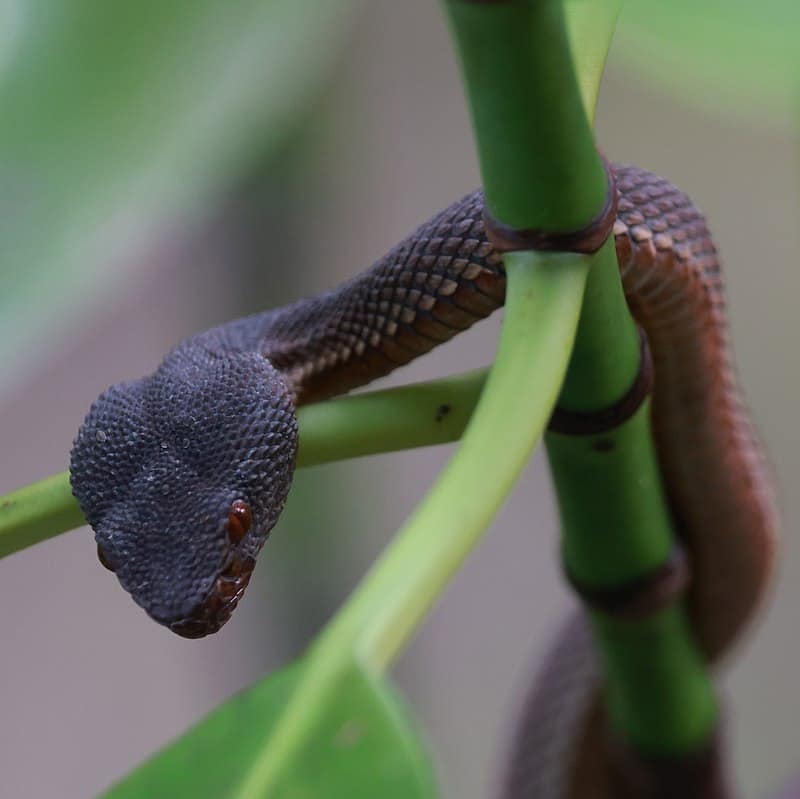
Maximum length: 107cm.
A species with a moderately dangerous venom. The mangrove pitviper (Trimeresurus purpureomaculatus) is found in southern Thailand, Malaysia, Singapore and Indonesia, where it lives an arboreal lifestyle, clinging to branches on the edges of water bodies. This species is usually found in mangroves, but also swamp forests. The Sungei Buloh Wetland Reserve in Singapore is one of its ultimate hotspots.
Mangrove pitvipers like to rest on branches while moving nothing except their forked tongue, which they wave up and down as though they’ve waving at people. Don’t bother waving back – they’re actually probing the air for reptile and frog scents, which form the majority of their prey.
Mangrove pitvipers are also confirmed to eat other snakes, including the crab-eating snake (Fordonia leucobalia). They remain motionless for much of the day, yet are easily agitated, and will spring at you without warning.
This is a rough snake in every way – mangrove pitvipers have keeled scales like overlapping leaves, and touching them will land you in hospital with a pair of fang marks. A bite is usually non-fatal, causing intense pain and a dose of uncontrollable haemorrhaging. While there’s no dedicated antivenom for this species, the general Thai antivenom used on white-lipped pitvipers is decently effective.