
| 1 | Mexican lancehead rattlesnake |
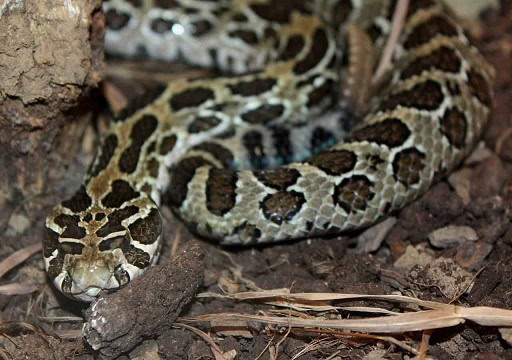
Maximum length: 100cm.
A dangerously venomous species of central Mexico, which is more neurotoxic as a hatchling before shifting to a cytotoxin-based venom with age. This obscure rattlesnake avoids forests, and sticks to grassy highlands, far away from bustling towns and cities. These are usually at high altitudes of 1450-2600 metres, providing sweeping vistas, if the rattlesnake cared to look at them.
The only problem with these open grasslands is the high amount of keen-eyed bird predators, searching for a reptilian meal. Fortunately, the Mexican lancehead rattlesnake has a solution – hiding in burrows.
This species is an expert at seeking out vacant mammal burrows, dug into soft grass. It’s an expert at completely vanishing underground, as though it never existed. Each sweeping plain could potentially contain several of these rattlesnake burrows. They could even be in photographs taken by tourists without them knowing.
Scientists estimate that Mexican lancehead rattlesnakes (Crotalus polystictus) would have far lower survival rates if it wasn’t for burrows. Burrowing mammals also form a large chunk of their prey. In a study from 2018, their diet consisted of 87.9% mammals. Prey include southern pocket gophers and Butler’s pocket gophers, two classic burrowers.
| 2 | Japanese forest ratsnake |

Maximum length: 120cm.
A non-venomous constrictor which leads a secretive underground lifestyle. The Japanese forest ratsnake (Euprepiophis conspicillata) lives on both of Japan’s main islands, Honshu and Hokkaido, yet is encountered relatively rarely. That’s because it spends a large portion of its life resting in dark mammal burrows, invisible to passing walkers. This has led to the name of Jimugari, or “burrower”, even though it doesn’t forge its own burrows, rather stealing existing ones.
This species particularly favours burrows within forests rather than in sweeping grassland. Its diet mainly consists of mammals, including the small Japanese field mouse. Some of these meals are eaten in the burrow itself, before the ratsnake lies down and digests for a while.
If you get lucky, you might see the Japanese forest ratsnake poke its head out of a burrow meekly, checking if the coast is clear. This snake is mostly restricted to Japan, but also appears on the Russian-controlled Kunashir Island. It has an impressive altitude record, pushing to 3000 metres above sea level.
| 3 | Crossed pitviper |

Maximum length: 169cm.
The crossed pitviper is one of Brazil’s many Bothrops pitviper members, and is the most common in open grassland. This species loathes forests, and steers well clear of marshes. Its favourite locations are sweeping plains with majestic views, commonly bordered by dusty rural roads.
Like the Mexican lancehead rattlesnake, shelter is a must for this species, and crossed pitvipers find it in the form of vacant mammal burrows. Sometimes, these burrows are vacant because their creators have moved on, while sometimes, it’s because the crossed pitviper has just eaten them.
Crossed pitvipers can enter burrows with tiny entrances, just 10-15cm wide. It’s possible that their eyesight is spectacular, but more likely that they simply seek out dense accumulations of scent particles. Crossed pitvipers are especially lazy, moving as little as 1.2 metres per day. This makes it especially important to find a comfy hideaway.
Ironically, the predator they fear above all others is the burrowing owl. Not because it likes burrows itself, but because it’s one of South America’s most notorious snake-eaters. Crossed pitvipers themselves eat 100% mammals, particularly rats and mice, and occasionally capybaras.
| 4 | African rock python |

Maximum length: at least 6 metres.
The African rock python is either the 2nd or 3rd longest snake on Earth, yet it still manages to stash itself in secret underground chambers. From early European explorers to modern scientists to wise local elders, everyone speaks of the same thing: that African rock pythons love to hide in aardvark burrows above all else. Aardvarks are like a cross between an anteater and a pig, and measure 65kg, so their burrows are suitable for a behemoth like the rock python.
This snake is a giant constrictor which is able to swallow impalas or even hyenas. The longest on record was 6 metres, and rumours persist of 10 metre monsters blocking paths. African rock pythons have no natural predators (except maybe Nile crocodiles), yet still love to hide in burrows, so the goal is more likely to escape the oppressive African heat.
Like most of our list, African rock pythons have no burrowing skills of their own, yet opportunistically take advantage of vacant ones. They might be enormous, yet they’re still thinking constantly about survival, looking for any angle they can.
African rock pythons lay their eggs in dark burrows too, and are a rare species to care for them, absorbing warmth in the sunlight and coiling around the eggs to transfer it. They also have a tendency to stash themselves in tree hollows.
| 5 | Black-headed python |

Maximum length: 3-3.5 metres.
Unlike the carpet python, the black-headed python lives far away from ordinary Australian folk. Rather than thick bushes by a Sydney bus stop, the black-headed python lives exclusively in barren, arid areas of Queensland and Northern Territory. There’s no forests to shelter in here, so the species’ only hope is to move underground. Black-headed pythons are nocturnal, and spend a large portion of their time in burrows.
Black-headed pythons are actually effective diggers themselves, but they’re not purists or burrowing diehards. They’ll just as happily grab a premade mammal burrow and curl up in it for several hours, if it saves them some effort.
Living in arid landscapes, black-headed pythons derive 92% of their calories from fellow reptiles. Burrows are a comfortable place to digest these meals in peace.
Male on male wrestling is another of their tendencies – the pythons will intertwine their bodies and struggle for dominance, but never bite. They also lay especially large eggs, which in turn create large hatchlings, compared to carpet pythons. With the jet black head and 2 metre plus length, it’s hard to misidentify this species.
| 6 | Road guarder |

Maximum length: 131cm.
A moderately venomous snake which moves by day. The road guarder is a Central American species which inhabits forests, but rarely climbs trees. It much prefers to move downwards into the safety of vacant burrows, which are one of its main refuges at night.
Road guarders (Conophis lineatus) are common in Central America, appearing from southern Mexico to Costa Rica. They face many threats in the wild, not least from their fellow snakes, as they’re confirmed to be prey for neotropical whipsnakes. Burrows are such a comfy hangout that they’d probably rather not leave at all. They’d rather sit and ponder, but road guarders aren’t like the ball python, which can go 18 months without eating. Some time or another, they must get their fill of frogs and lizards, and leave their cosy burrow in the crisp early morning to fleck out some promising new scent trails.
Road guarders are potentially dangerous to humans, as they have a venom consisting of 55% metalloproteinases. These toxins rarely kill, but tear through skin tissue and sometimes muscle tissue. Confirmed species in their diet include Gulf Coast toads and Gaumer’s spiny pocket mice.
| 7 | Banded krait |
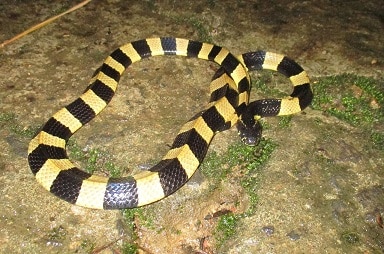
Maximum length: 212.5cm.
A severely venomous snake of Thailand, whose bite symptoms begin with a stomach ache and vomiting. This is a neurotoxic snake which normally kills via respiratory failure, as brain signals are interrupted mid-transit. Luckily, deaths aren’t common, and that’s because banded kraits are much shier than their neighbours like the hyperactive monocled cobra.
Banded kraits (Bungarus fasciatus) are nocturnal, and like to rest calmly in tree trunks or termite mounds by day. Rodent burrows are their favourite, particularly those close to water.
Female banded kraits have been observed to share burrows, and lay their eggs in them together; 15 hatchlings were once observed leaving a single burrow. Banded kraits mainly eat other snakes, so things might not be so harmonious if another species entered the burrow. Confirmed prey include the sunbeam snake, oriental ratsnake and buff-striped keelback.
Banded kraits rarely act aggressively during the day, but flip a switch at night, and become more willing to strike. During the day, they often hide their heads in their coils. They’re particularly fond of burrows on the edges of agricultural fields.
| 8 | Butler’s garter snake |
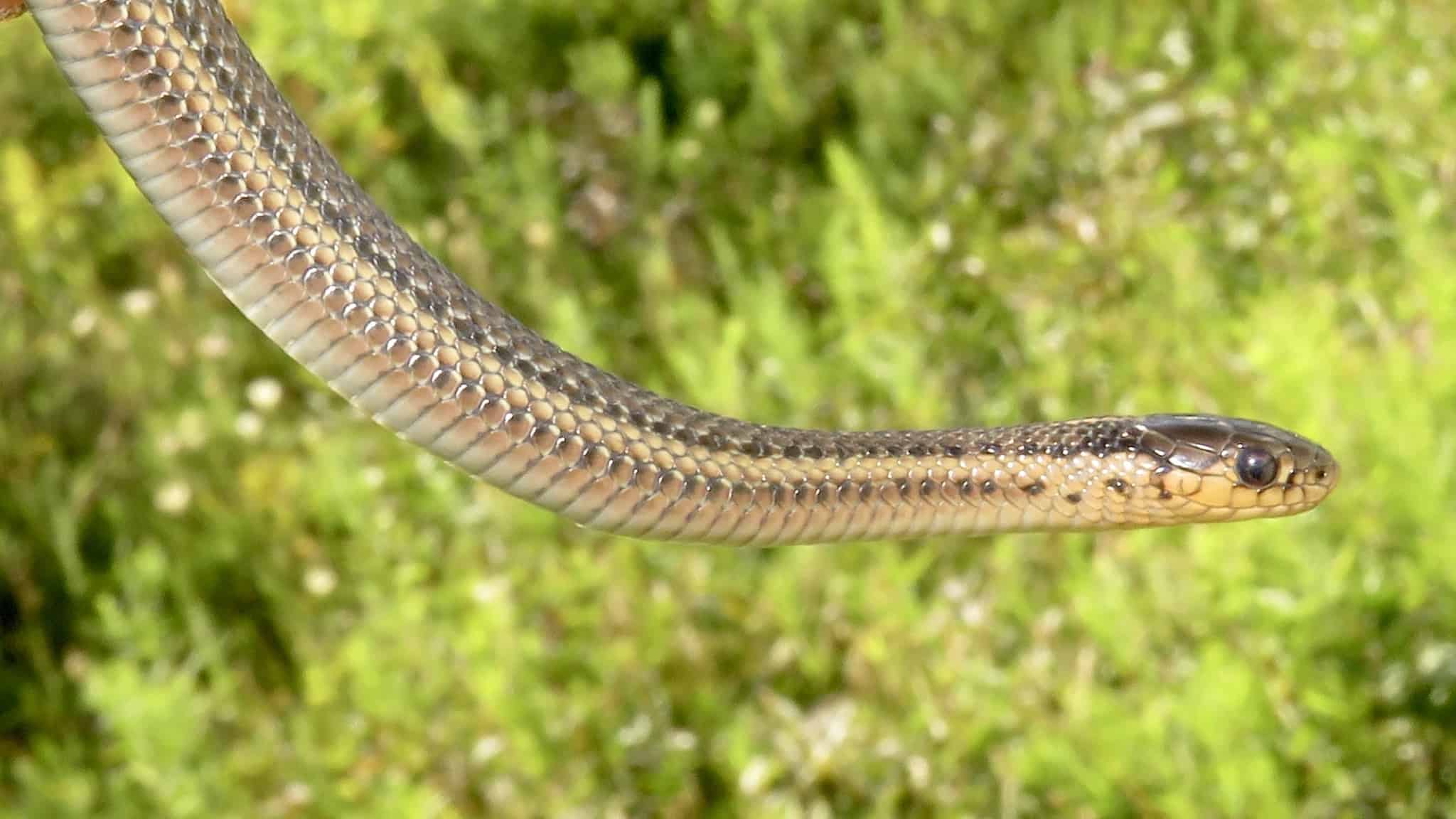
Maximum length: 73.7cm.
Butler’s garter snake (Thamnophis butleri) is one of 35 garter snake species in existence, and one of 3 to live in Canada. It inhabits northern US states such as Michigan, Wisconsin and Ohio, and prefers moist meadows and woodlands right next to streams.
One word predominates in this species’ daily life: earthworms. Butler’s garter snakes rely on earthworms and slugs for their survival, and are constantly flecking their tongue amid soft mud and luscious grass strands to find them.
When the day’s hard work is done, they retreat to their favourite hideaway, which is a vacant animal burrow. In riverside areas, they particularly love empty crayfish burrows. Here, they can guarantee warmth and security, should a sudden cold snap or storm blow in from the frigid north. In crayfish burrows, a Butler’s garter snake can listen to the rain pouring down in the meadow and plot its next move in peace.
Specifically, it can plot how to outcompete those pesky common garter snakes (Thamnophis sirtalis). This is a fully separate species, yet the two sometimes live in the exact same meadows. They regularly mingle in states like Michigan, without interbreeding. Butler’s garter snake is venomous, but only to the mildest level possible.
| 9 | Sharp-tailed snake |

Maximum length: 48.3cm.
A creature of mulchy forest floors, occasionally below rubbish in people’s back gardens. Sharp-tailed snakes (Contia tenuis) live in the western US: California, Oregon and Washington, plus extreme southwest Canada. They measure just 30cm, and blend into mulchy, leafy forest floors to the extent that they’re very difficult to spot.
Sharp-tailed snakes are already a rare sight in summer. During winter, they’re almost never seen, as the moment the first cold weather strikes, they retreat underground for months. Specifically, they take refuge in subterranean mammal burrows, lurking in a maze of underground tunnels. The forest above their heads goes on as normal, albeit frostier than normal.
Sharp-tailed snakes can invade burrows during summer as well. Their life as a forest floor dweller is perfectly survivable, as they eat slugs exclusively, which they skewer using their namesake weapon: an extremely sharp tail.
Sharp-tailed snakes lack venom, and almost never bite humans. Their love of burrows can allow them to escape detection for decades. In 2011, an entirely new colony was discovered on a wooded ridge in Pemberton, Canada. In 2006, the same happened on the San Juan Islands of Washington state.
| 10 | Caspian cobra |
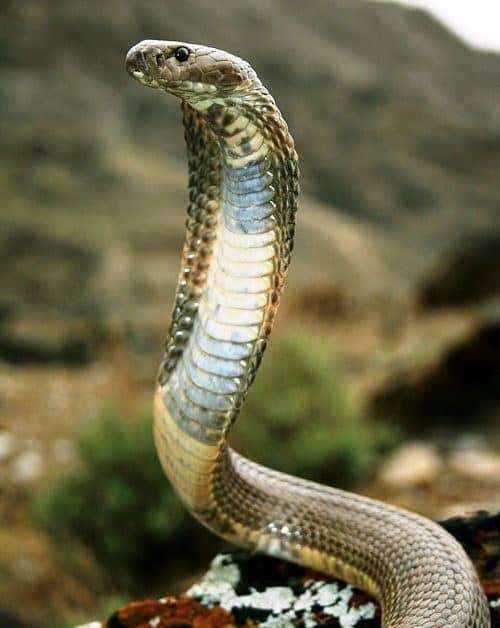
Maximum length: 175cm.
According to some lab tests, this species is the deadliest cobra of all. Its LD50 toxicity rating is 0.14mg, compared to 0.19mg in an Egyptian cobra, and its venom is particularly toxic to heart tissue.
The Caspian cobra is native to a swathe of rocky, arid territory, including eastern Iran, Turkmenistan, Kyrgyzstan and Pakistan. It’s an energetic menace which spends hours zooming around dry landscapes searching for mammals, but no matter how powerful its venom, the Caspian cobra will still tire eventually, and begin longing for a cosy shelter.
Like a Texan dashing for aircon after going out to buy milk, Caspian cobras will retreat to the coolness of a mammal burrow at the end of the day. They will sleep and digest their prey, which includes mammals and other snakes such as Hodgson’s ratsnakes.
A confronted Caspian cobra raises 13-22% of its body off the ground, and performs the classic cobra hood flare. It produces a piercing hiss, but with a short duration. Instead of a python’s long hiss, Caspian cobras produce multiple brief yet explosive bursts of hissing.