
| 1 | Guardian of Brazilian grassland |
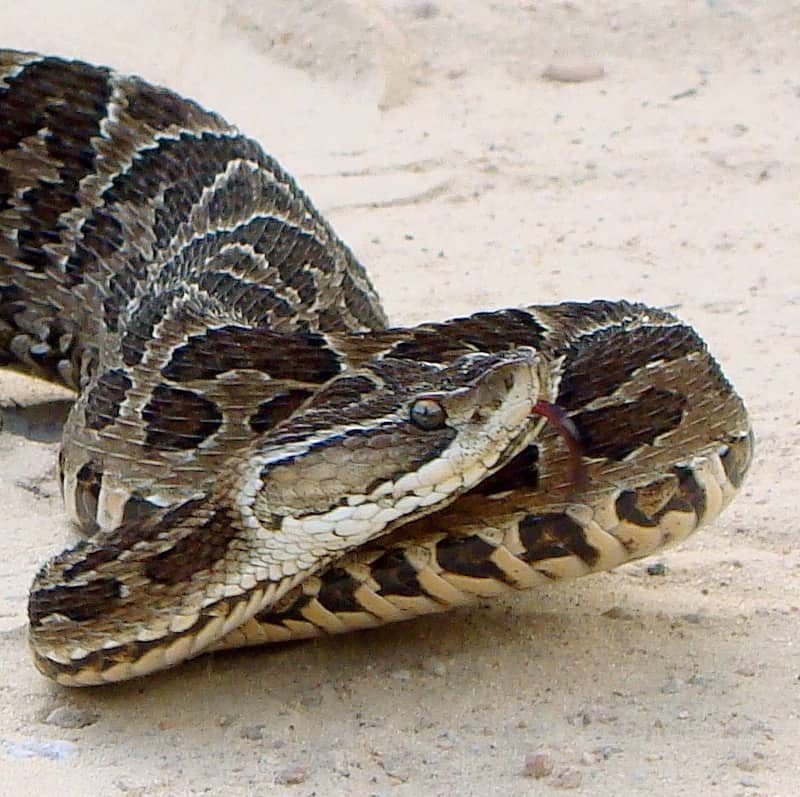
In southern Brazil, there’s virtually no environment which doesn’t contain one venomous snake, except maybe the penthouse of a skyscraper (and even that isn’t guaranteed). In riverside forests, you’re most likely to bump into the Brazilian lancehead. In a park in São Paulo, you’re most likely to meet the lethal jararaca. In open grassland, meanwhile, the species you’re most likely to encounter is the crossed pitviper, AKA Bothrops alternatus.
This species measures 80-120cm, with a confirmed record of 169cm, and rumours of over 2 metres. It’s part of the 48-member Bothrops lancehead genus, and like most of them, it would really rather be left alone, but often ends up biting people anyway, despite its best efforts.
Crossed pitvipers also inhabit Paraguay, Uruguay and northern Argentina, and their bites rarely kill. A 1949 study recorded 384 bites, of which only 8 (2%) were fatal. This was before the dawn of antivenom as well.
Nevertheless, a crossed pitviper’s bite can cause life-changing injuries, even if treated in hospital. So far, the venom has had over 100 components identified. The deadliest toxins include L-amino acid oxidases, disintegrins, thrombin inhibitors, and metalloproteinases. Like most Bothrops members, this species possesses almost no neurotoxins, specialising in haemorrhaging and tissue destruction instead. Crossed pitvipers cause a decent chunk of Brazilian bites, and are responsible for the majority of venomous snakebites in northeast Argentina.
| 2 | Causes blood to gush uncontrollably |
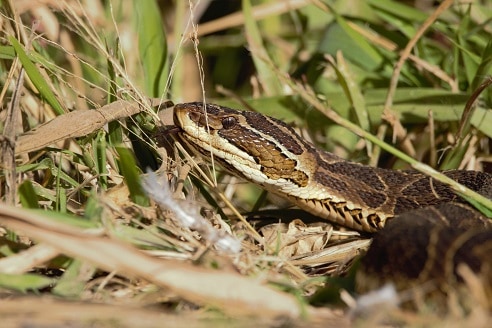
A study on 32 crossed pitviper bites confirmed that this species overwhelmingly specialises in blood clotting disruption, with 97% of hospital patients affected. This is when even a small gash to your knee could prove deadly, as the slightest wounds begin to bleed uncontrollably. 32% of victims experienced painful blisters, and 9% necrosis, where sections of skin slowly die and slough off, potentially causing life-changing injuries.
41% of crossed pitviper victims experienced spontaneous bleeding, which was most common in a specific location: the gums. The venom causes blood to gush from the bite mark, but also haemorrhaging in random locations.
In 2013, scientists discovered a strong myotoxin in the venom, a toxin which attacks muscle tissue. It was focussed purely against muscle, and caused damage via cellular destruction, disarrangement of muscle fibres, extreme infiltration of inflammatory chemicals, and the swelling of individual muscle cells at a microscopic level. A crossed pitviper can destroy enough tissue to rob the use of a limb forever.
| 3 | Medium in venom potency |
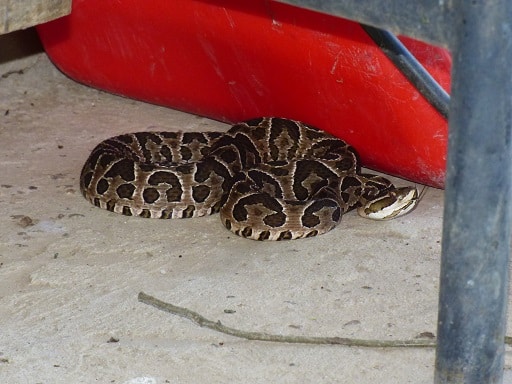
2010 saw the discovery of a completely unique toxin in crossed pitviper venom: balternin. This was one of the main agents in cleaving through fibrinogen, the building block of healthily clotting blood. Balternin also caused physical damage to many organs, including the heart, liver, lungs and muscles. More positively, this unique toxin was deemed promising as a future medication, possibly by dissolving deadly blood clots, preventing strokes or deep vein thrombosis.
Another study on rats found that post-bite, the venom of the crossed pitviper was detectable in their kidneys after 30 minutes. However, the concentrations decreased sharply afterwards, and the damage was reversible.
The crossed pitviper has an LD50 venom toxicity rating of 2mg, which fails to match the fer-de-lance’s 0.35mg. Its venom yield is respectable at 60-100mg per bite, but the fer-de-lance spews out 100-200mg.
Overall, the crossed pitviper is an intermediate venomous snake: too weak to consistently kill, but dangerous enough to carefully tiptoe around.
| 4 | Almost never found in trees |

Crossed pitvipers never appear in rainforests, and only occasionally in drier woodlands. Instead, their heartlands are open grassy areas.
The image above is typical habitat for a crossed pitviper: dry grassland bordered by old dirt roads and rickety fences, with excellent views in the distance. Crossed pitvipers like places where the sun can beat down on their back. They also appear in campo cerrado: grassy shrubland with scattered trees.
Who knows why crossed pitvipers are so scared of forests. Maybe they get confused by the labyrinth of trees, or maybe the darkness and stretching shadows of nightfall spook them. Either way, crossed pitvipers only inhabit open areas.
With a large rolling grassland to play in, you’d expect crossed pitvipers to be energetic, but they’re actually one of the laziest Bothrops pitvipers. A 2020 study tracked several crossed pitvipers in São Paulo state, and found movements of as little as 1.2 metres per day. After 43 days, the laziest snake had slithered just 52 metres from its original capture point. A second crossed pitviper was more energetic, moving 137 metres over 28 days, but this still amounted to just 4.8 metres of movement daily.
| 5 | Eats mammals exclusively |
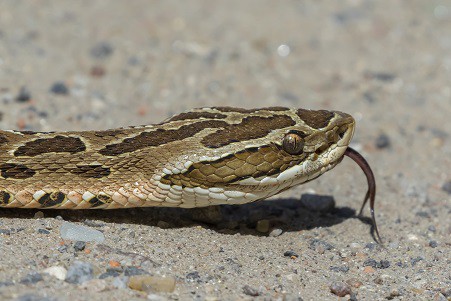
The crossed pitviper has a claim to fame: the Bothrops pitviper most heavily specialised in mammals. For example, a study tested food samples from 85 crossed pitvipers, from Brazilian regions such as Rio Grande do Sul and Santa Catarina. Every single prey retrieved was a mammal. The Brazilian lancehead (Bothrops moojeni) was far more balanced, at 42.1% mammals and 33.6% frogs and toads.
The Bothrops pitviper genus has 48 members, but the only others to eat mammals exclusively are Bothrops cotiara and B. fonsecai, which are much rarer. These are part of a 4-member subgroup within the Bothrops genus, also including crossed pitvipers and the São Paulo lancehead (B. itapetininagae), which have closer genetic relationships on the evolutionary tree.
Another study called upon old university samples, using 182 crossed pitvipers originally collected in Rio Grande do Sul and Paraná (both southern Brazil). Again, the diet consisted of 100% mammals. Rats and mice contributed 80.8%, marsupials 9.6%, and another 9.6% came from the Caviidae family of guinea pigs and capybaras. The vast majority were swallowed headfirst.
| 6 | Nemesis: burrowing owl |
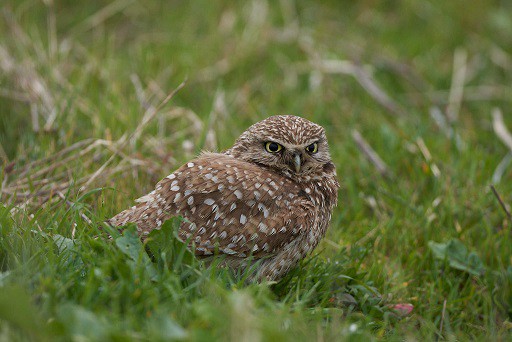
Every creature has an arch enemy. Humans have mosquitoes, cape cobras have the mongoose, and crossed pitvipers have the burrowing owl (Athene cunicularia).
Our first tale happened in April 2001. The scientists were at an ecological station in São Paulo state, driving along an unpaved road in untouched shrubby grassland. They were searching for snakes, but instead spotted a burrowing owl.
As the car’s beaming headlights approached, the owl took flight, with a snake visible in its claws, and landed a short distance away. The scientists spent 15 minutes trying to edge closer. Eventually they reached 7 metres away, and saw the owl tearing pieces of muscle off its prey, which was still moving.
The scientists scared the owl off, before examining the snake and finding it to be a 37.5cm crossed pitviper. The owl had ripped the poor snake’s head off, and devoured much of its muscle. The head was never found.
Another sighting happened on August 26th 2002. This was on another unpaved road, with pristine grassland on one side and manmade grassland on the other. The scientists scared another burrowing owl away, and found that it had gone straight for the crossed pitviper’s brain, which was almost dead, but still attempting to crawl away.
The snake was young, measuring just 33.4cm. Like many reptiles, a large proportion fail to survive to adulthood. Crossed pitvipers clearly use unpaved dirt roads as a prebuilt corridor, but they have a nasty nemesis to watch out for.
| 7 | Strike style |
In 2006, a study tested 5 Bothrops pitvipers for their aggressive responses when people invaded their space. The 5 species were similar in many ways. They commonly vibrated their tails against vegetation, struck at the aggressor, and unlike a coral snake, they rarely hid their head in their coils to protect their brain.
The main difference with crossed pitvipers was a tendency to flatten their body dorsoventrally. They elongated themselves sideways, making their body flatter overall, to give a false impression of size to predators. Their 4 cousins almost never used this trick; these were the jararacussu, jararaca, Brazilian lancehead (B. moojeni), and cerrado lancehead (B. pauloensis).
When preparing to strike, the Brazilian lancehead (a forest species) raised its head further in the air, but both the crossed pitviper and cerrado lancehead kept their neck closer to the ground in horizontal formation. The latter two are both grassland species. One possible explanation is that forest species have to raise their heads further to see past logs and thickets.
In open grasslands, meanwhile, birds of prey are a greater risk, so staying horizontal with the ground may help the crossed lancehead to stay hidden in long, swaying grasses. If it does get detected, then it has enlarging itself sideways as a fear-inducing backup.
| 8 | Random folk remedies |
Antivenom is easily available in Brazil as of 2026, from Rio de Janeiro’s busy hospitals to a village grandma’s bedside cabinet. Crossed pitvipers are one of 5 pitvipers used in the country’s most common formula, contributing 12.5% of antibodies to the final mixture.
Jararacas make up 50% of the formula, with jararacussus, Brazilian lanceheads and Neuwied’s pitviper each contributing another 12.5%. Each of these are injected into hyperimmunised horses to collect the antibodies.
Consequently, Brazil’s main antivenom is tailormade against this snake. New mixtures are also being released. In 2018, Uruguay released Lyophilized Suero Antiofídico Polivalente BIOL, an antivenom specifically targeted against the crossed pitviper.
There’s even the annals of folk medicine to explore. In Brazil, Schizolobium parahyba, AKA Brazilian firetree has long been popular as a folk snakebite remedy. Scientists put it to the test in 2008, and found strong protection in animals against crossed pitviper venom (plus Brazilian lancehead venom). The plant was strongest at preventing the destruction of fibrinogen, the main building block for healthily clotting blood.
Specifically, the leaves were tested, and deemed to contain “compounds that can display specific inhibitory activity against snake venom toxins“.
| 9 | Contains anti-anxiety medications? |
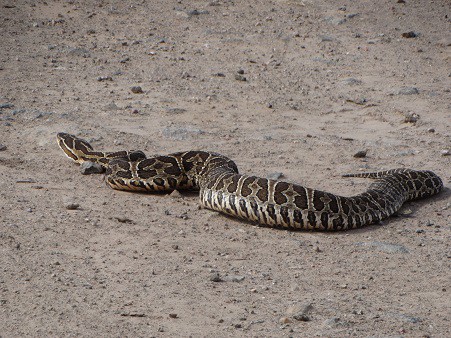
In 2021, scientists were concerned about the epidemic of anxiety in Western countries. They were particularly worried about the menstrual cycle, and whether it was connected to higher stress in women. So naturally, the first thing they did was fly to southern Brazil and grab a crossed pitviper.
The scientists placed the pitviper in front of rats, which flew into a panic. The female menstruating rats became particularly distressed and anxiety-ridden, thus proving the connection to stress that scientists had theorised.
Crossed pitvipers may also save humanity from the gathering storm of antibiotic resistance, which is threatening to make current medicine useless. A study on crossed pitviper venom from northeast Argentina found that it destroyed 3 microorganisms: Pseudomonas aeruginosa, E. coli, and Staphylococcus aureus.
E-coli is feared by all, but S. aureus is almost as notorious: methicillin-resistant staph A (MRSA) is a plague stalking hospital corridors, which clings to instruments and re-infects sick patients. It wouldn’t be the first family member to advance medicine, as a Brazilian lancehead toxin was transformed into an anti-blood clotting drug (batroxobin).
| 10 | Disappears into dark mammal burrows |
Crossed pitvipers are confirmed to prey on guinea pigs, specifically the Brazilian guinea pig (Cavia aperea). The crossed pitviper is also the only Bothrops member to lack a colourful tail tip in juveniles. This is used to lure in prey like frogs, mesmerising them with bright colours which they mistake for insects. Fer-de-lances and Brazilian lanceheads have this tail from birth, before losing it in adulthood. Crossed pitvipers don’t even have it as a baby. It’s possible that their mammal-heavy diet is involved.
At the same time, crossed pitvipers have far more toxic venom as a newborn in order to compensate. They’re also born at larger sizes than other Bothrops members.
With their grasslands home to hundreds of scurrying mammals, crossed pitvipers commonly take shelter in the dark burrows they forge. Crossed pitvipers have been discovered in burrows of the Talas tuco-tuco, an Argentinian rodent, possibly after eating the occupants. They can worm into extremely tight gaps, entering burrows with a 10-15cm mouth. The other impressive skill is spotting these concealed entrances in the first place.
Crossed pitvipers overlap with just a couple of their cousins. The venomous species they’re most commonly spotted alongside is Bothrops itapetiningae, the São Paulo lancehead, which also likes open grassland.