
| 1 | Red-necked keelback |
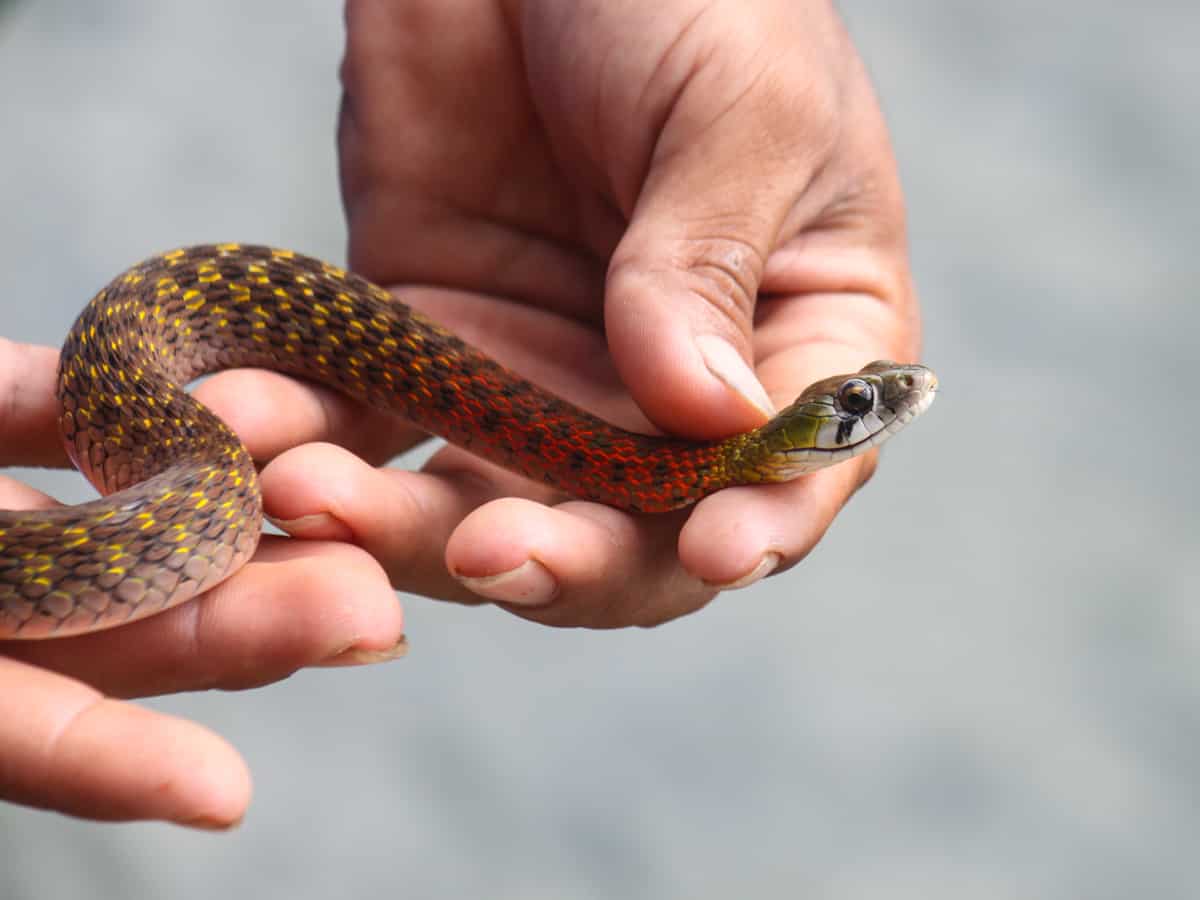
Maximum length: around 1 metre.
Rhabdophis is a genus of venomous snakes with 31 members as of 2023, which ranges from India through Thailand to most of Indonesia. The red-necked keelback is the most abundant, and best studied member of all. This species is common in Thailand, Hong Kong and Malaysia alike, and has a deadly venom capable of triggering kidney failure. This snake stays close to water bodies, including forest streams, and drainage ditches in towns near Bangkok.
Red-necked keelbacks have two rare features in the snake world. Firstly, they’re immune to the deadly bufanolides secreted by toads. Other snakes would drop dead after such meals, but the red-necked keelback feasts on them greedily, even while the toad desperately releases a white poisonous froth down its back.
Most importantly though, red-necked keelbacks actually sequester these toad toxins, and repurpose them for their own defences. The toxins are stored in nuchal glands in their neck, within the namesake red stripe. These parallel nuchal glands either burst upon contact, or when a red-necked keelback deliberately triggers it, possibly with a flex of its neck muscles. The stored toxins are used to ward off deadly predators, but also curious human villagers.
Other Rhabdophis members possess these nuchal glands as well, including the blue-necked keelback. Red-necked keelbacks were once thought to be mostly harmless, and Thai villagers paid them little attention, but the reality is starkly different.
| 2 | Tiger keelback |
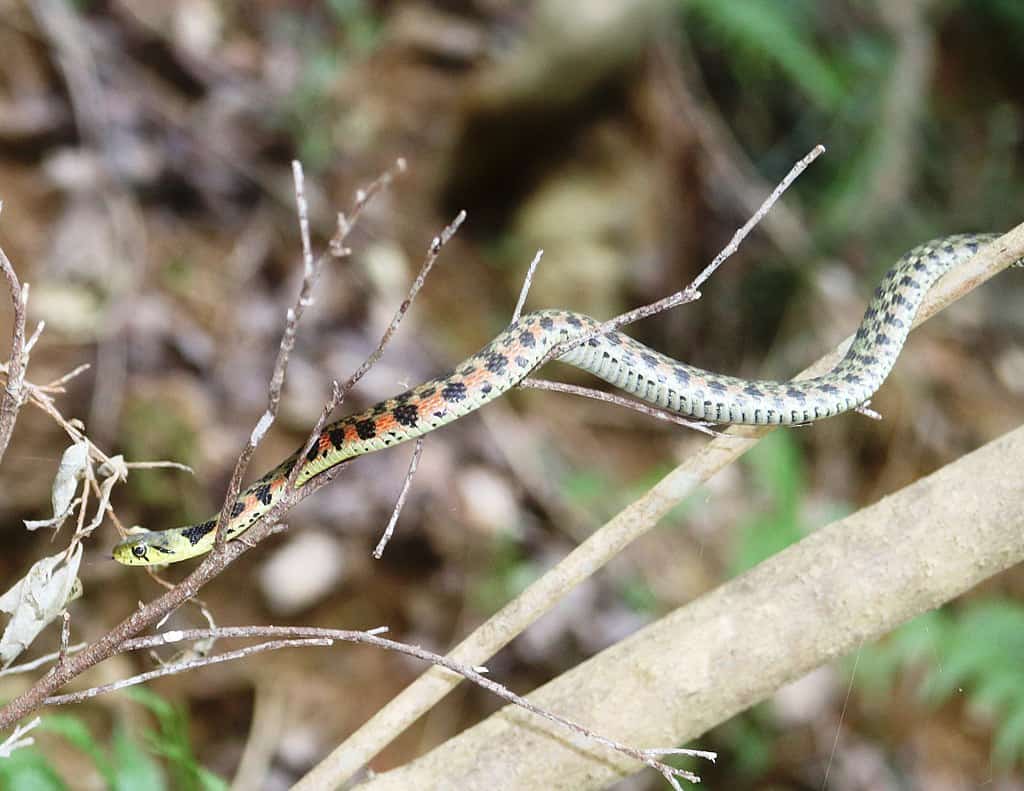
Maximum length: 150cm.
The main Japanese Rhabdophis member. Tiger keelbacks also inhabit South Korea, southeast China and Taiwan, making them the easternmost Rhabdophis member overall, as well as the most northerly.
Tiger keelbacks possess the same diabolical nuchal glands as the red-necked keelback. This time, it’s Japanese common toads (Bufo japonicus) which they steal bufotoxins from, as a natural part of their diet. As with red-necked keelbacks, they’re capable of releasing these toxins from their neck, in a lethal white froth.
Tiger keelbacks also possess a nasty venom. While only 5 Japanese people died from 1971 to 2000, a bite can trigger disseminated intravascular coagulation, when numerous small clots suddenly form at once. The bite specialises in kidney failure, with a rate of 40% without antivenom (which reduced the rate to 5.3%). Bites are particularly common in the west of Honshu, Japan’s main island.
Amphibians are their main prey, and confirmed meals include Japanese tree frogs, and Bankor toads in Taiwan. Tiger keelbacks are most common in streams within forests, with plenty of grass, though in the summer, they tend to move further away from these streams.
Be careful in the Japanese countryside, as like the red-necked keelback, tiger keelbacks can unload their poison stash at will. They can fire clouds of the toad poison through mid-air, striking people in the eye at a distance of 1 metre.
| 3 | Blue-necked keelback |
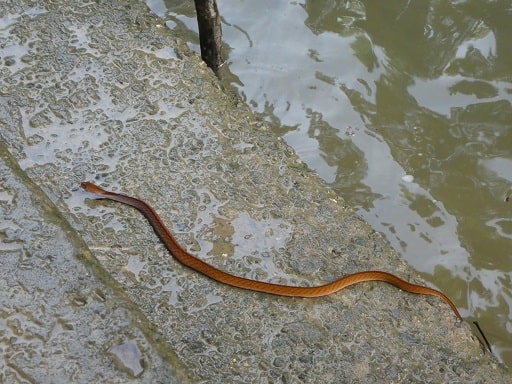
Maximum length: 75cm.
A rarely sighted snake, which is most common in streams within evergreen forests. The blue-necked keelback (Rhabdophis rhodomelas) inhabits far southern Thailand, but is most common in peninsular Malaysia, Singapore, Borneo and Sumatra. While the blue neck is real, a more consistent ID sign is a vivid black spinal stripe, contrasting against an orange body. A subtler ID sign used by scientists is 126-136 belly (ventral) scales, one of the fewest of the Rhabdophis group.
This species has never killed anybody on record, but a 2004 victim experienced muscular weakness, slurred speech, a cold sweat, faintness, and laboured breathing. This was the first ever detailed bite report.
Like our first two snakes, blue-necked keelbacks possess the ability to store toad toxins in their nuchal glands, ready to burst in people’s faces. A Mr H. N. Ridley made one of the first observations of this. Ridley watched the keelback flatten its neck, and exude a mysterious white dribble of liquid. His dog bit the snake, and white froth poured from its mouth like it had just bitten a poisonous toad.
Blue-necked keelbacks prey on amphibians, and one observation happened in Singapore’s Central Catchment Nature Reserve, along the Terentang trail. The victim was a common Asian toad (Duttaphrynus melanostictus), and the snake sank its fangs into the toad’s mid-section, leaving a bloody red mark. This happened in a thick bed of leaf litter. The keelback spent 10 minutes chewing on the toad, which tried frantically to break free.
The keelback then dragged the toad away from the path, but gave up due to disturbances from joggers and the scientists. Another confirmed place to find this species is the Ula Muda forest of northern Malaysia.
| 4 | Black-banded keelback |
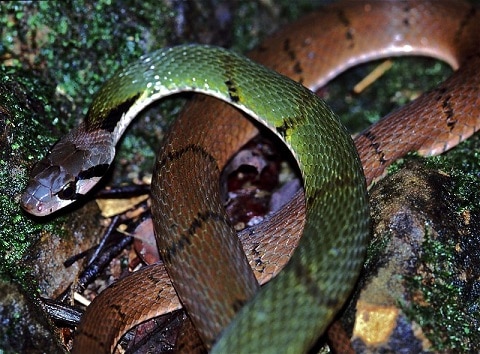
Maximum length: 95cm.
Another Thai keelback, and another one capable of storing toad bufotoxins, which was first confirmed back in 1938. Black-banded keelbacks (Rhabdophis nigrocinctus) inhabit most of Thailand except the extreme south. They also cross the borders of Laos to the north, Cambodia to the east, and Myanmar to the west, but their territory is centred around Thailand. This is a much more northerly species than the blue-necked keelback.
Black-banded keelbacks are rarely seen, sticking to obscure jungle streams, rather than towns and cities. This is a poorly researched species, and the strength of its venom is unknown.
However, black-banded keelbacks eat the usual amphibian-based diet. In March 2017, in a pebbled stream in Kham-mouane province of central Laos, scientists found a black-banded keelback grasping an Asian rice frog (Fejervarya limnocharis) by its hind legs and lower body. Within 3 minutes, the snake had fully swallowed the frog from the legs upwards.
Asian rice frogs are also confirmed prey for oriental ratsnakes and painted bronzebacks, so the black-banded keelback has heavy competition for its food supply. Another food chain player is the king cobra, which was witnessed eating a black-banded keelback in 2006, despite its corrosive venom.
| 5 | White-lined water snake |
Maximum length: 52.4cm.
The resident keelback of the Philippines, including near Davao City. This species is found nowhere outside the Philippines, and is the only member of this list to occur on Luzon, the largest Philippine island.
White-lined watersnakes (Rhabdophis auriculata) are very poorly researched, and it’s unknown whether they sequester toad toxins in a nuchal gland like their cousins. They’re confirmed to inhabit the forests surrounding Mount Malindang, and are plentiful in Mt. Kalatungan Range Natural Park. They range from 75 to 2100 metres above sea level, with their highest locations being near Mount Apo. A study from the Mt. Hamiguitan Range found several white-lined watersnakes, but categorised them as “rare”. They were mainly found in creeks and on low-lying vegetation.
Rhabdophis auriculata is recognisable by white stripes on either side of its body, and intermittent white spots between these stripes. The area inbetween is dark brown. This white-brown colour scheme extends to its head as well, which has intricate patterns.
The most colourful body part is the belly, which is aqua blue with an electric blue spot in the centre of each scale. But few will notice this splash of colour, even in the unlikely event that they find this species.
| 6 | Speckle-bellied keelback |
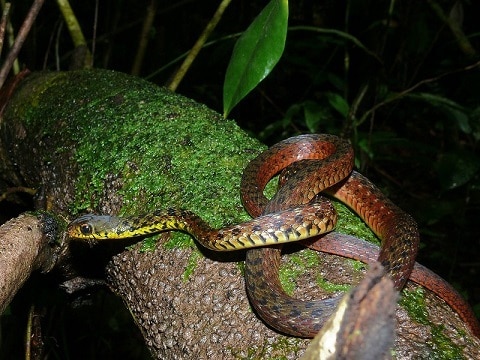
Maximum length: 105cm.
The first Rhabdophis member of this list which is confirmed not to sequester toad toxins in nuchal glands, lacking the awesome power of its cousins. Speckle-bellied keelbacks (Rhabdophis chrysargos) are widespread, inhabiting all of Thailand except the east. They inhabit peninsular and mainland Malaysia, Sumatra, Java, and also reach Palawan, the Philippines’ westernmost island.
As you can see from the image above, this species has one of the most jungled appearances of any Thai snake, like pure rainforest spawn. Speckle-bellied keelbacks are found near streams in forests, but also manmade canals through sugar plantations.
In December 2015, in Pahang province, peninsular Malaysia, scientists came across a venomous Siamese peninsular pitviper (Trimeresurus fucatus) swallowing a fellow snake, whose tail was just disappearing. The scientists moved the pitviper to some vegetation adjacent to the road, when suddenly, it regurgitated its meal, allowing them to make an ID. It was a speckle-bellied keelback, thus confirming that this species is hunted by fellow venomous snakes in the wild.
Meanwhile, its own prey include the Philippine toad (Ingerophrynus philippinicus), observed in 2017, which was this keelback’s first frog meal to be confirmed down to the species level. In a 2018 observation from Thailand, a speckle-bellied keelback ate a green paddy frog (Hylarana erythraea), taking 7 minutes from start to finish, making this species a fairly speedy eater.
| 7 | Taiwan keelback |
Maximum length: 70cm.
This species is found exclusively on Taiwan. In fact, it was the first ever endemic snake species to be described from Taiwan. The Taiwan keelback (Rhabdophis swinhonis) is one of the dullest members, with grey scales like a grass snake, albeit with sharply contrasting cream-black colours around its neck.
Whether this species can store toad toxins is a mystery. A 1999 study reported that the nuchal glands were missing, but a 2009 study noted that they were present. A brown dribble of liquid has been reported to spew from Taiwan keelbacks’ necks when harassed, and they’ve been witnessed widening their neck to create an illusion of size.
Taiwan keelbacks are docile in personality, biting less commonly than other members. They usually stick to forest floors, and prefer areas with high humidity. Their diet may be slightly unusual, as the first official observation happened in 2006, when a Taiwan keelback was spotted by the side of the trail in Yunlin County eating a large earthworm. However, they’ve been mentioned to eat the usual frog staples as well.
| 8 | Bindee keelback |
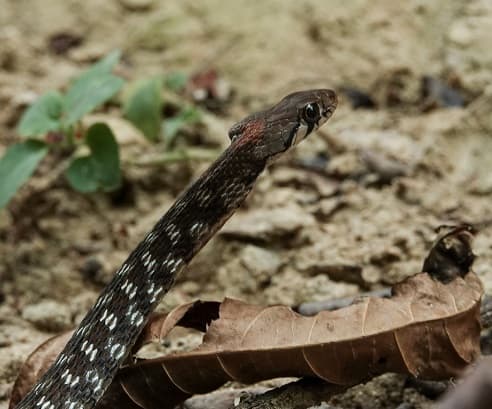
Maximum length: around 75cm (so far).
A completely new species, made official only in 2021. The Bindee keelback (Rhabdophis bindi) was discovered while scientist Abhijit Das surveyed the Barail Hills Range of Cachal District, northeast India. Its mixture of grey, white speckles and bulging eyes looked different to the snakes he normally encountered there, and genetic analysis ultimately confirmed its independent status.
The Bindee keelback had previously been sighted in Bangladesh, but falsely attributed to the Himalayan keelback species, which is actually the Bindee keelback’s closest relative. Himalayan keelbacks are found only in mountainous areas, while Bindee keelbacks prefer lowland forests. The very first study discovered a lack of nuchal glands (unlike the Himalayan version), so there’s no toad toxin threat with this species.
Bindee keelbacks measure 50-70cm, and were named for a distinctive red spot on their neck, which resembles the “bindi” marking found on some Indian women’s foreheads. Das had found the first snake in 2007, before finding ten more, all below 100 metres in altitude. It then took 14 years to conduct thorough genetic analysis, before the new species was finally announced. The original Bindee keelback was found near a small evergreen forest stream, showing the usual liking for water.
| 9 | Indian green keelback |
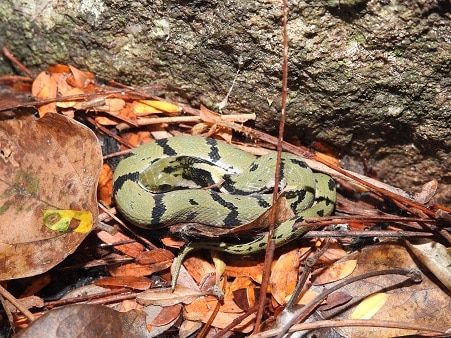
Maximum length: 73.1cm.
The Indian green keelback, AKA Rhabdophis plumbicolor, is the westernmost species on our list. You won’t find this species in Thailand, Malaysia or Indonesia, but you will find it in around two thirds of India, as well as Sri Lanka to the south and Bangladesh to the northeast.
Within India, this species is only missing from the drier northwest and towering Himalaya. Unlike the Bindee keelback, green keelbacks are in full possession of nuchal glands, which allow them to spray sequestered toad toxins in your face. This was confirmed in 1938, and more recently in 2016.
Green keelbacks have a variety of defensive tricks: kinking their body to resemble vegetation, faking death by flipping onto their back, hissing loudly, and vibrating their tail loudly. Their ability to flatten their neck is extreme; just check out this image of a Sri Lankan individual. Unlike a cobra, they keep their widened neck flat to the ground rather than upright.
Green keelbacks are fairly easy to recognise. While the local pitvipers are equally green, Rhabhopis plumbicolor is commonly adorned with intermittent black bars. However, these are sometimes missing, and there’s weird morphs around, like this fully blue version discovered in 2020 in Maharasthra state. No individual prey species are confirmed, but green keelbacks are known to feed on frogs.
| 10 | Sahul keelback |
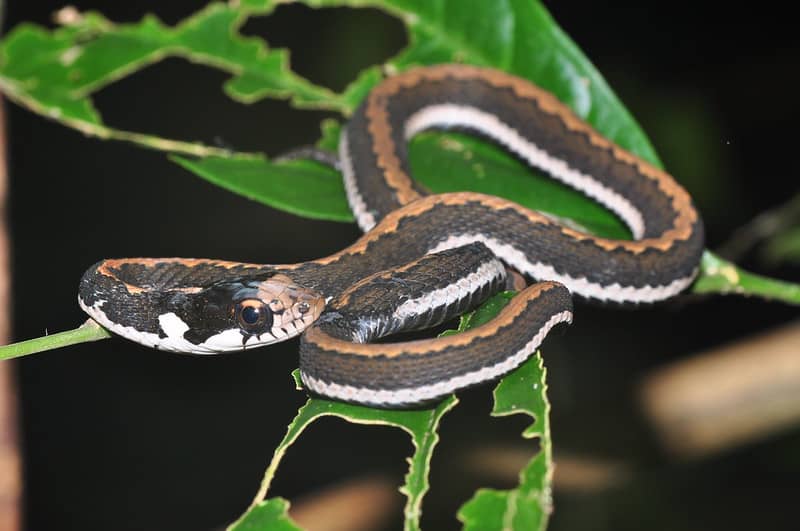
Maximum length: 87cm.
Also known as Günther’s keelback, this species is found mainly in the Sulawesi islands of Indonesia, and in parts of Java. Most members of our list could do with more research, but the Sahul keelback (Rhabdophis chrysargoides) is the most mysterious of all. The first unknown characteristic is its nuchal glands, namely whether they exist, and therefore whether this species can sequester toad toxins. Its actual venom is completely mysterious, with no detailed bite reports in existence.
Most of our information is gleamed from photos, including snapshots of a Sahul keelback sitting on a large rainforest leaf, or coiled around a thin branch. This is a high contrast snake rather than a dull one, as Rhabdophis chrysargoides has colours that almost look like the dabs of a paintbrush, with black sides and a wavy red vertebral stripe. But there’s also a handful which are plainer, with a brick red colour. One of the technical ID methods used by scientists is 164-171 belly (ventral) scales.
This species is found in rainforests with a high canopy cover (90% coverage), where they drape themselves over branches 1 metre above a shallow stream. Sahul keelbacks are sometimes found along the edges of streams on the ground as well.
One of their hotspots is Button Island, South Sulawesi, where they’re commonly found near water. While Java is listed as a location, the vast majority of sightings have been on Sulawesi. Indonesia is the only nation this keelback is confirmed to inhabit.
| 11 | Orange-collared keelback |

Maximum length: 112cm.
An easily recognisable species, due to the bright orange neck collar it possesses. Himalayan keelbacks (AKA orange-collared keelbacks) are known to exceed 1 metre, but otherwise, this is one of the most poorly researched Rhabdophis members of all.
Their range stretches from Nepal to northern Myanmar, also including southwest China, covering a large area of the Himalaya as you’d expect, although they’re mainly found in the lower foothills rather than towering peaks. This isn’t a species which will destroy your attempt on Mount Everest just as you’re crossing the South Summit (as the only animals up there are birds called goraks).
Most importantly, Himalayan keelbacks are confirmed to have a nuchal gland. As we discussed above, when the new Bindee keelback was announced in 2021, one of the key differences to the Himalayan keelback was that it didn’t have one.
Whether Himalayan keelbacks can sequester toad toxins in their neck and later blast them at people is unconfirmed, but a definite possibility. Their diet is confirmed to include the usual frogs and toads as well. Himalayan keelbacks (Rhabdophis himalyanus) are poorly researched, but should never be touched, and certainly not picked up.