
| 1 | Common in eastern Brazil |
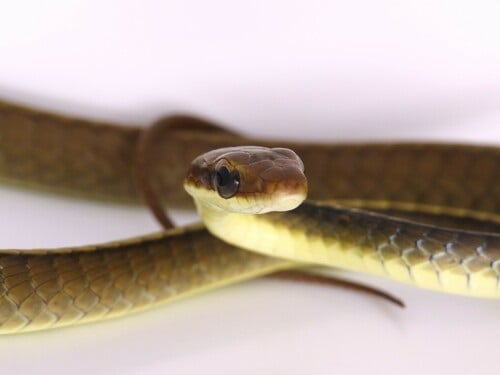
Brazil is full of snakes that could paralyse your lungs, melt your brain, and cause spontaneous bleeding from your gums. But the reality is that most are harmless, coexisting peacefully with humans. One such character in eastern Brazil is Boettger’s sipo, AKA Chironius flavolineatus, a medium length snake at an average of 80-120cm.
This is a South American species only, coming nowhere close to the Central American border (Panama), or even Venezuela and Colombia. Boettger’s sipo is a hyper-flexible snake, which only really avoids rainforests, high mountains and true deserts. It can appear in dry forests, riverside forests, urban areas and rocky hillsides alike, with a slight preference towards more open areas.
While incapable of killing, Boettger’s sipos won’t hesitate to snap and bite if gripped firmly. They can also release a foul snake smell, which is so strong that it engulfs anyone nearby.
This snake is part of the 23 member Chironius sipo genus, also including the machete savane. Boettger’s sipos are neither fully ground-dwelling nor tree-dwelling (arboreal). They tend to forage on the ground, with their entire diet consisting of frogs, before retreating to a comfy branch perch at night, typically 2 metres above ground. They have several arboreal adaptions, including a long, thin tail, and a slender body to reduce weight.
| 2 | A manically active snake |
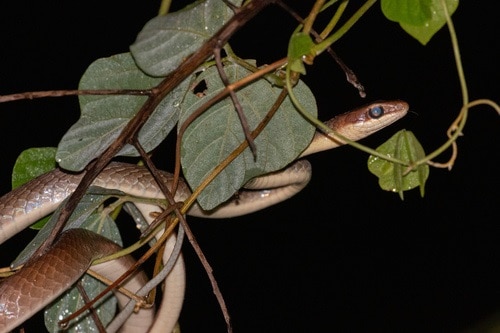
Boettger’s sipos favour active foraging for their hunting, rather than lazy ambush. Each day, they must prowl eastern Brazil searching for new meals, new calories to digest, in a neverending cycle. Each Boettger’s sipo will have many failed lunges, many frogs that slip away, and many unexpectedly weak disguises over its lifetime, yet they simply keep going and going, surviving through sheer determination. Again, they have several adaptions for this foraging lifestyle: a fast, whippy speed, and large eyes for improved eyesight.
Boettger’s sipos are exclusively diurnal, never hunting at night. A study from Brazil’s northern Bahia region found that all observations were made from 06:43 to 17:20.
Boettger’s sipos are inventive, and exploit their environment in whatever way they can. One sipo leapt from a leaf litter bed onto a low tree branch when scientists approached, escaping their clutches. The same 2016 survey showed how flexible they are. It recorded 21 Boettger’s sipos, in the following places: soil (9 times), bushes (5), leaf litter (3), a fallen tree trunk (1), herbaceous vegetation (1) and a pond (1).
This species even appears in caves 30 metres deep, specifically one called Cave of the Rabbits in Ibitipoca State Park, in southeastern Brazil. This species is extremely unlikely to go extinct, ever.
| 3 | Swallows frogs while they sleep |
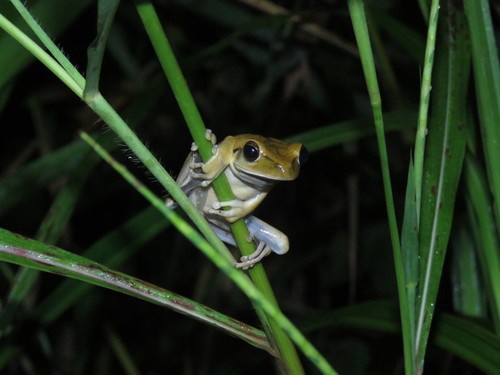
Boettger’s sipo has a highly specialised diet, feeding exclusively on amphibians. The cerrado areas of eastern Brazil are swarming with lizards, yet Boettger’s sipo ignores them and goes straight for the slimy delights of frogs. Frog-eating isn’t uniform across the Chironius sipo genus. For example, the machete savane eats a high amount of lizards such as rainbow ameivas, as well as frogs.
The best study came in 2008. It analysed 167 Boettger’s sipos from university collections in Brazil, along with their close relative the central sipo (171 examined). 17 prey were discovered inside the preserved Boettger’s sipos, with nearly 90% containing no meals, which is unusually low, showing that this is a snake which regularly goes hungry.
The results were clear, as every single Boettger’s sipo prey detected was a frog or toad. 71.1% were Hylid treefrogs, including species such as white-spotted tree frogs and Bischoff’s tree frogs.
One weird quirk was that the frog prey were mostly nocturnal, whereas Boettger’s sipo is diurnal. There was only one explanation: that this snake is a sneaky den raider, which ambushes frogs while they sleep.
| 4 | Avoids massive meals |
Boettger’s sipos wisely skip gut-busting meals, instead focussing on much smaller prey. In the same study, their meals averaged at just 5% of their own body weight, with a range of 0.00-0.21%. Meanwhile, the Paraguay green racer they coexist with in eastern Brazil sometimes dies from its meals, once eating a Peter’s lava lizard 41.4% of its own body weight.
As a thin-bodied snake, Boettger’s sipo instinctively avoids larger meals, similarly to the black mamba. The single heaviest prey in the study was a Chaco tree frog (Boana raniceps), weighing 17.44 grams. This pale frog is extremely common across South America, and Boettger’s sipo has competition, as this is a confirmed meal for 3 other snakes: Lichtenstein’s green racer, the yellow-bellied liophis, and green parrot snake. The smallest prey was a miniscule juvenile of the rock river frog (Thoropa miliaris), weighing just 0.31 grams.
Most prey (65%) were swallowed headfirst, and the central sipo (Chironius quadricarinatus) also ate amphibians exclusively. Several of the tree frogs discovered only create their nests above ground, whether in bushes or on tree branches, hinting that Boettger’s sipo regularly climbs several metres high in its relentless pursuit of food.
| 5 | Dives into streams to escape |
Boettger’s sipo isn’t an aquatic snake in the slightest, preferring open ground and trees. It only has two uses for streams and ponds: as a base for its frog prey, and as a refuge to escape hungry predators.
In December 2018, scientists were exploring the Chapada do Araripe plateau in northeast Brazil, when they found a Boettger’s sipo in a stream, which had a thick bed of leaf litter. The snake noticed them, and submerged to the bottom, burying itself in this underwater leaf layer, where it hid for 6 full minutes, managing to hold its breath. The snake thought it was hidden, even though the scientists were filming its every move with a digital camera.
The Boettger’s sipo then reappeared, but submerged into the stream and leaf litter again, apparently noticing the scientists. This time, it remained underwater for 1 minute 20 seconds.
Eventually, the snake swam away and emerged from the stream at a further point, trying to escape using leaf litter on land this time. Boettger’s sipos can not only hold their breath for ages, but are smart enough to know when a stream or thick leaf bed offers a shelter.
| 6 | ID: search for the creamy stripe |
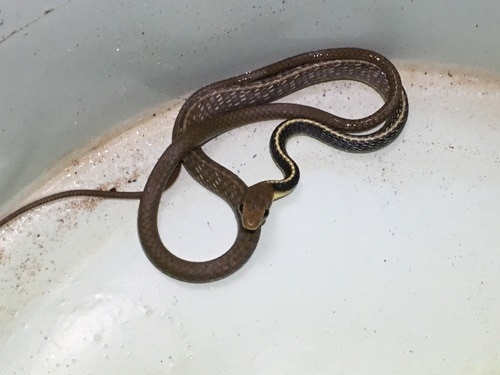
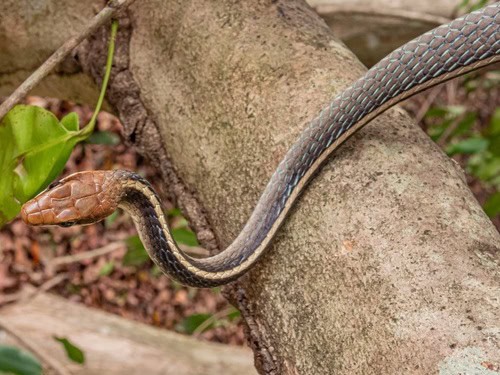
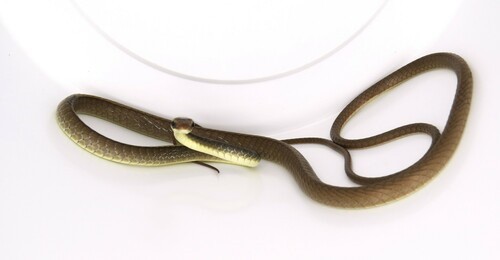
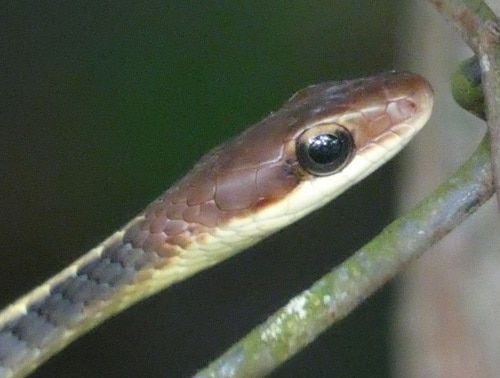
Boettger’s sipo is easy to distinguish from most Chironius sipo members, thanks to a thin, creamy stripe that extends down the entire length of its spine. This has created the alternative name of yellow-striped sipo, and the stripe is bordered by a thinner black stripe on either side. Another ID sign is a brown or beige head, which contrasts sharply with a dark grey upper third of the body.
Boettger’s sipo has little ontogenetic colour variation, keeping the same shades from birth to adulthood. Females are slightly longer than males, though not by much. When 57 female Boettger’s sipos were tested, the average length was 115.8cm. Among 37 male sipos tested, the average was 110.0cm. Females were significantly heavier though, at an average of 81.15 grams versus 65.0 grams. They also have a thicker body in order to carry more eggs.
Males had the visual advantage, with relatively wide eyes. These were believed to be for tracking down females, scanning the forest for any possible hints of their presence. The study also found that for both genders, the tail was massive, representing nearly 40% of total body length.
| 7 | Relatively civilised and cultured |
Unlike their close relative the machete savane, Boettger’s sipo males rarely wrestle each other to win female affections, in grand duels lasting for 2 hours while females watch on with popcorn. Apparently, their strategy is more basic. Scientists wandering a riverside gallery forest of Minas Gerais state, Brazil, found one female Boettger’s sipo accompanied by six males, all attempting to woo her.
When one male drew close and rubbed its body against her, the next annoyed male simply grabbed its rival and ripped its body away. Then it slithered in for the prize, before the outraged original male reappeared and pulled its rival away again. Then a new male would join the fray and rip both males away.
Meanwhile, the female was just getting flustered and stressed out. Apparently, the males were so focussed on each other that they hadn’t noticed that the female snake didn’t care anymore.
This cycle continued for 30 minutes, during which the male sipos sometimes coiled around the female, or rubbed their chin on her body lovingly. Despite their rivalry, the male snakes showed no aggression towards each other, no biting for example.
| 8 | Split into three species |
Boetger’s sipo still has a vast empire in Brazil, but parts of it have been chipped away in recent years. In 2014, a new species called Chironius diamantina was discovered in the Chapada Diamantina highlands of Brazil’s Bahia state, which had previously been misidentified as Boettger’s sipo. This had a creamy spinal stripe too, proving it to be a close relative. It lived in Caatinga environments at around 1000 metres above sea level, and was thought to have no coexistence with Boettger’s sipo lower down.
2015 saw a bigger change, when another new species was discovered: the southeast Brazilian sipo (Chironius brazili). It turned that many members of this species had been confused with Boettger’s sipo for decades.
C. brazili occasionally overlapped with Boettger’s sipo, inhabiting cerrado and riverside forests at elevations from 0-1360 metres, usually above 590 metres. The main physical difference was that Boettger’s sipo had a consistently cream-coloured belly. With the new Chironius brazili, the belly (ventral scales) gradually darkened instead. Genetics proved the two species to be separate, and it’s thought that they diverged 5 million years ago.
C. brazili reaches further south than its cousin, even reaching Uruguay. But it’s far less common overall, mainly inhabiting southeastern Brazil. A 2017 study added some new details, revealing that C. brazili tended to inhabit cooler areas than Boettger’s sipo, favouring highlands where the temperatures occasionally dropped to below 0 degrees celcius.
| 9 | May contain 2 more species |
We probably aren’t done with the new species yet either. The entire Chironius genus is believed to have originated 20.2 million years ago, while Boettger’s sipos diverged from the rest approximately 5.05 million years ago. But in 2017, scientists analysed Boettger’s sipos from all over eastern Brazil, and found massive genetic chasms between certain populations.
Clade 1 came from the coastal lowlands of Rio Grande do Norte and Paraiba, and was believed to be the real Boettger’s sipo. Clade 2 came from the Serra da Ibiapaba highlands, found in northeast Brazil, which are 600-1100 metres above sea level, and contained remnant Atlantic forests with an unusually high amount of rare species. Clade 3 consisted of a snake found in northeast Brazil, in the Serra das Três Barras highlands, at over 800 metres.
The latter two were both theorised to be undiscovered independent species, hiding within the Boettger’s sipo umbrella. For example, clade 2 and clade 1 were estimated to have diverged 0.56 million years ago. There was evidence of deep genetic separation between the 3 groups.
In a few years, yet more snakes could be added to the 4000 we know about worldwide, and the 23 official Chironius (sipo) members.
| 10 | More unsolved mysteries |
New locations for Boettger’s sipos are still being discovered. In 2015, they were confirmed in French Guiana for the first time. One was found in the centre of the Kaw river in 2013, floating on a piece of vegetation, and instantly identified by its creamy spine stripe. The scientists had spotted a fast snake zooming around Kaw village for years, suspecting it to be a Boettger’s sipo, but never getting close enough to make an ID.
Finally, in February 2015, they captured a snake measuring 93.5cm, which was proven to be Boettger’s sipo. These observations extended its territory by a whole 700 kilometres to the north.
However, they’ve also disappeared from Peru, which used to be on their territory maps. Not because they’ve disappeared, but because scientists examined the individual found in Peru, still in storage, and found it to be the wrong species. There was no signature creamy stripe, for one thing. Boettger’s sipo is confirmed to exist in adjacent Bolivia, and may just cross into Peru, but it isn’t official yet.