
| 1 | Common garter snake |
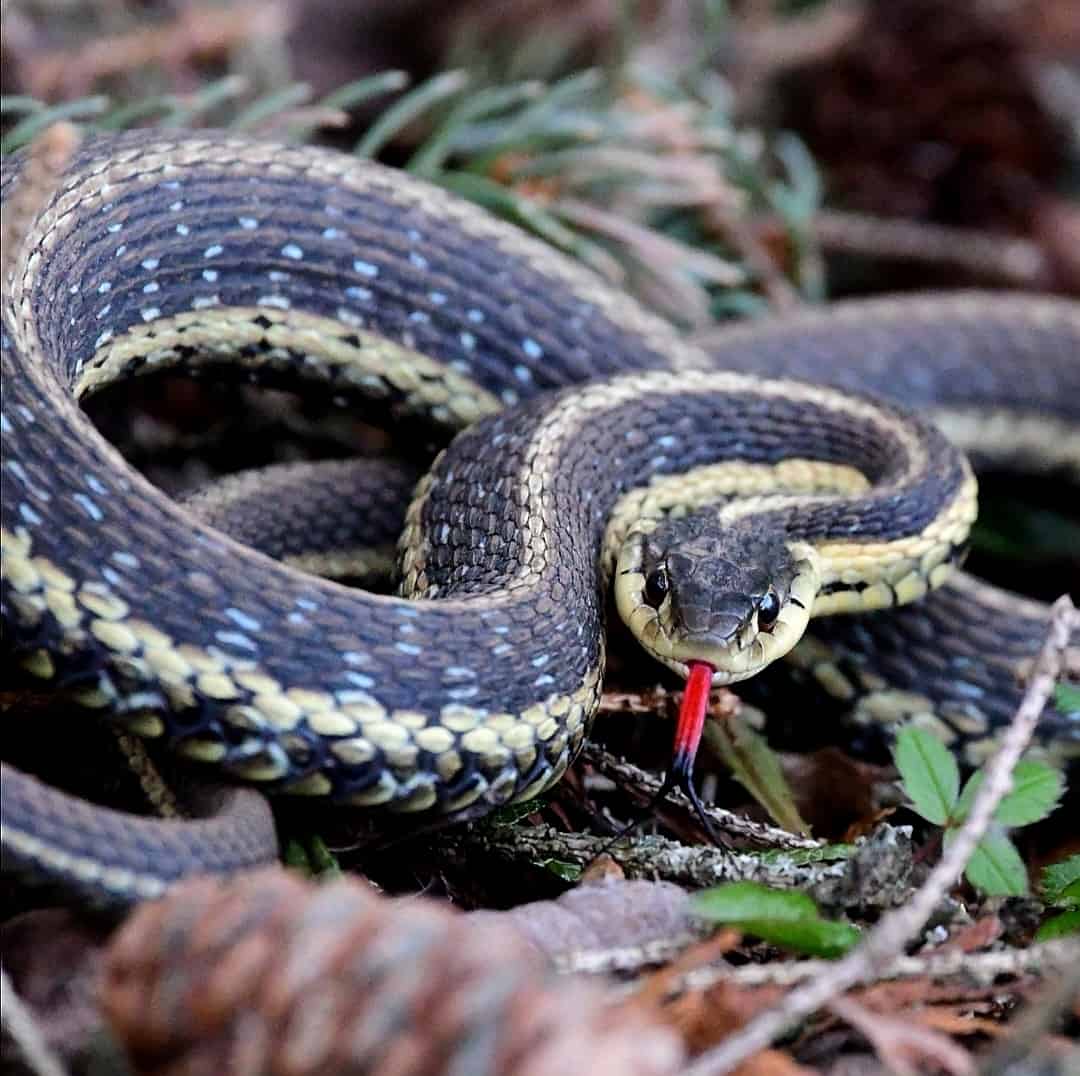
Maximum length: 137.2cm.
Range: virtually the entire USA, most of southern Canada. A tiny population in northern Mexico (Chihuahua).
The garter snake which all others are judged against. The common garter snake is the most widespread reptile, not just snake, in the whole of North America. It inhabits every lower 48 US state except Arizona, and is the sole snake found in the frigid Northwest Territories (NWT) region of Canada. It may, just may, reach southeastern Alaska (still unconfirmed).
For reasons nobody knows, common garter snakes can cope with far more varied habitats than their cousins. Thick forests, town gardens, and rocky shrubland are acceptable, with only deserts being truly out of bounds for them.
Nevertheless, their favourite spots are undoubtedly grassy meadows not far from streams or ponds. These moist zones are home to their favourite prey, amphibians and earthworms. Common garter snakes are non-aggressive, but manufacture a few toxins in their saliva, which can surprise bite victims with their strength.
Thamnophis sirtalis coexists with virtually all other garter snake species on this list, as though it’s the main garter snake from headquarters supervising all the smaller ones, which have been handed smaller slices of territory. Common garter snakes also have 13 varying subspecies, including the red-sided garter snake, which has red and blue tinges. However, this article will only cover the full species of the garter snake genus (Thamnophis).
| 2 | Eastern ribbon snake |
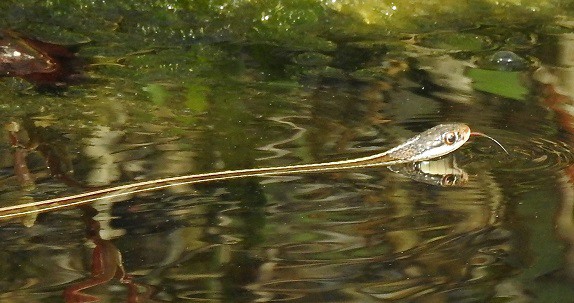
Maximum length: 104.0cm.
Range: eastern USA, Ontario.
The most aquatic member of the Thamnophis genus. While possessing a fancier name, and occupying a more distant branch on the evolutionary tree, the eastern ribbon snake is still classed as an official garter snake member.
Eastern ribbon snakes (Thamnophis sauritus) are most common in the northeastern US, appearing in countryside streams of Ohio, Pennsylvania and New York state. They have many survival tricks up their sleeves, such as shifting warmth from their tail to their bodies during cold weather, and climbing 6 metres high into riverside branches to dodge sudden floods, which they have a mysterious ability to anticipate.
Many riverside dog walkers have misidentified this snake over the years, but this is one of the easiest garter snake species to distinguish. Its belly tends to be paler than the common garter snake’s, and its face is cleaner, with less markings. Eastern ribbon snakes are also the thinnest Thamnophis member, and have a signature white dot in front of each eye.
Eastern ribbon snakes source over 90% of their calories from amphibians, with a bonus helping of caterpillars and fish. Studies reveal that the northern leopard frog is their favourite prey of all. Eastern ribbon snakes use neither venom nor constriction, preferring to grab a frog and swallow it down using whatever clumsy methods possible.
| 3 | Aquatic garter snake |
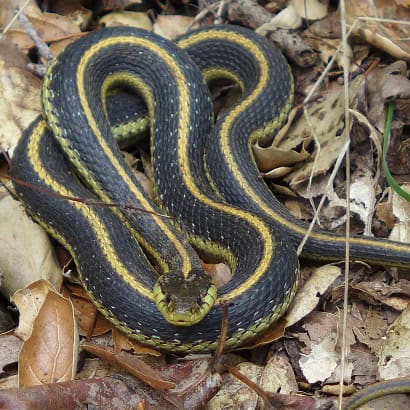
Maximum length: 101.6cm.
Range: California, Oregon.
A species found in just two US states. The aquatic garter snake isn’t fully water-dwelling like a sea snake, but definitely gravitates towards water more than most of its cousins.
This species is most commonly spotted swimming in streams, ponds, and marshes, along the west coasts of California and Oregon where it resides. At least 80% of its diet consists of frogs and toads, with the rest being salamanders. This species is even able to use its tongue to mimic insects, poking it just below the water surface to attract curious fish.
Aquatic garter snakes are probably the easiest to identify of all garter snakes in the USA (the Mexican golden-head is another simple one). They’re often completely missing the stripes on their sides, and the yellow stripe down their spine is thicker and blotchier than usual. The contrast between the black and yellow is especially sharp as well.
A study from Saint Lucia Preserve revealed how neighbouring members of the group compare. 3 garter snakes lived side by side in the study zone, and the local aquatic garter snakes were always found 1 metre or less from a pond. The common garter snakes reached 20 metres away from pond edges, while the terrestrial garter snakes were often found hiding under cover in grassy fields, 50 metres away from the nearest water body.
| 4 | Terrestrial garter snake |
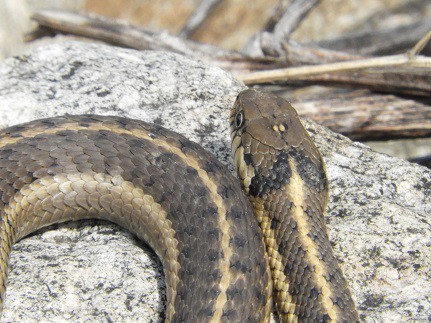
Maximum length: 109.2cm.
Range: western USA, southern Canada.
The second most sprawling garter snake after the common one, occupying 14 states, and just reaching far western Oklahoma and Nebraska. Terrestrial garter snakes (Thamnophis elegans) are extremely flexible and can inhabit grassy fields, forests, streams and rocky shrubland alike.
Their diet is the most varied out of any garter snake, shifting effortlessly within one location. In one river, the local terrestrial garter snakes ate 56.2% crayfish, with a side helping of voles, while in the Saint Lucia Preserve of Monterey County, California, mammals made up 82% of their diet. Yet another dataset found that fish made up 38%, frogs and toads 23%, and mammals just 2%. Either way, the terrestrial garter snake is much more likely to eat mammals than other Thamnophis members. The common garter snakes in Saint Lucia Preserve ate no mammals at all.
This species is tricky to distinguish from the common garter snake, but has a larger saliva gland and several scale differentiations. It’s also smaller than the common garter snake, with a record length of 109.2cm versus 137.2cm. Despite a similar appearance, the two have a large genetic chasm between them.
Thamnophis elegans is the most likely garter snake to constrict its prey, and its venom also seems particularly severe. This species doesn’t come close to an Egyptian cobra, but one prolonged bite resulted in swelling, pain and local haemorrhaging.
| 5 | Giant garter snake |
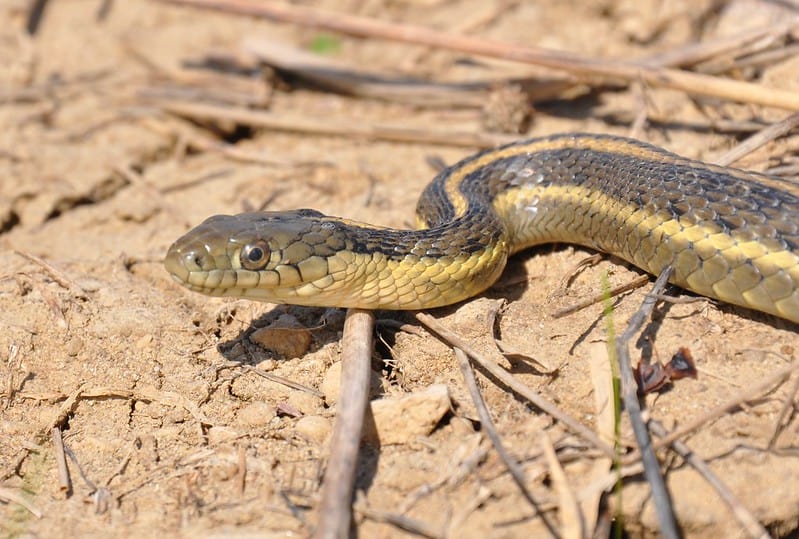
Maximum length: 162.6cm.
Range: California.
The largest garter snake of the USA, but also the most endangered. Giant garter snakes can reach 162.6cm, and exclusively inhabit the Sacramento and San Joaquin valleys of California. As of 2022, just 10% of their 19th century ranges remain.
This is a strongly aquatic species which once roamed freely around unending marshlands, which have long since been absorbed by agriculture. The only thing holding the giant garter snake back from ultimate doom is that Sacramento is now covered with rice paddies, which are semi-flooded and have numerous water drainage channels, making them a perfect mimic of its natural habitats.
Giant garter snakes correlate closely with one plant: long strands of tule. Their favourite marshes are ones with heavy borders of vegetation, but also gaps they can slither through, in order to inspect dry land.
Giant garter snakes have the sneaky skill of slithering through water culverts and crossing busy highways, without having to run the gauntlet of speeding cars. Their diet is heavily reliant on frogs, including the Sierran tree frog, with a side helping of fish. Giant garter snakes are mostly lethargic, but can slither up to 5 miles in a few days when on a quest for new territory.
| 6 | Northwestern garter snake |
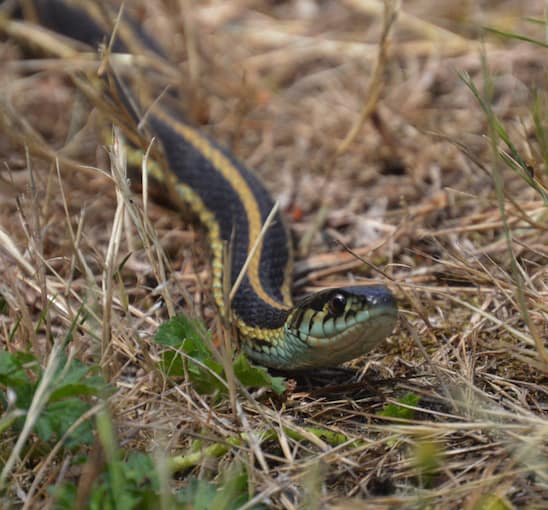
Maximum length: 96.5cm.
Range: Washington, Oregon, northern California.
This garter snake is one of the most variable in colour, as red, blue, orange and green striped versions can regularly be found within the same field. Northwestern garter snakes (Thamnophis ordinoides) are relatively short for their clan, averaging at just 40cm. They also have a smaller head than most, with the same red tongue as usual. They’re one of the least aquatic garter snakes, appearing in water occasionally, but mostly sticking to open fields on the edges of forests.
Even the pattern itself varies with this garter snake, and strangely, scientists have found that this correlates with personality. Striped versions are more likely to flee in a straight line, while those with spots or no patterns dart to the side and then pause, seeking camouflage.
Northwestern garter snakes mostly eat small, slimy creatures, the kind that destroy your garden crops: slugs and earthworms. Two of their favourite species are the banana slug and dew worm.
A difference to the common garter snake is that they often have vivid red spots on their bellies. Northwestern garter snakes are also found in southwestern British Columbia.
| 7 | Sierra garter snake |
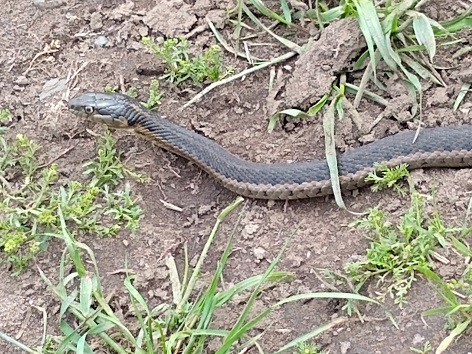
Maximum length: 125.9cm.
Range: California, far western Nevada.
This Californian garter snake is easily one of the most recognisable Thamnophis members. It has one of the blackest bodies of all, with an undercurrent of vivid orange, and the standard spinal stripe is as thin as a pencil line.
Thamnophis couchii is one of the more aquatic garter snakes. As a hatchling, this version hunts in shallower waters, before moving to the deeper river centres as an adult. One of its favourite foodstuffs is newborns of the Pacific giant salamander, and a large chunk of its diet comes from fish. This garter snake has also evolved resistance to the orange-bellied newt (endemic to California) and its deadly tetrodotoxins.
Sierra garter snakes have a reputation for aggression in captivity, meaning that they’re rarely kept. Keepers have tried and failed to get them attuned to rodents, even tempting them with artificially swabbed scents, to no avail.
Sierra garter snakes reach relatively high altitudes, as they’re often found in high mountain streams of the Californian Sierra Nevada. Elevations of 2440 metres have been confirmed, but there’s even rumours of Sierra garter snakes living at 2500 metres in El Dorado county.
| 8 | Short-headed garter snake |
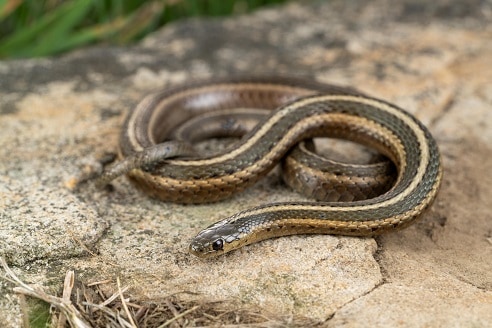
Maximum length: 57.8cm.
Range: New York, Pennsylvania.
This species has one of the smallest territories of all US garter snakes. Short-headed garter snakes (Thamnophis brachystoma) exist naturally in only two regions: New York state and northwestern Pennsylvania, with introduced populations in southern Pennsylvania. Within those ranges, they’re very common, yet they disappear very suddenly on the outskirts, despite little change in habitat type.
Short-headed garter snakes tend to live in meadows, and occasionally forests adjacent to them. They’re shier than average, and hide under rocks and wood. Being a small garter snake, at an average of just 36.7cm for males and 41.8cm for females, most of their diet consists of earthworms.
This northeasterly species is easily confused with the common garter snake. However, as you’d expect, the head is the easiest separator. It’s extremely tiny in the short-headed garter snake, measuring just 4.3% of its body length. Unlike the common garter snake, the head is barely larger than its neck, carrying on like a tube, which is noticeable in the image above.
Short-headed garter snakes also look very “clean”. They have a pale stripe down their spine and on each flank, but between those stripes, there are no scattered markings, just a neat and consistent brown colour.
| 9 | Plains garter snake |
Maximum length: 109.3cm.
Range: central northern USA and southern central Canada.
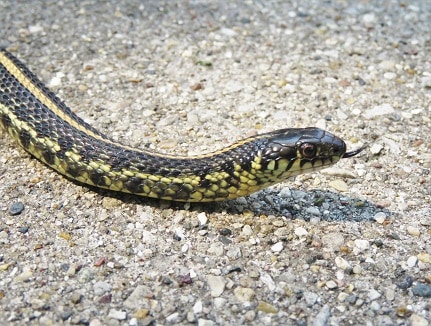
Of all Thamnophis members worldwide, the plains garter snake (Thamnophis radix) is the most similar to the common, the trickiest to distinguish by appearance alone. This species inhabits northern US states such as Ohio, Wisconsin and Minnesota, and spills well across the Canadian border.
Plains and common garter snakes are regularly found just metres from each other in the very same fields. Their daily lifestyle is similar, moving most between 1-3pm, and sticking close to water bodies without being fully aquatic. Even their diet is extremely similar, relying on amphibians with a 5-10% supplementary helping of earthworms.
Yet the two are completely separate genetically, as they never interbreed and produce hybrids in the spots where they coexist. There are clearly differences which science hasn’t pinpointed yet, and the main confirmed one is that plains garter snakes are less flexible in their habitats, while common garter snakes can inhabit virtually anywhere except deserts (hence why they’re missing from Arizona). A study in Ohio found that common garters are more common in forests, while plains garter snakes preferred wet prairies.
The physical differences are only subtle, but plains garter snakes have a more strongly orange stripe down their spine. The inbetween scales are also darker on average, creating a more vivid contrast.
| 10 | Butler’s garter snake |
Maximum length: 73.7cm.
Range: northern USA, Ontario.
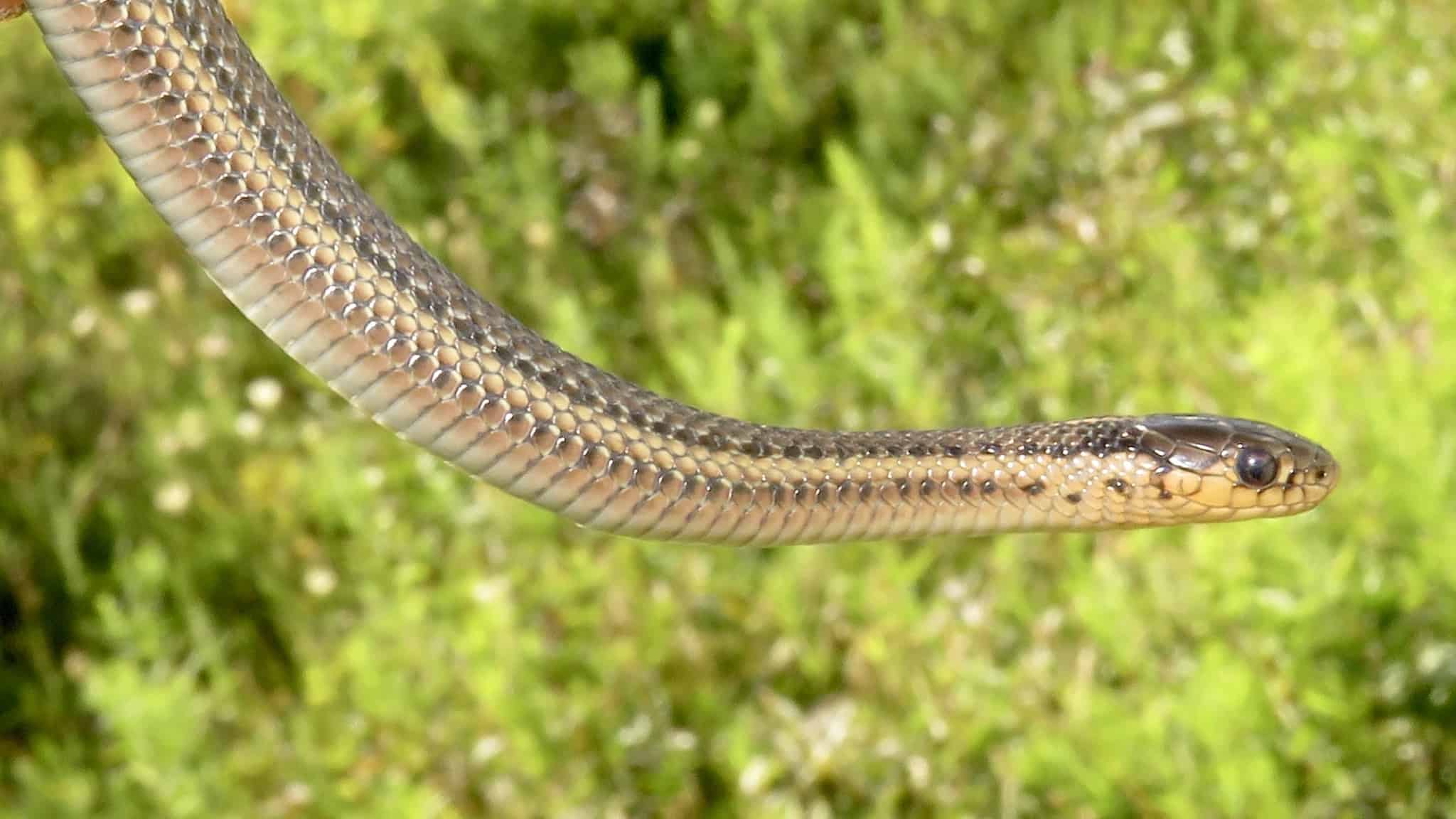
This small garter snake is found in four US states: Michigan, Wisconsin, Indiana, and Ohio. Butler’s garter snakes live in wet meadows and tall grass prairie, often taking refuge in the burrows of chimney crayfish. They have the usual liking for moisture, but prefer open areas rather than forests. They move an average of 14 metres per day, accelerating during summer.
Butler’s garter snake (Thamnophis butleri) is one of the shorter US species, with a female record length of just 73.7cm. Its other characteristics, however, are nearly impossible to separate from the common garter snake. The only hope for a layman lies in the pale side stripes. In common garter snakes, these are centred on the 2nd and 3rd rows of scales above their underside, while in Butler’s garter snake, they’re centred on rows 3 and 4.
Butler’s garter snakes almost never swim in rivers or lakes, but like to hide in 8 inch high vegetation on their borders. Consequently, Butler’s garter snake is able to use these as a corridor to infiltrate towns. This is one of the more suburban-friendly members, sometimes showing up beneath scattered rubbish in vacant lots.
Nowadays, Butler’s garter snakes derive 83% of their calories from earthworms, which aren’t native to the USA. They likely ate slugs before these were introduced.