
| 1 | The longest garter snake of all |
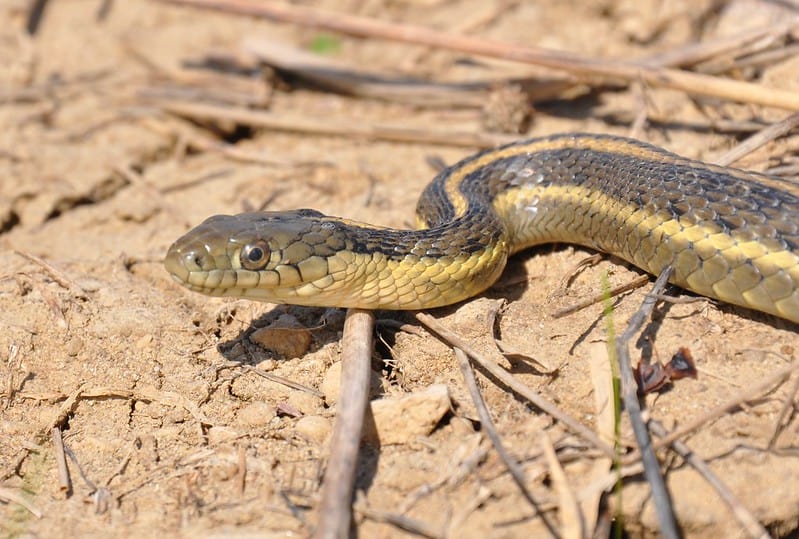
The garter snakes are a large group of semi-aquatic US snakes, which are slightly venomous but pose no threat to humans. There’s 35 confirmed species in North America, and some members like the common garter snake have over 10 subspecies within them. Tucked away in lush Californian valleys, one species has ballooned to be the largest of all: the giant garter snake (Thamnophis gigas). This species looks fairly similar to the rest, but has an average adult length of 90-125cm.
The common garter snake averages at 70-90cm, with the largest of all time measuring 137.2cm. Another extremely large one measured 134cm, and was discovered near Jenpeg dam in Manitoba by a university student. Meanwhile, the largest giant garter snake of all time measured 162.6cm.
Females are larger than males. The giant size is believed to stem from their Californian climate, where their shallow pools of water are warm all year round, allowing for a plentiful supply of prey. Over millions of years, this allowed an ecological space for a much larger snake, whereas the garter snakes of frosty Canada would die rapidly if they had to fulfill such a large calorific requirement.
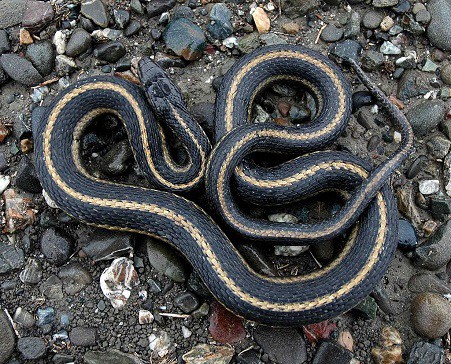
Giant garter snakes are typically brown, olive or black. Like most garter snakes, they have a bright yellow to orange stripe down their spine, with an additional stripe on each flank.
| 2 | Seriously endangered |
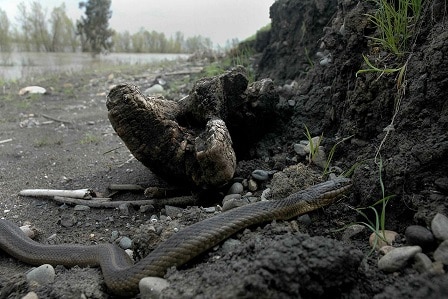
Like the yeti which only lives on a couple of Himalayan mountains, the giant garter snake is an elusive monster which now occurs in only two Californian valleys: the Sacramento and San Joaquin valleys.
Prior to the 19th century, giant garter snakes were found all over the central valleys of California. As of 2022, less than 10% of their old ranges remain. Human development is the main problem. The wetlands and marshes they favour have been consumed by agricultural sprawl, swallowing up ever more untouched wilderness. The surviving areas are severely fragmented, unable to link up and replenish each other.
The San Joaquin Valley has fared the worst, with 98% of the species’ former range vanishing. In the Sacramento Valley, they’ve clung on much better, mainly because the valley has been turned over to vast rice plantations. These are a rare manmade habitat which giant garter snakes can adapt to, as most rice fields are semi-flooded and surrounding by irrigation canals which mimic their natural marshland habitat. Effectively, the species was saved purely by chance.
There are now just 13 isolated populations of giant garter snakes remaining, whereas the common garter snake occupies almost the entire mainland US (excluding Arizona). Within California, the giant garter snake is found nowhere south of northern Fresno County.
| 3 | Habitat: search near rice fields |
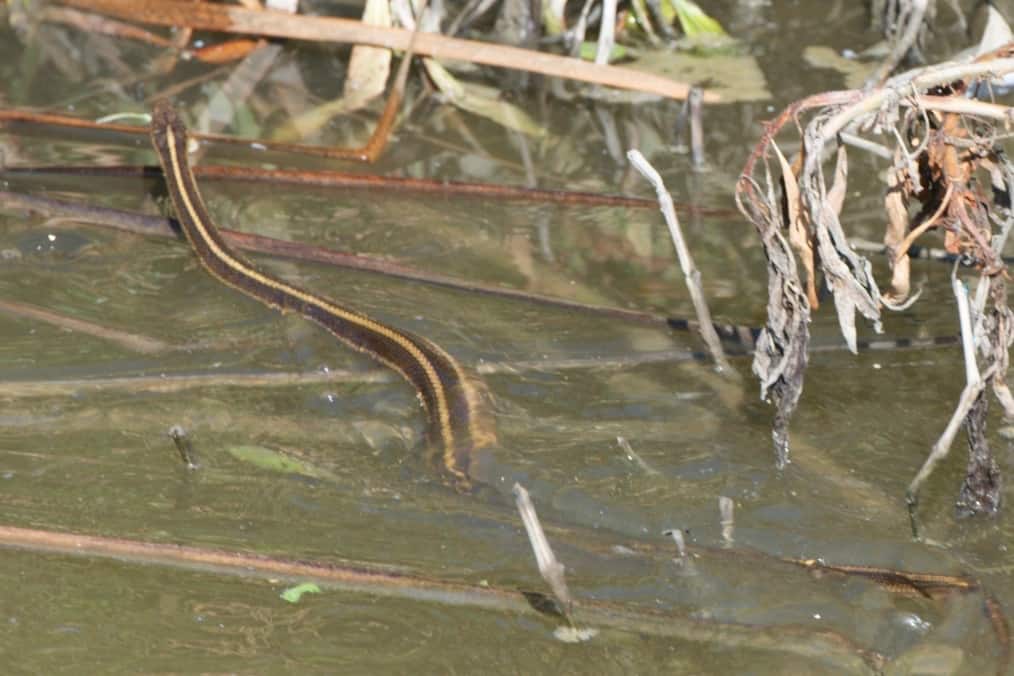
The main reason why giant garter snakes are endangered is their overattachment to water. Some time long ago, the giant garter snake split off from its relatives. It swelled and developed its gigantic size, ruling over all others, yet a less fortunate adaption was that its habitat requirements became extremely specific.
Giant garter snakes can’t thrive in woods or hills. Instead, they’re heavily reliant on tule marshland ecosystems, containing watery pools interspersed with grassy shallows. They’re one of the most aquatic of the sprawling garter snake clan, and stay within 10 metres of water 95% of the time. The exception is during winter floods, when they can move up to 180 metres away to seek higher ground.
Giant garter snakes love water, but they’re also ultra-specific within this water obsession. Giant garter snakes are never found in larger rivers or lakes, or areas with no vegetation. They have a strong preference for treeless areas, which are usually close to sea level, and climb to an absolute maximum of just 122 metres. You won’t find this Californian snake in mountain streams where 19th century fur trappers once hung out (e.g. Grizzly Adams), whereas the more flexible aquatic garter snake copes well with these areas.
Giant garter snakes appear in the centres of rice fields, but particularly love the shallow drains and irrigation canals surrounding them. Rice farmers have got to know this snake well over the years.
| 4 | Ultra-narrow habitat requirements |
Researchers have discovered that giant garter snakes have 4 non-negotiable habitat requirements. The first is an abundance of water during their active season from March to early November.
The second is thick vegetation on the shores of their streams and marshes, which they need for disguise against predators. Giant garter snakes love to laze around in this vegetation, but flee quickly into the water when their sharp senses pick up danger approaching. Their absolute favourite plant to hide in is thick strands of tule. When giant garter snakes were given a choice between shoreside tule and cattail to hide in, they always chose the tule.
The small areas where historical tule marshes survive are their strongholds in the San Joaquin Valley, which has less rice farms than Sacramento. Giant garter snakes normally stick to the edges of these vegetation patches rather than the thick bushy core.
Requirement number 3 is grassy banks and openings in the waterside vegetation – it can’t be a thick impenetrable wall. Finally, giant garter snakes require dry uplands not far away from their watery bases, which they can flee to during winter floods. Not many places in California meet those strict requirements today.
| 5 | Crosses highways using pipes |
Another danger to giant garter snakes is pesticide and chemical fertiliser run off, which is poisoning their native prey, the Sierran tree frog. Giant garter snakes are also vulnerable to wildfires. If an area burns, then they stay well away until the vegetation grows back.
Garter snakes can be lazy at times, but are fairly active overall. They sometimes enter turbo mode and move 5 miles in a few days, if they decide to upgrade their habitat. A 2006 study from the Colusa Drain in Sacramento found that they moved 61 metres in an average day, with a range of 3-173m. A 2003 Colusa Drain study found that the giant garter snakes moved 0.7 to 3.3 kilometres between captures.
Giant garter snakes are fearful of roads and will never stray onto them, but are skillful at threading through the water culverts below. This allows them to cross busy routes like California Highway 99 as if by magic.
| 6 | Preys heavily on tree frogs |
The giant garter snake is a water-lover, and therefore derives its calories from amphibians and fish, with a leaning towards frogs. In the olden days, this species ate native species such as red-legged tree frogs, thicktail chub (now extinct), and Sacramento blackfish. These days, its main prey are the introduced American bullfrog and the native Sierran treefrog.
Rather than mindlessly scouting about, giant garter snakes cleverly investigate pools which trap and concentrate amphibians. They then take advantage of the buffet using a mild venom in their saliva. Their fish prey include western mosquitofish and common carp, which they’ll grab if they casually swim past, when the opportunity to swallow one is such an open goal that they can’t resist.
Studies have tested giant garter snakes with the scents of nearby amphibians, and they clearly flecked their tongue more strongly in response to the native Sierran treefrog. The response was more muted with the American bullfrog (which naturally lives in the eastern USA), as both adults and tadpoles. Despite this, giant garter snakes slowly and falteringly get the hang of hunting bullfrogs as they grow, as it dawns on them that they’re potential food.
| 7 | Nemesis: American bullfrog |
The warm, luscious Sacramento Valley has an extremely high amount of predators. A 1986 study found that nearly all adult giant garter snakes had scars on their bodies, ranging from missing scales to incomplete tails. Their enemies include raccoons, striped skunks and grey foxes. To compensate, giant garter snakes lay high amounts of neonates. The species gives birth to live young, with totals ranging from 10 to 46.
Some of this is the natural circle of life, but the American bullfrog, introduced from the east, is a more unnatural threat. It’s estimated that 22% of giant garter snake hatchlings are swallowed up by American bullfrogs each year, and the worst thing is that giant garters struggle to recognise non-native predators.
The study above found that garter snakes respond with fear and alarm to the scent of native California kingsnakes, an ophiophagous (snake-eating) serpent. They can detect subtle chemicals and pheromones they produce, yet the giant garter snakes had no recognition of the American bullfrogs which are constantly eating their children. Consequently, their ancient defences are inadequate for the current situation. This is yet another reason for the species’ population decline.
| 8 | Detects humans from far away |
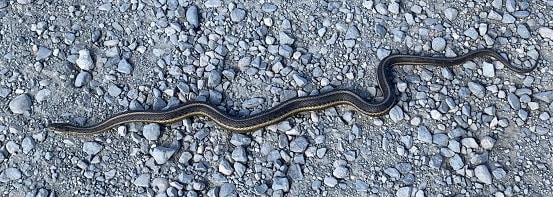
The giant garter snake is a large snake, yet a wary one which almost always flees if agitated. You only have to enter a 15 metre radius for the giant garter snake to take notice of you and dash into the nearest water body. Even within its surviving population fragments, it’s a hard species to get hold of.
Giant garter snakes are very skillful at hiding in burrows or decaying piles of leaves and barely moving, so that predators walk right past without noticing. By positioning themselves in riverside vegetation like tule strands, they’re only ever a quick decision away from never being seen again.
If you do manage to pick one up, then the giant garter snake won’t just give up; it can thrash, produce a foul smell, and maybe even bite. There’s no life-threatening danger, as this species only possesses a mildly venomous saliva, but a bite could become red and itchy.
Another ID trick is that giant garter snakes in the San Joaquin Valley sometimes have broken stripes. The species normally has yellow or orange stripes, but these colonies can look more checkered. Those in the northern Sacramento Valley have full stripes, and a particularly dark underlying colour.
| 9 | Its closest relative |
Giant garter snakes are commonly spotted in spring, as they bask in the sunlight near vegetation. The only trouble is getting close enough without scaring them away. Giant garter snakes can be nocturnal or diurnal, only gravitating towards night-time antics during extreme summer heat. A study concluded that giant garter snakes aim for a body temperature of 29.8C, ranging from 27.6 to 31.7C.
Males emerge from hibernation in mid-March, and begin searching for females immediately. Breeding season is from March to May, and females give birth from late July to early September.
There’s so many garter snakes in North America that their evolutionary tree is a tangled mess, but it’s believed that giant garter snakes are most closely related to the aquatic garter snake (Thamnophis atratus). This water-lover lives exclusively along the coasts of Oregon and California, and the giant garter snake is believed to have broken off after being trapped in the central valleys. The bountiful food supply allowed gigantism to kick in, which joined subtle colour and scale changes.
The giant garter snake’s other two closest relatives are believed to be the terrestrial garter snake (Thamnophis elegans) and Sierra garter snake (Thamnophis couchii). A weird fact is that not a single giant garter snake fossil has been discovered.
| 10 | Garter snakes they coexist with |
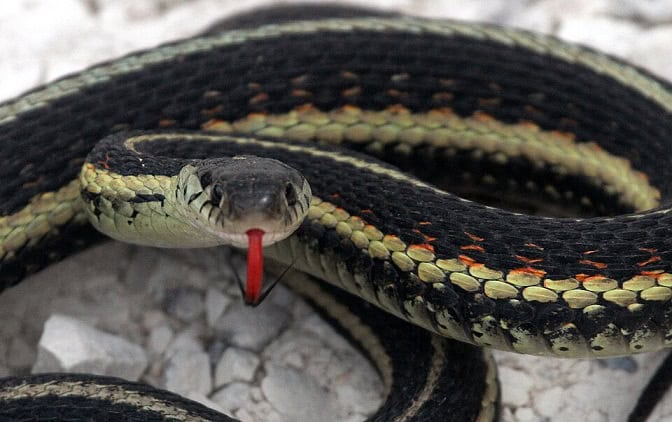
Giant garter snakes have the feature of their jumbo size, but the smaller members can overlap in size with the largest ones of others. There are two other garter snake species coexisting with them in their lush Sacramento and San Joaquin valleys.
The first is the red-sided garter snake (pictured above), one of the common garter snake’s 10-15 subspecies. This garter snake also gravitates towards water, though not exclusively, but is obviously separable by its red sides. It also has larger eyes and a smaller body.
Then there’s the mountain garter snake (Thamnophis elegans elegans). This only shares a few spots with the giant garter snake, in the foothills of the Sierra Nevada. This species lacks any red as well, and differs to the giant garter snake with its even smaller size (the smallest of the 3). Another ID sign is much more sharply contrasting colours on the face; the mountain garter snake has a yellow chin and black top of the head which are clearly separated, while in the giant garter snake, there’s a vague separation, but the two blend together significantly more (see here and here).
Both of these species have a shorter and wider muzzle than the giant garter snake. Nevertheless, giant garter snakes are similar enough to others that they weren’t declared to be a full species until 1987.
Thanks for this. I have seen these snakes a few times (and I am so glad you have used some of my iNaturalist pictures here). But I know very little about them so it is nice to learn about the species I got a few pics of.
Thanks for the good pictures! The one in water is particularly good.