
| 1 | Green vine snake |
Maximum length: 216cm.
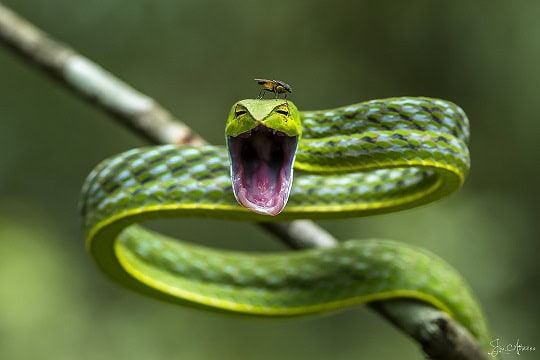
The green vine snake (Oxybelis fulgidus) is a moderately venomous snake of Central and South America, which mainly inhabits rainforests and riverside gallery forests. This species is a patient ambush predator, which captures reptiles running along branches, as well as small birds like hummingbirds.
Green vine snakes are all-powerful in the Americas, with a massive range, stretching from central Brazil to southern Mexico. One reason for their success is their threat display, as this species is excellent at looking as demented as possible, despite not being particularly deadly.
If a human walks past its branch, then the green vine snake may not react, or it may fly into an insane frenzy. The photo above shows a green vine snake preparing to unleash a vicious strike, perhaps against the photographer themselves. The vine snake in this photo even has an insect on its head, as though it can spew swarms of them at people.
The green vine snake’s venom is tailored against its lava lizard and iguana prey. It usually causes little more than swelling or pain in human beings, and must be chewed into a victim’s arm repeatedly to take effect.
That said, this snake is so demented that it may be difficult to rip away once it’s secured a fang hold. There was one report of a 67 year old man experiencing dizziness, so there may be more substance to its demented appearance than previously believed. Several snakes once thought to be “harmless” have ended up being unexpectedly dangerous, like the USA’s western hognose snake.
| 2 | Western diamondback rattlesnake |
Maximum length: 233.7cm.
This lethal snake covers a vast swathe of the southern USA, from southern California to western Kansas. Tied with its eastern cousin, it’s responsible for the highest number of US snakebite deaths per decade.
Western diamondbacks (Crotalus atrox) are much more likely than their neighbours to appear in parks and backyards. Mojave rattlesnakes only appear on barren desert flats, while rock rattlesnakes stick to rocky slopes within high altitude woodlands and forests. Western diamondbacks are significantly more comfortable near humans, and therefore more likely to bite them.
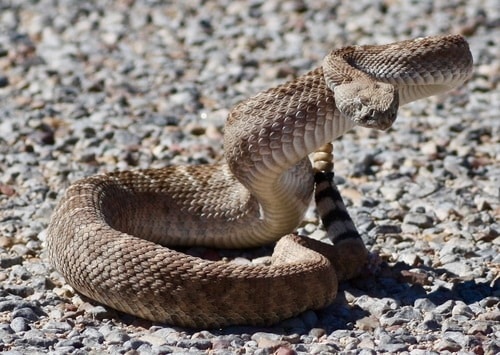
This species tends to provide a warning strike first, as shown above. But vipers are unpredictable, and sometimes skip warnings altogether, particularly while basking in the sun (as they hate being disturbed).
Just remember that the photograph above wasn’t generated by AI, but taken by a very brave person, though whether they survived is debateable. It’s possible that their camera was washed into a creek following a summer downpour, and was only grabbed and processed downstream.
Luckily, western diamondbacks combine a 1.5-2 metre length (record 233.7cm) with a thick body that makes them hard to miss. They’re doubly impossible to avoid if their neck is raised in mid-air and their body thrown into an S-shaped coil, contorted at bizarre angles.
| 3 | Brown tree snake |
Maximum length: 3 metres.
The world’s most infamous invasive snake. Brown tree snakes are native to northern Australia and New Guinea, but invaded the Pacific island of Guam sometime in the mid-20th century, where they’ve now reached populations of over 2 million, and 13,000-30,000 per square mile.
The main damaging effect has been on the birds, with 10/12 native forest species going extinct, resulting in a deathly silent forest, and an abundance of spider’s webs due to the lack of predators. But it isn’t fun for Guam’s locals either. Their lives now involve stepping over endless snakes, creeping past them while they cling to walls, and looking up constantly to ensure that a brown tree snake isn’t about to fall on their heads. The island of Guam only measures 10km by 50km, and this species has infested every corner.
Brown tree snakes have no fatalities to their name, yet have an aggressive personality. Invade their space, and they will make vicious lunges, which are usually bluff strikes, but can become real.
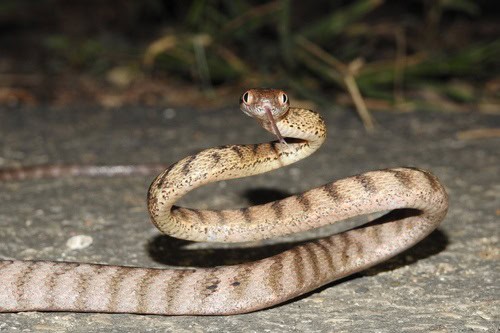
With its bulging eyes, sticking sideways off its head like a frog, this snake has a particularly demented appearance while attacking. The photo above shows a brown tree snake readying itself for such an assault. Unlike a rattlesnake, its head is raised above its body while preparing to strike. Its body is coiled tight to enable a springing motion, and this can achieve great lengths, considering that brown tree snakes regularly exceed 2 metres on Guam.
| 4 | Sri Lankan pitviper |
Maximum length: 130cm.
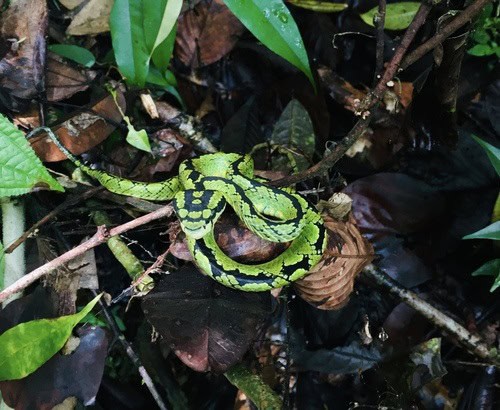
This photo is slightly less alarming, yet all the more dangerous for it. The image above shows a Sri Lankan pitviper (Craspedocephalus trigonocephalus), a venomous species endemic to the island nation, found nowhere else on Earth.
The snake is relatively thin, and while trying its best to look intimidating, it can’t match the fear factor of a rattlesnake. But this is where the danger lies, because this forest dweller is much less likely to be seen, both due to its smaller size, and its superior camouflage against the juicy jungle foliage.
This pitviper is on the forest floor, and most explorers would walk past obliviously in a swarming, humid, chirping, cackling jungle. It’s easy to miss one small pitviper, even when it has already identified you as a mortal threat, and thrown itself into an aggressive display. You could walk on and never understand how close you came, or alternatively, you might wait to admire a rainforest waterfall for just a moment too long, and feel sharp viper fangs sink into your ankle.
The image above shows a typical viper posture: a sudden coil of the back, neck and chest, with a particularly sharp kink around the neck, in order to face its predator head on. To a snake, facing your opponent head on is designed to show fearlessness, just as with humans. Many snakes that refuse to fight will hide their heads in their coils to protect their brain.
| 5 | Indian cobra |
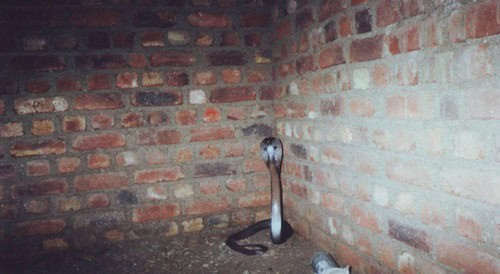
Maximum length: 2.2 metres.
Naja naja is India’s main cobra, and inhabits virtually the entire country, excluding sand deserts and rainforests. We don’t know what the story behind this photo is. Maybe smoking teenagers headed to their usual abandoned building hangout, before finding that someone else had discovered it. Maybe a travelling Indian mystic took shelter one night, and woke up the next morning to find a new friend (which he may have taken as a sign).
What we do know is that the cobra is agitated, and performing the species’ classic threat display, which often appears just seconds before a lethal strike. The Indian cobra is clearly backed into a corner with nowhere to escape to. It has made the completely logical decision to attack, and has reared the upper third of its body up, with its neck vertebrae flaring outwards to create a terrifying hood.
Indian cobras provide victims with a grace period where they flare their necks, but hold off on attacking for a brief moment. This gives their enemies a chance to back off, as despite their lethal venom, Indian cobras would rather not engage at all.
Flight is the preferred choice of this species, but if trapped in a concrete building, that may not be possible. While the photo above shows an India cobra’s classic defensive posture, there’s little difference between offense and defence for this species.
| 6 | Black-tailed rattlesnake |
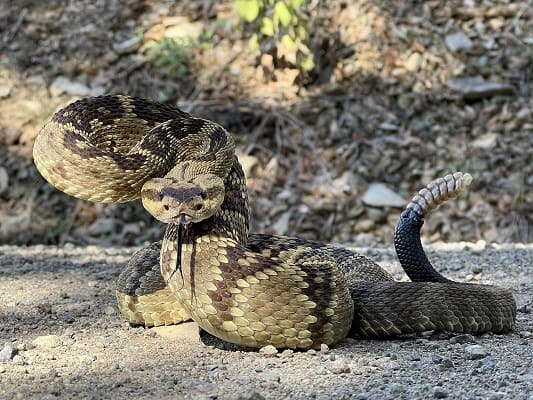
Maximum length: 152.4cm.
A species of rocky desert slopes, which usually lives far from towns and cities. The black-tailed rattlesnake is a species that few ordinary citizens encounter, but you don’t need to be a genius to run away when you see one doing this.
The black-tailed rattlesnake (Crotalus molossus) is a species of Arizona and New Mexico, as well as a swathe of Mexico to the south. Like most rattlesnakes, it has a memorable strike posture, coiling its body into a semi S-shape before unleashing a powerful lunge. The area just below its neck is kept at the highest point, with its head and face kept slightly lower.
At the neck itself, there’s a sharp kink, so that its intimidating viper face directly faces the opponent. The goal is to be coiled up like a spring, creating maximum muscular tension, so that when it finally releases, it lunges forward with lightning speed. The speed of this strike couldn’t be more different to the species’ often sluggish everyday movements.
While preparing to strike, the black-tailed rattlesnake will also loll out its oily black tongue. Mothers of this species have been spotted defending their young, advancing viciously on a human near Tucson, Arizona who strayed too close to a pile of rocks where her newborns were secretly stashed.
This species is easy to identify, as no other US rattlesnake has such a clearly darkening tail. Great times to identify this tail include while sitting on a picnic bench, while the rattlesnake is reared up in attack posture, while it’s flying through the air majestically, and strangely getting larger and larger.
| 7 | Mount Kenya bush viper |
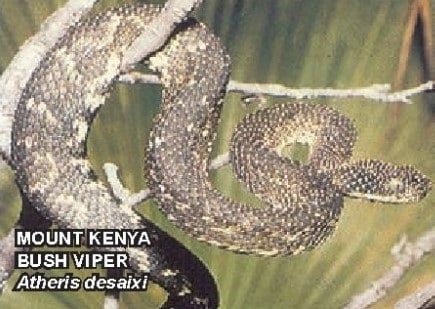
Maximum length: 70cm.
The Mount Kenya bush viper (Atheris desaixi) is a dangerously venomous species which is found only in a narrow area of southwest Kenya. Barely anything is known about this rare, branch-dwelling viper. Its entire purpose in life seems to be preventing tourists from ascending the slopes of Mount Kenya, acting as a guardian in the lower forested sections, ensuring that nobody penetrates the first wall of defences.
The only known habitats of this viper are the southeastern slopes of Mount Kenya, and the forested Nyambeni Hills not far away. The photo above shows a typical posture for the Atheris viper genus – coiled up on its tree, retracting its neck and head, with its lower body securely fastened around a branch in order to prevent itself from plummeting to the ground during its explosive lunge. The photo above was taken by the US army, and is one of the few to exist of Atheris desaixi.
The Mount Kenya bush viper is believed to have a haemorrhagic venom, but other members of the Atheris viper clan are equipped with neurotoxins. Regardless, if you see one coiled up like a spring such as above, you should turn around and find a new way to the summit.
| 8 | Collared catsnake |
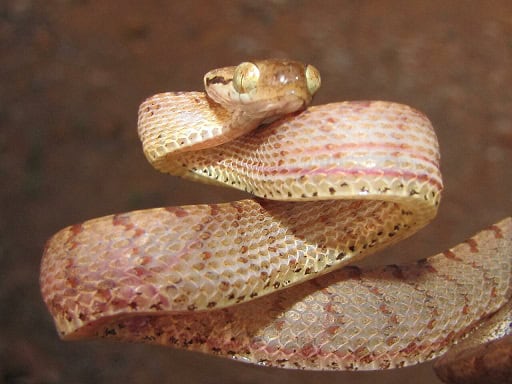
Maximum length: 120cm.
A mildly venomous species with a sharp bite, which lives exclusively in the Western Ghats mountain range of southwest India. Collared catsnakes (Boiga nuchalis) prey on lizards, plus a dose of treefrogs and geckos, and move by night, usually staying above ground on tree branches.
Maybe it’s just us, but this snake is far less intimidating than its Boiga cousin, the brown tree snake. Something about its overly enormous eyes and silly facial expression just isn’t frightening at all.
It’s like the collared catsnake is barely convinced itself, knowing that it can’t compete with its cousin for sheer intimidation, and is just going through the motions with a sigh. Huge eyes with vertical pupils are intimidating according to nature’s rulebook, but this species tips way too far into cartoonish territory.
On Wikimedia, this image is labelled as a Ceylon catsnake, but upon closer inspection, the image is mislabeled. The photo is from Kerala, India, but as of 2024, Ceylon catsnakes are deemed to live exclusively on Sri Lanka. The collared catsnake is the species found closest to where the photo is taken (Payyanur), and easily has the closest resembling patterns. Thackeray’s catsnake also lives nearby, but tends to have thicker, darker markings.
| 9 | Radiated ratsnake |
Maximum length: 230cm.
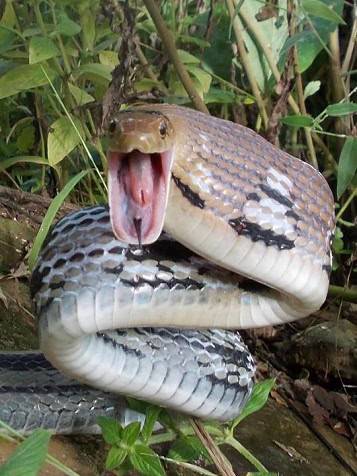
This is a much more focussed and serious-looking species than the mysterious catsnake above. In fact, the copper-headed trinket snake might have the most vicious, demented-looking strike posture of any non-venomous snake in Thailand.
Worse, this snake isn’t bluffing. Its mouth is bared wide, and yes, it might bite you. It’s coiled tightly like a spring, and yes, it might unload on you, striking within milliseconds.
The copper-headed trinket snake (Coelognathus radiatus) resides in Thailand, Cambodia and Vietnam, where it’s a relatively common snake. While non-venomous, this is a ferocious species in general. Copper-headed trinket snakes can blast into the undergrowth at exceptionally high speeds, disappearing the second you loosen your grip. They have vicious, tearing fangs, which they wield expertly, and are more than capable of drawing blood.
While copper-headed trinket snakes lack venom and cannot kill you, they mean everything they imply with their terrifying threat display. Part of their defensive repertoire is spreading their scales to reveal bright white skin underneath, which is visible above. Supposedly, Coelognathus radiatus is able to enlarge its neck vertically, instead of horizontally like a cobra. This species often exceeds 2 metres, and moves primarily by day.
| 10 | Prairie rattlesnake |
Maximum length: 151.5cm.
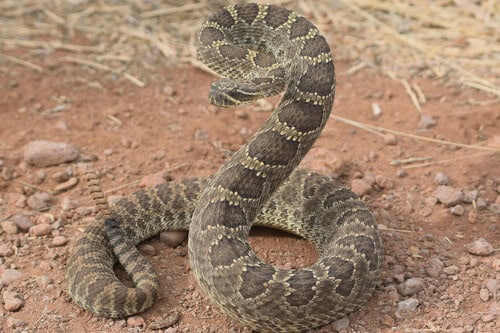
For our final photo, we return to the Crotalus rattlesnake genus. This species has two main danger factors to consider. Firstly, the prairie rattlesnake lives in sweeping prairie hills amid long dry grasses, which it blends into perfectly using its brown-beige camouflage, making it very difficult to spot. Yet living in such open spaces also makes this species easier to spot compared to if it inhabited jumbled rock fields (like the rock rattlesnake).
Prairie rattlesnakes are particularly common in Colorado, New Mexico and Wyoming. They’re middling in length for the rattlesnake clan, with an all-time record of 151.5cm.
This species uses the classic rattlesnake threat display, with its head held lower than the upper back, and a sharp kink in the neck at the last moment, allowing it to face the enemy head-on. It’s not unique, but just as terrifying as ever.
If you see a prairie rattlesnake performing this action, then don’t stare in wonder – run over the Great Plains as far and as fast as you can. If you’re lucky, the rattlesnake will shake its tail loudly before you ever get close. Throwing its body high into the air is also easier to spot compared to if it kept close to the ground – in fact, that’s the prairie rattlesnake’s whole idea.