
| 1 | Mexico City: Lined Tolucan ground snake |
Country: Mexico.
Population: 9,210,000 (city), 22,505,000 (metro).
Elevation: 2240 metres.
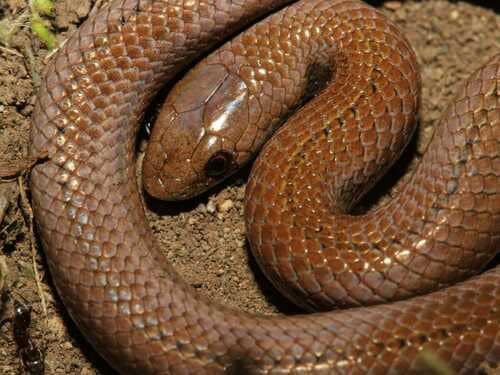
A harmless snake which is easily the most common species near Mexico City, despite few having heard of them. Lined Tolucan ground snakes (Conopsis lineata) are found in pine and oak forests and nearly always below debris, rotting logs and vegetation. Their confirmed prey includes spiders, grasshoppers and termites.
The Conopsis genus has 6 members, and at an average of 21.5cm, this is the smallest member. Yet size is not all, as Conopsis lineata has managed to completely take over Mexico City. This species has concentrated its efforts in one place, as lined Tolucan ground snakes are not only endemic to Mexico, but found nowhere outside of a small region in southern Mexico surrounding the capital, where they’ve multiplied to great numbers.
When viewed on a map, it’s almost like this snake is defending the city from invaders to the north. Yet there’s little it can do. With no venom and no sharp, ripping fangs, the lined Tolucan ground snake would be brushed aside instantly by any Mexican cantils or rattlers that decided to invade. Luckily, this means that it’s a perfectly safe species to pick up.
Lined Tolucan ground snakes can be tricky to recognise, as they vary in colour from beige to yellowish to grey. However, they nearly always have 3 to 5 thin lines covering their body lengthways. Their belly is usually yellow and free from markings.
| 2 | Canberra: eastern brown snake |
Country: Australia.
Population: 480,000 (metro area).
Elevation: 580 metres.
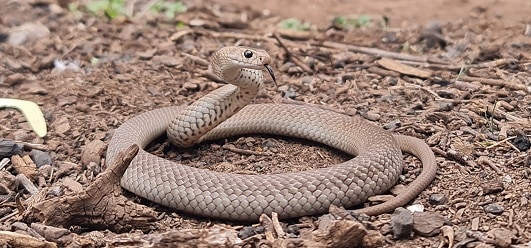
Australia’s capital city has a most common snake far less peaceful: the eastern brown snake, AKA Pseudonaja textilis, perhaps the Australian species responsible for the most venomous snakebites. Eastern brown snakes are comfortable on garden tiles, park picnic benches, alleyways with crisp packets strewn everywhere, tarmac roads, holes in concrete under bridges, etc.
In other words, city life is no obstacle for this killer snake, whether it’s Sydney or Melbourne. Canberra lies at the heart of their range, and any long term resident would be incredibly lucky not to meet one at all. It’s actually believed that urbanisation has made eastern brown snakes more common in Australia.
Eastern brown snakes are fast, whippy and willing to attack humans, although as this video shows, an expertly timed kick to the face can cause them to reverse and flee into the undergrowth (we don’t actually recommend this). They average at 1.5 metres, are relatively thin, have round pupils, and have very few patterns on top of their brownness.
Eastern brown snakes eat a mixture of mammals and reptiles. They’re preyed on by various birds like wedge-tailed eagles, brown falcons, silver gulls, and white ibis, so it’s possible that one will be carried off the moment it’s about to get you, after cornering you in an alleyway.
| 3 | Tokyo: Japanese ratsnake |
Country: Japan.
Population: 14 million (city), 37,115,000 (metro).
Elevation: 40 metres.
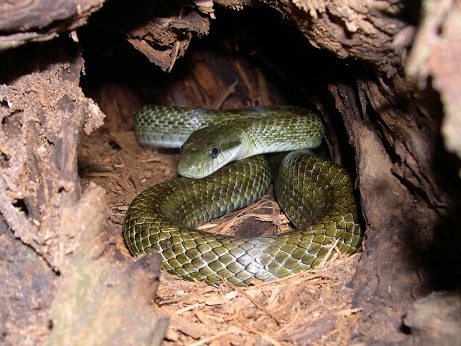
The Japanese ratsnake (Elaphe climacophora) is probably the most common snake in Japan overall, and Tokyo is no exception. Japanese ratsnakes are mostly harmless to humans; they can turn aggressive at times, but lack any form of venom, even a mildly venomous saliva.
Japanese ratsnakes are surrounded by superstition, as there’s a rare pure white form dubbed Shirohebi, believed to be a representative of the goddess Benzaiten. These white individuals even have a full temple devoted to them, attached to a breeding centre and gift shop. However, there’s plenty of normal Japanese ratsnakes near Tokyo. These are greenish with hints of mud, and reach lengths of 1.8 metres.
Japanese ratsnakes are likely to appear in sparse woods, fields and by rivers, yet they’re sometimes spotted even within urbanised areas of Tokyo, as long as some form of remnant grass exists. Climbing bridges, railings, and navigating pavements is no challenge for this nimble snake.
Japanese ratsnakes often prey on eggs, swallowing them whole and cracking them open using their spine, sometimes so loudly that it makes an audible crack. Only adult Japanese ratsnakes are able to eat eggs, as in younglings, the hypapophyses of their spinal column aren’t sharp or developed enough.
| 4 | Nairobi: Battersby’s green snake |
Country: Kenya.
Population: 5,541,000 (metro).
Elevation: 1795 metres.
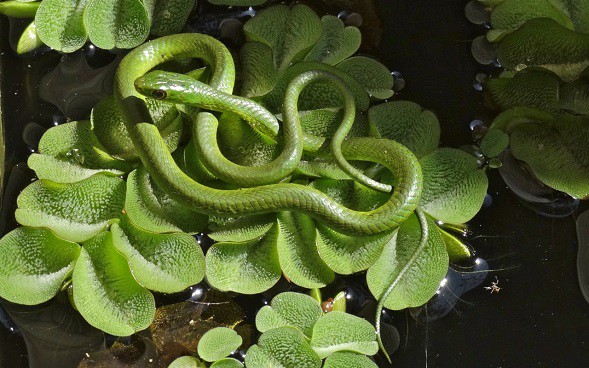
The most common snake in Kenya’s capital isn’t a brutish puff adder, or deadly cobra, but a humble watersnake: Battersby’s green snake (Philothamnus battersbyi). This species is non-venomous and measures up to 90cm. It also appears in Ethiopia and northern Tanzania, but its real heartland is southwest Kenya, including Nairobi itself.
Battersby’s green snake is extremely tolerant of urbanisation. It’s even found in polluted streams within cities, similarly to the northern watersnake of the USA. Hence, it’s perhaps the most common snake found in Nairobi.
Battersby’s green snakes can be extremely difficult to spot. Sometimes, they randomly climb branches for no obvious reason, perhaps to sun themselves. When surrounded by greenery and swampside vegetation, their green colours blend in perfectly. Their scales have subtle white edges, and this improves their camouflage further, by mimicking condensation and any reflective drops of water on the greenery.
Battersby’s green snakes are fairly safe to pick up, if you wish to remove one from your Nairobi garden, but they can suddenly turn vicious and unleash a pair of sharp (though non-venomous) teeth against your skin. Luckily, there’s no reason to remove this species, unless you have a family of pet frogs in your pond. Confirmed prey of this snake include reed frogs of the Hyperolius genus.
| 5 | Bogotá – thickhead ground snake |
Country: Colombia.
Population: 11,658,000 (metro).
Elevation: 2625 metres.
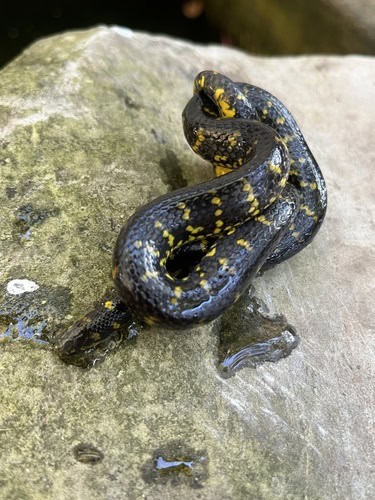
Colombia hosts vicious fer-de-lances and neurotoxic coral snakes which could freeze your heart at their mere sight. Yet the most common near the capital Bogotá is easily the harmless thickhead ground snake (Atractus crassicaudatus), which measures 40-44cm.
Being small, thickhead ground snakes mainly prey on small grubs like earthworms. This is a species which you can easily pick up without meeting a grisly demise. Within Bogotá, and the surrounding hills, thickhead ground snakes are most often found in grassy areas close to human settlements. They often lurk under limestone rocks, in areas rich with organic matter. Ripping up these rocks is the best way to find them.
Once you find them, thickhead ground snakes are easy to recognise, with their mostly night black scales overlaid with yellow markings. Sometimes, the yellow forms encircling bands, while others have messier yellow spots. In fact, the thickhead ground snake sometimes resembles a miniature yellow anaconda, although the two live thousands of miles from each other.
| 6 | San José: banded coffee snake |
Country: Costa Rica.
Population: 1,480,000 (city).
Elevation: 1172 metres.
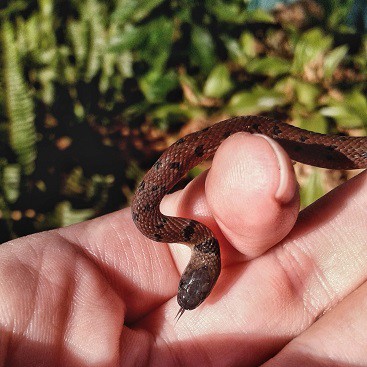
If you’re planning to visit Costa Rica’s capital San José, then bad news: the place is infested with snakes. The good news is that they’re harmless banded coffee snakes (Ninia maculata), which are incapable of hurting humans. These are often found hiding under logs, lurking in people’s backgardens, and have a tendency to curl up in the palm of your hand when picked up.
Banded coffee snakes are found only in Central America, not South America. They range from Honduras to Panama, and San José lies almost at the epicentre of their range. They have a presence in Panama City too, but the numbers can’t compare to in San José, where they just beat Hoffman’s earth snake as the most common local serpent.
Banded coffee snakes reach a maximum of 35cm. They usually have a chocolatey brown base, overlaid with thin black bands, and always a black neck collar. Skills they lack include a pulsating venom that causes your blood vessels to burst and neurotransmitters to cease functioning. Skills they have include a neck they can widen for intimidation, and an acting repertoire which allows them to flip over, loll out their tongue and play dead.
| 7 | Pretoria: Cape house snake |
Country: South Africa.
Population: 2,890,000 (metro).
Elevation: 1339 metres.
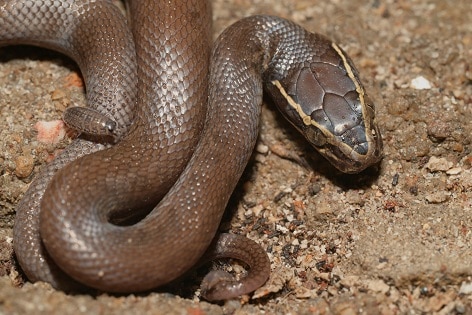
Technically, South Africa has two capitals, as Cape Town is the legislative capital. However, Pretoria is generally considered to be the true capital, as it’s where the administration is based. Here, the most common snake is the humble Cape house snake (Boaedon capensis), even though the egg-eating snake (Dasypeltis scabra) gives them a run for their money.
Cape house snakes are easy to recognise by two pale lines on either side of their head, and large bulging eyes. As the picture above shows, the lines often form a triangle from a bird’s eye view.
Cape house snakes have an extremely flexible diet, and highly flexible habitats. They feed on mammals, reptiles and birds; they dwell in forests, fields, and back gardens. This toughness is why they can roam the streets of Pretoria freely, with more flexibility than even a Mozambique spitting cobra.
Cape house snakes are harmless and have sharply vertical pupils. They’re also one of the most widespread species in southern Africa overall. Meanwhile, the most common snake in Cape Town is the common slug-eater (Duberria lutrix), another completely harmless species. Cape house snakes are extremely common here too.
| 8 | Panama City: rhombic cat-eyed snake |
Country: Panama.
Population: 2,016,000 (metro).
Elevation: 50 metres.
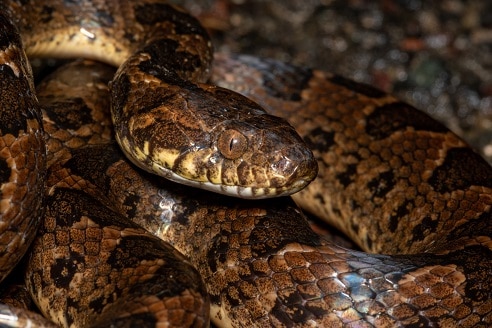
If you’re in Panama City on business or pleasure, and you see a dark brown snake with vertical pupils, overlaid with even darker blotches, measuring approximately 60-90cm, there’s a high chance that you’ve just seen the rhombic cat-eyed snake (Leptodeira rhombifera). This is the most frequently sighted snake in the city, though there may be armies of underground blind snakes which nobody ever sees.
Rhombic cat-eyed snakes live in Central America exclusively, ranging from Guatemala through Costa Rica to Panama. They possess a mild venom, which isn’t anything to be terrified of, but once caused noticeable symptoms when an 88cm snake bit a boy on the hand.
This species looks duller from a distance, but has incredibly detailed patterns up close, with endless speckles and fine colourful lines. In an untouched world, rhombic cat-eyed snakes would inhabit dry tropical and humid forests, yet they’ve coped well with the sudden emergence of Panama City 500 years ago (founded August 15th 1519).
Rhombic cat-eyed snakes are very flexible. They can dwell on branches, move along the forest floor, through back gardens, and invade artificial ponds in search of frogs. Drainage ditches are another hunting arena they enjoy.
Their confirmed prey within Panama include túngara frogs (Engystomops pustulosus) and Rosenberg’s treefrogs (Hypsiboas rosenbergi). In fact, they were once found to be the main predator of Rosenberg’s treefrog during its breeding season, so there’s plenty of creatures which fear this snake. Luckily, you don’t have to be one of them.
| 9 | Rome: green whipsnake |
Country: Italy.
Population: 4,332,000 (metro).
Elevation: 30 metres.
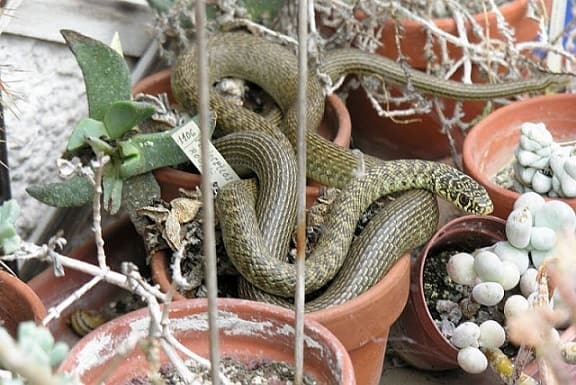
Rome is home to several snakes, but there’s no doubt about which the most common is, unless there’s a secret civilisation of giant vipers living in the ancient underground Roman catacombs. The most common species here is undoubtedly the green whipsnake, a 1.5-2 metre creature which copes very well with human-altered habitats. In Rome, green whipsnakes can appear in parks, streets, alleyways, gardens, plant pots – even inside your house.
Green whipsnakes are fast-moving and flexible in their dietary preferences. They have savage, ripping teeth, which they’ll use to relentlessly assault your arm if you dare to pick them up.
Originally, they were assumed to be mostly non-venomous, just aggressive. But it recently turned out that secretions from their Duvernoy’s gland (via rear fangs) are way stronger than once thought.
In one report, a drunken man wrapped a green whipsnake around his neck like a necklace, was bitten repeatedly, and 30 minutes later experienced a wave of dizziness and muscle weakness. Green whipsnakes mainly move during the day, and another of their characteristics is a high tolerance for hot temperatures.
| 10 | Jakarta: painted bronzeback |
Country: Indonesia.
Population: 11,436,000 (metropolitan).
Elevation: 8 metres.
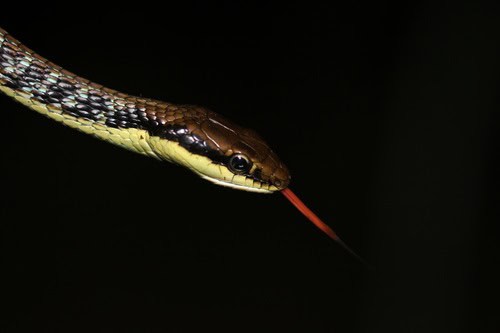
On the streets of Jakarta, you’re highly likely to see a fast, twitchy snake staring at you from a tree branch, only to vanish into the roadside undergrowth seconds later. This is the painted bronzeback (Dendrelaphis pictus), which is abundant all over southeast Asia, and is also the most common snake in Hong Kong.
Painted bronzebacks measure 100cm and only have a mild venom. They have a high metabolism, and will feed every 3-7 days if they get the chance, unlike the anacondas, which can go over a year without eating if they swallow down a deer.
Painted bronzebacks prey on Asian rice frogs, copper-cheeked frogs, and white lip frogs. They sometimes find themselves in the stomachs of mangrove catsnakes, and on Java, the Javan spitting cobra, which is occasionally found in the streets of Jakarta itself.
There is one other bronzeback you might see in the Jakarta region: Underwood’s bronzeback (Dendrelaphis underwoodi). This has a similar temperament, but has far brighter colours overall, and its belly tends to be greener rather than pale beige. Like the painted bronzeback, Underwood’s bronzebacks have electric blue patches visible occasionally. Underwood’s bronzebacks are much less common than their cousin, so the odds are high that it’s a painted bronzeback you’ve just found.