
| 1 | Green mamba |
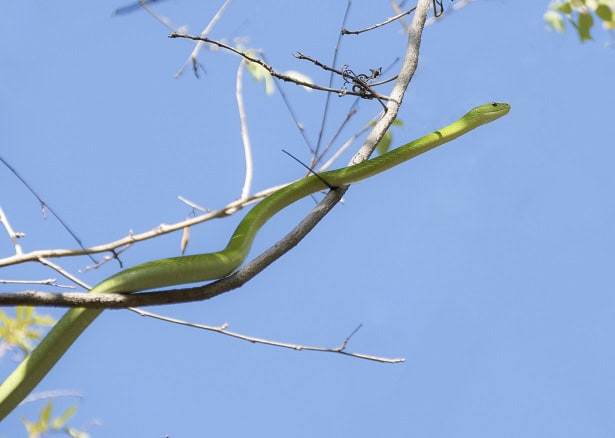
Maximum length: 230cm (at least).
The cousin of the infamous black mamba, which is significantly less common, but still generates a huge quotient of fear wherever it lives. Green mambas are found in eastern South Africa, Mozambique, Tanzania and Kenya, where they generally appear in forests and woodlands close to the coasts.
The main difference of the green mamba to its cousin, except its appearance, is in its tendency to live in trees. Green mambas are capable of venturing to the ground, but spend virtually all their lives on branches.
To enable this lifestyle, they have excellent climbing skills, combining a light weight with an innate sense of agility and balance. The green mamba can ascend trees to levels that a human being or even chimpanzee couldn’t dream of.
Green mambas are perfectly at home in thick green bushes, spookier, Halloween-style branches with no leaves, and the flimsy upper reaches of trees, which grant them a superior view of the surrounding area. Exactly whether they can use this view is unknown – it’s mysterious whether green mambas can spot scientists coming at a distance, or tourists, or even a small rat preparing to climb their tree. One clue is that their cousin the black mamba has super eyesight, and is even known to flee when humans are over 10 metres away.
| 2 | Black mamba |
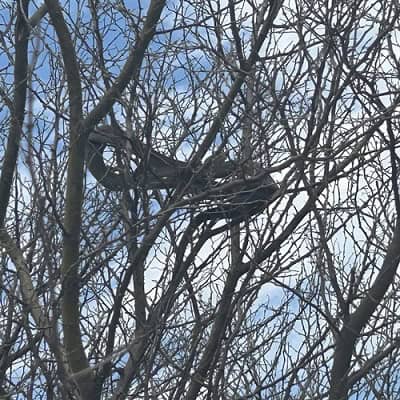
Maximum length: 4.25 metres.
Despite the black mamba being a more ground-dwelling species than its cousin, it’s still more than capable of climbing trees if necessary. Its diet consists of 81% mammals and 15% birds according to one study – not an essential part of its menu, but important enough that black mambas regularly ascend high into the treetops.
Black mambas are just as dangerous as their reputation, with a neurotoxic venom capable of paralysing your entire body within hours, or less. They appear across a wide range in southern Africa, from South Africa to Kenya to Botswana.
There’s no direction where black mambas can’t appear – downwards in a burrow, forwards in a bush, or upwards in a tall tree. This raises the nightmarish, but all-too-real prospect of a black mamba landing on your head, or if you get lucky, bouncing off your hat and falling to the ground.
A crazy myth revolves around the black mamba’s tree-climbing tendencies – that walking through a forest with a bowl of porridge strapped to your head will protect you. This is popular in local African villages, and supposedly, the mamba will die the moment it touches the porridge.
| 3 | Green watersnake |
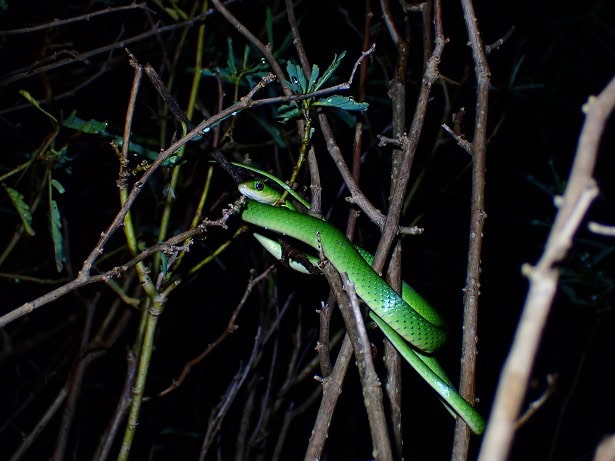
Maximum length: 96cm.
A much safer species than our first two entrants. The green watersnake (Philothamnus hoplogaster) has a very mild venom, which is mainly capable of subduing small frogs, its main prey. Green watersnakes are found in the eastern half of South Africa, where they’re fairly common. They also appear in Kenya, Tanzania, and Zimbabwe to the north.
This is one of the snakes in South Africa which most effectively combines tree-climbing and an aquatic lifestyle. Despite being a pond lover, this species can climb high in trees, winding around the fragile branches centimetre by centimetre until suddenly, it’s several metres above ground. The one caveat is that green watersnakes always appear in trees where water is close by, and nearly always in moist, leafy trees, rather than the parched trees an African rock python might leap out of.
Fortunately, this is a completely harmless species. The green watersnake might shock you if it fell into your arms as you walked past a woodland pond, but you wouldn’t be in any actual danger.
| 4 | Cape cobra |
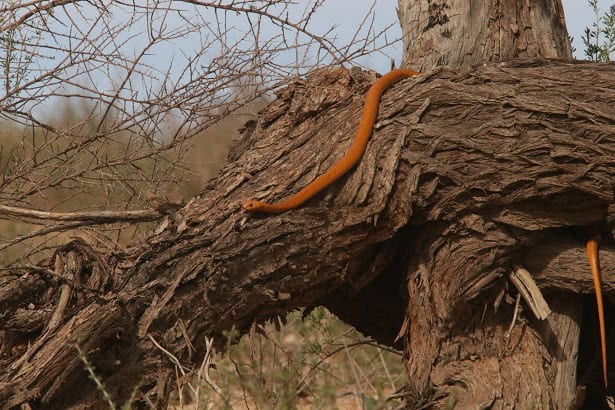
Maximum length: 231cm.
The most aggressive cobra in southern Africa, and one of the most resistant snakes to hot conditions. This species appears in the savannah at burning midday when most other snakes are hiding in cool burrows.
Like the black mamba, cape cobras aren’t restricted to trees, but climb them effortlessly if scent particle trails draw them upwards. Their venom is heavily neurotoxic, and more than capable of killing human beings. This is a dangerous species to encounter, but is variable in appearance and possibly difficult to recognise. Bright orange-yellow is one version, as visible above.
Tree-climbing isn’t just a fun sideshow for the cape cobra, but a vital part of its hunting repertoire. This species is an efficient nest raider, weaving high up trees in order to snatch nestling and even adult birds from their sanctuaries.
One of their confirmed bird prey is the sociable weaver, a species which makes its nests on the undersides of trees, to protect their entrances using the perils of gravity. But the cape cobra is able to enter these upside-down entrances, and snatch the nestlings from within. It’s likely that they fail a large portion of the time as well, as mother birds return with a furious flapping of feathers.
| 5 | Southern vine snake |
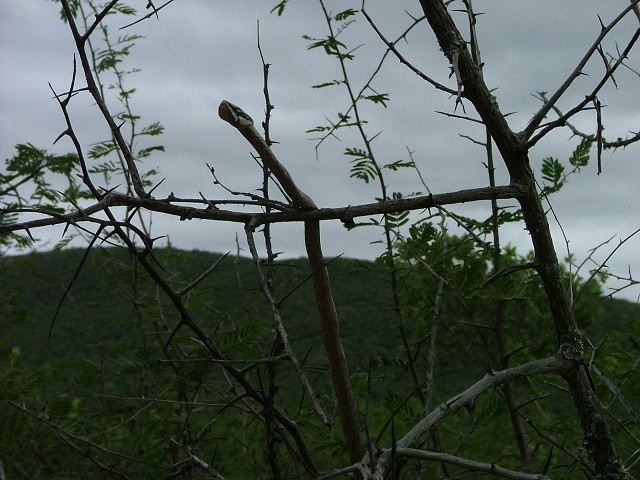
Maximum length: 168cm.
The southern vine snake is one of the undisputed tree masters of southeast Africa, appearing in trees from eastern South Africa to Zimbabwe, Tanzania and Kenya. This is a moderately venomous species, which has caused 2 confirmed deaths on record. It also has an intimating bonus ability of inflating its throat grotesquely, adding to its overall size and general fear factor.
The southern vine snake eats meals such as frogs and bulky chameleons, many of which seem barely able to fit into its mouth. This species climbs trees so effortlessly that they might as well not exist. It’s almost like the tree trunks this species moves up have a gravitational pull of their own, but they don’t, as the real answer is this species’ light weight, and its immense sense of agility and balance, which is ingrained into its serpent brain from birth.
Camouflage is another key to this species’ success, as the southern vine snake possesses both leafy green and tree bark brown scales, which allow it to blend with both areas of trees with ease. The head of the snake is recognisable in the snake above, but below the first horizontal branch, the vertical section of its body is barely distinguishable from the vertical branch to the right.
| 6 | Nosy Komba ground boa |
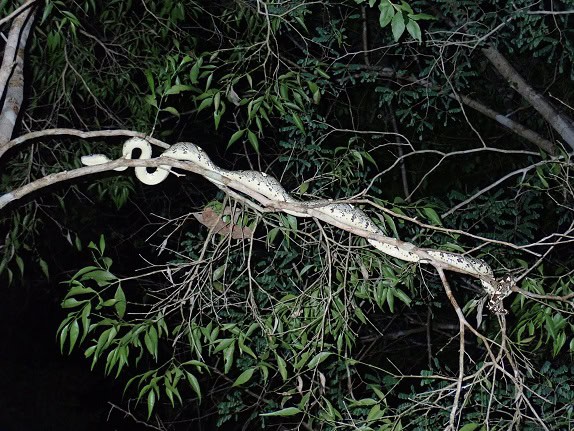
Maximum length: 158cm.
One of the 4 large boas found on Madagascar. The Nosy Komba ground boa appears in all regions of Madagascar, from north to south to east to west.
This species isn’t nosy, nor does it have a large nose. Nosy Komba is a small island off the northern coast of Madagascar, separated from the main island by a channel 2.5 miles wide. The name is actually misleading, as Nosy Komba ground boas appear all over the mainland. The ground boa name is equally confusing, as this species spends plenty of time on tree branches as well.
While this species lacks any venom, and is non-aggressive towards humans, it has the great skill of climbing tree branches with ease, moving steadily upwards, and coiling around thinner branches in order to gain support and balance (see above).
This species was originally confused with the Madagascan tree boa, but identified as independent in 2004. The two are the only surviving members of the Sanzinia genus, with other boas on Madagascar belonging to the Acrantophis genus, e.g. the huge, crushing Dumeril’s boa, which is much poorer at climbing trees.
| 7 | Southern African rock python |
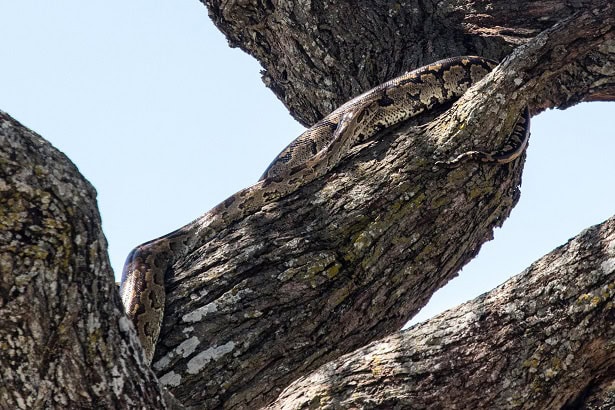
Maximum length: around 6 metres.
The longest snake in South Africa, Zimbabwe, Mozambique, and more. The southern African rock python is the southerly equivalent of the central African rock python, and is essentially the same in terms of behaviour, with only genetics and minor pattern differences leading to separation.
African rock pythons measure up to 6 metres and are fairly thick-bodied as well, not light and thin like the Haitian vine boa further west. Despite this, they ascend thick tree trunks relatively easily, as proven by many images. This is mainly a ground-dwelling species, unlike the southern vine snake, but African rock pythons are perfectly comfortable in trees, albeit fairly careful and methodical as they climb, rather than instantly zooming upwards.
Rock pythons are widespread across sub-Saharan Africa, and their ability to venture to most locations is partly behind it. The can slither through fields on the ground, enter dark aardvark burrows and eat any mammals inside. Alternatively, they can venture up tree trunks to see what a distant birds’ nest has to offer. This species has even been spotted 1000 metres up a cliff, with no explanation of how it got there – see here.
| 8 | Spotted watersnake |
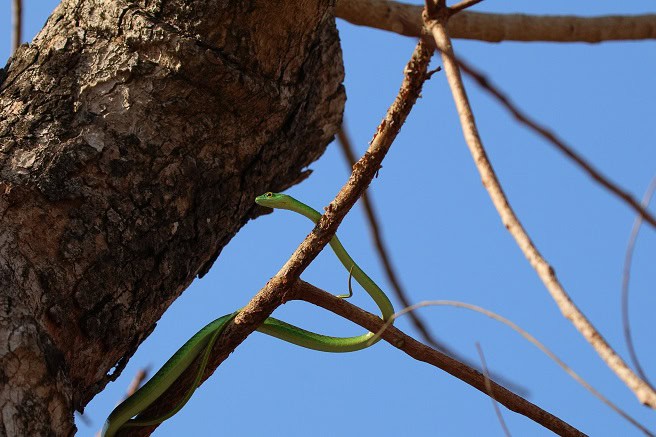
Maximum length: 120cm.
A cousin of the green watersnake, and a similarly excellent tree climber. Like its cousin, this species is commonly found in ponds, or in overgrown vegetation near ponds. Likewise, it commonly climbs up trees nearby as well, and it apparently does so with little effort at all.
Spotted watersnakes (Philothamnus punctatus) are most common in northeast Tanzania and southeast Kenya. They pose no threat to the local human population, and can move quickly if pushed, darting away from threats rather than confronting them head on.
This species is recognisable by a large eye, and a green body overlaid with multiple tiny dark speckles. From below, its underside is greenish-yellow, and always slightly paler than the main body. This extends to the chin as well. This species could be confused with the green mamba, a much more sinister tree-dweller, but the latter has a plainer green body.
Another physical feature of this snake is a long tail, measuring up to 37% of total body length. This is a classic feature in many tree-climbing snakes, contributing extra balance and dexterity, which are essential for navigating the thinnest, most spindly branches of the upper canopies.
| 9 | Boomslang |
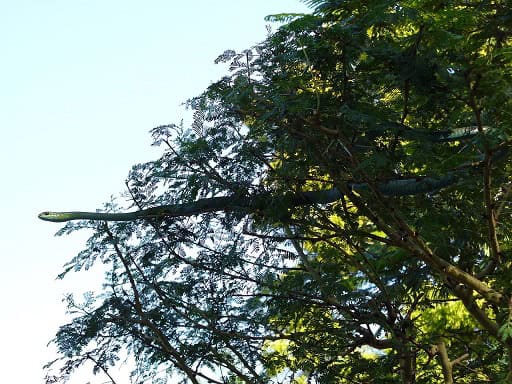
Maximum length: 2.1 metres.
One difference of sub-Saharan Africa to southeast Asia is that the latter has far more venomous tree-dwelling snakes. Africa tends to have more on the ground, but there’s still a handful of lethal tree dwellers, and the boomslang ranks chief among them.
This species doesn’t just climb trees, it rules over them, causing African villagers to accelerate rapidly or back off completely at the mere sight of them. Boomslangs are common in eastern South Africa, Zimbabwe, Tanzania, Uganda and more, and cause a great deal of fear wherever they live.
The truth is that the boomslang has a highly haemorrhagic venom, causing spontaneous bleeding from the gums, nose and old cuts. However, it causes fewer deaths than its reputation would suggest, and is relatively non-aggressive, preferring to stay in trees. In any case, the boomslang is an incredible tree climber, suspending itself and even gaining height using impossibly thin branches. This species varies in colour, as some are leafy green, while others are parched brown, with both offering excellent camouflage.
| 10 | Marbled tree boa |
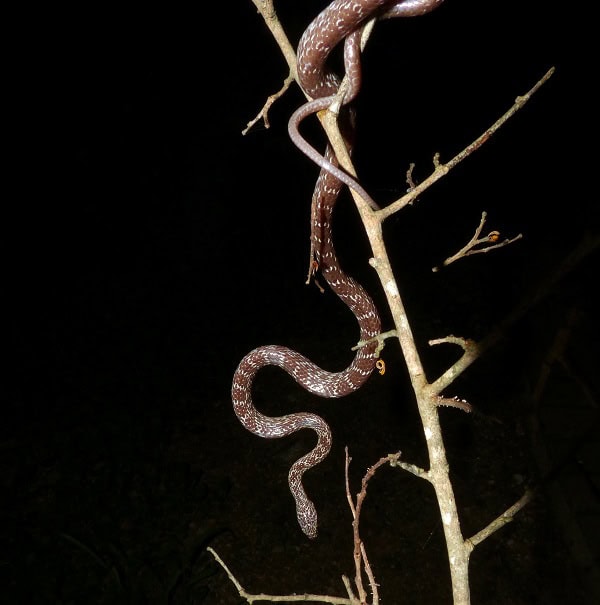
Maximum length: 85cm.
A species which poses no threat to humans, unless you pick one up, in which case this species occasionally bites humans, with little to no venomous symptoms. The marbled tree boa (Dipsadoboa aulica) has a fairly narrow range in southeast Africa, appearing in eastern South Africa, southern Mozambique and parts of Zimbabwe. But it can be numerous in certain areas, flourishing in relatively moist clumps of woodlands, and isolated remnant patches of trees near villages.
Rather than a clean brown or white or green, this species has patterns of rapidly alternating brown and white, with the brown almost being chocolatey in tone. This enables great disguise, not against leaves, but tree trunks, and it’s lucky that’s the case, as Dipsadoboa aulica spends a great deal of time ascending tree branches like a step ladder.
This species has great balance on higher branches, and great disguise against trees. The final piece of the puzzle is climbing, which the marbled tree boa achieves with ease. It also dangles from branches with ease, fixing itself in position using a prehensile tail, before plucking lizards (its main prey) off lower branches or the woodland floor.
| 11 | Emerald snake |
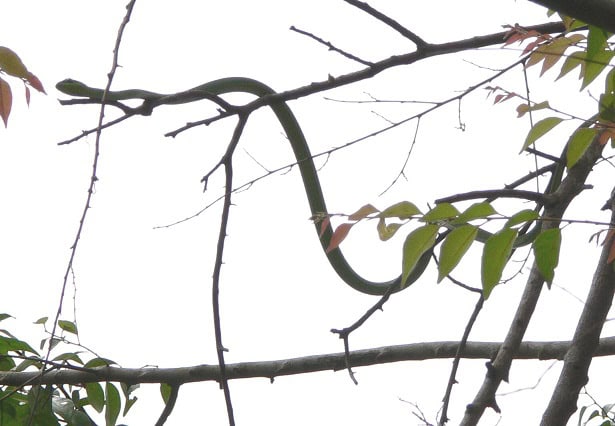
Maximum length: 119.1cm.
A forest-dwelling species of central and western Africa, appearing in around 20 countries from Uganda to Guinea-Bissau. This is a mildly venomous species which poses no threat to humanity, despite often living in villages near forests. Emerald snakes prey heavily on reptiles and frogs, mostly ignoring mammals.
Emerald snakes are excellent climbers, aided by a particularly thin body. While they don’t spend their entire lives in trees, sometimes preferring the safety of a low bush, they’re more than able to climb to the very tops of trees if the urge strikes. They also have particularly large eyes, and an extremely long tail.
Emerald snakes have great disguise against trees, blending into leafy greenery. But as the image above proves, they’re not completely shy, often taking risks and exposing themselves on bare branches. The emerald snake above is completely immune to humans, being too high for all but the lightest, most nimble circus acrobat. Even Simone Biles would probably fail to backflip that high. But a bird could be seconds away from swooping down and claiming a meal, perhaps a hungry snake eagle (a common snake predator group in Africa).