
| 1 | Alcatrazes lancehead |
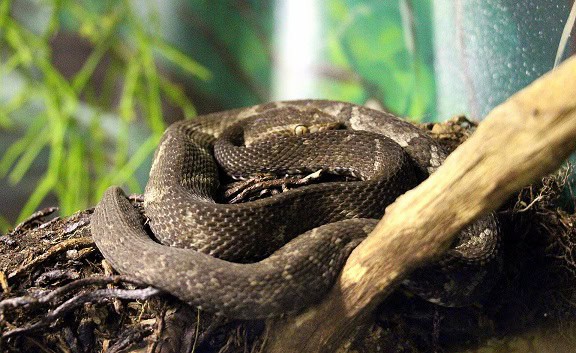
Maximum length: 50.5cm.
In southeast Brazil, the villages and woodlands are absolutely swarming with venomous jararacas. Travel southeast, and your next stop is São Paulo, the 4th largest city in the world, with a population of over 20 million. Next, we arrive at the Atlantic Ocean, at the stormy, lapping waves home to dolphins, schools of fish, and vessels trying desperately to stay afloat. Finally, we come to Alcatrazes Island, an isolated outcrop which looks appealing from a distance, but actually has just as many snakes as the cursed mainland.
Alcatrazes Island (not to be confused with Alcatraz in the US) is a small mass of land measuring 2.5 kilometres across, which has no human population. It’s home to a unique snake species found nowhere else in the world: the Alcatrazes lancehead (Bothrops alcatraz), which was only officially identified in 2002. This snake is closely related to the jararaca (Bothrops jararaca) on the mainland, but has diverged significantly, due its stranded circumstances.
The Alcatraz lancehead has an unusually small size, with a maximum of just 46.2cm in female and 50.5cm in males. Its eyes are unusually large, its head is longer, and it has a lower number of ventral (belly) scales, at 173–186, versus 197-218 for the jararaca.
Its diet is also unique, as unusually, Alcatrazes Island is completely devoid of mammals. Instead, the Alcatrazes lancehead is forced to feed on centipedes and cockroaches. Among the Bothrops pitviper genus (48 members), it’s the only species to feed mostly on ectothermic prey – most members feed heavily on mammals.
It’s believed that during previous ice ages, Alcatrazes Island was connected to mainland Brazil by a land bridge, allowing the ancestor snake to cross. What isn’t known is precisely when this occurred. It may have been 11,000 years ago, with the extreme pressure of food shortages causing a new species to emerge in a dramatically accelerated timeframe. Alternatively, it could have been during an earlier global temperature decrease, with a more gradual evolution.
Alcatrazes lanceheads are listed as endangered, partly due to their low area of land. Another threat was the Brazilian navy, who once used a portion of Alcatrazes Island’s cliffs as target practise. The venom of this species is rich in metalloproteinases, which can cause haemorrhaging by assaulting blood vessel walls, as well as local skin tissue damage (but not neurotoxic effects).
| 2 | Hetfield’s bush viper |
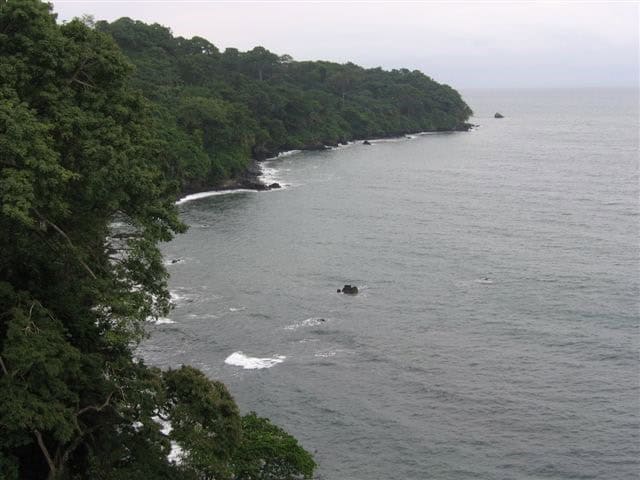
Maximum length: 52cm (so far).
Bioko is a lush paradise of an island which lies off the middle west coast of Africa, which was formed through the eruptions of now long-extinct volcanoes. It’s technically part of Equatorial Guinea, but lies much closer to Cameroon, appearing 20 miles south of the nearest coastline. Bioko is 43 miles long and 20 miles wide, which isn’t huge, but it still manages to pack in plenty of menacing creatures, one of which is Hetfield’s bush viper (Atheris hetfieldi).
This toxic species was only identified for the first time in 2020. The island is also home to the African bush viper (Atheris squamigera), part of the same Atheris genus, which also appears on the mainland. Consequently, it took time for Hetfield’s bush viper to be recognised as independent.
This species has physical features such as an olive-green colour, a black tip of the tail, and faint, repeating black bars on the body. Unlike many Atheris bush vipers, it lacks enlarged “eyelash” scales above each eye; these are a famous feature of the hairy bush viper over in Uganda.
Hetfield’s bush viper is found solely on Bioko, appearing in humid equatorial forests in the centre and south of the island, including near the town of Moka. The exact potency of its venom is a mystery. The hairy bush viper in Uganda was considered to have a relatively mild venom, but neurotoxic symptoms have been observed lately. Generally, Atheris members bite far fewer people than cobras or puff adders in Africa, and there’s less data on their effects.
Hetfield’s bush viper is one of various celebrity snakes, as it was named after Metallica frontman James Hetfield, who the study authors had been lifelong fans of. Back in 2023, Leonardo DiCaprio gained a snake minion: DiCaprio’s snail-eating snake (Sibon irmelindicaprioae), which was discovered in Panama.
| 3 | São Tomé cobra |
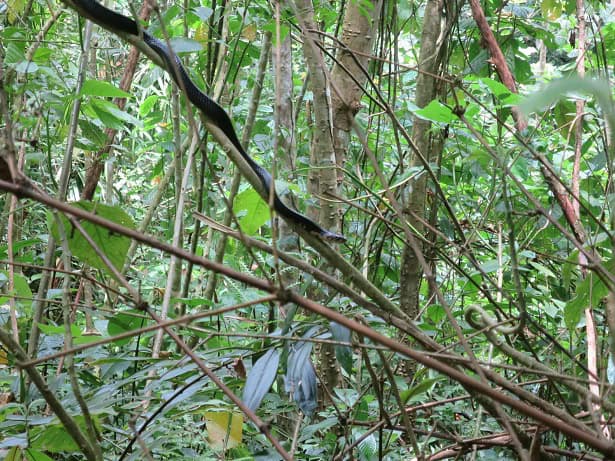
Maximum length: 260cm.
Another of Africa’s volcanic islands is São Tomé Island, which is one of two main islands of the offshore nation of São Tomé and Príncipe. These lie 155 and 140 miles off the west coast of Gabon respectively, and were formed by earth-shattering volcanic eruptions millions of years ago, before the magma cooled and mixed with sea water, altering its composition and forming complex layers of rock. The islands were colonised by the Portuguese in the 16th century, at which point they were completely empty. These days, the country has a thriving population of its own, but one creature that always existed was the São Tomé cobra (Naja peroescobari).
This species is one of the longest cobras in Africa, reaching a maximum of 260cm. It appears exclusively on São Tomé, and is simply known as cobra-preta by locals, which translates from Portuguese as black snake. Another local cobra saying is “homem mordido, homem perdido“, which means “man bitten, man lost”.
The São Tomé cobra is mainly found in forests, where it generally sticks to the ground, but is skillful at weaving along tree branches (see above). This species has a fascinating history, as for decades, it was considered to belong to the forest cobra species (Naja melanoleuca) found in western Africa. It was long stated in textbooks, scientific journals and nature magazines to be an introduced population, brought by Portuguese colonists, possibly to reduce rat numbers. This belief went unchallenged for decades in 2020, until it was finally established as an independent species, which had been there naturally all along.
Firstly, the São Tomé cobra is far blacker than the forest cobra, which has paler patches on its back. On its body (dorsal scales), this species is almost fully a midnight shade. On the underside (ventral scales), the São Tomé cobra is also darker, with paler scales extending only down to the 22nd ventral scale, versus down to the 80th for the forest cobra. Subtle scale differences on the chin also proved this species’ independence.
To find a São Tomé cobra, you must land in São Tomé International Airport, rent a hire car, drive into the local forest, and start walking around aimlessly for a while. Whether we actually recommend this is another story. The venom of this species is barely researched, but the verdict from Portuguese colonists in 1504 wasn’t promising: “so venomous that when it bites a man, his eyes will explode out of the head and he will die“.
| 4 | Golden lancehead |
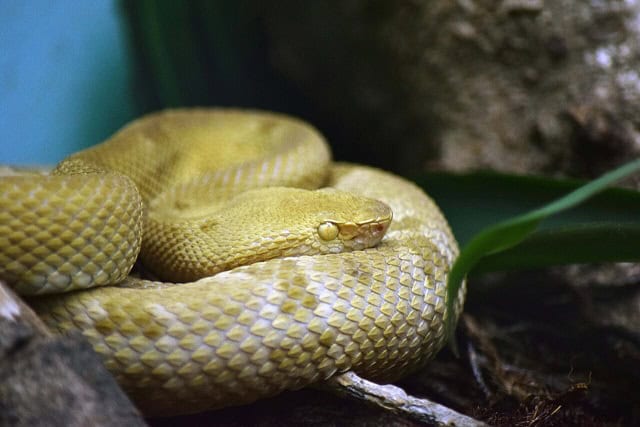
Maximum length: 118cm.
The golden lancehead (Bothrops insularis) is another Bothrops pitviper which lives solely on one island off the eastern Brazilian coast. Like the Alcatrazes lancehead, it’s most closely related to the jararaca, but compared to the Alcatrazes lancehead, it has a couple of large differences, including an easier life overall.
The outcrop where this species lives is Ilha da Queimada Grande, found 21 miles off the coast of southeast Brazil, and less than 100 miles southwest of Alcatrazes Island. This is another rocky island, with towering cliffs and low shrubby bushes making any human settlement impossible. The only human inhabitants were lighthouse operators who left in the 1920s.
Another good reason for the lack of people is the pitvipers covering every inch of the island. Golden lanceheads are incredibly abundant on Ilha da Queimada Grande, much more so than the Alcatrazes lancehead on its hideout. Put a foot wrong, and it could land on a very annoyed golden lancehead, potentially leading to a fatal next 48 hours.
Compared to the Alcatrazes lancehead, golden lanceheads are much brighter – hence the name. They’re much larger in size, though not enormous, with a maximum of 118cm versus 50.5cm. Compared to their jararaca relative, they have a much longer tail, designed for climbing trees.
The reason is all down to their prey. Golden lanceheads have a bountiful food source, despite being stranded – birds, which use Ilha da Queimada Grande as a staging post, somewhere to roost inbetween their long flights. The golden lanceheads are waiting, and lunge into mid-air to pluck birds from the sky as they hover cautiously down to the ground. Another unique feature is being active by day, unlike the nocturnal nature of most Bothrops pitvipers.
This bird hunting is kept in an equilibrium whereby the golden lanceheads can feed to their hearts’ content, but not quite enough that the birds stop coming. This bird feast is why golden lanceheads are relatively large, and why they cover almost every inch of the island.
Ilha da Queimada Grande is now a place of fear, known internationally as Snake Island. Landing on the island is banned, partially to protect the snakes, and partially to protect the people. As for the venom of Bothrops insularis, its symptoms appear to be similar to mainland Bothrops pitvipers, causing swelling, blood blisters, nausea and haemorrhaging.
| 5 | Roatán coral snake |
Maximum length: 60cm.
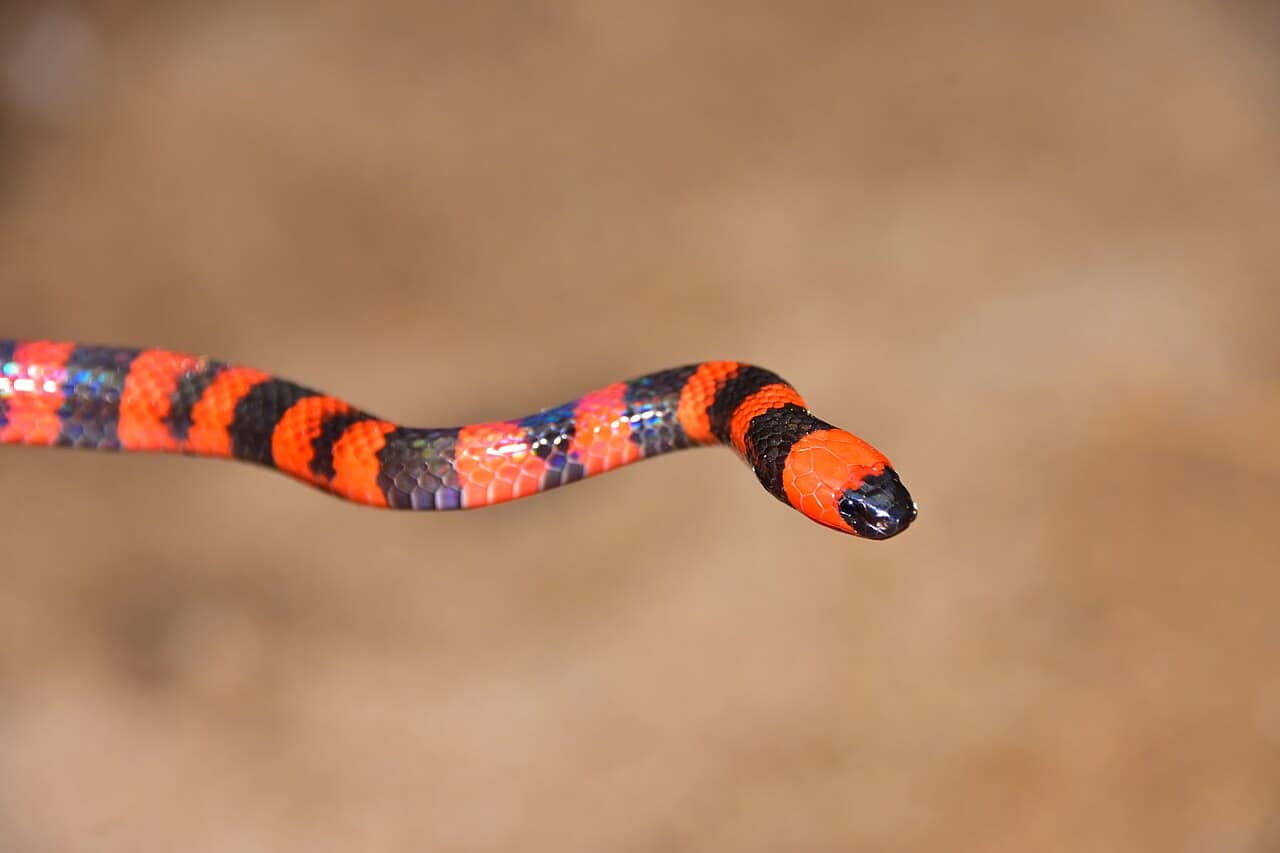
Pirates, long-stashed treasure chests, wide-eyed nature tourists, rough-toothed dolphins and yellow-naped parrots. These are all things you’re likely to find on the scenic island of Roatán, located in the Caribbean Sea off the northern coast of Honduras. But if you’re unlucky, something else you may stumble into, between the sandy and dry forest matter around your feet, is the Roatán coral snake (Micrurus ruatanus), a severely deadly species.
This species lives exclusively on the island of Roatán, which measures 37 miles long and 5 miles wide. The island has all the scenic sparkling beaches you’d expect, and blue oceans that seem to stretch into the distance forever. Behind those beaches are palm trees and thick, salty undergrowth, and here you can find the Roatán coral snake, minding its own business. All coral snakes have a tendency to live in forests, and this species is no different. Most coral snakes are relative non-aggressive, but generally bite if picked up and manhandled, and the Roatán coral snake is likely similar.
This species is the only dangerously venomous species found on Roatán, as the yellow vine snake and Roatán longtail snake are only slightly venomous. Roatán coral snakes have a relatively distinct pattern for their kind, with rapidly alternating black and red bands, without any white or yellow scales.
The venom of this species was studied in 2019, and the result was a typical Micrurus mixture: three-finger neurotoxins, with smaller levels of amino acid oxidases and metalloproteinases. The venom had a high activity against mice, hinting at lethal dangers for larger mammals too (e.g. tourists).
Roatán coral snakes are easy to recognise, for the simple reason that no other snake on Roatán resembles them. Their patterns also allow them to stand out against forest undergrowth relatively easily. This species prefers untouched areas, and is extremely unlikely to invade a hotel lobby, a hotel room, and definitely won’t sneak up on you in the hotel shower. In fact, it’s now regarded as “critically endangered” by the IUCN, due to habitat decline on the island.
| 6 | Phuket pitviper |
Maximum length: 74.8cm.
Phuket is the largest island in Thailand, situated off the middle-west coast, over 500 miles to the southwest of Bangkok. Compared to Roatán or Alcatrazes Island, it’s well inhabited by humans, home not only to a thriving tourist industry, with sea snakes and turtles aplenty, but a high population of expat Westerners (over 20,000). Despite this busy population, one thing still hasn’t changed: the Phuket pitviper (Trimeresurus phuketensis), a dangerously venomous species found exclusively on this island.
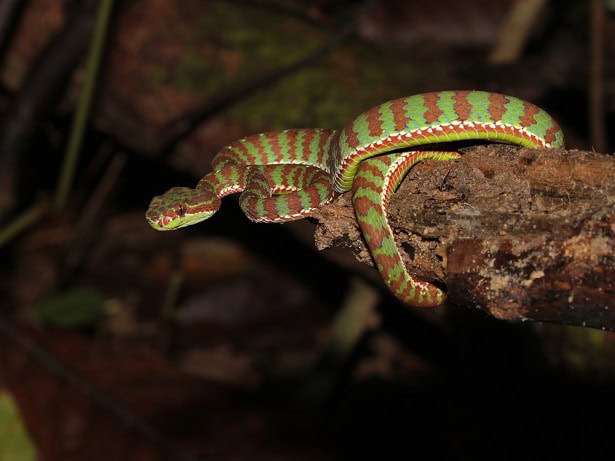
Phuket pitvipers belong to the vast 44-member Trimeresurus genus, but appear nowhere else. They were originally recognised as independent in 2011, and have several distinct features, such as a recognisable eye stripe, which is full copper red in the thicker upper portion, and snowy white on the thinner lower portion.
The tail is also distinct, with a much browner colour than the body, occasionally with a banded pattern. Then there’s the usual Thai pitviper features such as a leafy green body, and vertical pupils.
The Phuket pitviper is an aggressive species, even snapping at the air after receiving a beam of torchlight to the face. It appears on tree branches, but generally at low levels, up to 3 metres high, similarly to other Trimeresurus members, It also hunts on the forest floor occasionally, including on large boulders.
Phuket is only separated from mainland Thailand by 10 miles, yet even this small distance is enough to keep them confined to the island. Scientists have searched equivalent mature forests in Phang-Nga Province on the adjacent Thai mainland, and found no members of this species. Being an inflexible forest snake makes you far less able to cross small gulfs, compared to say, the boa constrictor, which is perfectly comfortable in open areas. Despite its small territory nationwide, this pitviper is abundant in forested areas of Phuket – watch your step.
| 7 | Crocker’s sea snake |
Maximum length: 90cm.
Crocker’s sea snake is an aquatic species which preys heavily on gobies, and has a powerful venom, whose potency is unresearched in humans. It has various aquatic adaptions such as enlarged lungs, and nostrils angled on top of its head, allowing it to breathe underwater for possibly up to an hour.
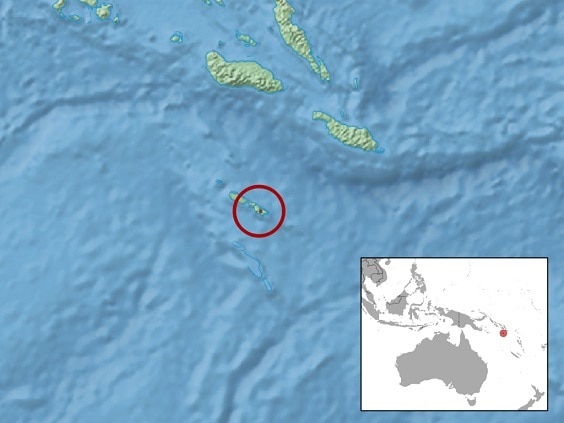
Unfortunately, this sea snake has a problem – it has lost contact with the sea. Instead, Crocker’s sea snake is stranded in one narrow location – Rennell Island, which is home to 1840 Polynesian people and is officially part of the Solomon Islands.
Crocker’s sea snake is part of the 8-member Laticauda sea krait genus. While other members live in the ocean, this species is found in just one brackish inland lake. Rennell Island is 50 miles long and 8.7 miles wide, and is relatively pristine. One fascinating ecological zone is Lake Tegano, which is home to both banded sea kraits (Laticauda colubrina), and the rare Crocker’s sea snake (Laticauda crockeri).
The latter lives nowhere else on Earth, and since this lake has no connection to the ocean, it has no prospect of colonising fresh territories. Its body has adapted to require less salty conditions, and it has a completely different appearance to the black and white cousin it lives alongside. Crocker’s sea snake has a mostly black body, and occasional faint white bands which seem to abort before truly getting started. Another feature of this species in photographs is shininess, reflecting light easily.
Crocker’s sea snake reaches a maximum of 85-90cm in females, and around 70cm in males. Being stranded is unusual, as various other Laticauda members are widespread. The banded sea krait dominates Indonesian and Malaysian waters, while the black-banded sea krait is common near the Philippines and reaches as far north as Japan. But Crocker’s sea snake is found in just a single inland lake, on a single remote island, from which it has little chance of escaping. Within this lake, the banded sea krait strays to the shores more commonly, while Crocker’s sea snake sticks to the murky lake depths.