
| 1 | Common lancehead |
Maximum length: 172.3cm.
Location: most of South America.
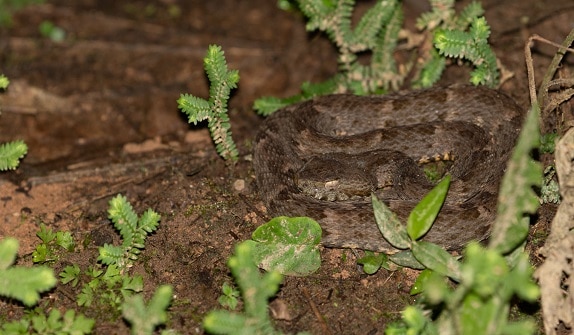
The most common Bothrops pitviper in the world also has some of the niftiest camouflage. Common lanceheads are found in Colombia, Venezuela, eastern Peru, French Guiana, Suriname and over 50% of Brazil, and they’re abundant wherever they’re found, unleashing high totals of bites. They don’t have especially flashy patterns, but this is their stroke of genius, as it allows them to blend in with endless forested environments.
Common lanceheads can become near invisible on rotting logs, soil-covered earth, and piles of leaf litter alike. They have a strong tendency to invade coffee and banana plantations, and lurk there for hours in order to ambush rodents. Workers can be harvesting coffee beans all morning, standing just metres away from a disguised common lancehead, yet never notice its presence.
When threatened, their response varies. Common lanceheads can flee, or shake their tail loudly against leaf litter, but also attack without warning.
Symptoms include necrotic skin, haemorrhaging, and death by kidney failure. Common lanceheads can release 342mg of venom in one bite, and cause 50% of all snakebite deaths in some Amazonian regions. Before the dawn of antivenom, a bite was a virtual death sentence, but these days they’re easily treatable – as long as you reach the hospital in time.
| 2 | Burmese python |
Maximum length: 579cm.
Location: Myanmar, Bangladesh, Thailand, Florida (invasive).
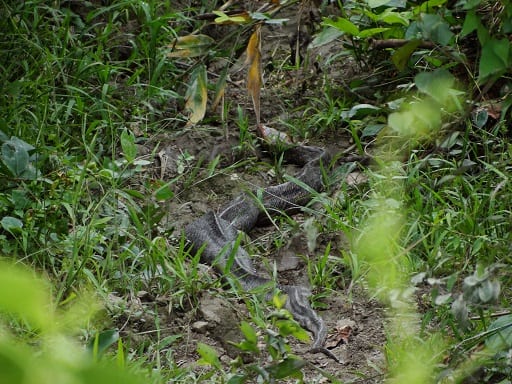
The Burmese python is an ambush predator, most of which have excellent camouflage, but this species has gone particularly far down the path of invisibility. Burmese pythons are native to southeast Asia, but are also a notorious invasive species in the Florida Everglades. They have a beige base of colours, covered with huge brown blotches, each with a dense black outline.
Burmese pythons can be extremely hard to notice in forested undergrowth, and above all marshland. They arrived in Florida in the 1990s, and determined efforts have been underway to wipe them out ever since. These have completely failed, and their amazing camouflage is one reason why.
At a confirmed maximum of 579cm (so far), this is one of the largest snakes in the world, which makes it all the more impressive how they can vanish without a trace. The population in Florida now numbers up to 500,000, and it’s estimated that for every Burmese python spotted by a passerby, another 1000 go unnoticed.
This was exemplified in 2013, when a month-long hunt was announced, open to all members of the US public. Tempting financial rewards were offered, yet the final tally after 1 month was just 68 pythons killed. Burmese pythons undergo no ontogenetic colour change, remaining the same beige-black shade from birth until death.
| 3 | Timber rattlesnake |
Maximum length: 189.2cm.
Location: eastern USA.
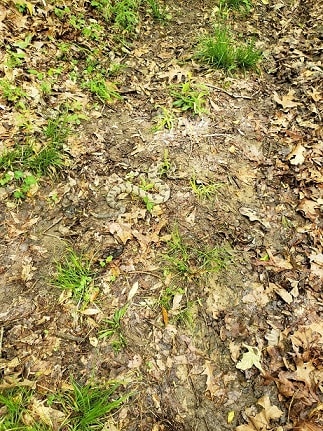
A common species in Ohio, Pennsylvania, Georgia and North Carolina alike. The timber rattlesnake is one of the most commonly encountered members by ordinary Americans, and this is made worse by its incredible camouflage, which grants it the ability of complete disappearance. This species is found almost exclusively in leafy forests, littered with fallen branches and twigs.
Each year, dozens of dog walkers stop to admire the forest, only to jump back in fright as a random rattlesnake suddenly appears out of a leaf bed. This species is visible while on the move, but while resting in ambush, as it often does, it’s very difficult to detect.
Timber rattlesnakes are mainly docile, and not desperate to strike, but have killed 15-20 Americans since the turn of the century. The best solution is simply to stick to paths, and tread carefully when wading through fallen leaves. Take your headphones off when strolling through the forest, and keep an ear out for the signature warning rattle – this might be audible even if the rattlesnake itself is invisible.
If you’re lucky, the timber rattlesnake will be resting inside a hollow log instead, one of its favourite relaxing spots. Like other rattlesnakes, this species can strike from distances measuring up to two thirds of its own body length.
| 4 | Common death adder |
Maximum length: 100cm.
Location: Australia.
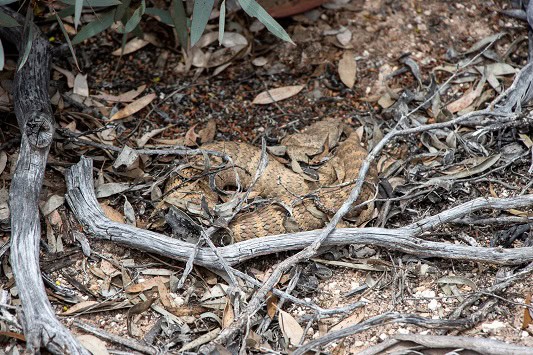
The common death adder’s entire survival strategy is reliant on camouflage. Rather than an aggressive, fast-moving species like the eastern brown snake, this Australian species relies on ambush, and camouflage is essential to disappearing into a mixture of leaves and scattered woodland debris.
Common death adders rarely appear in urban areas, but inhabit woodland trails, forest edges, and dry, wispy undergrowth, hoping for small mammals to wander past, but occasionally receiving human beings instead. This is mainly a species of southern and eastern Australia, including Victoria and New South Wales. Meeting the common death adder is a cause for great concern; its venom mixes neurotoxins, haemotoxins and cytotoxins into one lethal mixture.
Spotting the death adder is a great way to prevent this deadly outcome, but that’s easier said than done. The death adder not only has excellent camouflage, but is variable in colour, allowing it to blend with different landscapes. The one consistent feature is that this is a relatively dull snake, rather than bright and flashy (or neon green).
| 5 | Asian vine snake |
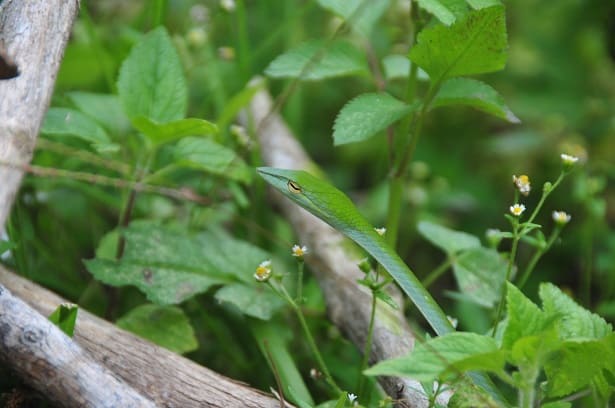
Maximum length: 197cm.
Location: southeast Asia.
One of the most bizarre snakes on Earth, with a pointed snout and keyhole shaped pupils. Asian vine snakes (Ahaetulla prasina) feed primarily on lizards, and all their survival points have been funnelled into camouflage. More specifically, this species almost perfectly resembles a swinging piece of jungle vegetation.
Asian vine snakes are found in Thailand, Vietnam, Cambodia and Malaysia alike. They almost perfectly match the precise shade of green in the forests they inhabit. By dangling from a tree branch with their strong, prehensile tail, swaying slightly in the wind, they perfectly mimic the forest vines they’re named after.
What happens if you fall for this deception? There’ll be a cackle of laughter and a blindingly fast lunge – or more accurately, the Asian vine snake will probably flee rapidly into the bushes. This species is fairly cowardly, and gets spooked quickly when its disguise is foiled. However, it has recently turned out to secrete a very mild venom from its rear fangs, which is unlikely to harm a human.
A 2018 study found that this venom consisted of metalloproteinases, with a similar profile to viper venom. Metalloproteinases physically break down healthy skin cells, cleaving through amino acids, replicating the process of natural skin recycling, but to extreme, destructive levels. The result in a more powerful snake would be necrosis, but Asian vine snakes are better at disappearing than they are attacking.
| 6 | Sahyadri Hills whipsnake |
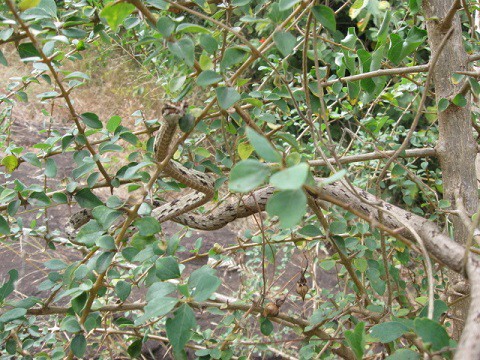
Maximum length: 180cm.
Location: central western India.
Part of the same Ahaetulla genus as the Asian vine snake, but with a difference. Instead of juicy green, the Sahyadri Hills whipsnake (Ahaetulla sahyadrensis) is parched brown, in order to mimic drier tree branches.
Sahyadri Hills whipsnakes live exclusively in the Western Ghats mountains of southern India, sticking to deciduous forests on the outskirts of perennial streams. They might be even more bizarre than the Asian vine snake, as their pointy mouth curls upwards at the end, looking like a fleshy hook. Their pupils are even more warped, while their scales seem to have stolen the bark of a tree.
Very little is known about this snake’s diet or lifestyle. All we know is what’s clearly ascertainable from photographs – that its main survival strategy is extreme camouflage. Ahaetulla sahyadrensis is a relatively new snake, as it was originally classed as the same species as the brown vine snake (Ahaetulla pulverulenta) of Sri Lanka, before being split in 2020.
| 7 | Smooth green snake |
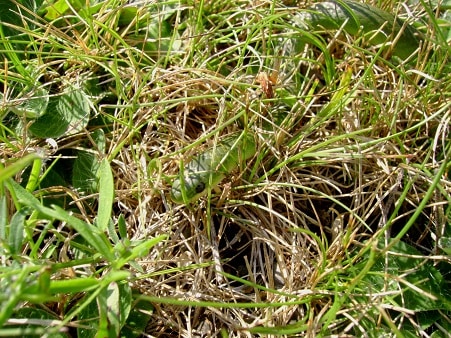
Maximum length: 79.7cm.
Location: USA.
One of the best camouflaged snakes in the entire USA, and easily the best camouflaged in grass, alongside its cousin the rough green snake. The smooth green snake (Opheodrys vernalis) is found in rural areas of the northeastern US, including in New York, Ohio and Pennsylvania. It occasionally climbs low bushes, but mostly sticks to the ground, where its camouflage in juicy green grass is almost impenetrable.
This non-venomous snake is a master at disappearing in fields, or the overgrown borders of busy roads. On a piece of tarmac or a footpath, it’s easy to spot, but the moment it enters vegetation, all hope vanishes. This snake is particularly difficult for scientists to survey, despite living in densely populated northern US states.
Smooth green snakes have subtle colour variations, but always with green predominating. They have slight blue tinges in Kansas, olive tinges in Texas, and bronze tinges in Wisconsin. They have a strongly olive tint as newborns, but once their first skin shed is complete, they blossom into the bright green camouflage specialists of adulthood.
The only non-green section of their body is the tongue, which is red with a black forked tip. Smooth green snakes also turn blue when they die, due to the yellow pigments of their scales decomposing more rapidly.
| 8 | Dumeril’s boa |
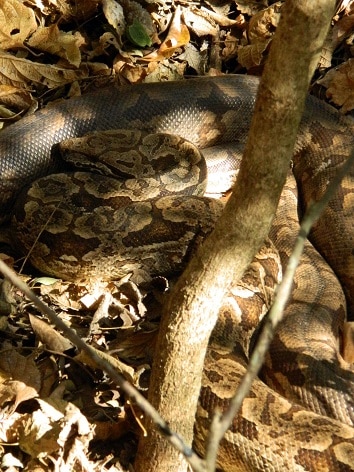
Maximum length: 259cm.
One of two huge boas on Madagascar. Dumeril’s boa (Acrantophis dumerili) reaches 2.5 metres long, and is found primarily in the southern half of Madagascar, while the Madagascan ground boa is slightly longer and primarily inhabits the northern half.
Dumeril’s boas eat a diet of mainly mammals, including primates like bamboo lemurs. Their habitats include marshes and swampy areas within forests, but also dry woodlands covered with fallen leaves. It’s here where they deploy one of their greatest survival skills: impenetrable camouflage.
Dumeril’s boa is a beige-black snake covered with many circular blotches, which interlock to create a constant chain of waviness. On a grassy hill, it’d be exposed instantly, but the forest floor is another story. The ambushing nature of this species allows it to stay completely still, totally blending in.
Some Madagascan villagers believe that their ancestors’ spirits are captured in the Dumeril’s boa’s circular patterns, and refuse to harm them, while others kill them on sight. This is also a popular captive species in zoos worldwide.
Dumeril’s boas mainly stick to the ground, as they’re very poor climbers. In a study comparing them to boa constrictors and gaboon vipers, the belly scales of Dumeril’s boas produced the smallest friction by far, preventing them from digging into tree trunks.
| 9 | Prairie rattlesnake |
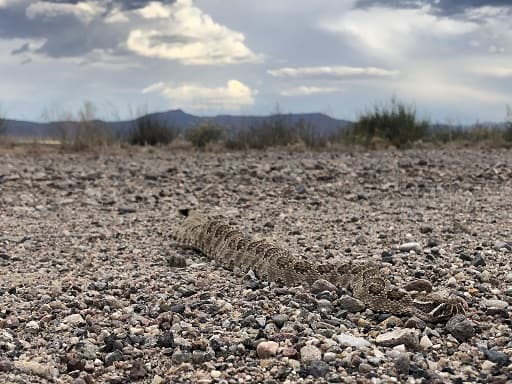
Maximum length: 151.5cm.
Location: the American Midwest.
A common rattlesnake of Colorado, New Mexico and Wyoming. The prairie rattlesnake (Crotalus viridis) is medium in size, averaging at 100cm. Its venom is equally middling, relying heavily on muscle-assaulting myotoxins, with a side dose of haemorrhaging.
Prairie rattlesnakes are significantly less deadly than the Mojave rattlesnake, but one area where they shine is in their camouflage. Rather than parched deserts or green grass, the prairie rattlesnake is engineered towards total camouflage in sweeping prairie landscapes. These realms of rolling hills and swaying dry grasses can hold hundreds of prairie rattlesnakes at once, all lurking out of sight of hikers or explorers.
Prairie rattlesnakes are pale beige, in order to hide in grass or blend into sandy areas. Overlaid on top are faded brown blotches, in order to mimic darker pebbles strewn around. This is one of the paler rattlesnakes overall, similar in tone to the tiger rattlesnake of the Sonoran Desert (which also has excellent camouflage).
Without this immense camouflage, it’s unlikely that prairie rattlesnakes would be as common as they are, stretching from southern Canada all the way to northern Mexico. Prairie rattlesnakes need all the help they can get, as they’re often hunted by mountain lions, cunning red-tailed hawks and even roadrunners dashing through dusty canyons.
| 10 | Gaboon adder |
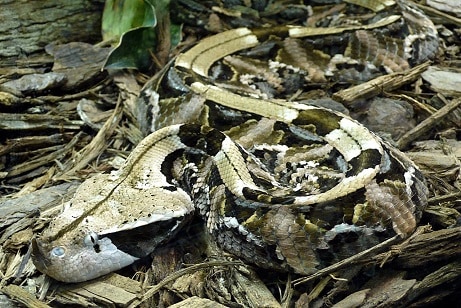
Maximum length: 175cm.
Location: sub-Saharan Africa.
The gaboon adder is an African snake famous for having the longest fangs of any venomous species, measuring 5cm each, with a colossal venom yield. But its camouflage is another incredible feature.
Gaboon adders (Bitis gabonica) have the typical colours of vipers – beige, brown, with lighter patches – but take the stealth game even further than their cousins. The shapes of the blotches closely resemble overlapping leaves, while the varying shades mimic the normal mixture of fresh foliage versus old, dried-out forest debris. The gaboon adder may be nature’s finest work in forest floor camouflage, the greatest leaf-blending snake yet invented.
Gaboon adders prefer forests, but don’t inhabit them exclusively. They’re common threats to workers in agricultural areas, particularly in cashew, tea, and coffee plantations in Uganda. Gaboon adders are most closely related to the puff adder, another venomous ambush snake, but have walked even further down the forest floor camouflage path.
Thankfully, they have a calm personality, rarely striking a human being unless severely provoked. Gaboon adders derive roughly 80% of their calories from mammals, with birds comprising 20%. They use their immense camouflage to wait patiently for hours at a time.
| 11 | Common Madagascar cat-eyed snake |
Maximum length: around 1 metre.
The common Madagascar cat-eyed snake (Madagascarophis colubrinus) is one of Madagascar’s most multi-skilled snakes. This snake climbs trees without thinking, is fast and darting, and has a surprisingly neurotoxic venom which was only discovered for the first time in 2023. It’s not surprising that this is Madagascar’s most widespread overall snake species, and the most commonly observed by ordinary people.
Adding to its skillset is a strong ability to camouflage. This species isn’t an immobile ambush predator like the Dumeril’s boa, far from it. It prefers to charge down and pursue its reptile and bird prey, seizing them before chewing in paralysing toxins, However, it has an excellent ability to blend in anyway, just to add to the complete overkill.
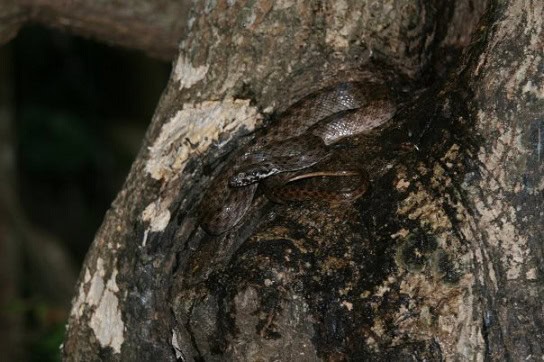
Madagascar cat-eyed snakes have a strong ability to blend with gnarly tree trunks, as shown above, or rocks on the ground. They can be almost invisible when resting in a tree trunk hollow, a camouflage which probably works on their chameleon prey just as well as human tourists or farmers.
This species belongs to the 5-member Madagascarophis genus, of which it’s easily the most common. While Dumeril’s boa is the island’s ultimate leaf camouflage snake, this species is superior when it comes to tree trunks.