
| 1 | Green tree python |
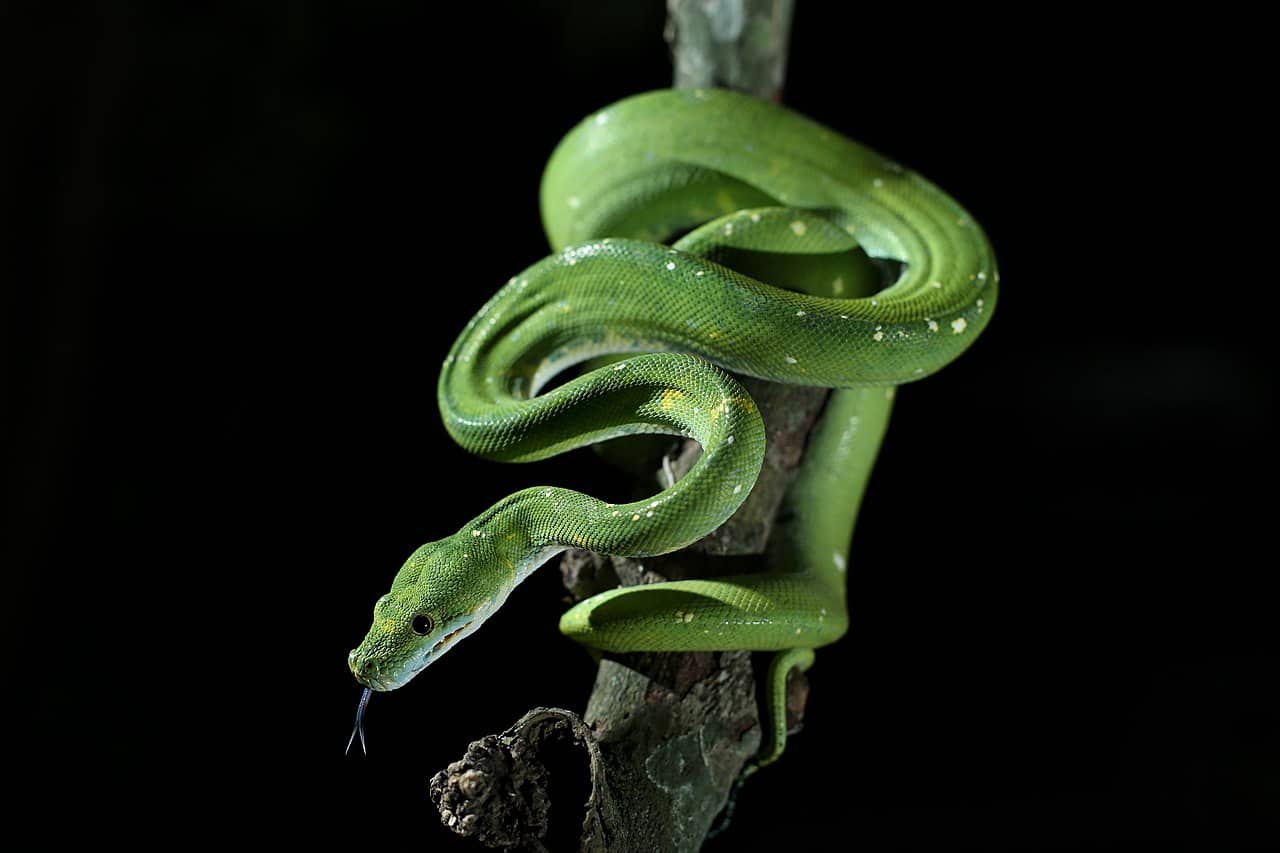
Maximum length: 220cm.
A crushing constrictor of northeast Australia. Green tree pythons inhabit the dense rainforests of Queensland and Papua New Guinea, almost never straying to the grasslands next to forests.
Whether it’s a specific survival strategy or they’re just showing off, we’re not sure, but green tree pythons reach extreme heights in the canopies. A study from Iron Range National Park in Queensland found that while young green tree pythons stayed within 10 metres of the ground, adults regularly ascended to 25 metres or more, one of the most towering records of any snake.
Green tree pythons prey on mammals and occasionally birds, which they ambush from a comfortable nest of coils. They must choose the most optimally angled branch for making sudden lunges, otherwise their prey might dodge and escape. If this branch happens to be 20 metres above the rainforest floor, then so be it.
Green tree pythons ascend so high simply because they can. They have excellent climbing abilities in spite of their bulky weight, and there’s no limits on where they can place themselves in an ambush position.
| 2 | Amazon tree boa |
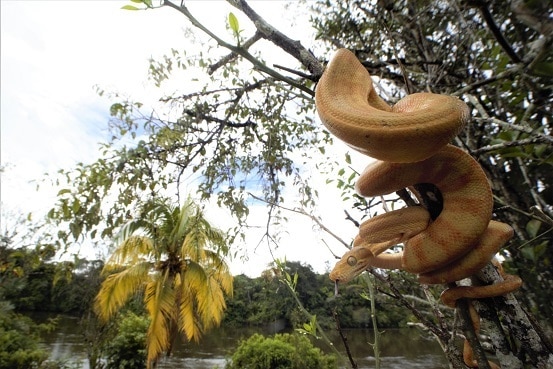
Maximum length: 188cm.
A forest might be a forest, but there’s multiple sublevels within them. You have the earthy soil chambers where ant-eating blind snakes live, hidden from view. You have the forest floor, containing venomous bushmasters and human explorers attempting to tiptoe past them. Then you have the towering canopies, where beams of sunlight shine through, and Amazon tree boas rest peacefully on branches, oblivious to the drama below.
Amazon tree boas are completely non-venomous, preferring to rely on an aggressive temperament for their survival. They range from Brazil to Peru, and appear in isolated tree clumps near farms as well as fully fledged forests.
Their body isn’t too twig-like, but they navigate branches with ease, and have been recorded at 25 metres high in the crowns of trees. Amazon tree boas also vary wildly in colour, from grey to brown to neon orange. The Amazon tree boa has access to areas a human being couldn’t dream of, with excellent climbing skills and no fear of heights.
If this snake wants to stay out of sight, then it will, unless people are willing to climb 20 metres high in a swarming rainforest canopy.
| 3 | Brown tree snake |
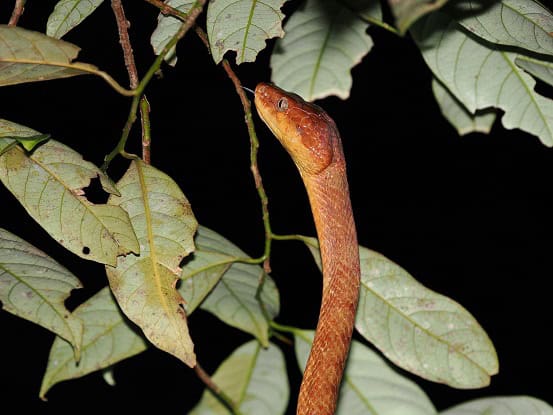
Maximum length: 3 metres.
Many forest snakes have a safety switch built into their brains. They know that if they climb too far then a fall would be correspondingly more catastrophic, ending their lives. But the brown tree snake just keeps on climbing, with no fear whatsoever. This is a native Australian species which mainly lives in the forests of Queensland. It’s also a notorious invasive species on Guam, the US-controlled Pacific island, where it has wreaked havoc on the native birds, driving many to extinction.
According to a 2022 study on Guam, brown tree snakes prefer lower branches, but regularly ascend to 10-15 metres, with one individual reaching 18 metres. On average, males reached higher perches than females.
These discoveries were purely inadvertent, as the scientists were actually on a quest to map out every possible brown tree snake characteristic in an attempt to eradicate them (which failed). It’s likely that brown tree snakes reach 20 metres when not being observed.
The brown tree snake is mildly venomous, though no threat to humans. This snake also inhabits forest edges and more isolated tree clumps, so it gets a superior view to most high-climbing snakes. This species can observe a grassy plain, the sunset, the ocean, or even a group of US government exterminators approaching.
| 4 | Coastal sipo |
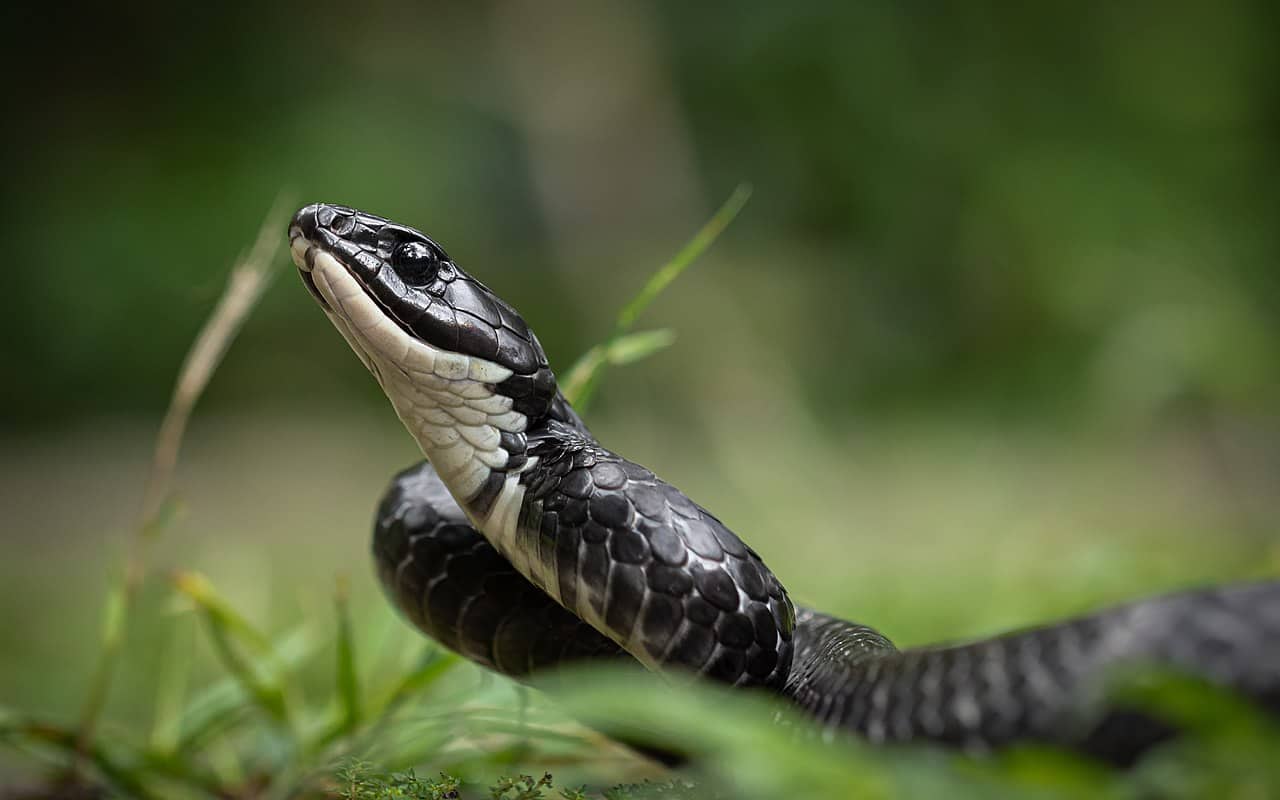
Maximum length: 134.5cm.
Coastal sipos belong to the 23-member Chironius genus, and are one of the less widespread members in territory. They’re found only in coastal areas of southeast Brazil, including areas near Rio de Janeiro and São Paulo. They reach a maximum of 134.5cm, and lack any form of venom. Luckily, the coastal sipo has a different form of survival: staying 15 metres above ground.
This is a slow, steadily climbing snake, which has no fear of living in high, unstable canopies. In a 2021 study featuring 5 family members, also including brown sipos and Brazilian sipos, coastal sipos (Chironius foveatus) reached the highest branch perches of all, at 16 metres.
This species mainly preys on Hylid tree frogs. It has a thin body, perfect for crossing between overlapping tree branches. It has a great view of treefrogs hopping around, but seeing humans wandering below is very difficult, as its forests are just so thick. Likewise, it’s hard for humans to spot this snake 15 metres above their head.
| 5 | Stephen’s banded snake |
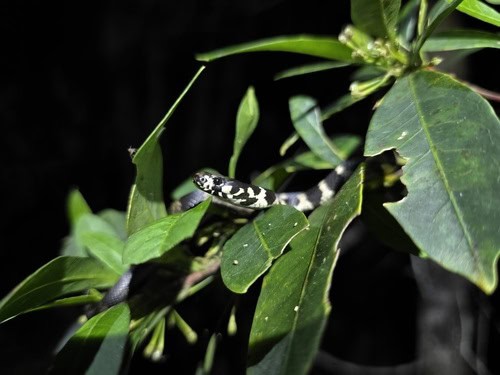
Maximum length: 120cm.
This dangerously venomous snake achieves some of the highest branch heights in Australia. Stephen’s banded snakes (Hoplocephalus stephensii) are native to eastern Australia, and live in remnant forest patches with minimal human influence. They’re excellent tree climbers, and have been recorded at a towering 25 metres above ground, with 20 metres being perfectly common.
This species is found exclusively along Australia’s east coast, especially near Brisbane. This is not just a high climber, but a likely snake to be found poking its face out from a dark hole in a tree trunk. Stephen’s banded snakes stop feeding for five whole months in winter, during which they stash themselves in tree hollows. Their body temperature has been found to fluctuate wildly, from 11-37C.
Climbing so high means that Stephen’s banded snake is a candidate snake to plummet down and land on your head. Fortunately, this species is alert and nimble, and the odds of one slipping and falling out of a tree are minimal (but not quite zero).
| 6 | Blanding’s catsnake |
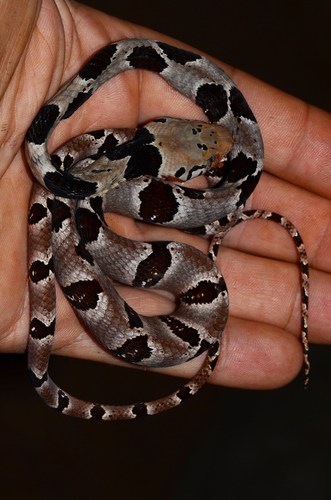
Maximum length: 2.8 metres.
This African snake regularly reaches 15 metres above ground, and rests there for hours with no worries. It rests so high that the forest floor ceases to exist, and its world consists purely of branches and beams of sunlight shining through.
Blanding’s catsnake (Toxicodryas blandingii) is mildly venomous, and moves by night. With less cones and more rods in its retina, creating increased sensitivity to minute quantities of light, it can navigate canopies 20 metres high in complete darkness.
Blanding’s catsnakes also hunt while in the air, searching for airborne prey like birds and Angolan free-tailed bats. They sometimes drop to the ground, but are easily most at home in branches, with a relatively thin body and elongated tail.
Blanding’s catsnakes live in over a dozen countries, including Nigeria and Guinea, mainly in forests, but also parks. They also have a cousin which is a high tree climber: Toxicodryas vexator, which lives further to the southeast in Uganda and DRC, and is confirmed to reach 30 metres high.
| 7 | March’s palm pitviper |
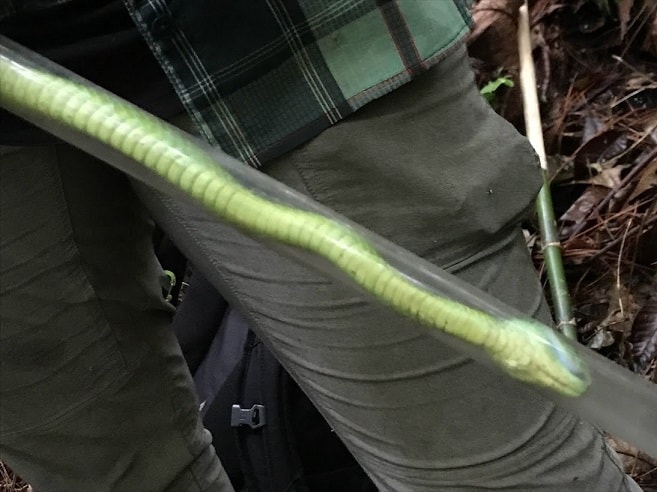
Maximum length: 96.5cm.
If you ever fell face first into a Honduran rainforest from a helicopter, this is probably the first snake you’d meet. March’s palm pitvipers (Bothriechis marchi) occupy branch perches of 1-2 metres, but also 25 metres if the urge strikes. They can remain at these towering heights for many hours and days.
March’s palm pitvipers average at 80cm, and are closely related to the far more common eyelash viper. This is a Central American species which inhabits two countries: eastern Guatemala and western Honduras. March’s palm pitvipers never appear in towns and cities, but might be encountered by villagers lost in their local forest. A 2022 study from Casuco National Park, Honduras, found that they regularly break through 20 metres, and climb far higher as adults than juveniles.
March’s palm pitvipers don’t climb particularly quickly, moving up trunks carefully and concentrating while they navigate the grooves and ridges of branches. But they just keep going and going, until suddenly, they’re 18.68 metres high.
March’s palm pitvipers are vulnerable to birds, yet are a vicious opponent, snapping back and injecting a dose of cytotoxic venom. Check out this video to see one climbing.
| 8 | Green jararaca |
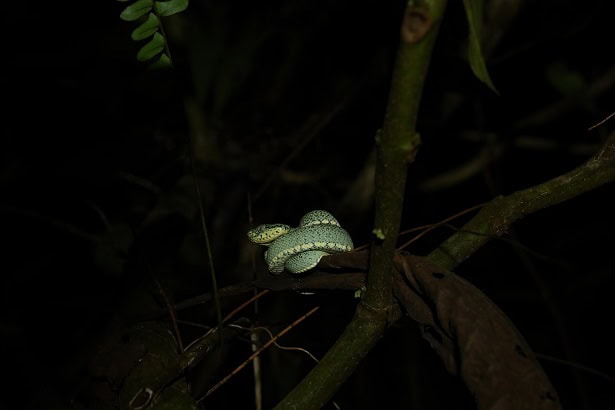
Maximum length: 123cm.
By definition, measuring a snake’s branch height can be difficult if it’s just a casual survey, because they’re so far above your head. In 2021, scientists embarked on a dedicated expedition to analyse the lifestyle of Bothrops bilineatus, AKA the green jararaca.
This common species occurs in rainforests all over the Amazon, and is the most tree-faring of the Bothrops pitviper genus, sticking to a branch and injecting venom into passing frogs. It reaches a maximum of 123cm, and is dangerously venomous, with an occasional tendency to strike humans from branches.
Over their 12 month study, the scientists recorded several snakes resting above 10 metres. One individual climbed to 20 metres above the mulchy rainforest floor, while another green jararaca remained on the same branch for 17 days. A separate study in 2019 observed a green jararaca rest at 9.4 metres for 3 days straight.
Green jararacas can move vertically as much as they wish, with no barriers. This is a strict forest species which is never found in open grassland. It prefers the dense interiors of rainforests, where it can feast on red snouted treefrogs and Marmorea frogs to its heart’s content. Being so green, Bothrops bilineatus is hard to spot in any case, but being 10 metres above your head makes it even more difficult.
| 9 | Blunt-headed tree snake |
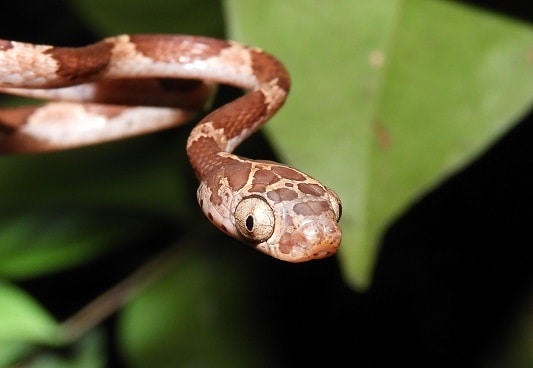
Maximum length: 155.4cm.
One of Earth’s most fully adapted tree snakes. Blunt-headed tree snakes are extremely widespread in South America, inhabiting all countries except Chile and Uruguay. This nocturnal species strays to the ground sometimes, but spends the majority of its day in trees and vegetation.
Imantodes cenchoa can do it all; climbing incredibly high, ascending death-defying vertical trunks, and weaving across super-thin branches like a tightrope walker. While it usually prefers mid-height vegetation, this snake will sometimes keep on ascending and ascending. Consequently, blunt-headed tree snakes have been recorded at 30 metres above ground in the towering canopies.
Why they climb so high sometimes and not others is a mystery. It’s possible that certain overwhelming lizard scents become too intoxicating for them to resist, drawing them upwards.
Blunt-headed tree snakes are venomous, but only mildly. Their adaptions to branch life are manifold. There’s sharply angled scales to dig into tree trunks, and bulbous eyes to scan every inch of the forest. Their body is compressed, adding length without making them heavier, allowing them to cross the thinnest of branches. Even their neck is incredibly thin.
This species mainly preys on rainforest lizards, including bridled anoles, pug-faced anoles and border anoles.
| 10 | Ringed tree boa |
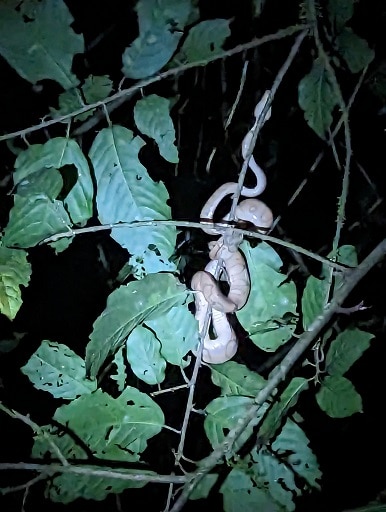
Maximum length: 172.5cm.
The ringed tree boa (Corallus annulatus) is the rarer, more secretive cousin of the Amazon tree boa. The first big difference is its location – mainly Central America, especially Costa Rica and Panama, plus Colombia. The second difference is that ringed tree boas are far more elusive, preferring the deepest, darkest forest areas well away from towns and villages.
Ringed tree boas are most at home in a primitive world, untouched by humanity. But the indisputable advantage they have is that so far, they’ve been observed at higher branch heights. In fact, based on current data, the ringed tree boa is the highest climbing snake on Planet Earth.
Ringed tree boas have been observed on tree branches 40 metres above ground. Like the best tree-climbing snakes, they can rest on branches which look absurdly thin relative to their size.
It’s one thing being a twig-like snake that slurps up gooey frog spawn, and requires no weight to hunt. But Corallus annulatus is a constrictor and has the body width to match, yet can still ascend to levels 25 times the height of the average human head.
Ringed tree boas prey on airborne creatures like Canada warblers and Brazilian long-nosed bats. They can drop down to the ground and investigate the forest floor, but require trees to survive.
What we don’t know is whether they can achieve the real dream: to reach the very top of the rainforest. 40 metres is already an incredible achievement – could this snake climb as high as you possibly can? Not to hang out in the uppermost canopies, but to breach the top of the rainforest, poke its head out, and witness a neverending sea of green for miles around. If any snake can, it’s the ringed tree boa.