| 1 | Chocoan toad-headed pitviper |
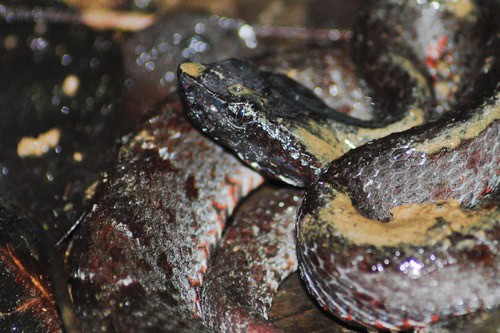
Maximum length: 75.6cm.
This is a snake species you’ll never get to meet, and you should be thankful, unless you like coming face to face with the most dangerous creatures planet Earth has cooked up over approximately 600 million years of evolution.
The Chocoan toad-headed pitviper (Bothrocophias myersi) is endemic to Colombia, and only western Colombia, appearing only in the most drenched rainforests. It appears only in areas receiving over 5000mm of rainfall per year, in regions swarming with other lethal forms of life.
The Chocoan toad-headed pitviper was only discovered in 2001, and case studies in humans aren’t available. But the venom has been analysed scientifically, and was found to contain potent myotoxins.
A myotoxin is a toxin from snakes or any venom which attacks muscle tissue preferentially. Various cytotoxins assault skin tissue, causing blackening necrosis, where healthy tissue rots and sloughs off. Myotoxins attack the layer deeper: muscle tissue, and this is often detectable in the bloodstream by an increase in creatine kinase, a metabolite of dying muscle tissue. “Myoglobia” is another term for the rapid destruction of muscle tissue, and extremely dark urine is one result.
A 2020 study analysed this species’ venom. It found coagulant and haemorrhagic activity, but the most interesting result was an increase in creatine kinase, and strong myotoxicity. If bitten by this species in a Colombian rainforest, you may be miles from a hospital, and you may lose the muscle tissue necessary to run away.
| 2 | Small-eyed snake |
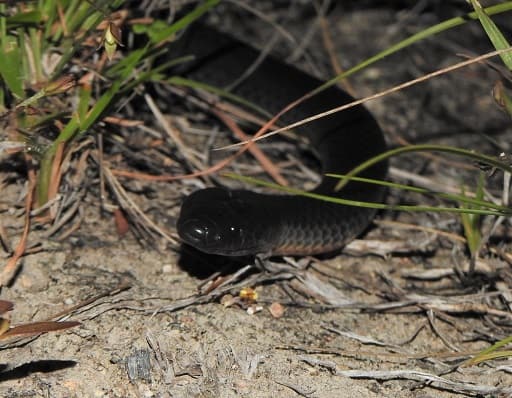
Maximum length: 120cm.
An eastern brown snake may freeze your muscles, and a death adder may melt your kidneys, but there’s no snake in Australia which damages muscle tissue quite like the small-eyed snake.
This is one of the less notorious Australian snakes, and for good reason. Small-eyed snakes kill few people – just 1 death in the last 100 years (in 1965) – and they’re non-aggressive towards humans. They tend to live in grassy, rocky areas, where they hunt skinks by ambushing them in their underground sleeping chambers. The vast majority of this species’ prey consists of reptiles, and its heartlands are the east coast, including New South Wales and Queensland.
If you don’t touch a small-eyed snake, you will escape without a bite. But if you do, then a rich elixir of toxins will be injected into your bloodstream, and that elixir will contain a powerful arsenal of myotoxins.
This species is one of the most destructive to muscle tissue in the whole world. Victims typically experience a flood of dark myoglobin in urine as muscle tissue is destroyed. Worse, the myotoxic effects are stealthy, as they can take weeks to fully manifest. After the patient died in 1965, an autopsy revealed large necrotic areas in his muscle tissue.
Other symptoms of this Australian snake include hypotension and an elevated heartbeat. This is a dark snake, with few patterns, which reaches high densities even near cities like Sydney and Brisbane.
| 3 | Pampas lancehead |
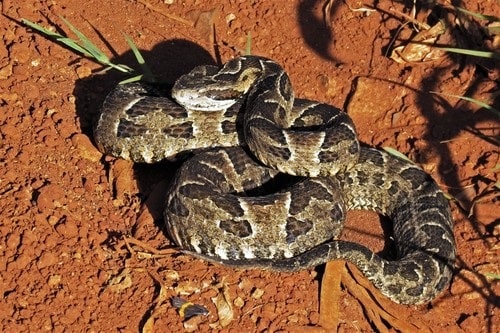
Maximum length: at least 120cm.
Bothrops is the signature pitviper group of South America. The bushmasters are the longest, but the Bothrops lanceheads have 40+ members, with the most common being the common lancehead. Most stick to the ground, with a few exceptions such as the green jararaca. None rank among the top 10 most lethal snakes worldwide (except maybe the fer-de-lance), but they occupy a respectable B-tier where they’re still more than capable of killing if antivenom isn’t administered swiftly.
A 2026 study examined 7 Bothrops pitviper members from Brazil. These included the following: Bothrops mattogrossensis, Bothrops pauloensis, Bothrops pubescens, Bothrops diporus, Bothrops neuwiedi, Bothrops marmoratus, and Bothrops erythromelas.
Of those, one species outstripped the rest for myotoxic, muscle-degrading properties: the Pampas lancehead (Bothrops pubescens). This species occupies southern Brazil, extreme northeast Argentina and a large swathe of Uruguay. It tends to appear along forest edges, where the shadows of trees blend perfectly with its alternating body patterns. Its diet is flexible, including over 50% mammals, plus a sizeable helping of reptiles.
Pampas lanceheads don’t have the largest territory in South America, but are common in their Uruguayan realms. Everyone knew they were dangerous, but nobody realised how strongly they specialised in muscle damage until this study.
| 4 | Beaked sea snake |
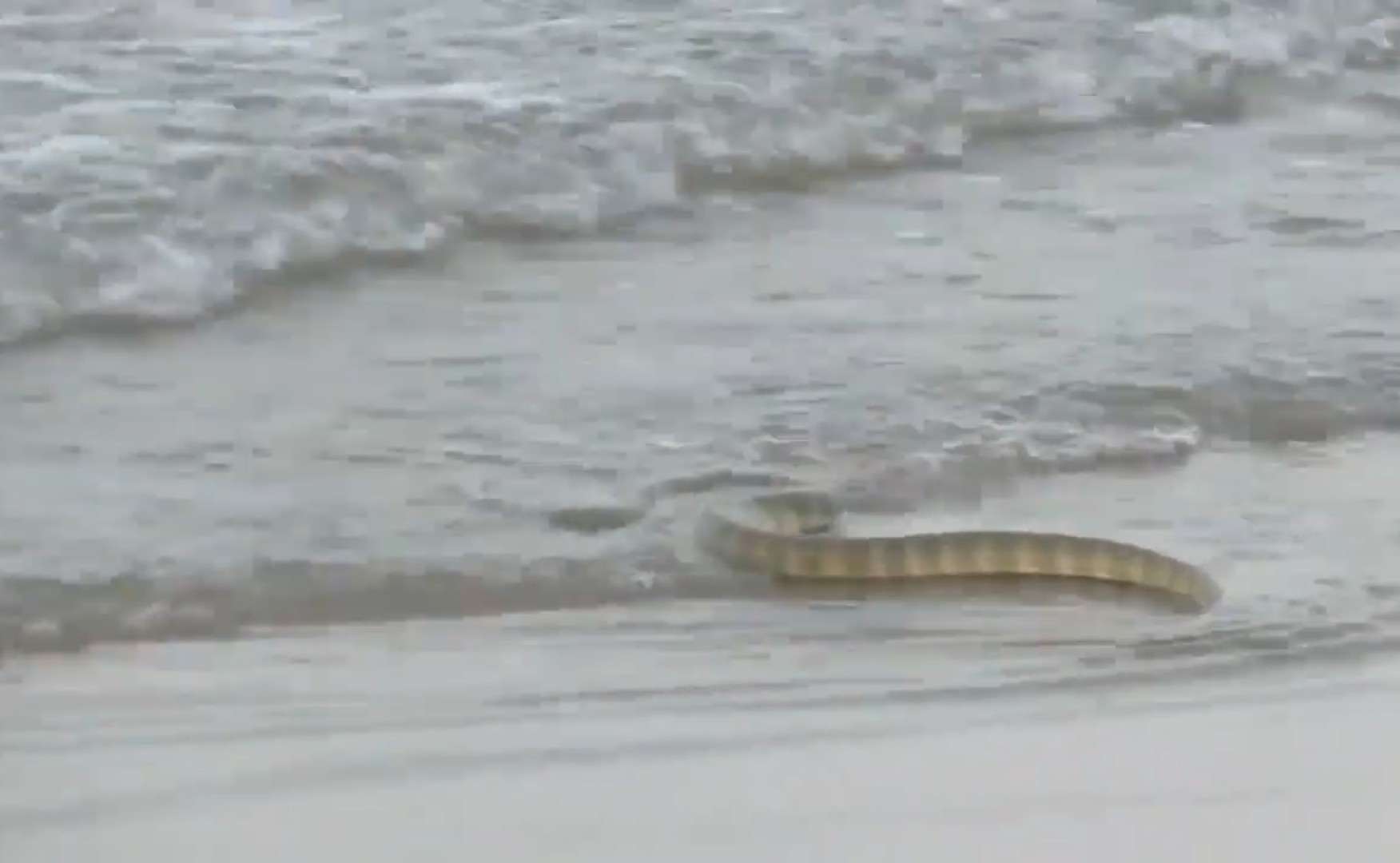
Maximum length: 140cm.
The beaked sea snake is one of the most dangerous sea snakes. The majority of sea snakes have a powerful neurotoxic venom, but most are docile around humans, allowing scuba divers to swim past freely. Not the beaked sea snake. This is perhaps the most aggressive of all 70-80 sea snakes worldwide, with multiple deaths among Indian fishermen. Herpetologists describe it as “cantankerous and savage“.
As for its venom, it seems to lack the usual neurotoxic effects. A study on 3 bite cases from Sri Lanka found that neuromuscular transmissions were normal in two of the patients. Instead, myotoxicity was the main danger, as two patients developed elevated creatine kinase, a classic marker of muscle tissue damage.
The third patient was aged 41 years, and developed symptoms 7 hours later including myalgia – the technical term for muscle pain. This patient actually died 3 days later, having stepped on the beaked sea snake in a Sri Lankan river mouth. His cause of death was cardiovascular failure, and analysis revealed rhabdomyolysis, the technical term for the rapid breakdown of muscle tissue.
Beaked sea snakes are found from Saudi Arabia and Iran to Singapore and Indonesia; avoid them wherever they appear.
| 5 | Olive sea snake |
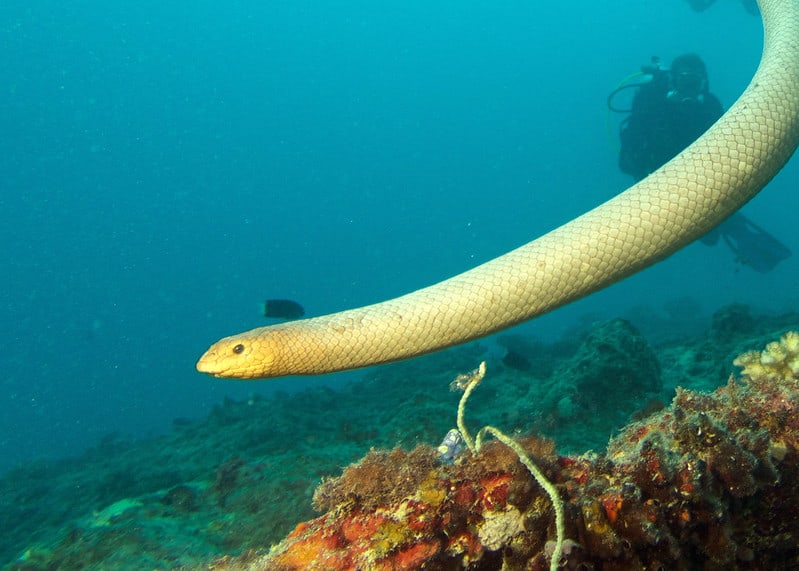
Maximum length: 2 metres.
Next we have one of the calm, non-aggressive sea snakes, as you can see by the friendly-looking photo above (though never judge a snake by its cover). The olive sea snake dwells in coral reefs of Australia, including Great Barrier Reef. It’s abundant in tourist heavy spots, and is a classic species which scuba divers and casual snorkellers can swim past freely with no concern. The image above shows exactly such a scenario.
Nevertheless, the olive sea snake has an extremely powerful venom, which contains high amounts of neurotoxins. No deaths are confirmed, but the venom would most likely be fatal if successfully injected (a wetsuit might get in the way).
Another ingredient of the venom is a powerful dose of myotoxins, as revealed by a study from 2018. It analysed 4 sea snake species, and found that olive sea snakes, elegant sea snakes and Australian beaked sea snakes produced high amounts of myotoxins. Meanwhile, Shaw’s sea snake produced substantially less.
16 years earlier, a study on mice from 2002 found that the venom was “directly myotoxic“, targeting muscle tissue specifically, as well as toxic to the kidneys. As of 2026, there are no detailed bite reports in humans, and hopefully, that won’t change.
| 6 | Central American coral snake |

Maximum length: 115cm.
The Central American coral snake (Micrurus nigrocinctus) is one of the more common coral snakes worldwide, appearing in all 7 Central American countries and southern Mexico. It’s particularly common in the southern half of Costa Rica, and has the typical red-yellow-black bands with a jet black face, and a tail where the red completely disappears.
Central American coral snakes are flexible in their habitats, appearing in forests, but also villages and back gardens. Their diet consists of fellow snakes. As for their venom, it contains the usual potent neurotoxins of coral snakes, but is also unusually myotoxic, destructive to muscle tissue.
This was revealed in a study from 1986, which analysed its destructive effect on muscle tissue in some of the most extreme detail ever. The venom seemed to unleash its damage specifically on the sarcolemma, the specialised outer membrane of muscle cells. It began with wedge-shaped lesions appearing at the periphery of cells, which began within just 15 minutes. Myofilaments (microscopic strands of protein) became hypercontracted, stretching out and morphing the structure. Eventually, “the striated structure was totally lost“,
Under a microscope, the scientists clearly detected a massive outflux of creatine and creatine-kinase, and a calcium influx, showing that the cell integrity was utterly compromised. The lesions created on individual muscle cells by the venom were large enough to allow these molecules to escape.
Repeated thousands upon thousands of times across the body’s muscle tissue, the result would be systemic myotoxicity, the destruction of muscle tissue. Mice tested in the study produced reddish urine, a classic sign of myotoxicity.
| 7 | Red-tailed bamboo pitviper |
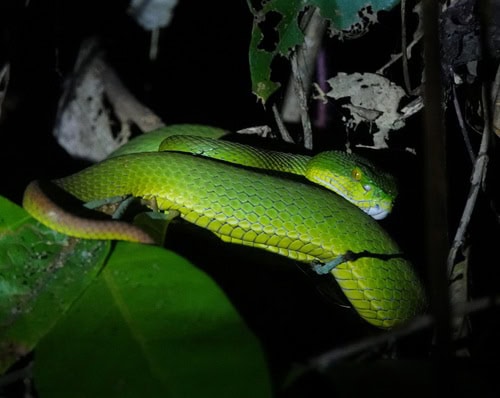
Maximum length: 104.5cm.
A green pitviper found in northeast India and Bangladesh. This species sticks to tree branches, and isn’t responsible for a vast amount of deaths. Nevertheless, its venom contains an insidious cocktail of toxins, which could cause an unpleasant few days in hospital.
A 2025 study found two discoveries in this venom. The first was a series of K49 basic phospholipase A2s, which were already confirmed myotoxins. The second was “severe skeletal muscle damage” in mice tested with the whole venom. The Trimeresurus green pitvipers aren’t generally known for myotoxicity, among their 40+ members worldwide, but this species seems to unleash some of the strongest muscle tissue destruction.
Red-tailed green pitvipers are mostly leafy green, while their tail is a duller brick red rather than bright and neon. The venom also had a “high lethality” according to the study. While this species requires trees to survive, it sometimes appears in villages and other human-altered zones in northeast India.
| 8 | Mulga (king brown snake) |
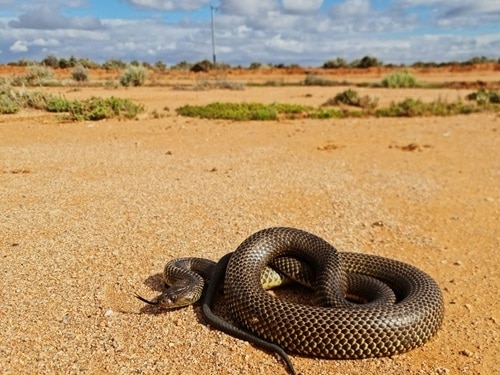
Maximum length: 330cm (Australia’s longest venomous snake).
Not just the longest venomous snake in Australia, but one of the more aggressive. This species avoids the coastlines, but inhabits the vast majority of inner Australia. It covers most states, including New South Wales, Queensland, Northern Territory and Western Australia.
As a large snake, the mulga injects a vast quantity of venom, sometimes up to 1000mg. The composition of this venom is also highly myotoxic, toxic to muscle tissue, as proven by a study from 1998.
7 venomous snakes from Australia were compared. Damage to muscle fibres was analysed under a microscope, and the mulga was ranked as the most myotoxic. Close behind were the lowland copperhead and red-bellied black snake. All three of these venoms achieved deterioration of muscle fibres within just 30 minutes.
The next tier included the common death adder and tiger snake, which began to destabilise muscle tissue within 60 minutes. The coastal taipan was weaker still, achieving myotoxicity to cells within 2 hours. The least myotoxic of the 7 was the peninsula brown snake.
Meanwhile, the small-eyed snake wasn’t included in this study, so that and the mulga join forces as the masters of myotoxicity on Australian soil.
| 9 | Malabar pitviper |
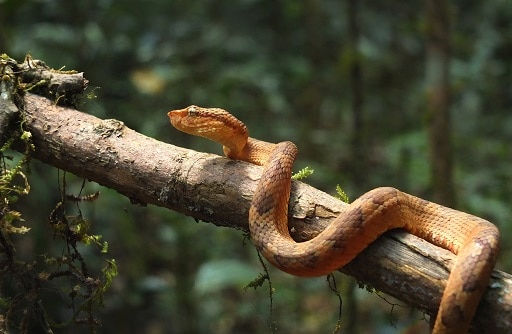
Maximum length: 89cm.
The Malabar pitviper holds a few interesting records, including being the most variable viper in colour around the world. This Indian pitviper can be green, brown, orange, white or even blue, depending on the precise colour of the local forest section it needs to blend into. Another skill is gulping up many frogs at once, which it ambushes from a branch position. It’s an exceptionally lazy species, sometimes shifting around the forest, but often staying in position for weeks.
Malabar pitvipers aren’t particularly deadly, with less fatalities than the Indian cobra or the hump-nosed pitvipers they often share their forests with. However, their venom is particularly toxic to muscle tissue. One study from 2006 explained everything, comparing the venom to that of Russell’s viper and the Indian cobra. According to the scientists, injecting Malabar pitviper venom into mice “causes extensive degradation of muscle tissue within 24 h“.
Microscopic analysis of muscle tissue revealed haemorrhaging of tiny blood vessels, followed by “extensive necrosis of muscle fibers“. This was followed by the usual myotoxic markers such as an increase in creatine kinase.
Interestingly, neither the Indian cobra nor Russell’s viper, two of India’s most lethal snakes, caused similar myotoxic symptoms. Russell’s viper specialises in kidney failure, while the Indian cobra leans towards paralysis and therefore respiratory failure.
| 10 | Eastern diamondback rattlesnake |
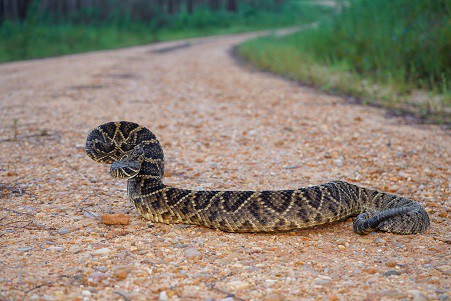
Maximum length: 251.5cm.
Among the USA’s 20-25 rattlesnakes, it’s the eastern diamondback which stands out as having a particularly myotoxic venom. This species is found in the southeast, including Florida, Georgia, Alabama and Mississippi. Within those realms, it appears in spacious woodlands, where it often takes shelter in dark mammal burrows. This species is the largest rattlesnake worldwide, but is regarded as less aggressive than the 2nd largest, the western diamondback.
An old study from 1983 tested 25 separate snake venoms. These included 6 Australian elapids and of those, the mulga and blue-bellied black snake produced a 30-70 fold rise in creatine kinase, proving strong myotoxic activity.
Among numerous vipers tested, most produced increases in creatine kinase of 2-5 fold. The eastern diamondback was an exception, producing a 20 fold rise.
This species is highly destructive to muscle tissue, and a 1991 study continued the research by isolating a specific myotoxin from the venom. This was similar in structure to myotoxins from the prairie rattlesnake in the US Midwest, another heavily myotoxic species. The prairie rattlesnake undergoes a large shift with age: juveniles contain more metalloproteinases to physically predigest large prey, whereas adult venoms shift towards myotoxins and therefore muscle tissue destruction.
| 11 | Neuwied’s false boa |
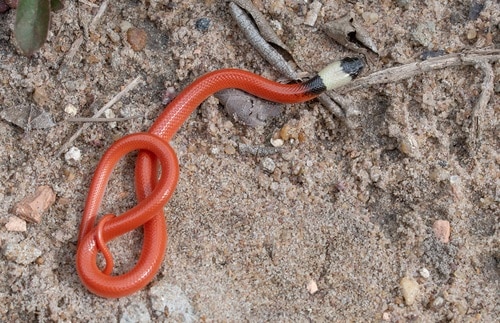
Maximum length: 121.7cm.
A quiet species of central and South America, quiet in its daily lifestyle and avoidance of humans, but also quiet in that few are aware of its powerful venom. Neuwied’s false boa belongs to the small Pseudoboa genus (6 members), and is recognisable by a red body with a black face, a white lower head, and then a black neck before the sea of red resumes.
This species begins in southern Costa Rica, covers most of Panama, and occupies most of northern South America, including Colombia, Venezuela, French Guiana, northern Brazil and Suriname. Its diet contains mostly reptiles, including Amazon racerunners, lava lizards and fellow snakes such as Trinidad snail eaters.
A 2017 study examined two poorly studied snakes: Neuwied’s false boa and Erythrolamprus bizona. The latter is a common coral snake mimic, which covers a similar territory to Neuwied’s false boa. The study found a variety of effects, including moderate neurotoxic effects, with both venoms causing a neuromuscular blockade. The two had proteolytic effects, degrading protein tissues across the body, with E. bizona being the stronger.
The final symptom was myotoxicity, direct damage to muscle fibres. Both snakes had myotoxic powers, but in this case, Neuwied’s false boa was stronger.