
| 1 | The world’s highest climbing snake |
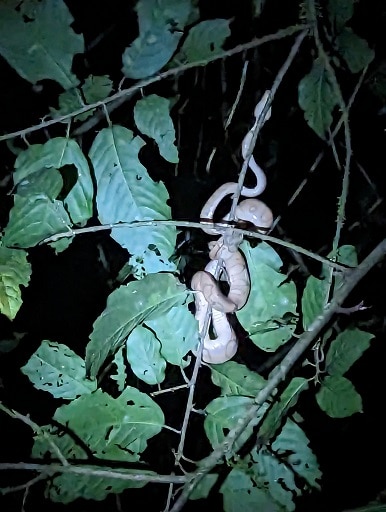
The ringed tree boa (Corallus annulatus) is a non-venomous species of Central America, which appears in deep forests, and is only rarely encountered by humans. It’s a moderately widespread species, appearing in 5 known countries: Honduras, Nicaragua, Colombia, Panama, and Costa Rica, with the last two being its main bases.
Compared to other boas, this species is only medium in size, with an all-time record length of 172.5cm, versus over 4 metres for the boa constrictor. Nevertheless, the ringed tree boa compensates with a great skill: being one of the greatest climbers in the entire snake kingdom.
Ringed tree boas spend the vast majority of their lives on tree branches. Rather than low bushes, they’re perfectly comfortable in the towering canopies of rainforests, where the first beams of sunlight are only just beginning to shine through. Finding one at 1.5 metres above your head is perfectly normal, and 10 metres high is nothing exceptional either. In fact, the ringed tree boa has been recorded at a heart-pounding 40 metres above ground, making it the highest recorded climber of any snake worldwide.
The ringed tree boa is one of nature’s great acrobats, with the ability to hunt mammal prey while fastened to a tree branch using only its tail. It’s equally nimble when crossing delicate branches in the treetops, and has the muscular power to raise its body with just the lower third securely attached. Most of this happens far from prying eyes, as ringed tree boas are extremely difficult to find.
| 2 | A shy rainforest dweller |
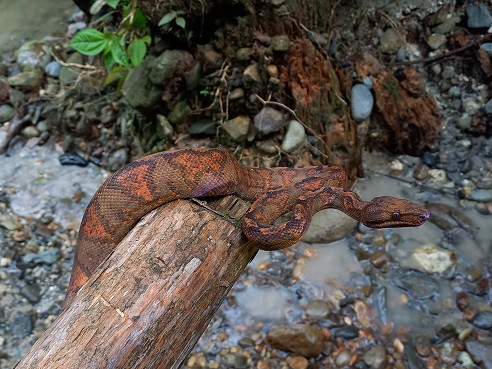
Ringed tree boas are found mainly in undisturbed lowland rainforests, at low altitudes of 0 to 650 metres. They occasionally venture to manmade structures as well, such as scientific research huts, fruit orchards, banana plantations, and agricultural land directly adjacent to forests.
Though mostly arboreal, ringed tree boas venture to the ground on occasion. They sometimes coil around bridge rails near rainforest research stations, mistaking them for branches. They can even appear on window sills, checking if there’s any prey living inside. Ringed tree boas have occasionally been found in overseas fruit shipments, despite averaging at well over 1 metre.
The older and longer a ringed tree boa, the higher the branches it will venture to. A Costa Rican study found that those with a snout to vent length (AKA length excluding the tail) of below 90cm averaged at 208.3cm high. Those with a SV length above 90cm averaged at 416.7cm, and that excluded adults high in the canopies which were impossible to spot.
| 3 | Very difficult to find |
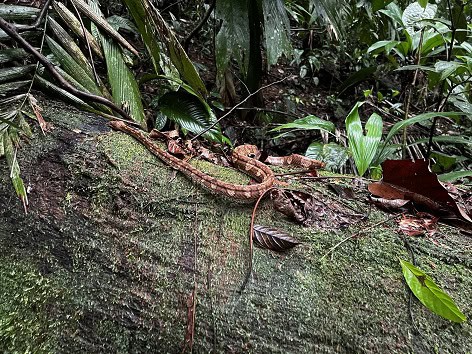
Ringed tree boas inhabit a decent stretch of territory, from Nicaragua, through Costa Rica and Panama to Colombia. However, they’re extremely uncommon within that territory, and spotting one is a very lucky experience to have.
One survey was conducted in Costa Rica’s Caño Palma Biological Station. Over a ten year period, the scientists encountered just 26 ringed tree boas. Another herpetologist spent 10 years searching before finally encountering just one.
For whatever reason, this species is naturally sparse, never gathering in vast colonies like garter snakes or even some US rattlesnakes. The scientists’ best detection trick was eyeshine – ringed tree boas have naturally reflective orange eyes, which show up vividly in the blare of a torch.
Actually attempting to find a ringed tree boa is an epic task, far more difficult than finding a boa constrictor. Speaking to village locals may give you clues, or following studies like above which point you to certain research stations. Tortuguero National Park in Costa Rica is one confirmed area they inhabit.
Even then though, ringed tree boas are nocturnal creatures which are difficult to actually encounter. They can ascend so high in tree canopies that you might walk right below one without noticing, condemning your 3 week expedition to failure when you were only an upwards glance away from success.
| 4 | Turns savage if provoked |
The ringed tree boa isn’t an aggressive, violent snake. It won’t spot you, freeze for a second, then engage in a brutal charge. It’s perfectly possible to walk under one resting on a branch and suffer no ill effects. However, if you decide to touch this species, then it tends to bite instantly. It bites without hesitation, and with long (though non-venomous) front fangs, this bite can be extremely painful.
A ringed tree boa’s usual response when approached is to move upwards. With such excellent climbing skills, this snake effectively lives in a 4D world, whereas humans live in 3D. Ringed tree boas can gain a few metres in height and instantly escape a threat, balanced precariously using their thin bodies.
Corallus annulatus also has subtler defensive techniques. These include coiling up into a ball to shield its head, and producing a vile serpent smell to force aggressors into leaving the vicinity. The final strategy is tail vibration, swishing it against vegetation to produce a loud buzzing sound.
| 5 | Sharp fangs for gripping prey |
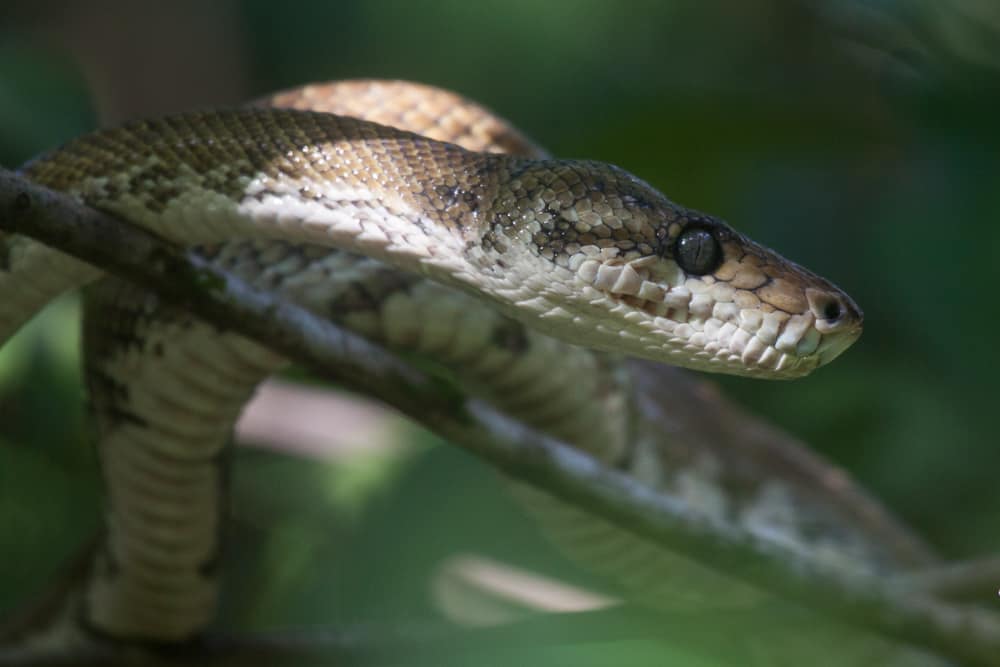
The ringed tree boa is easily recognisable thanks to two characteristics: its slender neck and head, and its namesake rings. The name Corallus annulatus is derived from “annulus”, the Latin word for ringed, and these circular patterns distinguish the species from the Central American boa (Boa imperator), another species found in its territories.
Ringed tree boas are nocturnal, foraging during night and deactivating completely during the day, often while still clinging to perches 10 metres high. They sometimes hide under loose bark or leaf litter during the day, particularly juveniles. Like all boas, their pupils are sharply vertical.
One interesting thing about ringed tree boas is how they’re constantly coiling. In photographs, it’s extremely rare to see one with a fully straight body. This is designed for hunting, as clinging to branches in a constantly coiled position allows them to lunge at passing prey with propulsive force, without wasting valuable seconds shifting into position.
Ringed tree boas always strike with their mouth bared wide, allowing them to instantly seize prey. Their front fangs are long and needle-like, and designed not to inflict wounds, but to keep hold of small forest creatures. Like most boas, Corallus annulatus constricts its prey before swallowing them whole.
| 6 | Many colour variations |
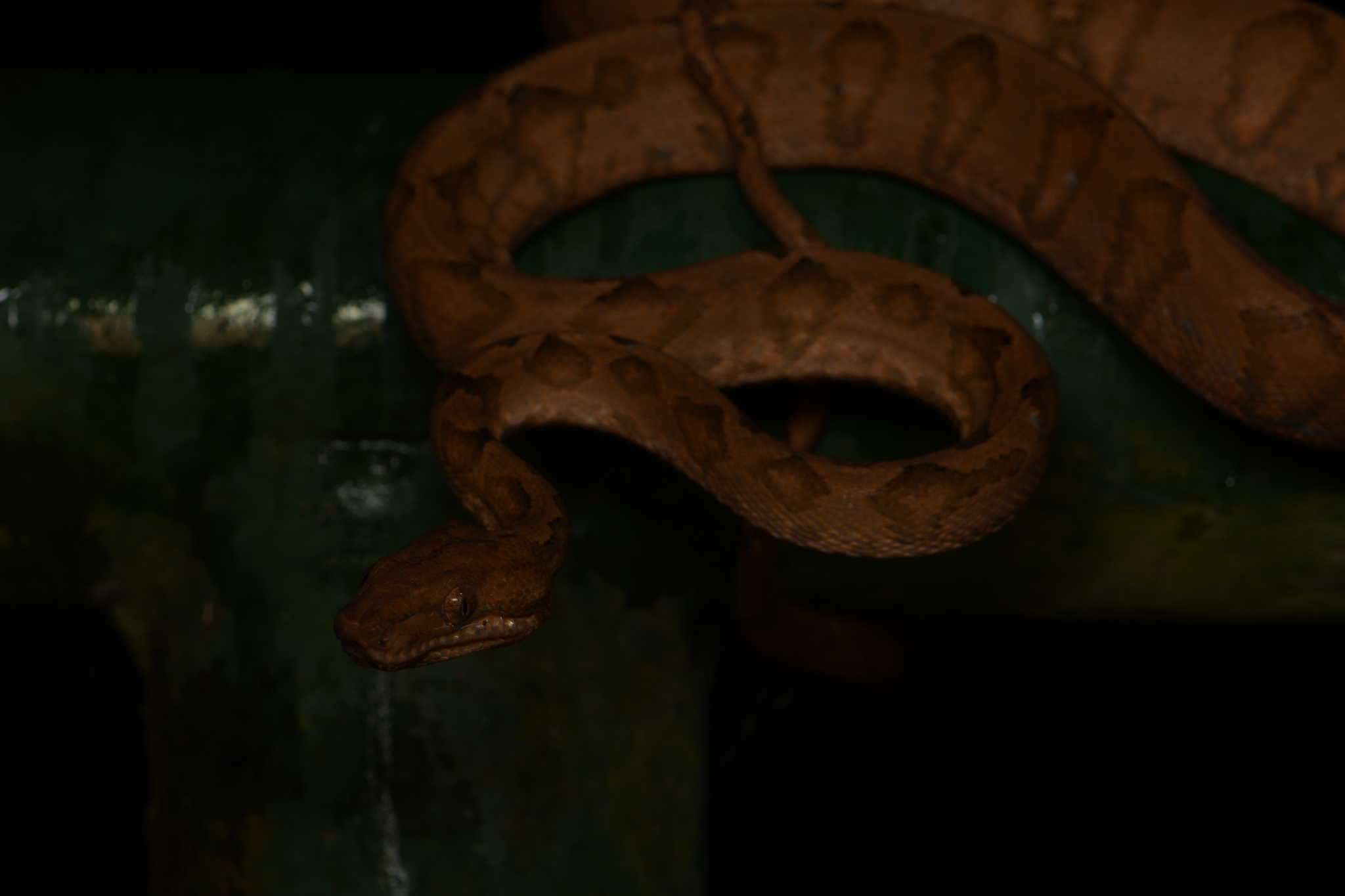
The ringed tree boa is a multicoloured snake, which can display numerous colours of the rainbow within the same location. Dull orange is the most common colour, with the signature rings being a slightly darker shade. Some are a much more vibrant orange, with vivid blotches resembling sizzling patches of lava on their back. There’s also grey versions, interspersed with brown.
Then you have almost everything inbetween – eternally varying combinations of orange, brown and grey, with even patches of pink occasionally popping up (see here). This species is a herper’s dream, as while some are duller, others are fabulously colourful, and searching for the coolest morph could take a lifetime.
In Costa Rica’s Caño Palma Biological Station, scientists once spotted a jet black ringed tree boa. Initially, they assumed this to be melanistic, a condition occasionally found in all snakes, where melanin genes go into overdrive and destroy all else (like a reverse albinism). However, there were still light markings on its underside, revealing it to be a genuine black morph.
| 7 | A medium-sized boa |
Corallus annulatus is a medium length boa, at an average of 90-120cm. In some places, its maximum length is listed as 165cm. However, the largest ringed tree boa ever was discovered in Guatemala, and measured 172.5cm. A female of 154.4cm was once found in Costa Rica.
Meanwhile, the largest Amazon tree boa of all time measured 187.6cm. That said, ringed tree boas are so elusive that longer monsters may be lurking out there, in obscure rainforests near some poorly manned research station being hammered by constant rainfall.
Compared to the boa constrictor, ringed tree boas are much thinner-bodied, reducing weight on branches, preventing them from snapping. They possess the usual pits between their nostrils and eyes, which are heat-sensing IR pits which grant them rudimentary night vision. These allow them to detect minute changes in temperature from their prey to the surrounding environment.
Ringed tree boas are also recognisable by a head which is far wider than the neck, and they have an especially long tail, again fuelling their tree-climbing dreams.
| 8 | Has a taste for bats |
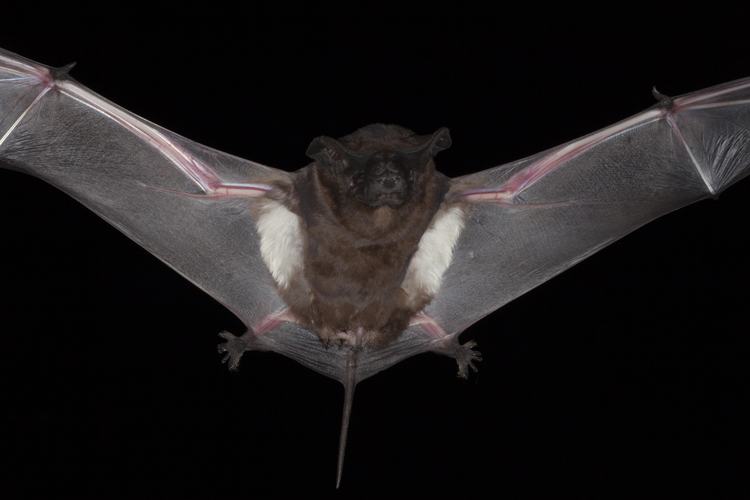
Ringed tree boas eat a combined diet of birds and mammals. No detailed diet studies exist yet, but their confirmed avian prey include red-capped manakins (Ceratopipra mentalis) and Canada warblers (Cardellina canadensis). They have a strong taste for bats as well, as in a Costa Rican study, they preyed on one species twice: the Brazilian long-nosed bat (Wilsonia canadensis). Bat-hunting is also common in their cousin, the Amazon tree boa.
Ringed tree boas can grab bats from natural locations like swamp palms and dark manmade structures like research station buildings. As adults, they’re mainly ambush predators, coiling tightly around one branch above a forest floor section they perceive to be a small mammal trail. Juveniles are thought to be more active foragers, swinging from branches and investigating odours, until they spy a rodent they can sneak up on.
Though mainly an ambush predator, the ringed tree boa is significantly more mobile than its cousin the emerald tree boa (Corallus caninus), which can go days or even weeks without moving.
| 9 | Divided into pockets |
Ringed tree boas have a discontinuous range, which is split into several pockets. For example, there’s a large gap between their territory from northeast Honduras to southeast Nicaragua. In Costa Rica, they’re fairly constant, before another large gap opens up between southern Panama and northwest Colombia.
It’s also possible that ringed tree boas do inhabit these no man’s lands, but are so secretive that nobody has detected them. As a rule, ringed tree boas are far more common in Costa Rica along the Atlantic coast to the north, rather than the Pacific coast to the south (though there’s still a few pockets).
Ringed tree boas lay live young, in an average total of 13. They have a particularly long gestation period, lasting 6-7 months.
One skill they possess which a cobra could never dream of is sharp spurs on their lower body, remnants of the hind legs possessed by their reptile ancestors over 100 million years ago. Most snakes lack these spurs, but they’re normal for boas, the most primitive, unevolved family of living snakes. They’re assumed to be used for wooing ladies, with males scratching females to get their attention (an attempt she sometimes ignores). These spurs are a strong way to identify the gender of a ringed tree boa – males have longer ones than females.
| 10 | The Ecuadorian colony |
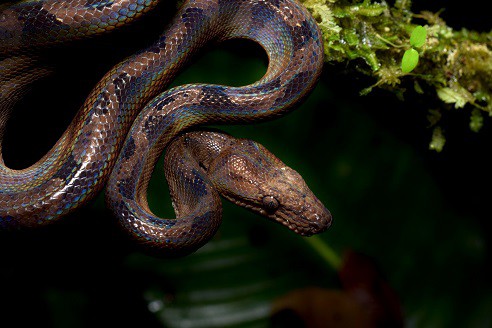
Mystery currently surrounds the population of ringed tree boas in Pacific Ecuador, which lie at the southernmost extent of the species’ territory. Until 2001, these were considered to be a subspecies called Corallus annulatus blombergi. But now, they’ve been elevated into an independent species – the Ecuadorian annulated tree boa (Corallus blombergi), adding a 9th member to the Corallus tree boa genus.
At first glance, the two species are similar enough that Corallus blombergi could be a mere morph, but there are a few subtler differences…
- In ringed tree boas, the centre of the ringed blotches matches the body colour, while in Corallus blombergi, the centre is paler.
- Corallus blombergi has a strong tendency to be milk chocolate brown, rather than orange for the ringed tree boa.
- In ringed tree boas, the lower body blotches tend to be 9-10 scales wide, compared with 7-8 scales in Corallus blombergi.
This new species is found in Ecuador, exclusively to the west of the Andes, at altitudes below 200 metres. In 2017, it was discovered in Colombia for the very first time, in the southern province of Tumaco. Ringed tree boas have been spotted a few miles to the north, meaning that the two species may have a slight area of overlap.
This article contains close ups of Corallus annulatus and Corallus blombergi faces side by side – from our perspective, it also appears that ringed tree boas have a more upturned snout than their cousin.