
| 1 | The most common snail-eater |
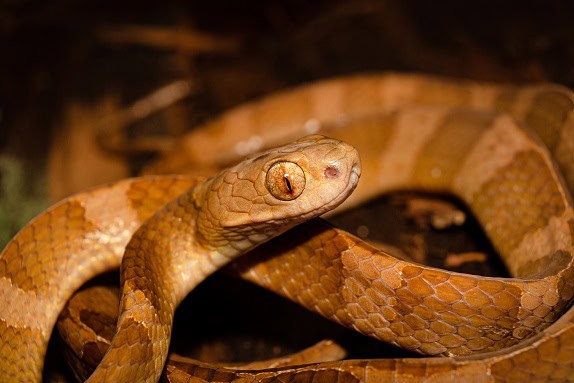
Central and South America are overflowing with snail-eating snakes, all of which are completely harmless, and derive virtually all of their meals from snails and slugs. The Sibon genus has 24 members as of 2026, and the Dipsas genus has over 50, both of which have received multiple newly discovered species over the last 10 years. Across these dozens of species, the most widespread and successful is probably the neotropical snail-eater (Dipsas indica).
This species reaches a maximum size of 115.3cm, and is generally 60-80cm. It’s slow-moving and patient, and typically found on bushes and tree branches 50cm to 3 metres above ground, but occasionally as high as 12 metres. It poses virtually no threat to humans at all, with no front fangs, in order to make swallowing its slimy meals easier.
Neotropical snail-eaters are widespread, appearing across the entire Amazon rainforest region, and also the Atlantic forests of southeast Brazil, e.g. near São Paulo and Rio de Janeiro. They inhabit the following countries: Brazil, eastern Ecuador, eastern Peru, eastern Colombia, Venezuela, Suriname, Guyana, and northern Bolivia, plus the territory of French Guiana. Countries they skip include Trinidad and Tobago, Argentina, Paraguay, and Uruguay.
| 2 | Loves rainfall and drizzle |
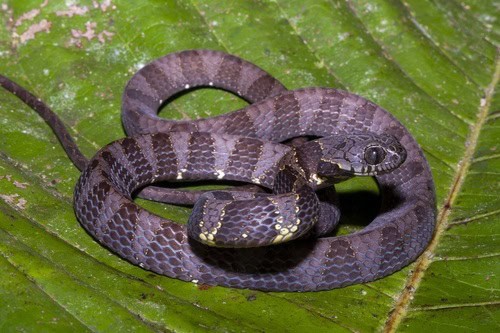
On a sunny, warm day in the rainforest, you’re highly unlikely to find a neotropical snail-eater. They’ll be around, sure, but they’ll be lurking in their tree trunk hollows or between tightly packed stems and foliage, not wanting to expose themselves. If you’re lucky, you may catch a single glimpse of a hyper-detailed eye before spinning around frantically trying to locate it again.
Instead, neotropical snail-eaters are most active at night, and particularly, they’re most active during drizzle or rainy conditions. Some South American snakes like the mussurana (a notorious snake-eater) prefer to come out after heavy rainfall, but the neotropical snail-eater prefers the wetness and chaos of rain itself.
The obvious reason is that snails and slugs are more prolific in moist conditions. The neotropical snail-eater must time its hunting sessions perfectly to maximise the chances of success. It’s also possible that Dipsas indica‘s predators are less active during rainy, drenched conditions. This snake is utterly defenceless, with no ability to fight back.
| 3 | Cunningly follows mucous trails |
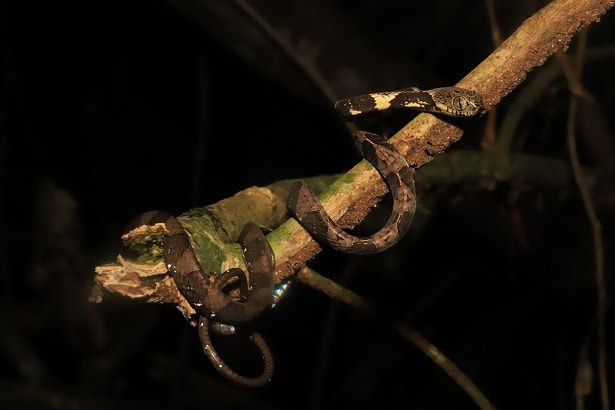
Neotropical snail-eaters are capable of grabbing snails on the ground, green leaves, tree branches and even the flimsiest stems of plants. The hard part is tracking the snails down in the first place… at least for a human. Dipsas indica has a cunning strategy, as it doesn’t search for the snails or slugs themselves. Instead, it searches for their mucous trails, the thin layer of slime left behind whenever they inch forward.
This was documented in a 1989 study from São Paulo state, southeast Brazil (Reserva Mata de Santa Genebra). The scientist found 14 neotropical snail-eaters active at night, including 11 on the ground, and 3 above ground, one of which was clinging to a barbed wire fence.
One neotropical snail-eater paused on the bare ground, and angled its snout downwards, towards what later turned out to be a mucous trail. It then followed the line of the trail for 2 metres, into thick undergrowth, disappearing out of sight.
| 4 | Slug-eating tactics |
The same study documented Dipsas indica feeding on wild slugs, and a few slug meals which the scientist had carefully placed.
With slugs, the snakes had an easier time than with snails. Once they reached the source of the mucous trail, they flecked their tongues towards the slug, then touched its slimy body with their tongue, ranging from once to several times. They aimed their snouts towards the ground, with their large, bulbous eyes focussed keenly on the slug. Then the snake raised its head, gaped its mouth wide, and lunged aggressively at its future meal, placing a firm bite on its mid-section.
From this point on, the hunting process was easy, if laborious. The result was a foregone conclusion, as the neotropical snail-eater lifted the slug cleanly off the ground, and began swallowing tail-first.
The snake’s strategy was to gradually advance its lower jaw along the slug’s body, with repeated alternating advancements of its left and right mandibles (lower jaw bones). Then the retraction phase began, as the snake dragged the slimy slug ever further down its mouth by reversing its extended lower jaw.
Medium-sized slugs in the study measured 3-6cm long, and these were swallowed in just 20-45 seconds, relatively quickly for a snake. Small slugs were swallowed in less than 10 seconds.
| 5 | Snail-eating tactics |
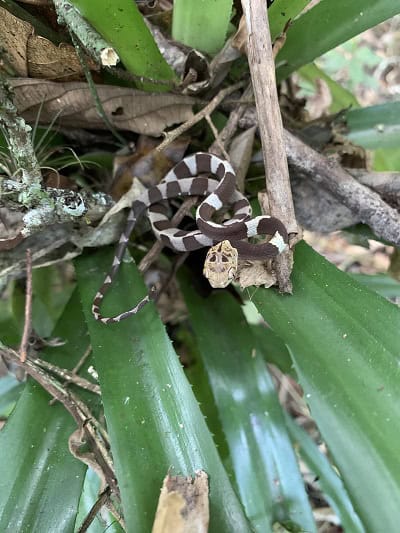
All that sounds very complicated, but it’s second nature to a neotropical snail-eater. They’ve practised slug-sucking many, many times over their humble existence, but snails are a slightly trickier meal, which requires more care.
The beginning processes are identical: following a mucous trail to a snail in long grass, on a leaf, or in a makeshift chamber in rotting tree bark. The 1989 study made more detailed observations. Several neotropical snail-eaters were observed, and after reaching their snails, they typically paused and gazed at their prize for a while. The goal here was to wait for the snail to emerge from its shell briefly, before unleashing a perfectly timed ambush.
When the time came, the neotropical snail-eaters performed a sudden lunge, connecting at the mid-section. They jerked their heads, lifting the snail off the ground.
So far, so similar to the slug assault, but with snails, Dipsas indica applied a constricting coil to the shell. This only appeared at the beginning of the feeding process, and was used to press the shell against its body, as it began inserting its lower jaw into the shell opening.
| 6 | Walkable lower jaw |
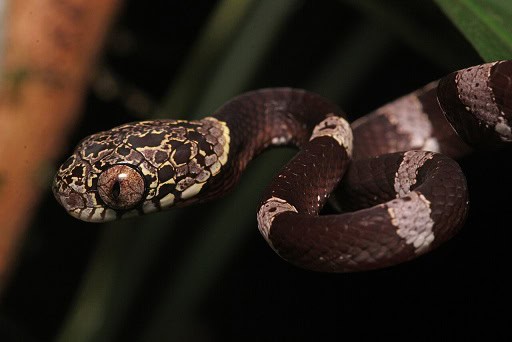
The goal of the snakes was to somehow suck the body free from the shell. They achieved this using the same jaw-walking method as with slugs: moving each jaw bone forward in alternating movements.
Neotropical snail-eaters have advanced, flexible jaw bones to make this happen; a viper could never manage such a feat. Eventually, one third of the lower jaw was inserted into the shell. Even the skin of the lower jaw retreated backwards to allow the extension.
Meanwhile, the snail was assumed to be retreating deeper to avoid the jaws (or lower jaw) of death. Nevertheless, the snail-eater always acquired its prize, taking 70 to 325 seconds to succeed in the study, with an average of 120 seconds after contact was made. Once the lower jaw was far enough into the shell, the neotropical snail-eater released its constricting coil on the shell, usually well before acquiring the snail’s body.
On each side, the snail-eaters made 16 to 25 advancements of each lower jaw bone (mandible). This was higher than with the slugs, with medium-sized slugs requiring 6 to 15 advancements on each side.
| 7 | Extremely large eyes |
The study captured some great images (albeit in black and white), including of Dispas indica with its eyes fixed keenly on the shell, waiting patiently for the slimy snail to poke its head out. This species seems to have immense patience. Neotropical snail-eaters have huge eyes relative to their size, which are believed to help in judging their distance from the snail, thus helping them to time their final, fateful pounce.
The real key to Dipsas indica‘s success is its hyper-extendable lower jaw. The upper jaw is used for gripping; it’s the lower jaw which advances and seizes the slimy body. This is the opposite to some blind snakes like the Texas blind snake, which has an extendable upper jaw with the goal of raking scurrying ants into its mouth, after locating the anthill (again via a scent trail).
Neotropical snail-eaters aren’t ambush predators, unlike boa constrictors or anacondas. Instead, they just search far and wide for the beginning of a trail, but in their swarming rainforests, they don’t have to wait too long.
| 8 | A mysterious jawline secretion |
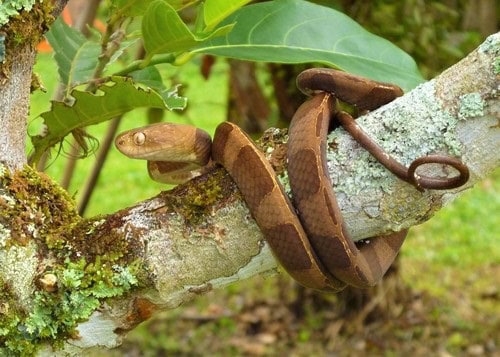
A 2008 study also revealed some hidden details about the neotropical snail-eater. It analysed two other harmless snakes as well, the Brazilian slug-eating snake (Dipsas mikanii) and
reticulate ground snake (Atractus reticulatus).
One discovery was that Dipsas indica had particularly well-developed muscles in its lower jaw. This is what you’d expect given its heroic snail sucking feats. But more interesting was an infralabial gland, found in the lower lip area. These glands had been known in snakes for years, yet rarely analysed. In Dispas indica, the gland was thin and elongated, with a length of 16mm and a width of 1.7mm, covering 70% of the snake’s head length. Most importantly, the gland released a mysterious mucous-like substance.
The composition of the secretion wasn’t analysed, but the scientists had a strong suspicion: that it acted as a hidden venom which could paralyse the mollusks’ slimy body, allowing for much easier retrieval from its shelled armour. Another possibility is that it lubricates the prey’s body.
The lower jaw contained a muscle which pressed against the infralabial gland, helping to force the secretion out. This was originally found in a separate species, the variegated snail-eater, before being discovered in the neotropical snail-eater in this study.
| 9 | Defensive techniques (fear) |
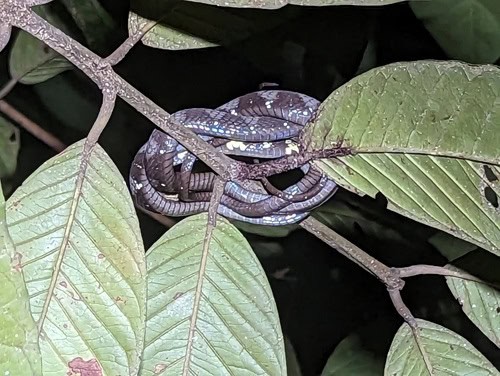
The neotropical snail-eater has taken over South America, despite being harmless, mainly because it’s highly specialised in its dietary niche. It would fail miserably to catch a fleeing mouse, or digest the toxic venom of a viper, but in the realm of snails and slugs it’s unbeatable.
Nevertheless, Dipsas indica has various defensive techniques as well. One is Batesian mimicry – its patterns bear a close resemblance to venomous lanceheads, such as the lethal jararaca in southeast Brazil. It varies in colour, but tends to be relatively dull, like most ground-based vipers.
Dipsas indica has a highly evolved skull in more ways than one – it can change its shape at will. Various Dipsas snail-eaters can flex bones to make their heads more triangular, to mimic vipers, and gain a deceptive safety shield. The tropical snail-eater of Colombia (common near Bogotá) is one great example, and Dipsas indica also possess this shocking ability.
| 10 | Convergent evolution |
The neotropical snail-eater has no ability to hurt a human, except maybe by luring them into an anaconda’s lair. This species is not only non-venomous, but lacks vicious tearing fangs. The machete savane is an Amazon rainforest snake with no venom but a ripping, tearing bite; Dipsas indica would be wiser to hide.
Nevertheless, this species puts on an intimidating display of bluff aggression, making false, jabbing strikes into the air, which it knows deep down it can never back up with genuine force. Combined with its viper-like patterns, this might be enough to force predators or villagers to leave. Other survival techniques include releasing a vile serpent smell, S-coiling like a viper, and raising the body menacingly.
Another strange fact is that when hunting slugs, the neotropical snail-eater acted extremely similarly to the common slug eater (Duberria lutrix) of southern Africa, despite the thousands of miles separating them. Somehow, the two have converged despite their lack of any relation.
| 11 | ID signs (patterns and eyes) |
South America is full of snail-eaters, but the neotropical snail-eater has a few clear ID signs. Firstly, its colour is variable, ranging from grey to brown to even pinkish. However, its patterns of thick, alternating bars with a semi-triangular shape are nearly always consistent. These dark bands are wider at the bottom, thinning as they approach the spine. The paler sections are wider along the spine.
In a few morphs, the dark and paler colours merge together, like in this brown morph. Nevertheless, the triangular bands are always faintly visible.
Another ID sign is the eyes. These have vertical pupils, but most importantly, are relatively pale, compared to some neighbouring species like the Brazilian slug-eater (Dipsas mikanii) and Catesby’s snail-eater of the Amazon. The eyes also vary in colour, from grey to orange to beige, but are always pale enough to clearly distinguish the pupils. The only morph which has darker eyes is the purple morph.
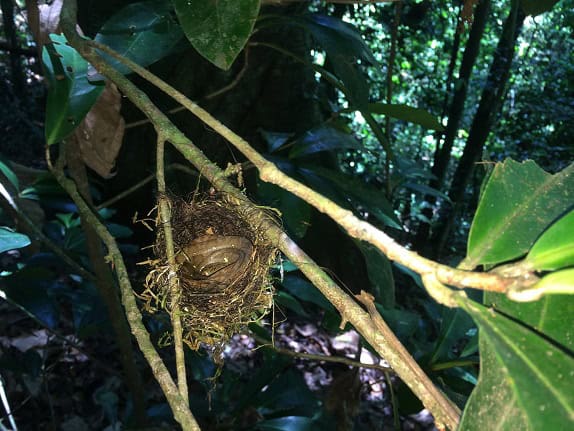
Dipsas indica is an egg-laying species, with one recorded clutch containing 5 eggs. During the day, this snake has occasionally been found resting in birds’ nests. Another common hideout is beneath layers of leaf litter on the forest floor, and its murky colours aid this, as beige-grey blends with leaves far more easily than green.