
| 1 | Black-headed snake |
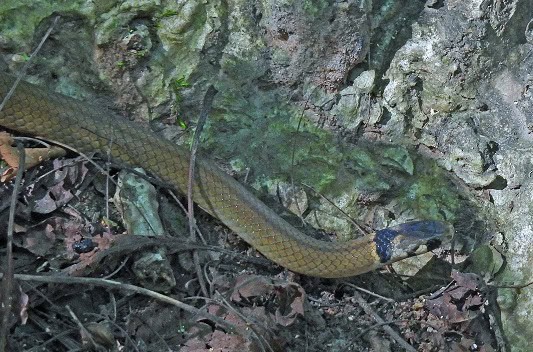
Maximum length: 43.5cm.
Eaten by: American pipe snake, common lancehead, Rio tropical racer, crowned false boa, false coral snake (E. bizona).
Some snakes have the honour of being large enough, cunning enough, and even venom-resistant enough that they can swallow fellow snakes at will and not worry about any repercussions. The main snake-swallower in South America is the mussurana, but at the opposite end, you have snakes which are very low on the food chain.
One example in South America is the black-headed snake (Tantilla melanocephala). This species preys almost entirely on centipedes, with a small handful of insects. It lacks any form of venom, or a painful bite, and only occasionally exceeds 40cm.
Consequently, this species is eaten by 5 confirmed neighbouring snakes, and that’s only the ones we’re aware of. One is the lethal common lancehead, which doesn’t even focus on snakes preferentially, yet can’t resist such an easy meal. The likes of American pipe snakes and false coral snakes eat snakes more commonly, and make plenty of room for the black-headed snake.
The black-headed snake is a weak snake, with few defences if exposed. Yet there’s a redeeming element to this story; this is the single most common small, harmless snake in South America. Black-headed snakes inhabit all countries of the continent except for Chile and Uruguay, spreading from Colombia through Brazil to Argentina. They’re constantly eaten by other snakes, yet are somehow still thriving.
| 2 | DeKay’s brown snake |
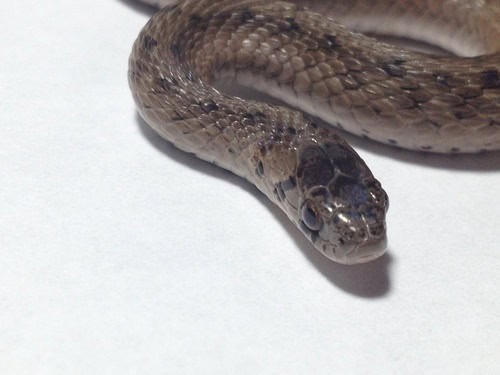
Maximum length: 52.7cm.
Eaten by: copperhead, Texas coral snake, speckled kingsnake, black kingsnake, cottonmouth, black racer.
A popular snake meal of the eastern USA. DeKay’s brown snake (Storeria dekayi) is common in urban parks and rural woodlands alike and covers almost the entire eastern half of the USA. Its diet consists of slugs and earthworms, which it lords over hungrily, shocking them as a gigantic serpent face sweeps in for the kill. Unfortunately, the same applies to them, as DeKay’s brown snakes are regularly startled by giant kingsnakes opening their mouths greedily.
DeKay’s brown snakes are hunted by 6 confirmed snakes so far, including two vipers and two kingsnakes. They’re neither safe in swamps (cottonmouths) nor forests (copperheads), and even open parks and grasslands are a potential minefield (black racer).
DeKay’s brown snakes are harmless, with no venom. However, they do have a variety of defensive techniques. The first is releasing a disgusting smell, forcing you to drop them. Whether this works on fellow snakes is still a mystery.
The second is baring their mouths and unleashing a vicious mock strike, while the third is faking death by flipping over and going completely limp. These are only used if DeKay’s brown snake is discovered, as its final overarching strategy is more basic: staying hidden, by blending with the cluttered undergrowth using its dull brown scales.
| 3 | Red-lipped snake |
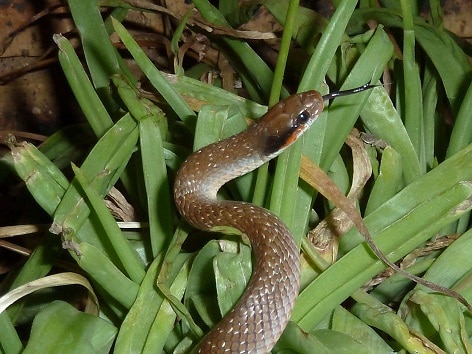
Maximum length: 89.1cm.
Eaten by: purple glossed snake, shieldnose snake, cape file snake, Bibron’s stiletto snake.
Probably the most common frog and toad-eating snake in sub-Saharan Africa. This species is extremely widespread, ranging from most of South Africa to as far northwest as Senegal.
Red-lipped snakes lack any venom, but have a few cool defensive techniques. The most striking is head triangulation, where they instinctively shift bones in their own skull to more closely resemble a viper, and therefore trick predators into thinking they’re venomous.
Whether this is targeted towards birds, snakes or primates, we don’t know. But we do know that red-lipped snakes are eaten by 4 confirmed snake predators so far, including the shieldnose snake, a dangerously venomous relative of the cobras. Bibron’s stiletto snake is a burrowing, jet black snake, which typically comes to the surface after rainfall. It’s also dangerously venomous, and confirmed to prey on the red-lipped snake.
Another skill of the red-lipped snake is changing colour, shifting from black to brown to greenish depending on the temperature.
| 4 | Brown-banded watersnake |
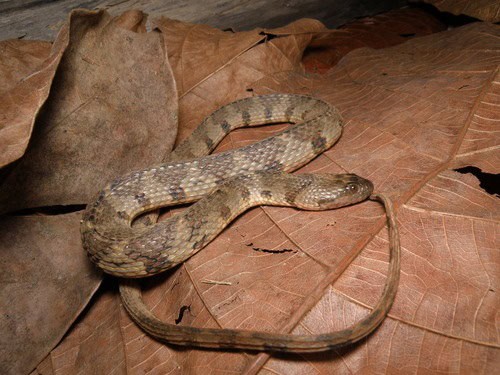
Maximum length: 113cm.
Eaten by: yellow-tailed indigo snake, mussurana, green anaconda, itself.
The brown-banded watersnake (Helicops angulatus) is a master of disguise, with brown scales to blend with shoreline mud, and upwards-angled eyes to see clearly while submerged. Despite this, it regularly wakes up to find itself inside a fellow snake’s stomach.
This species is found across the Amazonian region of South America, sticking to marshes, rainforest rivers and other water bodies. It isn’t fully aquatic, and prefers the muddy shores, where it can disguise itself, and search for earthworms sliming around in the soil.
This territory regularly brings the brown-banded watersnake across the path of the green anaconda, and sometimes into its mouth. It’s also a confirmed victim of cannibalism, and two heavy snake predators: the mussurana (South America’s main snake-eating snake) and the yellow-tailed indigo snake.
Brown-banded watersnakes are also nocturnal, combining murky colours with reduced visibility, in an attempt to stay alive. Yet the green anaconda is such a master of its rainforest rivers that this doesn’t always succeed.
| 5 | Yellow-bellied liophis |
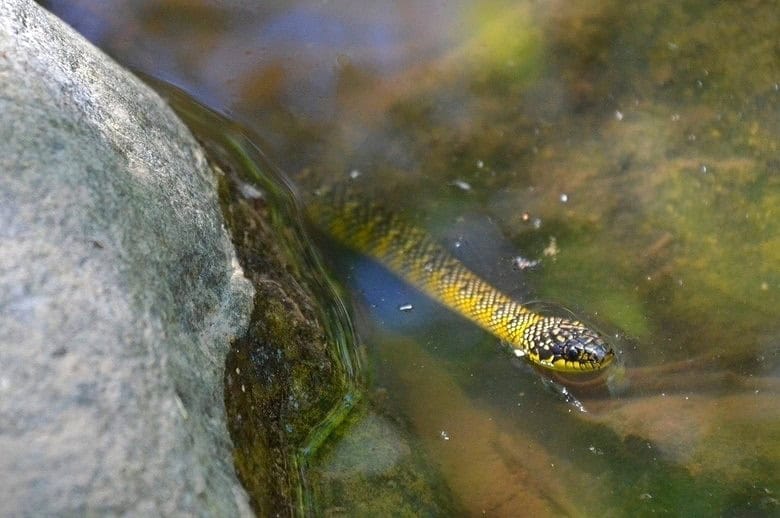
Maximum length: 112.1cm.
Eaten by: Aesculapian false coral snake, Patagonia green racer, Brazilian smooth snake, false mussurana.
Perhaps the most abundant and widespread snake in southeast Brazil. This species is recognisable by a maximum length of just over 1 metre, and sharply alternating yellow and black speckles. The yellow-bellied liophis derives 98% of its meals from frogs and toads, but also becomes a meal itself for numerous snakes.
The yellow-bellied liophis is a semi-aquatic species, appearing in ponds and marshes, and one of its predators is also semi-aquatic: the Brazilian smooth snake. Two are moderately venomous, the false mussurana and Patagonia green racer, while the Aesculapian false coral snake is a heavily snake-eating snake (90% of its diet).
Yellow-bellied liophises are also common in Paraguay, sharing space with the yellow anaconda. They’re almost a mini-me of the yellow anaconda, sharing the same yellow-black colours, but not the brutish length of 3-4 metres. Yellow anacondas are confirmed to eat snakes occasionally, so they too may be a yellow-bellied liophis predator.
Yellow-bellied liophises are venomous, not quite moderately, but more than mildly, as one victim experienced a swollen hand lasting for 7 hours.
| 6 | Cape wolf snake |
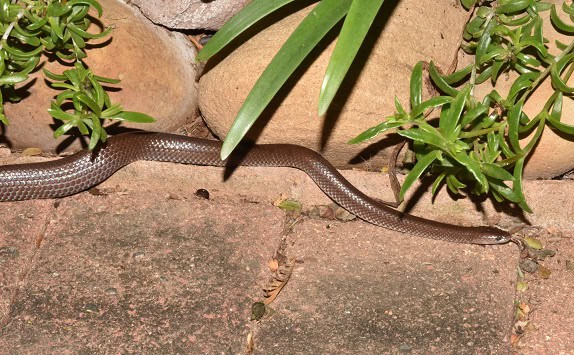
Maximum length: 65cm.
Eaten by: cape file snake, Mozambique spitting cobra, purple glossed snake, Bibron’s stiletto snake, shieldnose snake.
The cape wolf snake is found in South Africa, Zimbabwe, Kenya and more, and is completely non-venomous. This species’ main defensive method is a memorable one: coiling up into a tight ball to protect its brain. It’s one of the main balling snakes in Africa, alongside the ball python and the common slug eater. Yet this doesn’t always save them, and definitely not from fellow snakes.
This species has 5 confirmed snake predators, including the Mozambique spitting cobra, one of the most feared snakes in southern Africa. Apart from this cobra, the other four predators are identical to the red-lipped snake’s four. For example, the purple glossed snake is a harmless species which lives in soil, but has a weird dietary tendency: eating legless prey. This includes legless lizards such as worm lizards, but also fellow snakes.
Cape wolf snakes are extremely widespread, stretching from South Africa to South Sudan in the far north. Their own diet contains lizards, but isn’t fully researched.
| 7 | Glossy snake |
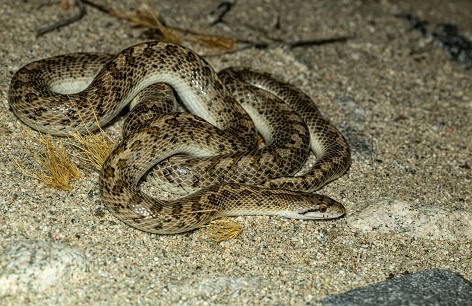
Maximum length: 177.8cm.
Eaten by: California kingsnake, Arizona coral snake, Texas coral snake, milk snake.
A harmless constrictor of the southwestern USA. This is the largest snake of our list, proving that snakes exceeding 1.5 metres can still be low on the food chain, if they lack venom or an aggressive personality.
Glossy snakes (Arizona elegans) are found in 3 US states: Arizona, New Mexico and California. They have a large altitude range, appearing from 350 to 2200 metres above sea level. They mainly appear in open areas such as grassland, desert scrubland and even actual deserts such as near Yuma, Arizona.
This is a snake with a high instinct for cover, whether it be mammal burrows or dark rock crevices. Yet sometimes there’s nowhere to hide, or a rival snake spots its scaly tail disappearing just in time, and the glossy snake becomes a meal for a larger, more aggressive snake.
Sometimes, the predatory snake might be smaller as an overall species. The Arizona coral snake is a confirmed predator, but has a maximum length of 68cm, over 1 metre shorter. Likewise, the Texas coral snake peaked at 121.3cm. Both species have a neurotoxic venom.
| 8 | Ring-necked snake |
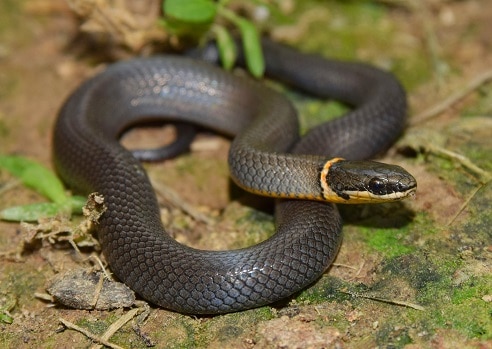
Maximum length: 85.7cm.
Eaten by: copperhead, black racer, milk snake, timber rattlesnake, black kingsnake, speckled kingsnake, California kingsnake.
The ring-necked snake is the third most widespread snake of the USA, behind only the common garter snake and the black racer. It covers 45 out of 48 lower US states, but wherever it lives, it faces constant pressure from fellow snake predators.
Ring-necked snakes are completely harmless. They prey heavily on ants, salamanders and insects, and sometimes take refuge in anthills in scenic forests. A wise choice that would be, for several of its cunning predators favour forests above all else, particularly the timber rattlesnake and copperhead, two infamous venomous species.
Ring-necked snakes rarely attack, except if their neck is touched. But even this would barely bounce off a salivating timber rattlesnake’s aggressive jaws. Ring-necked snakes have 7 known snake predators, the highest of this list, and 3 are kingsnakes, which have the strongest constriction powers proportionate to body length of any snake on Earth.
| 9 | Brongersma’s worm snake |
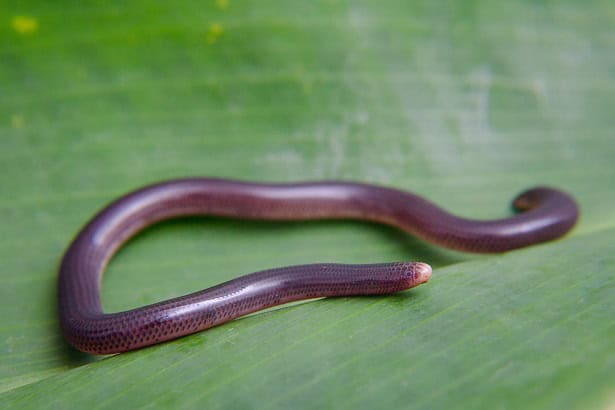
Maximum length: 32.5cm.
Eaten by: painted coral snake, double-banded coral snake, Brazilian lancehead, Argentinian coral snake.
One of the more widespread of the 200 blind snakes worldwide. This species is found all over Brazil, and spreads as far south as northern Argentina. It appears in forests, villages, and even cocoa plantations, with the gift of habitat flexibility, which has allowed it to defy its weakness and timidity and become extremely common.
Like the ring-necked snake, Brongersma’s worm snakes often eat ants, but similarly, they face many predators. 3 coral snakes are confirmed as predators, including the painted coral snake, which tops the charts for coral snake bite totals in Brazil. The Brazilian lancehead is a viper which hangs out in riparian forests, and has a very flexible diet, which extends to any blind snakes it happens to spot poking their heads out of subterranean soil chambers.
Like most blind snakes, this species spends most of its life underground. Brongersma’s worm snake has the disadvantage of not being able to see rival snakes coming, but it has the advantage of being able to dive down into the soil instantly. This species is not only tiny and able to thread through tiny insect burrows, but has natural instincts for infiltrating tiny soil tunnels.
| 10 | Redbelly snake |
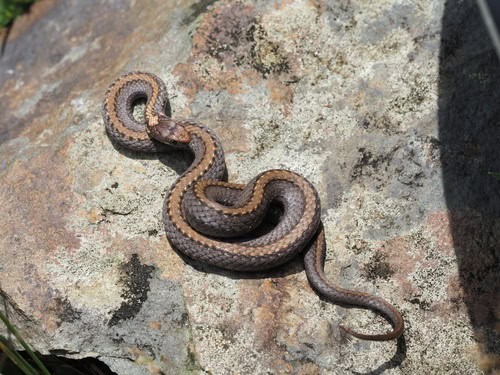
Maximum length: 40.6cm.
Eaten by: copperhead, cottonmouth, eastern coral snake, milk snake, common kingsnake, black racer.
A relative of DeKay’s brown snake, and just as low on the food chain. The redbelly snake (Storeria occipitomaculata) is found in almost the entire eastern half of the USA, just like its cousin. It also inhabits southern Canada. The main physical difference is the namesake redbelly, which is bright and vivid, and contrasts wildly with DeKay’s brown snake’s duller underside.
A similarity is a harmless, non-aggressive nature and a small size. Redbelly snakes are feasted on by the infamous viper duo of the copperhead and cottonmouth, two Lampropeltis members, and the black racer, a highly flexible species which goes anywhere it pleases and eats anything it fancies.
Meanwhile, its own diet consists almost entirely of slugs, according to a 2018 study from northern Illinois. DeKay’s brown snake was analysed in the same vicinity, and ate a slightly more flexible mixture of slugs, earthworms and snails.
The redbelly snake’s job is to not get so distracted with slugs that it fails to notice the cottonmouth sneaking up behind it. The snakes of the eastern US are searching for this snake in a demented feeding frenzy. You never know – they might swallow the redbelly snake from either end, lock lips, and accidentally eat each other.
| 11 | Rice paddy snake |
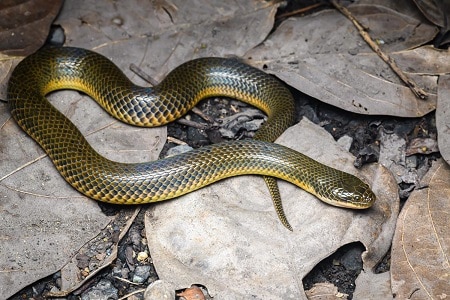
Maximum length: around 70cm.
Eaten by: Indian cobra, many-banded krait, red-tailed pipe snake, Indochinese spitting cobra.
The rice paddy snake is a species of Thailand, Vietnam and Cambodia, which usually dwells in lakes and swamps, but also appears on land after heavy rains. It preys on fish, and has aquatic adaptions such as eyes positioned unusually high on its head, to allow superior vision while submerged. The goal is to avoid predators, but this doesn’t always succeed, as rice paddy snakes are eaten by at least 4 fellow snake species, including 2 cobras, and one heavily neurotoxic species (the many-banded krait). The red-tailed pipe snake is non-venomous, but preferentially feeds on limbless prey.
Rice paddy snakes are non-venomous and small, yet they aren’t completely helpless. They do attempt to defend themselves, and their attitude depends on their location.
In the water, the rice paddy snake will flee to the opposite shore, reluctant to fight, taking advantage of its familiar environment. But out of the water, it’s much snappier and more aggressive. According to a 1963 report, “This snake will strike without provocation“. It’s possible that a few overconfident spitting cobras have got more than they bargained for and slithered away in fright back to their hollow log hideout, whimpering and nursing their wounds.