
| 1 | Texas coral snake |
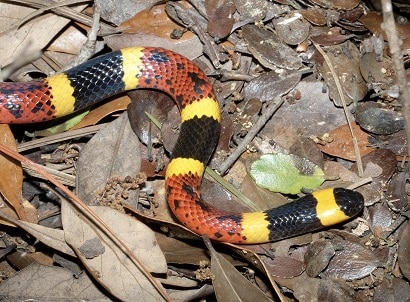
Maximum length: 121.3cm.
The western cousin of the eastern coral snake in Florida, which bears a close resemblance, but is actually a fully independent species (it was originally a subspecies). The Texas coral snake (Micrurus tener) is just as neurotoxic as its eastern cousin, and shares a love of dry, leafy forest floors.
Micrurus tener is relatively flexible for a coral snake, as it can also appear in more open plains, and pine and deciduous forests. However, its favourite habitats of all are oak woodlands, usually relatively spacious, and often those where every square foot is covered with leaf litter.
Texas coral snakes don’t have great camouflage when resting on top of leaf litter (just look at them), but they’re strong enough burrowers to disappear downwards into leaf beds, hiding themselves from predators. These leaf beds also host many of their prey species, including semi-fossorial reptiles such as the five-lined skink and little brown skink.
Texas coral snakes also derive a decent proportion of their calories from other snakes, including Texas blind snakes, ringneck snakes and DeKay’s brown snakes. As you’d expect, this snake is common in Texas, but its territory stretches to Arkansas in the north and almost to Mexico City in the south.
| 2 | Copperhead |
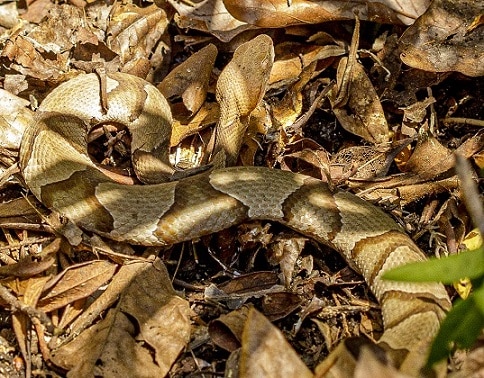
Maximum length: 134.6cm.
The copperhead spends its days on leafy woodland floors, and has one of the best disguises for doing so on the planet. Copperheads have a haemorrhagic and cytotoxic venom, and inhabit most of the eastern US, from Ohio to Texas. They’re a bulky 70-90cm, and rely on ambush tactics.
When completely still, which they commonly are, copperheads can be almost impossible to spot. Many “spot the snake” photographs have been published on the internet featuring virtually invisible copperheads – perhaps you’ve seen them.
Cottonmouths favour moderately thick woodlands rather than dense forests, particularly those with a thick coating of leaves. They sometimes bury themselves completely in leaves, but their disguise is so perfect that they blend in easily while lurking on the surface too.
It’s this disguise and their immobile ways which make them such a threat to humans. A golden eye gleaming at you from a pile of leaves might be the only chance you have. Luckily, the copperhead’s venom isn’t the worst in the world, and is usually survivable.
The cottonmouth and copperhead are closely related (Agkistrodon genus), yet have spiralled in different directions. Cottonmouths live in swamps, and are now a murky dark brown. Copperheads live in leafy woodlands, and have gained beige and light brown scales covered with vaguely triangular bands. If a cottonmouth entered these drier, autumnal worlds, it would succumb quickly, and vice versa.
| 3 | Red-banded snake |

Maximum length: 160cm.
A common species of southern China, Korea and the Ryukyu Islands of Japan. Red-banded snakes (Lycodon rufozonatus) typically measure 100cm, and possess no venom whatsoever. This snake can turn aggressive, but only if provoked or picked up.
Red-banded snakes are typically found in grasslands and woodlands, where they’re highly likely to be found resting on a thick pile of leaves. This is a relatively slow and patient snake; it’s an actively foraging species, but a patient one which flecks its tongue for lingering scent particles on leaves and logs.
Compared to the Chinese cobra not far away, there’s no comparison. Chinese cobras charge around the countryside like maniacs, almost at random, while red-banded snakes seem much more thoughtful and intelligent by comparison. They rarely climb trees, usually sticking to the leafy floors of forests.
Red-banded snakes eat confirmed prey such as the rice field frog and Japanese gecko, and also other snakes like the Tsushima Island pitviper. This is a snake you might meet if you have a picnic in the woods, or drop a coin in a leaf bed and start rummaging around frantically. Red-banded snakes also appear on beaches, where they’re confirmed to prey on sea turtles.
| 4 | Mexican jumping pitviper |
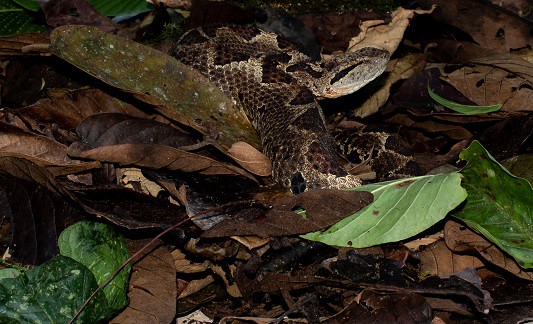
Maximum length: 69.5cm.
The Mexican jumping viper (Metlapilcoatlus nummifer) has one of the weakest skillsets of the entire viper family. This species almost never climbs trees, and lacks the stomach for a fight. Even the “jumping” name is a complete misnomer, as this viper has an unexceptional strike distance.
Instead, Metlapilcoatlus nummifer compensates by being a master of disguise, and leaf piles are one of its favourite places to lurk. This snake lives in southern Mexico, and rarely appears in open grasslands, as there’s no accumulated beds of leaves to lurk in. Instead, it appears in rainforests and cloud forests, the mulchier and more ancient, the better.
Mexican jumping vipers have a triangular head, and various shades of brown overlapping in triangular patterns. Even when moving, this species is difficult to distinguish against a thick bed of leaves. When stationary, there’s no chance.
This is a slow snake which relies completely on ambush. Even its tongue is primed for camouflage, with a brown base which gets steadily blacker towards the tip. Mexican jumping vipers average at 50cm, and bites are very rare in human beings. Poking them isn’t advised though.
| 5 | Smooth-scaled death adder |
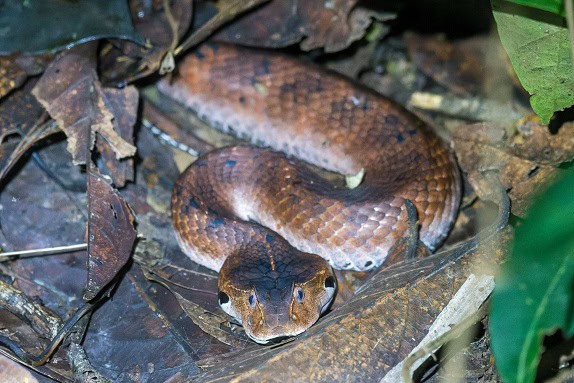
Maximum length: 100cm.
One of New Guinea’s most feared snakes. This dangerously venomous brute inhabits the Indonesian (west) half of the island, and Papua New Guinea to the east. Smooth-scaled death adders (Acanthophis laevis) average at 40-60cm, but are thick-bodied, and could probably knock a human over as they burst from their leafy piles.
This snake is dangerous not just because of its venom, but its lifestyle. If you could see this species charging at you down a hill, like a black mamba, then you’d at least know what you were dealing with, facing your nightmare head on. But instead, this species is stealthy, and loves to bury itself in piles of leaves.
This is mainly an ambush strategy, as all death adder species like to spring out at unsuspecting rodents as they walk past. With its beige-brown scales, the smooth-scaled death adder blends in perfectly, except for its relatively thick body. Alongside the Papuan black snake, this is New Guinea’s number 1 snake villain, as its leafy disguise makes it so hard to notice.
Smooth-scaled death adders also hide in bushes, but rock piles are too stiff, while fallen branches don’t cover enough area. Leaves are the ultimate invisibility cloak for this species, both for disguise and effortlessly bursting out of.
| 6 | Red bamboo snake |

Maximum length: 125cm.
A highly sought after snake by reptile keepers. The red bamboo snake once belonged to the large Elaphe ratsnake genus, but is now the sole member of the Oreocryptophis genus. Collectors cannot resist its elegant red body overlaid with black stripes, although this species is notoriously hard to find in the international reptile trade.
This snake ranges from India to Thailand and Sumatra. Just as a cow’s favourite place is a grassy field, the red bamboo snake loves nothing more than a leafy forest floor. By pointing its thin head downwards and digging, it can bury itself in these leaves and become invisible to passers-by.
Red bamboo snakes are usually found under cover of some kind, often logs and rocks, but usually leaves. Forests are their home, and they prefer cooler conditions, at altitudes of 800 metres or more. Damp mountain forests are their main base.
With striking red colours, you’d think that red bamboo snakes would stick out, but they disappear effortlessly in fallen leaves. They’re less adventurous than many ratsnakes, and usually wait calmly in their leafy disguises, hoping for rodents to walk past. Mammals are their main prey, and they happily swallow rats in captivity.
| 7 | Dwarf reed snake |
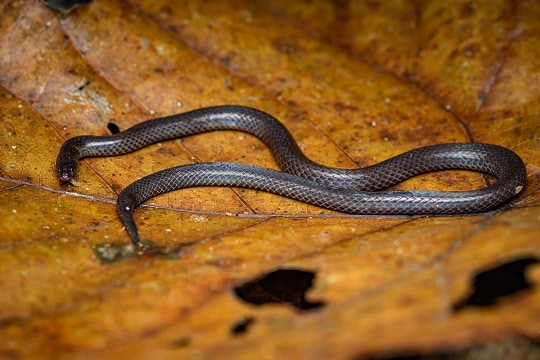
Maximum length: 23cm.
A semi-fossorial species, which spends much of its time underground. When they do surface, they usually stay in a comforting bed of leaves. Dwarf reed snakes (Pseudorabdion longiceps) are most common in peninsular Malaysia and Singapore, and are extremely docile. They’ve gained fame on the internet for their bizarre method of escape from predators, which looks kind of like cartwheeling.
Dwarf reed snakes have very small mouths, which probably couldn’t even pierce a human finger. They’re completely harmless to large animals as well, and hence, they’ve made the choice to live in thick beds of leaves, in humid forests.
Life is comfortable in their leafy worlds, as their earthworm prey are found in abundance directly below. If exhausted after a hard day of rummaging through leaves, the dwarf reed snake can switch off and go to sleep instantly, knowing that it’s invisible to the birds above.
Ground animals are another story, as a king cobra (a top snake predator) rummaging through a leaf bed could easily unearth the dwarf reed snake and swallow it whole. Nevertheless, it’s better to be harmless and hidden than harmless and completely exposed, and that’s the choice the dwarf reed snake has made.
| 8 | Pine woods snake |
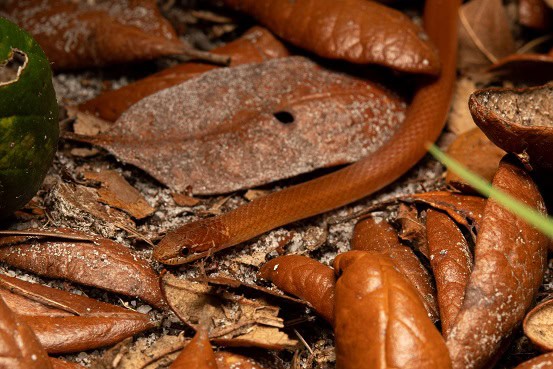
Maximum length: 40.2cm.
Some snakes are thin and ultra green, to mimic a swinging vine. Some are so venomous that birds won’t go anywhere near them. Blending into thick leaf beds in woodlands is a humbler yet equally effective survival strategy, one used by the pine woods snake (Rhadinaea flavilata), a poorly researched snake of the US southeast.
This species is found in central and northern Florida, as well as the Carolinas, Georgia, and eastern Louisiana. It’s found in various forest types, including mixed pine and pine hardwood forests. It rarely climbs trees, but lives among the forest substrate, like rotting logs, old tree stumps and beds of fallen leaves.
The pine woods snake is mildly venomous, but completely non-aggressive. When picked up, it never bites, only releases a foul smell. Disguise is key to its survival, and as long as leaf litter is nearby, the pine woods snake will always have a get out of jail free card.
Its disguise is excellent, with a golden brown colour overlaid with few patterns. There’s a stripe directly behind each eye, while the underbelly is significantly paler than the body. The diet of the pine woods snake is mysterious, but it’s confirmed to prey on the brown anole, the small darting lizard which is everywhere in Florida, but actually an invasive species from Cuba.
| 9 | Fer-de-lance |
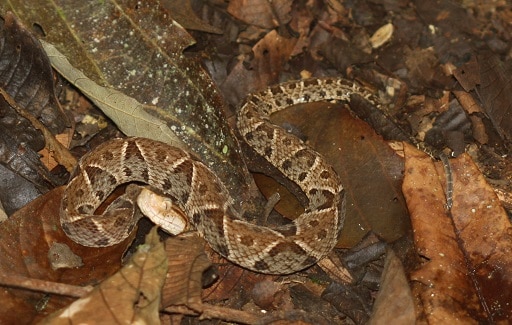
Maximum length: 250.1cm.
The fer-de-lance inhabits Central America, and reaches a maximum of 2.5 metres. Per total fear quotient generated, this is one of the worst snakes to crawl Planet Earth. Its venom kills humans with ease, and arrives in a giant yield of up to 456mg. However, fer-de-lances don’t seem to realise how dangerous they are, as they regularly take shelter under disguising piles of leaves.
With brown-beige colours similar to a cottonmouth, and sweeping zigzag patterns, the fer-de-lance blends into piles of leaves with ease. Its appearance is perfectly optimised, as if it were green, it would stick out like a sore thumb.
Fer-de-lances are notorious not just because they lurk in leaf piles, but because they move explosively fast when they do activate. In some states of Colombia, fer-de-lances cause 50% of snakebites. Their Latin title is Bothrops asper, with asp translating to “rough” or “harsh”. Whether this references their scales or personality is unknown.
Most worryingly, the fer-de-lance doesn’t always hiss from its cosy leaf pile, as some individuals can burst out without warning. Alternatively, you may find a relatively relaxed individual, which lets you walk past unscathed, albeit keeping a close eye on you. The fer-de-lance is notoriously unpredictable, whether hiding in leaves or patrolling the forest floor.
| 10 | Big ground snake |
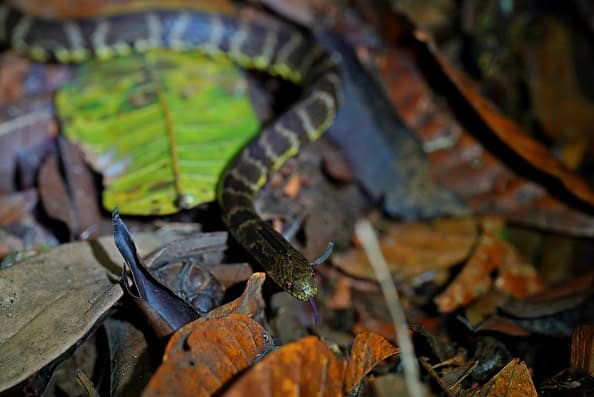
Maximum length: 98.6cm.
A rainforest has endless miniature niches which snakes can claim, resulting in countless non-competing snakes coexisting peacefully. There’s burrows, open ground, high branches, low branches, bushes. Leaf litter is another micro-niche, and the big ground snake (Atractus major) has taken this slot in eastern Ecuador and northern Peru.
This is a mildly venomous species which typically measures 70cm, which mainly feeds on giant earthworms. Big ground snakes belong to the vast Atractus ground snake genus (141 members), and as their name suggests, they’re one of the largest members. However, this doesn’t prevent them from completely disappearing into the leafy forest floor.
Hiding in leaf beds is one way to stay alive in the brutal Amazon rainforest, where just one false move could mean death. The big ground snake has the perfect colour for camouflaging in these leaf beds. Unlike the copperhead, which must be beige to blend with a dry North Carolina woodland, a leaf bed in an Ecuadorian rainforest still has a noticeable layer of mulch and slime. Therefore, Atractus major has a mixture of grey and green tinges, with large bands which help to break up people’s vision.
This species also has decent burrowing skills, used in soft rainforest soil. It lacks any form of venom, or even sharp front teeth, due to its earthworm-based diet, which makes sucking things down a higher priority than biting. Fortunately, big ground snakes always have the ability to disappear between a couple of overlapping leaves.