| 1 | Mexican jumping viper |
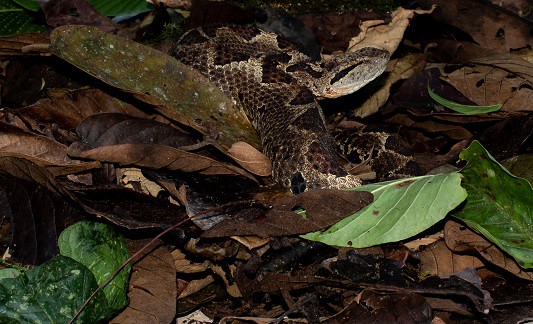
Maximum length: 69.5cm.
A dangerously venomous species found in the forests of southern Mexico. This sluggish species has a moderately intense venom, mainly causing swelling and some haemorrhaging.
From a distance, the Mexican jumping pitviper (Metlapilcoatlus nummifer) looks like a statue. It looks like an ancient sculpture left in the wilderness for thousands of years which is magically immune to weathering. Mexican jumping pitvipers are immobile for the vast majority of their day, as they’re mainly ambush predators. Their goal is to stay exceedingly still, as anything else would alert prey to their presence.
The same is true when a human walks past, as the Mexican jumping pitviper normally doesn’t react. But if touched, it has no choice but to respond, and the change can be shockingly quick. Dozens of steely scales suddenly shift at once, and the Mexican jumping pitviper makes a sudden lunge, which contrasts horribly with its usual speed.
From a head on view, a horribly detailed serpent face might be the last thing you see before waking up in hospital the next day. Fortunately, while they’re great at terrifying, Mexican jumping pitvipers rarely kill.
This species mainly sticks to the floors of forests rather than climbing trees. It averages at 50cm, and further south, you can find its close relative the Central American jumping viper (Metlapilcoatlus mexicanus).
| 2 | Small-eyed toad-headed pitviper |
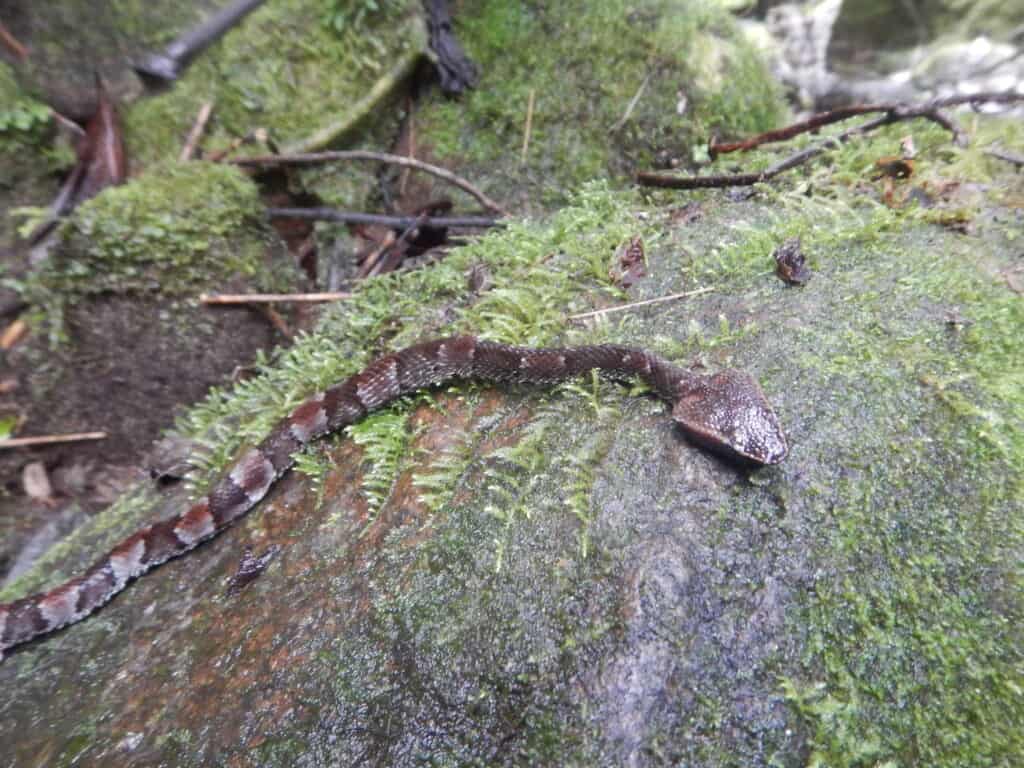
Maximum length: 116.2cm.
This rarely seen pitviper guards the humid slopes of the Andes, and loves to sit on rock slabs in forests in order to gain a superior view. The small-eyed toad-headed pitviper (Bothrocophias microphthalmus) is a species of far western Brazil, Peru, Ecuador, Colombia and Bolivia, and is recognisable by an incredibly triangular head, even more so than most pitvipers.
Toad-headed pitvipers have only a small presence in the snakebite statistics of Brazil, making up 1.5% in a couple of narrow regions, with common lanceheads ruling the roost. But bites are a possibility in jungled forest trails, particularly if you stride up to their rock and start provoking them. Their venom contains a dose of cytotoxins and haemotoxins, which can cause spontaneous haemorrhaging, and even amputation if victims are bitten on the finger.
Toad-headed pitvipers are usually relatively peaceful, but touching them is most unwise. At 10 metres, you’ll probably be fine. At 100cm away, you still have a chance to reconsider your decision. But the second your fingers touch its steely scales, there’s no going back. The toad-headed pitviper’s vertical pupils will flash up, and all its savage powers will be unleashed.
| 3 | Red-headed krait |
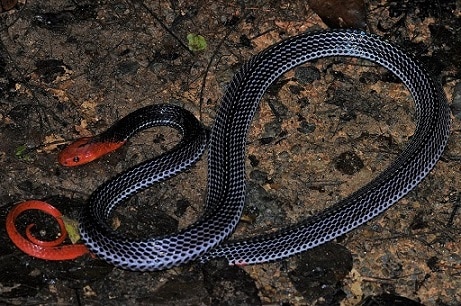
Maximum length: 207cm.
One of 3 Bungarus krait species found in Thailand. The red-headed krait (Bungarus flaviceps) is the least commonly encountered, as it tends to stick to thick forests, often resting in the darkness of a mammal burrow.
The red-headed krait has one of the snake kingdom’s deadliest venoms, with an LD50 score of 0.32mg. Despite this, bites are very rare in humans. This is a pretty relaxed snake, not mean-spirited and with an inferiority complex like the angry mulga of Australia.
The one thing that does send red-headed kraits into a rage is being touched by predators, particularly a human being 30 times larger than they are. A poke, a prod or a gentle flick will send this snake into a fiery rage all the same. The consequences of this could be neurotoxins flowing through your bloodstream, followed by slurred speech and even lung failure.
Red-headed kraits vary in personality based on time, as they’re far more agitatable at night compared to day. The red-headed krait also has two lookalikes in Thailand and Malaysia: the pink-headed reed snake, which is harmless, and the Malaysian blue coral snake, which is lethal. To be safe, avoid picking up any snakes with bright red heads in southeast Asia.
This snake does have one redeeming feature, as the bright red head makes it easier to spot in the undergrowth. The worst member to spot is the greater black krait of the Himalaya, which lacks any patterns, and is a 100% pure midnight black.
| 4 | Beautiful pitviper |
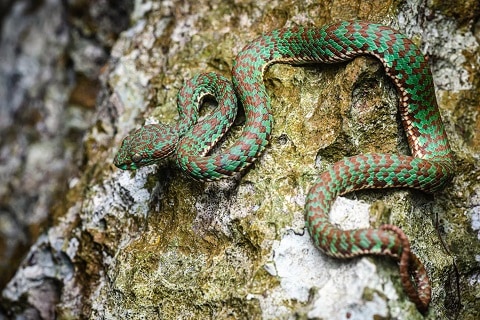
Maximum length: 58cm.
The beautiful pitviper (Trimeresurus venustus) is a species of southern Thailand, which nearly always appears in forests. Compared to other Thai pitvipers, it’s much more distinct, as it has the usual green patterns, but overlaid with reddish blotches. This allows for effortless disguise both in green foliage and on mossy boulders on the forest floor.
The beautiful pitviper is an ambush snake, and sits calmly for hours on end. It sees sights most human beings couldn’t dream of, watching endless battles between lizards, birds and other snakes. It’s fairly tolerant of humans walking past, chatting inanely, or even flashing a camera in its face.
But the one thing the beautiful pitviper cannot tolerate, which instantly sends it into a lethal rage, is being touched in any way. If poked, prodded or stroked, the beautiful pitviper will deliver a lethal snap of a bite which can strike fingers, hands or even the face.
It’s one of nature’s equations: a calm beautiful pitviper + plus human touch = an angry beautiful pitviper. Fortunately, this species has a milder venom than other Trimeresurus members. Lucky victims can survive with just pain and swelling, but we don’t recommend pushing your luck.
| 5 | Clark’s coral snake |
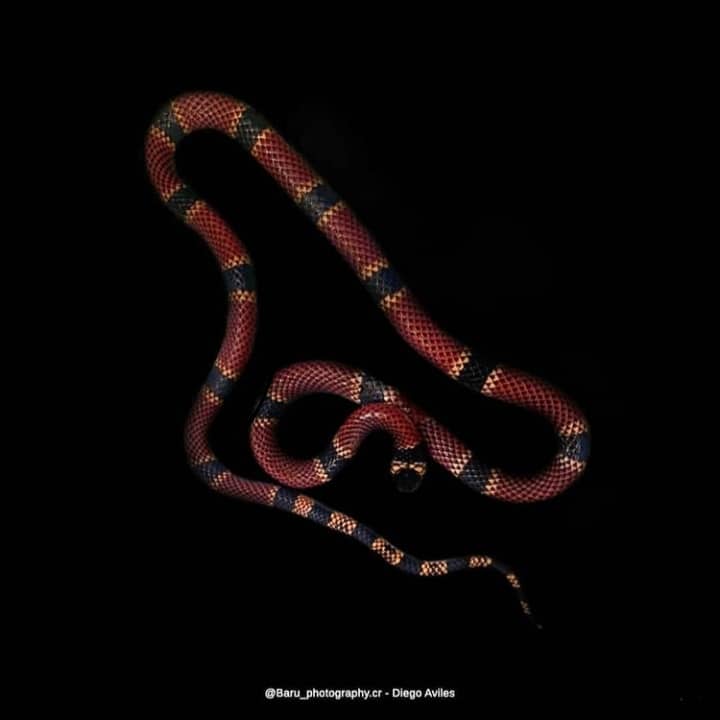
Maximum length: 92cm.
Many snakes are twitchy and nervous, and barely allow humans to come within any distance at all. The black mamba has superb eyesight, and sometimes flees when people are still 10 metres away. Then you have the opposite, which barely react to human presence, such as Clark’s coral snake (Micrurus clarki).
This species lives in moist forests of Costa Rica and Panama, particularly in deep wilderness areas. It dislikes open spaces, preferring to lurk in disguising layers of cluttered vegetation. Its diet consists of fellow snakes and swamp eels, which it disables using a neurotoxic venom.
Clark’s coral snakes cause very few bites in humans each year. They stick to the outdoors, and don’t have a tendency to sneak into people’s bedrooms overnight (like a mulga). The majority of incidents occur when people deliberately provoke them, with touching being chief among this.
Clark’s coral snakes are tolerant of humans approaching to within 1 metre. They might keep their eyes fixed on you menacingly, but they’ll rarely attack. When touched, they switch rapidly from peaceful to aggressive mode, and deliver a fast and efficient bite to your hand. Consequently, this is a piece of Costa Rican wildlife to look at and never interact with.
| 6 | Side-striped palm pitviper |
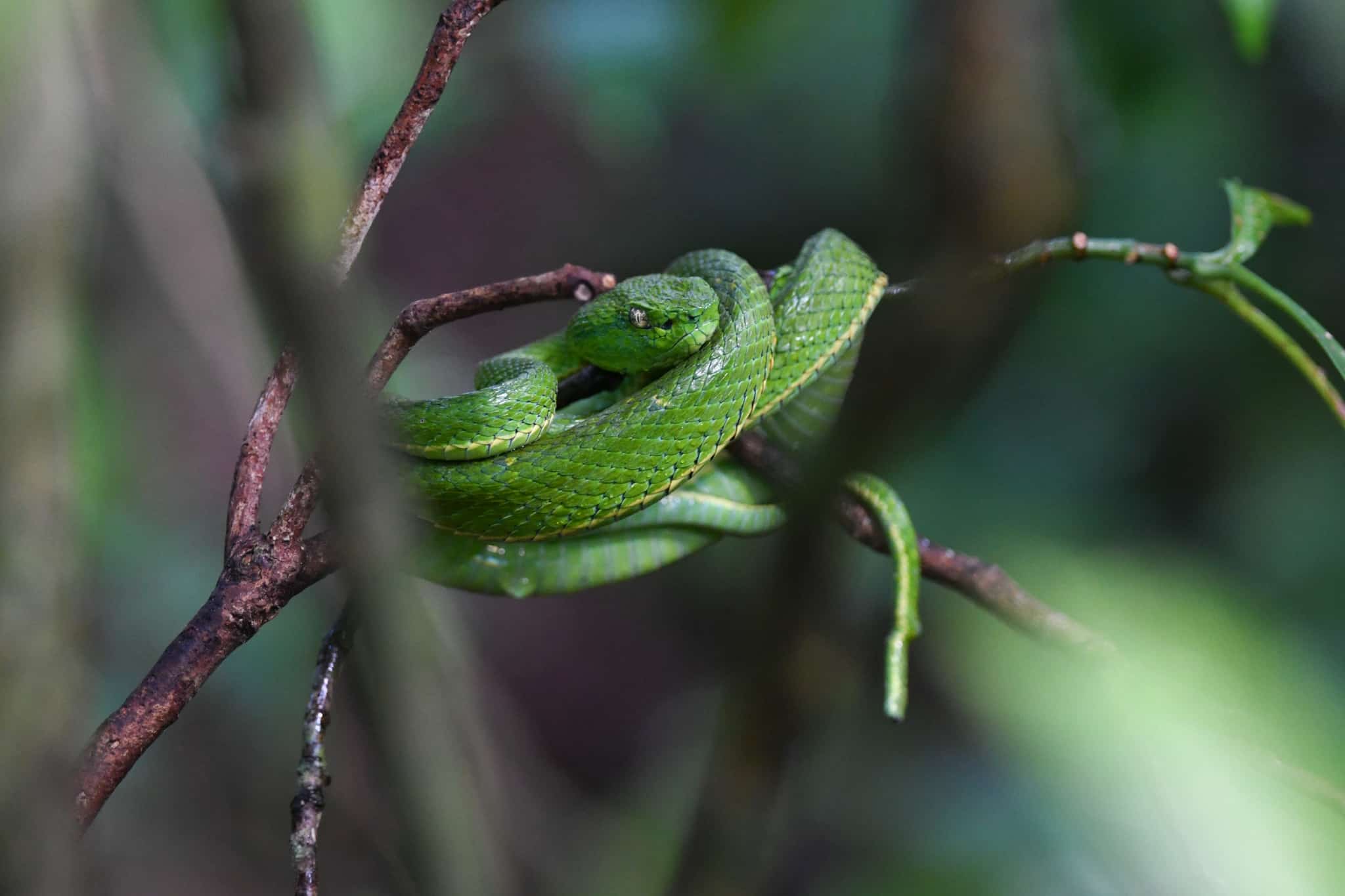
Maximum length: 95cm.
A menacing pitviper of Costa Rican and Panamanian forests, which is commonly found on tree branches. The side-striped palm pitviper (Bothriechis lateralis) doesn’t mind people walking past its tree, but enters an explosive rage if touched even slightly, which could leave you stuck in hospital for several days.
The side-striped palm pitviper’s venom is a wicked concoction of haemorrhagins and cytotoxins, and its strike is rapid. The initial symptoms are intense pain and swelling, possibly followed by spontaneous bleeding.
Victims usually survive, but can spend several days in hospital. The best way to avoid this miserable fate is to walk right past a side-striped palm pitviper, maybe flashing a camera, but never giving in to the temptation to touch.
This species is the cousin of the widespread eyelash viper, and its confirmed meals include brittle belly frogs and turnip tailed geckos. Side-striped palm pitvipers are very vigilant when it comes to predators (which they categorise humans as), and their default position is bite, bite, bite. Until actually touched, they remain calm, but they then flip a switch.
| 7 | Banded watersnake |
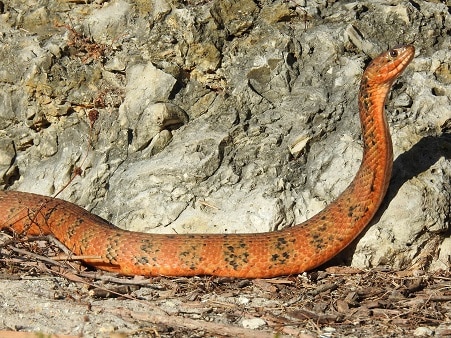
Maximum length: 158.8cm.
A non-venomous species found across a swathe of the southern US, from Florida to southeast Virginia to southern Texas. The banded watersnake (Nerodia fasciata) is a 100cm species of small streams and rivers, which it’s perfectly adapted to. Its life involves swimming, lurking under water surfaces, and investigating strange scents on the muddy shoreline.
Its diet, meanwhile, contains frogs and amphibians, with an occasional helping of earthworms and small turtles. Humans can watch these splendid scenes unfold in peace, unless they decide to touch the banded watersnake, at which point the idyllic scene will flip into a nightmare.
Banded watersnakes hate being touched. They just can’t stand it, as the contact of a human finger sends every danger sensor they have through the roof. A touched banded watersnake will lunge at the interloper’s hand in seconds, possibly biting simultaneously. It’ll hiss loudly, and keep on attacking until the aggressor leaves.
If not touched, then the banded watersnake will just swim on by, barely adjusting its speed. Not touching this river snake is a morsel of knowledge which local people probably learned the hard way.
| 8 | Sumatran short-tailed python |
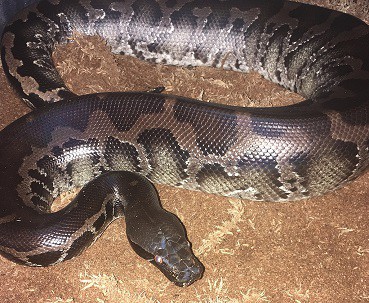
Maximum length: 200cm.
The Sumatran short-tailed python (Python curtus) lives in swampy forests of Indonesia, and mostly lives a peaceful life among humanity. It never charges across fields, and it never invades random people’s bedrooms like a Mozambique spitting cobra. But this tenuous truce comes with an agreement: that you must never, ever touch them. Some people foolishly breach this agreement, and soon find a 200cm python latched firmly onto their arm.
Sumatran short-tailed pythons lack venom, but have an extremely sharp pair of teeth. Their diet mainly consists of mammals, including legions of black rats which infest palm oil plantations. They also have a tendency to hide in termite mounds.
Sumatran short-tailed pythons rely on keeping still for long periods, as this enables their hunting method of crushing ambush. If a human walks past their muddy swamp shores, they won’t just turn aggressive for no good reason, ruining their stationary ambush posture. But if touched, this will all change, and the Sumatran short-tailed python will unleash every ounce of its sledgehammer serpent power.
This species isn’t the longest ever, just reaching 200cm, but has a particularly thick body. It’s also unusually long-lived, with the oldest ever reaching 27.8 years.
| 9 | Taiwan kukri snake |
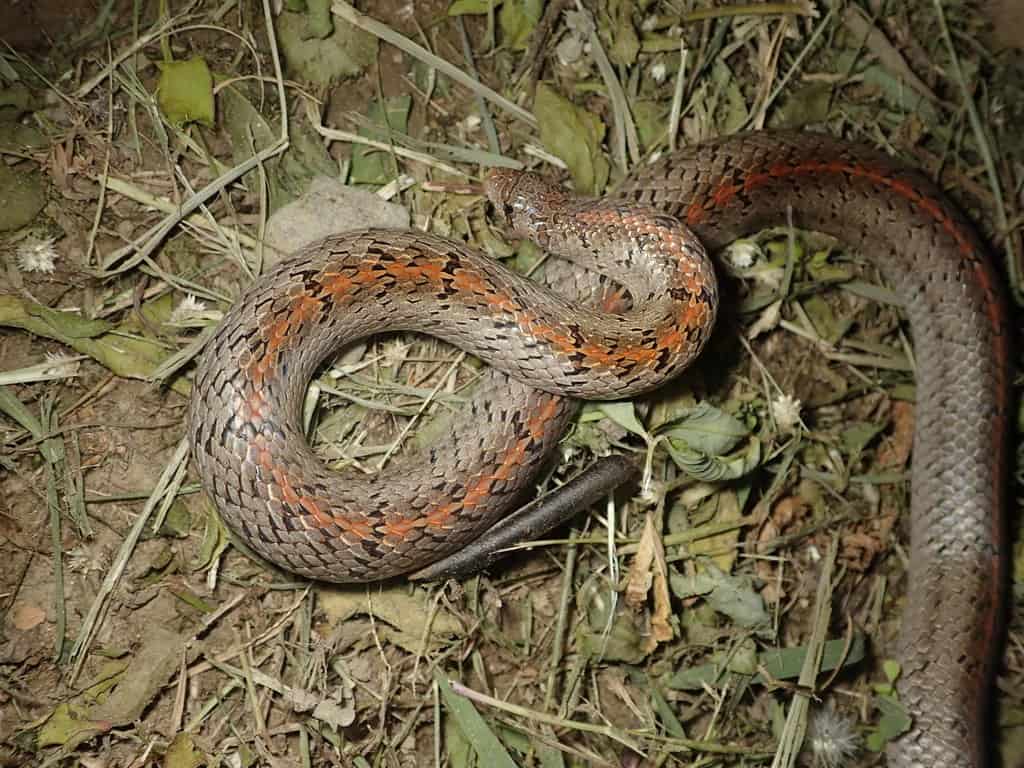
Maximum length: 95cm.
The Taiwan kukri snake (Oligodon formosanus) causes very few bites, mainly because most people aren’t stupid enough to touch them. Make contact, however, and this species will swing its head down and commence tearing your skin with its dagger-like teeth.
This species lives in southeast Asia, and is most commonly encountered along tourist trails in Vietnam, Hong Kong, and of course Taiwan. It’s most commonly spotted while basking on rocks, or slithering along the ground slowly.
Taiwan kukri snakes have no venom, and rely on loose constriction for hunting, applying a couple of vague coils to give them time to angle their mouths correctly. Incidents with humans are low, except for scaring people. However, researchers and scientists have all commented on how Taiwan kukri snakes strongly dislike being touched. Picking one up for a photo is virtually impossible without preparing yourself for serious pain.
The sunbeam snake is the opposite, refusing to bite even if picked up and poked. Likewise, for the grass snake of western Europe, where biting is virtually a moon landing level event. Taiwan kukri snakes average at 50cm, and are particularly common in the civilised forest trails of Hong Kong.
| 10 | Striped whipsnake |
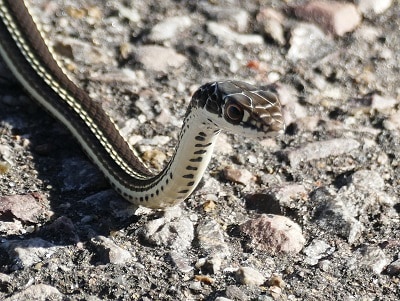
Maximum length: 199cm.
A non-venomous, fast-moving species which ranges from Washington and California to northern Mexico. The striped whipsnake darts around the dry countryside at a rapid pace, searching for small lizards to eat. It doesn’t take much notice of humans, considering them to be irrelevant, but touch this species, and it will rear forward instantly with a piercing hiss.
Striped whipsnakes measure 100-180cm, and favour fields and grassy clearings. They move quickly virtually all the time, occasionally swallowing up fellow snakes such as gopher snakes. Touch them, and all their speed will be directed at you instead.
Another of their characteristics is sharp teeth, which can easily rip human skin. Some even believe that they whip people with their tails. Striped whipsnakes lack the power to kill, but it would be intimidating to see one flying towards you with its fangs bared and eyes swiveling madly.
Though non-venomous, there’s a risk that bacteria will leach into the bite wound and multiply past the infection threshold. To avoid all this, you should look but never touch, and the striped whipsnake will never realise that you exist.