
| 1 | Ruschenberg’s tree boa |
Maximum length: around 250cm.
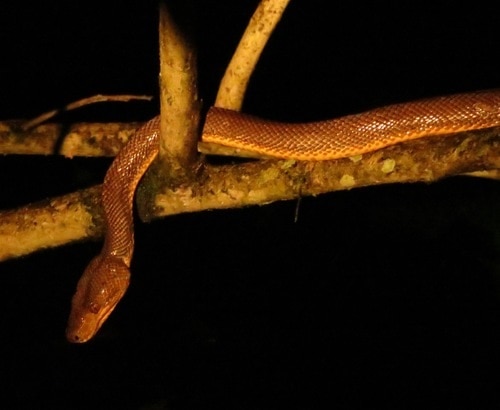
The most common constrictor on Trinidad and Tobago. This is a non-venomous tree dweller which commonly rests at 3-10 metres above ground on a branch, reflecting people’s torch beams with its eyes, and even flashing iridescent rainbow colours under intense light.
Ruschenberg’s tree boa (Corallus ruschenbergii) appears on both the larger island of Trinidad, population 1.27 million, and the smaller Tobago to the north, population 61,000. Local people call this species the Dormilona, and it has an aggressive temperament both in captivity and the wild. Habitats include forests such as Main Ridge Forest Reserve, and swampy forests, including near the protected Nariva Swamp and Caroni Swamp.
This species also dwells in Venezuela, Costa Rica, Panama and Colombia. Studies reveal that Corallus ruschenbergii (also called the Trinidad tree boa) is larger on these islands than on the mainland. Those on Trinidad ranged from 213.3 to 243.8cm, and possibly more. Likewise, the Trinidad versions have a specific appearance, lacking vivid patterns, and having a consistent bronze or brown tone instead.
This boa eats reptiles as a youngling, including anoles. In adulthood, it graduates to mammals, including Trinidad natives like the Brazilian spiny tree-rat.
| 2 | Tropical flat snake |
Maximum length: 143.1cm.
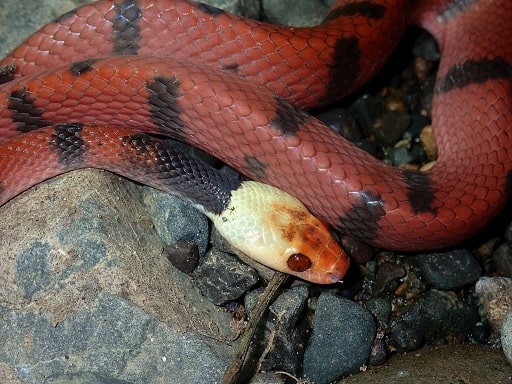
One of a handful of snakes worldwide with blood red eyes. But unlike Europe’s adder, this species cannot kill a human, possessing only a mild venom.
Tropical flatsnakes (Siphlophis compressus) are extremely widespread in South America, covering a swathe of Brazil, Ecuador, Colombia and Venezuela. Trinidad may have the most dots on the map of all, although they’re not found on Tobago.
Tropical flat snakes measure 65-120cm, and live an arboreal lifestyle, spending much of their time on tree branches, occasionally straying to the ground where they’re spotted on roads. They avoid human-developed zones, preferring untouched forests swarming with native Trinidad wildlife.
This species preys mainly on reptiles, such as lava lizards (Tropidurus), many-colored bush anoles, and the ubiquitous green iguana. As a nocturnal snake, Siphlophis compressus is thought to snatch lizards while they sleep at night, and reptile eggs have also been found in its stomach.
Other names of this snake include the red-eyed tree snake and mapepire de fe. A bite from Siphlophis compressus will probably cause stinging, a slight swelling, and muscular numbness. Its venom targets scaly reptiles, not workers picking bananas, or innocent people digging in their back gardens. The same can’t be said about our next snake…
| 3 | Common lancehead |
Maximum length: 172.3cm.
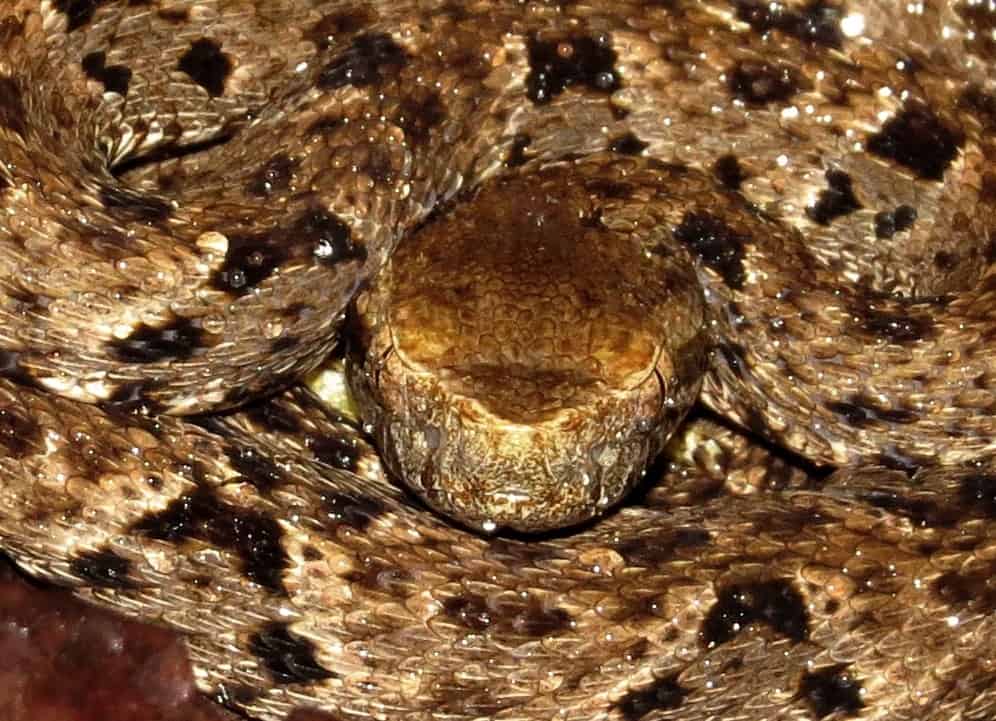
Probably the most common venomous snake in South America, and definitely the one responsible for the most bites. Trinidad and Tobago doesn’t escape the common lancehead’s wrath, as this species inflicts the majority of the nation’s venomous snakebites.
Common lanceheads (Bothrops atrox) are missing from Tobago, but are abundant on the more populated Trinidad. ID signs include sharply vertical pupils and a bulky head. They’re flexible in their habitats, appearing in gardens, forests, banana plantations, and hiking trails alike.
A 2009 report documented 9 Bothrops atrox encounters in Trinidad. 1 victim was bitten while pruning plants growing against her house, while a 3 year old girl ran into long grass to retrieve her ball and was bitten on the toe.
Meanwhile, a middle-aged man was bitten while weeding his garden, when he dug up a common lancehead which had been lurking below. Those who attended Sangre Grande hospital tended to fare well, as antivenom was stocked there, whereas Mount Hope hospital stocked no antivenom, and victims fared much worse.
Trinidad locals call this snake mapepire balsain. This dangerous species averages at 75-125cm, and can exceed 160cm in extreme cases.
| 4 | Long-tailed machete savane |
Maximum length: 1.9 metres.
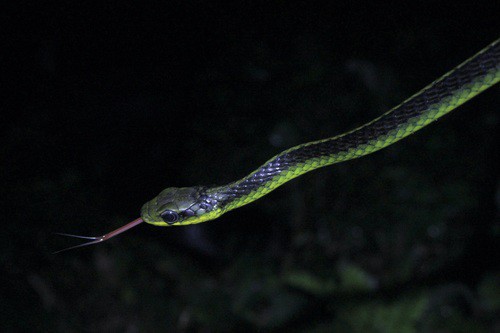
This energetic species lives in Trinidad and Tobago, and the Venezuelan mainland a few dozen miles away. The long-tailed machete savane (Chironius septentrionalis) moves by day, and climbs tree branches with ease, while also being comfortable on the ground. It’s fast-moving and aggressive, charging down its prey with great agility, but can also be found resting in tranquility on bushes and bamboo.
So far, only amphibians have been recorded in this snake’s diet, including Hylid tree frogs and Leptodactylid southern frogs. Males reach 1.8 metres, and females 1.9 metres. Large, bulging eyes with round pupils are a signature characteristic of this species.
According to Trinidad locals, this species “bites like a dog”. It comes close, unleashing snappy, vicious bites if humans stray too close. This is an overcompensation for its non-venomous nature, as the long-tailed machete savane lacks even a mild venom. It also has a tendency to inflate its throat when cornered, in a disturbing intimidation display.
Worldwide, this snake is most closely related to the South American sipo (Chironius multiventris) and coastal sipo (Chironius foveatus), both found in Brazil. Until 2006, it was a subspecies of the former, which is also found in Trinidad.
| 5 | Tobago stream snake |
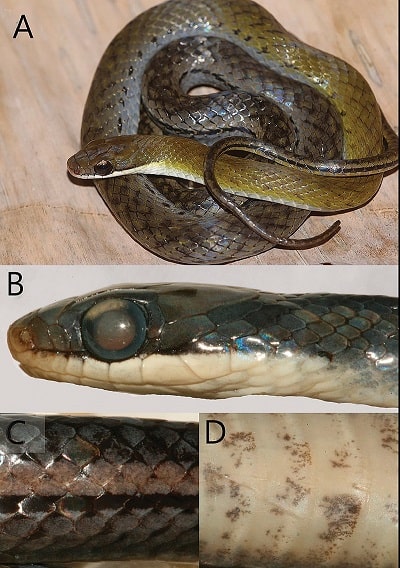
Maximum length: 53.9cm (so far).
The Erythroplamprus genus is collectively dubbed the “false coral snakes” and has 55 members as of 2024, all in Central and South America. The Tobago stream snake was a very recent addition, becoming an official species only in 2019. This snake lacks the coral-mimicking colours completely, and instead has an olive-grey back, contrasting against a brighter belly with a consistent yellow or red colour.
This is a very rare species. Tobago stream snakes are found mainly in forested ravines bordering Tobago’s main ridge, one of the island’s main geographical features, which reaches heights of 572 metres.
Main Ridge Forest Reserve dates back to 1776, and is the oldest forest reserve in the Americas, predating any in the USA. The Tobago stream snake is common within this sanctuary, so while obscure and rarely seen, it’s highly likely to cling onto survival.
This is the only snake on our list to appear solely on Tobago and not Trinidad. The first batch of Tobago stream snakes ranged from 43.6-53.9cm. The venom status of this snake is unknown, but hidden dangers are possible, as other members such as Erythrolamprus bizona have a highly cytotoxic venom. This is a diurnal, AKA day-faring snake.
| 6 | Boddaert’s tropical racer |
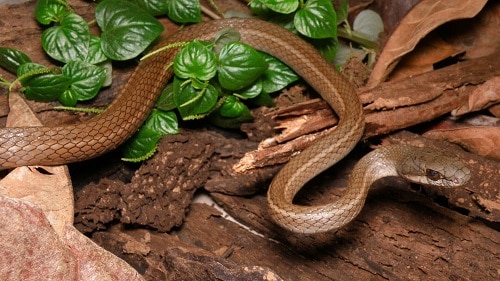
Maximum length: 180cm.
A non-venomous pursuit snake which eats 74% reptiles, 14.3% mammals, and 6.5% frogs and toads. Boddaert’s tropical racers (Mastigodryas boddaerti) are easily recognisable by a brown back and a light grey belly, with a sharp split between the two. Their average length is 105cm, and their record is 180cm. They have round pupils, and are fast-moving and energetic, with the ability to suddenly blast off into the undergrowth if cornered.
Boddaert’s tropical racers are especially common in the northern, mountainous regions of Trinidad. They sometimes climb bushes in search of prey, or sleep at night 1-2 metres high on branches, but this is mainly a ground-dwelling snake. You can find this snake in a mosaic of habitats, including forests and bushy areas with plenty of shade.
One of this species’ tricks is coiling into a ball and vibrating its tail furiously. Boddaert’s tropical racer can detach its tail if gripped, sacrificing body parts to escape, but can also spin around and bite viciously.
Boddaert’s tropical racer is definitely found on Trinidad, but Tobago is debatable. There’s certainly a racer on there, but some believe this to be a subspecies called M. boddaerti dunni, while others deem it to be a fully independent species.
| 7 | Triangle watersnake |
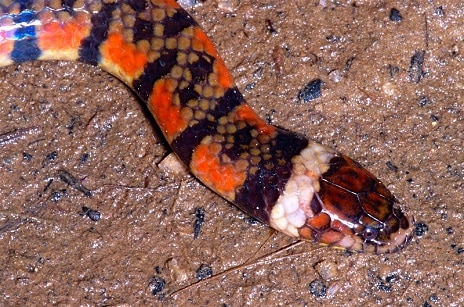
Maximum length: 78cm.
One of Trinidad’s most aquatic snakes. The triangle watersnake appears in flooded rice fields, swamps, ponds, and slow-moving rivers, usually in areas with plenty of shade. Still waters are its favourite of all, rather than raging rapids.
Triangle watersnakes (Hydrops triangularis) encounter humans regularly, as they don’t shy away from swamps directly adjacent to roads. Their eggs are laid in hollows in the banks of water bodies, and their diet consists of fish and especially swamp eels.
Triangle watersnakes are widespread in Brazil and Venezuela as well, but are missing from Tobago. Manzanilla Beach lagoon and the Cumuto River are two confirmed hotspots in Trinidad. Rather than dashing around like a maniac, they move slowly and deliberately.
Triangle watersnakes max out at 78cm, and lay up to 34 eggs per clutch. This is a variable snake, with the main morph being a rapidly alternating red and black. Some have jet black faces, while other faces are marbled red-black.
The triangle keelback is hardly a mass murderer, but its venom may be stronger than previously thought. One bite victim experienced headache, nausea, and even vomiting.
| 8 | Mangrove ground snake |
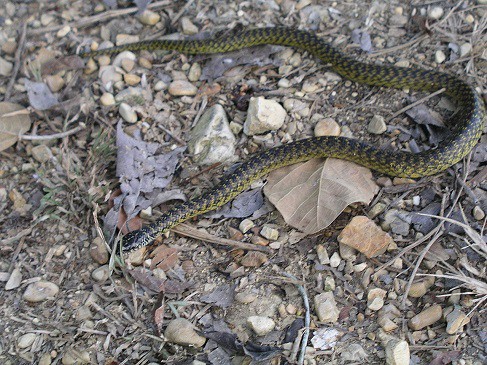
Maximum length: 79.5cm.
A species which hugs the north coast of South America, covering northern Venezuela, Brazil and Trinidad. The mangrove ground snake (Erythrolamprus cobella) reaches a maximum of 80cm, and again belongs to the Erythrolamprus false coral snake clan, but this time skips Tobago.
Erythrolamprus cobella inhabits watery areas like canals, swamps and rice fields. It’s a non-aggressive species, as even if picked up, it tends to stay relatively calm. However, it has a cunning defensive trick which it deploys in the presence of other snakes: rearing up and spreading a cobra-like hood.
Mangrove ground snakes have medium-sized eyes with round pupils. Their diet is poorly researched, but in captivity, they happily eat fish. A confirmed wild prey is the turnip-tailed gecko (Thecadactylus group).
This is a terrestrial species, very rarely climbing trees. Its heartlands are primary lowland rainforests, usually close to a water source. Instead of keeled, mangrove ground snakes have smooth scales to touch. While they’re hardly swarming the place, records are plentiful from every corner of Trinidad, except the mountainous north.
Originally, mangrove ground snakes belonged to the Liophis genus, until that group was wiped out overnight when every member was transferred to Erythrolamprus, turning it into the 7th largest genus of snakes worldwide.
| 9 | Trinidad upland parrot snake |
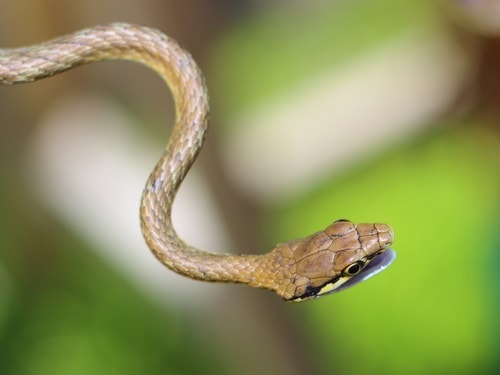
Maximum length: 83.2cm (so far).
Parrot snakes of the Leptophis genus are abundant in Central and South America, with 20 members overall. This is a branch-dwelling group of snakes, which bare their mouths and stare wildly at people when they draw too close. The giant parrot snake (Leptophis ahaetulla) is the most common member, while the Trinidad upland parrot snake (Leptophis stimsoni) is a far rarer form which is endemic to its namesake island.
Even in Trinidad, this is a highly rare snake. It was discovered only in 1937, and 50 years then passed until the second individual was found, near Cumaca Cave in 1987. Leptophis stimsoni appears only in the mountainous north, and being so rare, research is severely lacking.
The original 1937 individual was a male measuring 59.3cm. Like other parrot snakes, this is a branch and bush dweller, but not exclusively, straying to the ground regularly.
Trinidad upland parrot snakes are found in primary rainforest with a dense understory. The original individual from 1937 was found near the highly inaccessible Mount Aripo (Trinidad’s highest mountain), which doesn’t even have a trail to its summit. Leptophis stimsoni has a black stripe stretching back from each eye, and a green-brown body contrasting against a whitish belly.
| 10 | Trinidad snail-eating snake |

Maximum length: at least 80cm.
A harmless species which lives mainly on branches. The Trinidad snail-eating snake (Dipsas trinitatis) is not just endemic to Trinidad, but found exclusively in the mountainous areas of Trinidad’s north. Within that area, it’s observed fairly commonly, but there are no overseas enclaves in Venezuela, Colombia, or anywhere else.
The Trinidad snail-eating snake is one of the closest viper mimics in South America. The Bothrops lanceheads are an enormous venomous clan with over 40 members. They mostly have brown and beige viper shades, but one classic characteristic is that their dark brown blotches have a glowing border, which is either white or pale yellow. The Trinidad snail-eating snake is one of the few snakes that not only copies the overall colours, but this glowing border.
On Trinidad, meanwhile, this species is a close mimic of the common lancehead, albeit found far more commonly in trees. It even mimic its neighbour’s viper behaviours, by coiling up and performing mock strikes at humans, although these are pure bluffs.
Other characteristics include large, bulging eyes, which precisely mimic the colour of their scales. Trinidad snail-eaters are most active following heavy rains, when their snail and slug prey become more active too. This is one of two snail-eaters found on Trinidad, the other being the cloudy snail eater (Sibon nebulatus), which has far stonier patterns of grey and white.
| 11 | Three-lined ground snake |
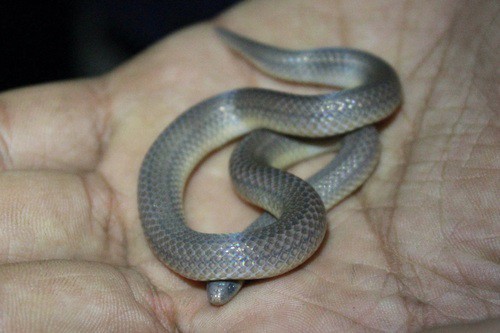
Maximum length: 35cm.
A member of the world’s largest snake genus, Atractus, which boasts 141 members as of 2024. The three-lined ground snake (Atractus trilineatus) inhabits both Trinidad and Tobago, which are easily its global hotspots. Its territory maps have just a handful of dots on the South American mainland, with one outpost being Guyana.
Three-lined ground snakes are usually grey or brown, and were named for three razor thin stripes: one on each flank, and a central stripe down the spine. Their belly, meanwhile, is a far brighter yellow. This is the shortest snake of our list, with a record length of 35.0cm. Atractus trilineatus averages at just 24cm, of which 1.5cm is a sharp tail, used for poking predators in self defence.
Three-lined ground snakes appear in various habitats, including forest, savannah and plantations. They lead a shy burrowing lifestyle, and aren’t completely blind, but hide in underground soil tunnels whenever possible. When on the surface, they lurk beneath leaf litter and rotting forest mulch, similarly to the sharp-tailed snake of the US (whose spiky tail they also share).
This snake is low in the Trinidad food chain, as it’s a confirmed foodstuff for freshwater land crabs and Erythrolamprus false coral snakes.