
| 1 | Bolivian anaconda |
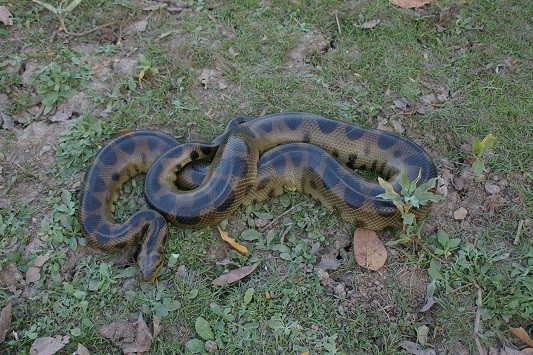
Maximum length: 3.2 metres.
This less famous anaconda species inhabits its namesake Bolivia, as well as extreme southwestern Brazil. It lurks in shallow waterways and wetlands, gliding through water effortlessly while continuously scanning its surroundings with a keen serpent eye.
The Bolivian anaconda (Eunectes beniensis) lacks venom, but has an extremely thuggish hunting method. It lunges at prey with all the force of its 3 metre body, then coils around them before they can possibly hope to recover.
A strike from this snake completely knocks the breath out of its prey. The Bolivian anaconda bursts forward with the power of a swinging anvil, or a barrel thrown by Donkey Kong. Disturbingly, it doesn’t even have to coil before producing this powerful strike. Other snakes need to get in position first, but the Bolivian anaconda just bursts forward out of nowhere. Its muscular structure has evolved specially for sudden pounces, to support its ambush lifestyle, keeping its movements quiet until the last millisecond.
The Bolivian anaconda’s diet is wide ranging, particularly favouring mammals, but also various wading birds, and occasionally each other. The best hope of its prey is to dart free before the flying snake hits them, otherwise their chances drop off a cliff.
| 2 | Red sand boa |
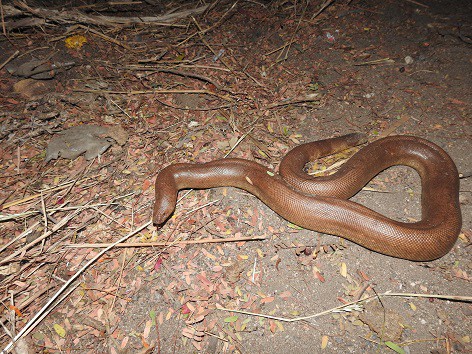
Maximum length: 110-120cm
The red sand boa (Eryx johnii) is a widespread species of India and Pakistan, where it appears in semi-deserts, scrublands and dry grasslands, always with loose soils which it can burrow into easily. Its food supply includes mice and rats, which it pounces on from a position of cunning disguise. John’s sand boas are immensely patient, settling into an ambush posture in soil and waiting for hours.
This species tends to have a dreamy expression the majority of the time. Not only is it immobile, but its mind seems to be in a completely different place, perhaps a slithering pit in Egypt which it wishes it lived in.
Red sand boas don’t look capable of much action, but the reality is that their lunge is extremely powerful. They can switch from day dreaming to explosive pouncing in half a second. Thankfully, they’re too short to use these lunging skills against human beings.
John’s sand boas are also part of a large trade in India, with many superstitious beliefs; some believe that they bring good luck, while others believe they cure AIDS. Their body is completely brown, with few noticeable patterns.
| 3 | Indian python |
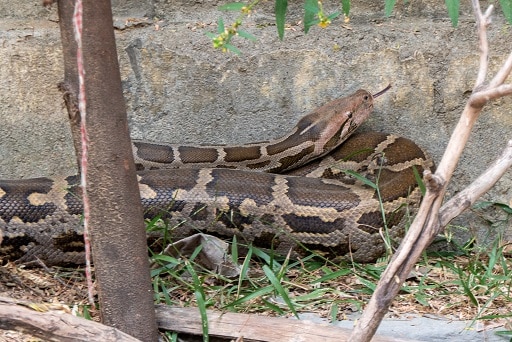
Maximum length: 4.6 metres.
The Indian python is a thick snake measuring 3-4 metres, and its lunge is just as powerful as you’d expect. It’s a common constrictor found all over the Indian nation, as well as Sri Lanka, appearing in fields, woods and river shores alike. This flexibility has made the Indian python a great success, but so too has its explosive pounce.
Indian pythons can take down wild pigs and young deer, using the sheer force of their body, before they’ve even thought of applying a coil. The power comes partly from their massive size, but also the inherent pouncing skills they possess, fuelled purely by instinct.
Despite the huge size of Indian pythons, deer still fail to spot them in the bushes, and this is when they seize their chance. They can also pounce from lakes, as this horrific video shows (warning: nightmare fuel).
A human’s muscles are designed for endless tasks: running, carrying, grappling, punching. In the Indian python, they’re geared mainly towards constriction, and performing sudden brutal lunges. Every sinew, every fiber, every cell of muscle is geared towards making this lunge overwhelmingly powerful, like a battering ram.
| 4 | Fer-de-lance |
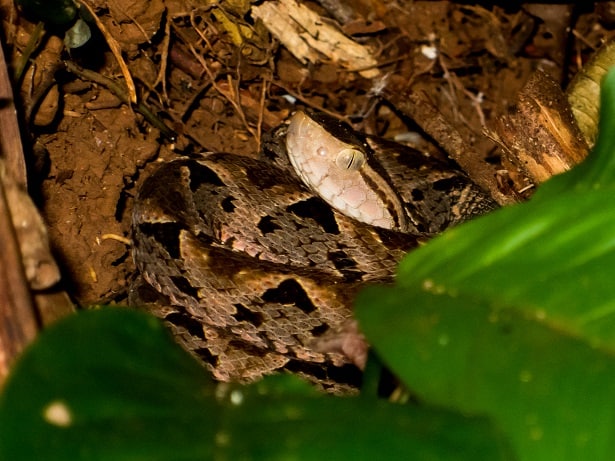
Maximum length: 250.1cm.
One of Costa Rica’s most feared venomous snakes. The fer-de-lance is closely related to the feared common lancehead, but inhabits Central America rather than South America, ranging from central Mexico to western Colombia.
Unlike a constantly moving cobra, the fer-de-lance is an ambushing venomous snake similar to the death adder. It favours shock and awe tactics, and a thuggish sledgehammer slam is part of it.
With a rodent knocked off its feet, this pitviper can inject over 500mg of cytotoxic venom to deal the finishing blow. Fer-de-lances prey on meals such as agoutis and big-eared climbing rats, but they don’t mind springing onto human intruders either, including villagers foraging for edible plants.
The mamushi of Japan is so nifty that some villagers don’t realise they’ve been bitten. The fer-de-lance, meanwhile, has no chance of going unnoticed, due to its bulk and power. To enable its crushing lunge, this snake likes to lurk in dry thickets, particularly on the borders of forests. These blend perfectly with its brown and beige scales.
| 5 | Madagascan ground boa |
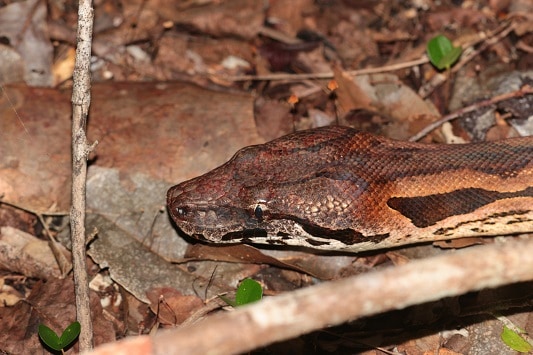
Maximum length: 320cm.
The Madagascan ground boa is a generally calm snake which likes to make its home at the base of a thick tree trunk. It’s commonly found in dry woodlands, sometimes close to villages. Those who meet this species will probably be greeted by a silent glare, but the overconfident few who get too close will be treated to an explosive lunge.
The Madagascan ground boa is an ambush hunter which pounces on brown lemurs and sifakas as they pass, knocking them down and giving them no time to react. It also swallow birds in captivity, and has been recorded to reach 320cm. Forget a battering ram – this snake could probably break through a castle’s fortified doors if soldiers placed it on the ground and begged it to do their bidding.
The Madagascan ground boa can lunge again almost immediately after the first attempt. It doesn’t need to coil up beforehand, and it doesn’t need to pant and catch its breath.
Fortunately, this species is relatively slow during its regular slithering. You only have to back off 10 metres to watch this morbidly thuggish snake from a safe distance. That said always, be careful in the Madagascan undergrowth.
| 6 | African rock python |
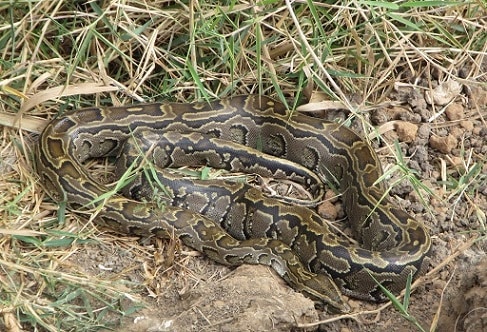
Maximum length: around 6 metres.
If the African rock python concentrated hard enough, it could probably spring forward and break through a front door. A flimsy back garden fence would stand no chance. In an unsteady mixture of soil and leaves, it could probably knock a human being off their feet and flat onto their back.
The African rock python is the world’s second longest snake, after the reticulated python of southeast Asia. It’s not particularly aggressive, but can be set off like a hidden mine if you stray too close. It has the disturbing power to swallow a small deer in minutes, and even knock over exploring hyenas.
This giant species patrols the woodlands and grasslands of sub-Saharan Africa, sometimes near farmland. The rock python’s general hunting tactics are nothing unusual. It’s an ambush snake which lurks in thickets, waiting patiently for its mostly mammal prey to pass. Yet nature blessed this species both with exceptional length, and exceptional weight.
While shorter than the reticulated python, the world’s longest snake, African rock pythons are typically thicker, giving them immense pouncing power.
| 7 | Timber rattlesnake |
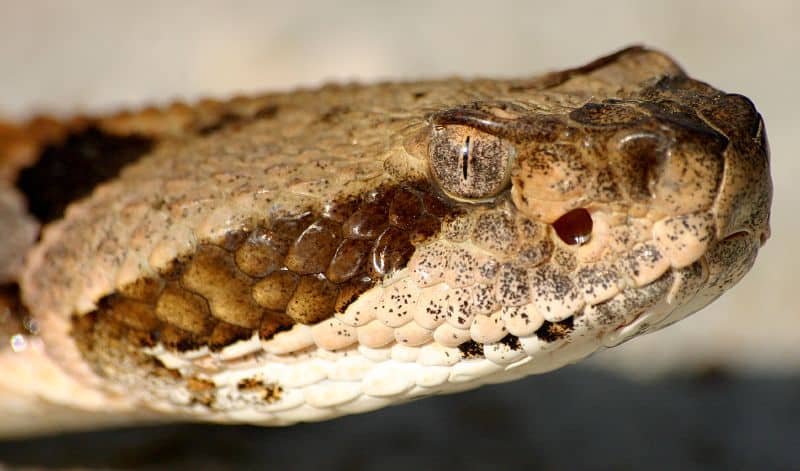
Maximum length: 189.2cm.
The timber rattlesnake lives in the forests of the eastern USA, and has a relatively thick body. This species averages at 90-115cm in length and 1.3-2 pounds in weight. What the timber rattlesnake lacks in elegance, it makes up for in power. It has an extremely powerful pounce, easily beating the likes of eastern racers for brute strength. It can pounce without warning, although if it could speak, it probably wouldn’t give you one anyway.
Timber rattlesnakes are relatively nervous for an ambush snake, and dislike humans straying too close. They live in various habitats, but particularly forests with an abundance of fallen branches and logs. Their realms include Florida, Georgia, Alabama and South Carolina.
Encountering this snake would be like a horror film. You’d walk into a small forest clearing, covered with golden leaves and a few rotting logs. It’s a scenic location, and all seems calm. Suddenly, a snarling rattlesnake bursts out of a leaf pile and strikes your leg within milliseconds. Fortunately, the timber rattlesnake’s venom isn’t especially strong, with an LD50 rating of just 1.64mg, compared to 0.06mg for a tiger rattlesnake.
| 8 | Death adder |
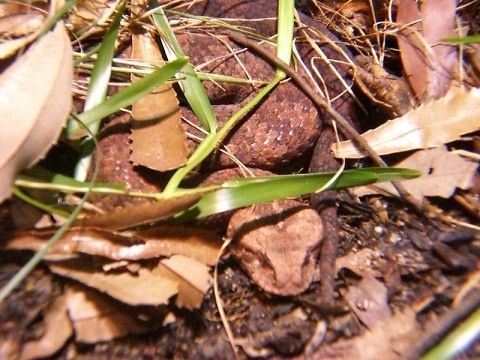
Maximum length: 1 metre.
The death adder is a grey and brown species which is native to Australian woodlands. Its primary prey is rodents, which it tackles with a brutally powerful lunge. This snake stays immobile for weeks on end, being an ultra patient ambush hunter. In fact, a sudden brutal lunge which advances the death adder 1 metre might be the most it’s moved for days.
The death adder is so propulsive while pouncing that it can lift half of its body off the ground. Thinner Australian snakes like the green tree snake would just bounce off you harmlessly, but the death adder collides with a nasty thud. If its fangs do make contact with your skin, then you can expert neurotoxic, haemotoxic and cytotoxic symptoms. Unusually, this species produces virtually every toxin type.
Being so bulky also means that its aim requires less accuracy. Death adders don’t have to focus and carefully lock onto their target. Instead, they can just explode towards things. Fortunately, this species is mostly calm around humans, generally staying still unless accidentally stepped on, or maybe poked with a stick.
| 9 | Palestinian viper |
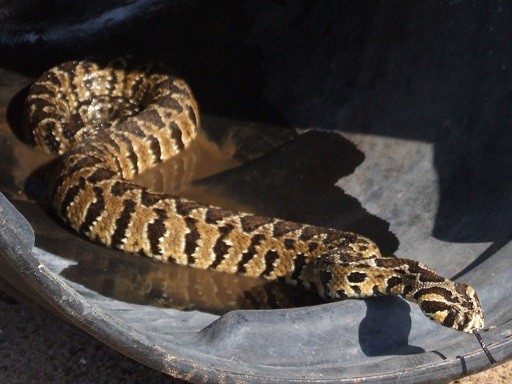
Maximum length: 140cm.
An Israeli relative of the lethal Russell’s viper, which causes so much chaos in India. Palestinian vipers (Daboia palaestinae) are found in Israel, southern Lebanon and southern Syria. They’re shorter than their Indian cousin, yet retain the same ambush strategies, complete with brutal pounce.
The Palestinian viper also attacks many humans, injecting a strongly haemorrhagic venom. It lives in arid semi-deserts, and its one redeeming feature is sub-par camouflage, with dark stripes which contrast sharply against its main beige scales.
The Palestinian viper has a pounce like an erupting volcano. It can knock over small animals with ease, pouncing from a nearly flat position on the ground, shifting ever so slightly before exploding forward. The Palestinian viper can burst from a variety of locations: behind rocks, dry bushes, swaying grass, shrubs, even a cupboard door if a villager was keeping one illegally.
With its thin, nimble body, the average cobra can coil up and deliver a succession of jabbing bites, returning quickly to its original position. Palestinian vipers are less nimble, but more powerful, favouring one massive lunge like a battering ram. Instead of agility, they chose the brute force route.
| 10 | Cox’s watersnake |
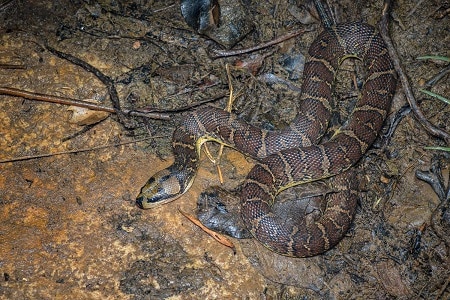
Maximum length: 137cm.
Cox’s watersnake (Homalopsis mereljcoxi) is a non-venomous species found in the swamps of Cambodia and eastern Thailand, which has murky brown colours optimised for camouflage in mud. It lurks for long periods in complete silence, with only rustling trees and faint droplets of water to keep it company. Suddenly, it spots a fish moving below the surface, and activates in a terrifying explosion of speed, aggression and force.
This species is an ambush predator, whose every sinew of muscle is optimised for seizing prey in one brutal lunge. Cox’s watersnakes dislike deep rivers, preferring shallow water bodies like streams, wetlands and swamps. They have a typical life for an ambush predator, waiting patiently in the shallows until they pick up subtle alterations in water currents generated by approaching fish. They wait until the optimal millisecond, and lunge with expert timing, seizing the fish in their jaws.
Cox’s watersnakes eat mostly fish, occasionally amphibians, and have a specially adapted jaw, for a grip which they never relinquish. This is a close relative of the puff-faced watersnake, which lives in southern Thailand, while Cox’s watersnake sticks to the east (plus Cambodia).