
| 1 | Green anaconda |
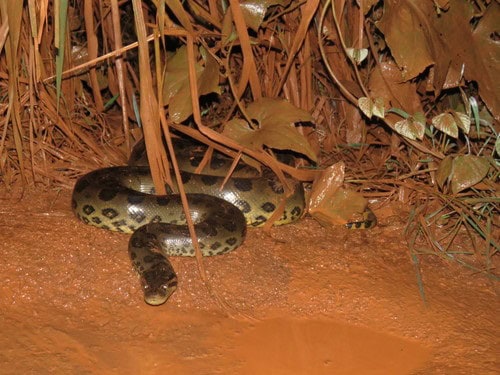
Maximum length: 5.21 metres (wild), 6.24m (captivity).
Did you really expect anything else? The green anaconda has long been reputed as swallowing entire teams of scientific researchers, growing to 11 or even 12 metres, and lurking quietly in the centre of rainforests just waiting for bumbling English explorers to turn up. None of that is true, but the green anaconda is undoubtedly the longest snake species in Brazil, and the western hemisphere overall.
Because the green anaconda lives in the depths of the Amazon rainforest, it’s much more difficult to establish the absolute record compared to the reticulated python in Thailand, which tends to live in villages and open areas. Likewise, the Burmese python is constantly tested in Florida, as it’s an invasive species, and scientists are constantly attempting to eradicate it. Nevertheless, the longest captive green anaconda measured 6.24 metres, and in the centre of the Amazon, where they can eat larger meals than on the outskirts, it’s likely that wild individuals exceed 6 metres as well.
Green anacondas are semi-aquatic, and prey on a mixture of mammals (e.g. deer) and wading birds. They sometimes hunt capybaras, which often fight back with clawing assaults. They also duel caimans, both as predator and prey. Green anacondas are found in the entire Amazonian region of Brazil, but are missing from the populous southeast, e.g. near São Paulo and Rio.
| 2 | Yellow anaconda |
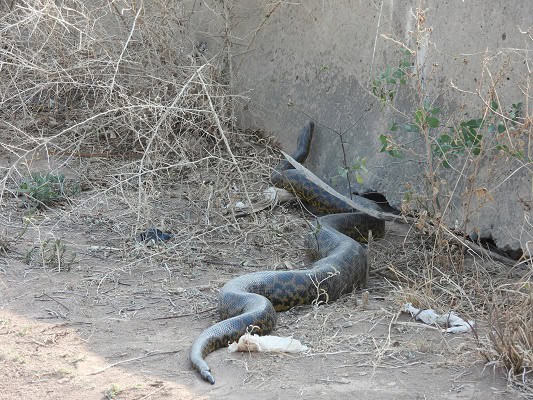
Maximum length: 4.6 metres.
The second most common anaconda member, and the second longest snake in Brazil overall. Apart from being smaller, the yellow anaconda has two main differences to the green form: 1) being yellow-black instead, and 2) living much further south. The heartlands of this species lie in the Paraguay River and its various tributaries, resulting in a range of far southern Brazil, the vast majority of Paraguay, and a swathe of northern Argentina. By contrast, the green anaconda comes nowhere close to Argentina.
During flooding, this species can be washed far afield, occasionally appearing in Uruguay. Yellow anacondas are just as semi-aquatic as their cousin, and eat species such as Maguari storks, neotropic cormorants and vesper mice. No attacks on humans are known, but there’s a thriving skin trade, where yellow anaconda hides are exported to Milan and turned into luxury handbags. At one point, this was decimating the species’ population, but fortunately, things are under control nowadays.
Worldwide, yellow anacondas likely number well into the millions. During wet season, they grow more adventurous, venturing to roads and villages, and it’s impossible to miss them when they do.
| 3 | Boa constrictor |
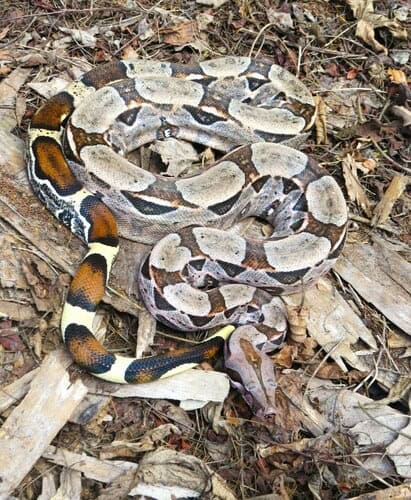
Maximum length: at least 4 metres.
The boa constrictor doesn’t have the advantage over the anacondas when it comes to size, even if it beats all other 400+ snake species in Brazil. Instead, this iconic species has the advantage of habitat flexibility and sheer territory covered overall.
Boa constrictors are able to inhabit not just dense rainforests, but grassland, woodlands, the edges of crop fields, and towns and villages. Their only real requirement seem to be high temperatures. Consequently, this species inhabits every single state of Brazil. The only area where they’re scarce is the extreme south, e.g. Rio Grande Do Sul just north of Uruguay, but they’re still found here in sparser numbers.
Boa constrictors can be found near São Paulo, as well as the rainforested city of Manaus, and the borders of Peru, Colombia and Ecuador to the northwest. They’re less aquatic than anacondas, and less arboreal than the tree boas, wading through water, climbing trees and moving over dry ground with equal ease. Their diet is flexible, but focuses on mammals, including rats and even the occasional monkey.
One strange fact is that boa constrictors have great difficulty in hunting iguanas, which can survive even their most crushing coils. They also have a weakness to alcohol, particularly when it’s held directly under their nostrils, which causes them to suddenly unwind their coils.
| 4 | South American bushmaster |
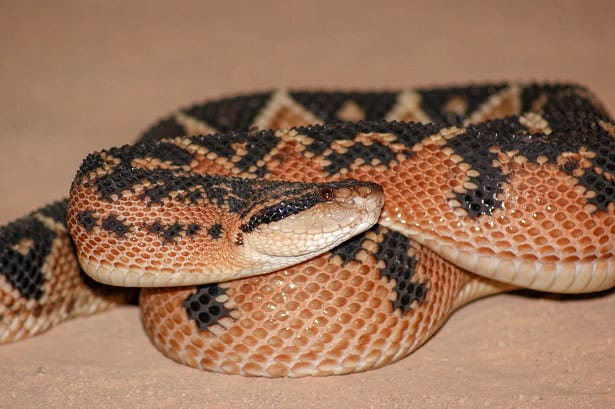
Maximum length: 3.65 metres.
If you wish to meet a viper face to face, Brazil is a good country to visit. You may even bump into the largest viper in the world: the South American bushmaster (Lachesis muta), which regularly breaks through the 3 metre mark, and exceeds the longest rattlesnake of all (the eastern diamondback) by a full metre.
Crazy rumours surround this snake, including transforming into armadillos, and leaping at the shining headlights of cars. South American bushmasters are actually hard to find, as compared to the boa constrictor, they much prefer the underground. They hang out in vacant mammal burrows, and these are typically within rainforests, making the South American bushmaster one of the trickiest Brazilian vipers to track down, despite being the largest.
South American bushmasters produce up to 500mg of venom per bite, in correlation with their large size. They inject various cytotoxins, haemorrhagins and neurotoxins, covering many snake venom bases. Their venom isn’t the strongest in raw potency, but is capable of killing a lost explorer or villager simply due to the high volume injected.
| 5 | Brazilian smooth snake |
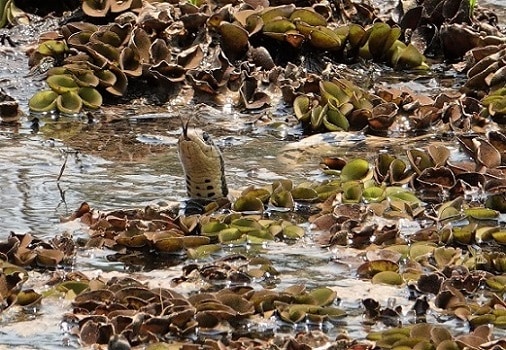
Maximum length: 300cm.
The longest snake in Brazil which isn’t a viper or boa, and one with a huge variety of skills. The Brazilian smooth snake lacks a dangerous venom, but has all sorts of survival tricks: faking death, spreading a neck hood like a cobra, and a confident and aggressive personality
Brazilian smooth snakes are semi-aquatic, and appear in the Amazon rainforest, but are more common in southern Brazil, Paraguay and northern Argentina. Their range has a strong overlap with the yellow anaconda, where the two sometimes appear side by side in the same locations, alongside Mato Grosso lanceheads and annulated cat-eyed snakes.
This species derives much of its meals from frogs, but is highly flexible. One study found a dietary breakdown of 41.4% amphibians, 20% reptiles, 15.7% fish and 14.3% mammals.
There’s no reason why this species grew to be so large. Boas are constrictors, and any size gained gives them a powerful advantage. Even the South American bushmaster is an ambush predator which knocks over its prey with an initial crushing pounce. But exactly why the Brazilian smooth snake ballooned above its rivals is a mystery, as it mainly relies on rapid pursuit for hunting.
This species either appears in rivers or on river shores, and has all the nimble swimming skills you’d expect.
| 5 | Dark-spotted anaconda |
Maximum length: 300cm (?).
The northern relative of the green anaconda, but much rarer. This species is found solely in extreme northern Brazil and French Guiana, and even then only in isolated pockets. Its aquatic habits are similar, but its appearance varies, with thick, rounded blotches. This is the smallest of the 4 confirmed anaconda species, though still hefty and thick-bodied.
In a survey covering 12 males and 35 females, the longest individual was a male, with a length of 230.7cm minus the tail. No tail length was given, so if we take the green anaconda’s relative tail length of around 0.18 for males, that equals a tail length of around 41.5cm for this super-large male. This would entail a total body length of 272.2cm, but given the relatively small sample size, it’s extremely unlikely that the team covered the species’ maximum size.
As this species has been reported widely to be smaller than the green anaconda, a maximum size of around 3 metres seems like an intelligent estimate.
| 7 | Amazon puffing snake |
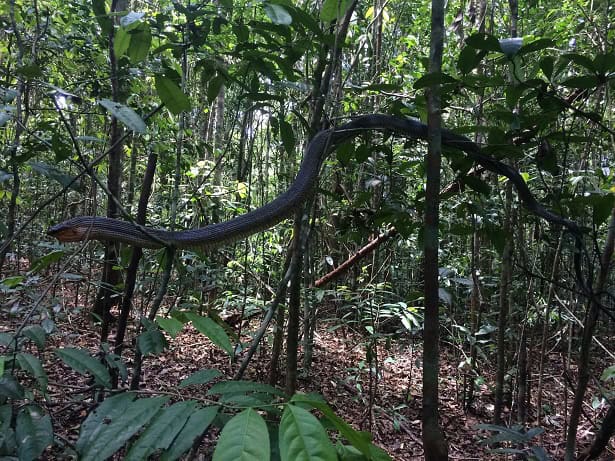
Maximum length: 291.5cm.
The Amazon rainforest is full of all sorts of dramatically enlarged species compared to the outside world, and this is yet another example. The Amazon puffing snake has ballooned in size far beyond the norm, blasting through the 2.5 metre mark with no obvious explanation as to why. This is a flexible species which appears on the ground, but also in trees, where it nimbly navigates even the thinnest of branches, despite its large size.
This species lacks a venom, but has a complex intimidation display. It rears up its chest, vibrates its tail, and puffs out its neck and chest so much that a meal seems to be lodged inside. It almost looks like a pelican’s distended neck, but the Amazon puffing snake’s goal is pure intimidation.
This species appears in Ecuador, Peru, Guyana and French Guiana as well, but Brazil is its heartland. Despite its brute size, the Amazon puffing snake still becomes a meal for fellow snakes, including the mussurana (see below).
| 8 | Mussurana |
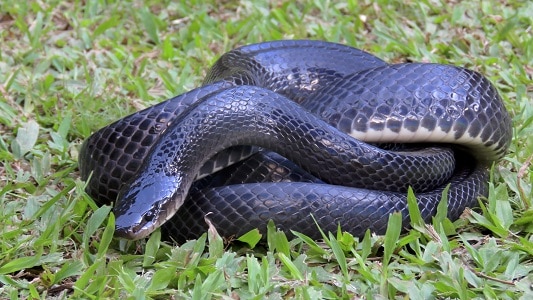
Maximum length: 275cm.
The largest constrictor in Brazil which isn’t a boa. The mussurana feeds primarily on fellow snakes, including common lanceheads and eyelash vipers. Its goal is to crush and control, and gaining ever more centimetres over the millions of years has helped it in this quest. Also useful is a complete resistance to the venom of pitvipers, which attempt desperately to bite the captor holding them, to no avail.
Mussuranas appear over the vast majority of Brazil, excluding the far south. They also appear in Central America, making them one of the most widespread snakes in the western hemisphere overall. They’re immensely successful in their chosen lifestyle, and their brute size is surely one reason why. This species outstrips every single rattlesnake in maximum size, and every single viper in Brazil except for the South American bushmaster.
Mussuranas appear in rainforest areas, but also grassland, and moist areas in villages between patches of remnant forest. Moisture is important for this species overall, as mussuranas are particularly common immediately after heavy rains, when they scour the land for new meals and new pitviper-swallowing opportunities.
| 9 | Tiger ratsnake |
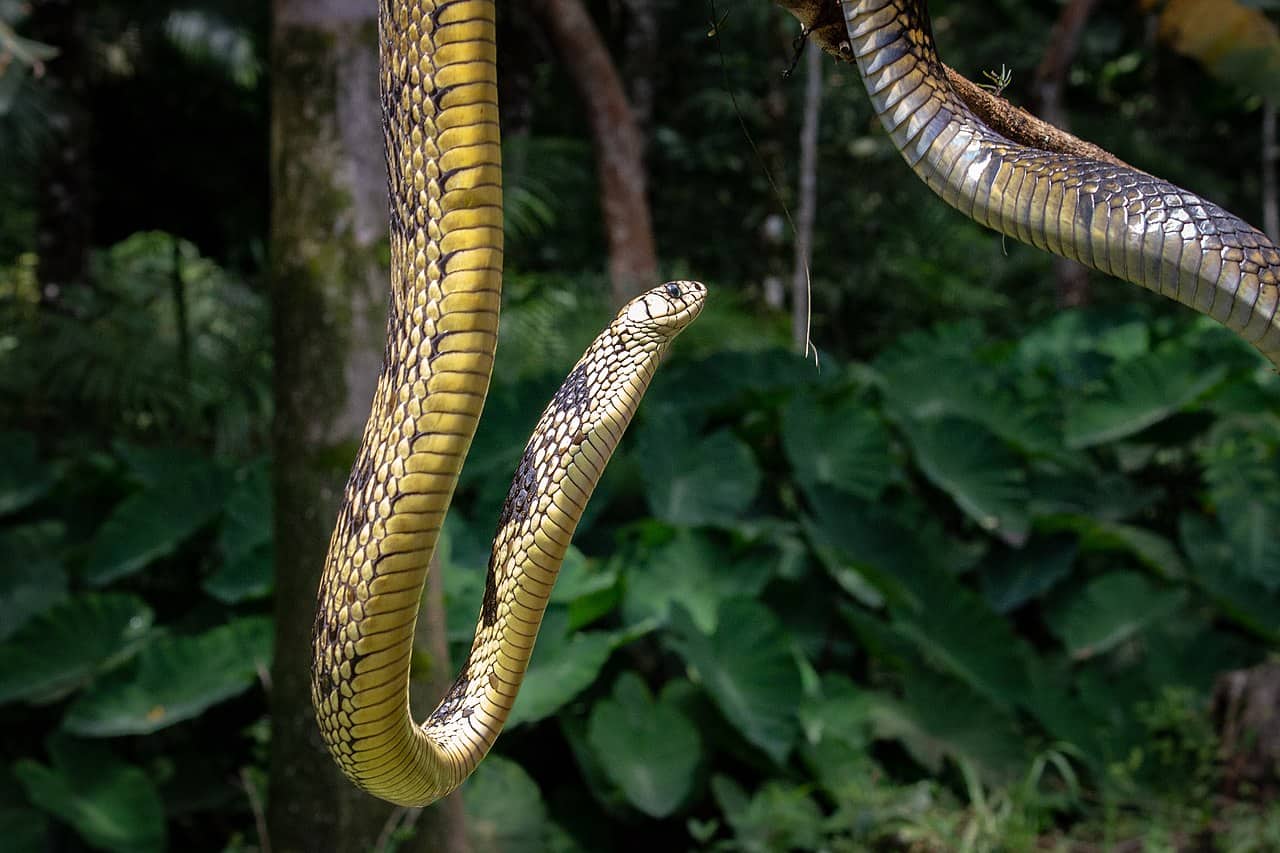
Maximum length: 270cm.
A close relative of the Amazon puffing snake, and almost as long, often exceeding 250cm. This species is even more widespread, covering the vast majority of Brazil, Central America, and even reaching Mexico.
Tiger ratsnakes have a sneaky tendency to hunt bats, using their immense climbing skills. They slither stealthily into dark roofs, or wait on a tree branch directly next to a roof and wait for the bat inhabitants to fly out. They also prey on birds, and are easily recognisable, due to their sharply contrasting black and yellow colours, which come in varying ratios.
Tiger ratsnakes are flexible in their habitats, but are usually found near trees. This species has a solid explanation behind its jumbo size – male wrestling. Males of this species engage in ritualistic combat, whereby the combatants attempt to force each other’s heads to the ground, with their bodies intertwined like spaghetti.
Generally, the larger male wins these fights, which probably created a strong pressuriser for the species to grow larger. The larger would have had more access to female tiger ratsnakes (the point of the wrestling ritual), and therefore been more likely to father increasingly large offspring. It’s possible that Amazon puffing snakes are large for the same reason.
| 10 | South American sipo |
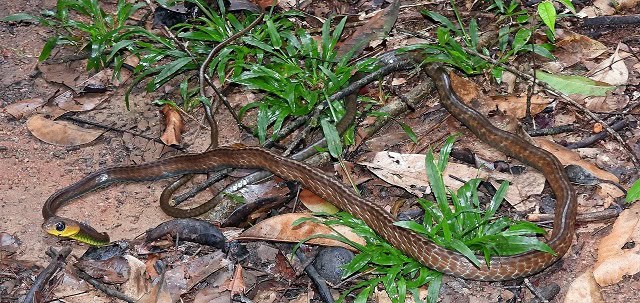
Maximum length: 261.1cm.
Another wrestling snake, and another species which often climbs tree branches. The South American sipo is common in forested regions of Brazil, and is recognisable by large eyes and a friendly facial expression.
This species always has a yellow belly, which is much brighter than its darker body, which is either grey or greenish. Its diet consists heavily of amphibians, including frogs such as Atlantic forest treefrogs, which it acquires by waiting patiently near streams within forests. It also eats the occasional snake, including venomous painted coral snakes.
South American sipos are only mildly venomous, but are often spotted coiled up in repeated S-shapes, as though about to unload savagely against an interloper. They’re also found in Guyana, French Guiana and eastern Ecuador. They belong to the Chironius genus (18 members), and are one of the largest members, and easily the largest in Brazil. The largest worldwide is the Ecuador sipo (Chironius grandisquamis), found from Ecuador to Costa Rica, which peaks at 271.8cm.