
| 1 | Southern African rock python |
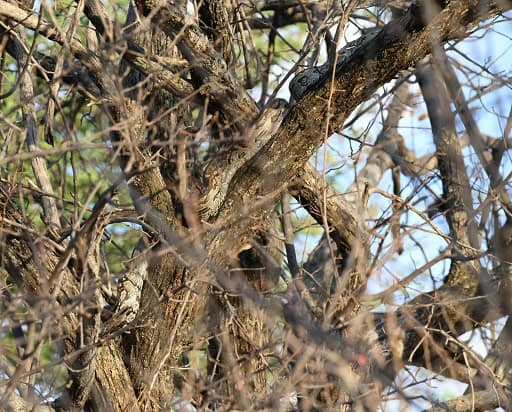
Maximum length: 5.8 metres.
The southern African rock python (Python natalensis) is one of the longest snakes in the world, probably ranking in 3rd or 4th place when judged by maximum length. It’s a thick-bodied constrictor which prowls around the African savannah, looking for new ambush spots to establish itself in, and settling down for several hours before a rabbit, impala or even small hyena walks past.
Given its enormous record length, you would at least expect this species to be easily noticeable, but the African rock python also counts camouflage as one of its great skills. Rather than bright green or red, this species has murky scales, which are more than capable of blending into dry, wispy undergrowth, or perhaps a dried-out tree, as seen above.
The photo above was taken in northern Namibia, the slighter moister half of the country, as opposed to the dry, deserted south. Other species which exist here include Anchieta’s cobra and the Angolan python, both of which have a greyish, beige tinge as well.
| 2 | Forskal sand snake |
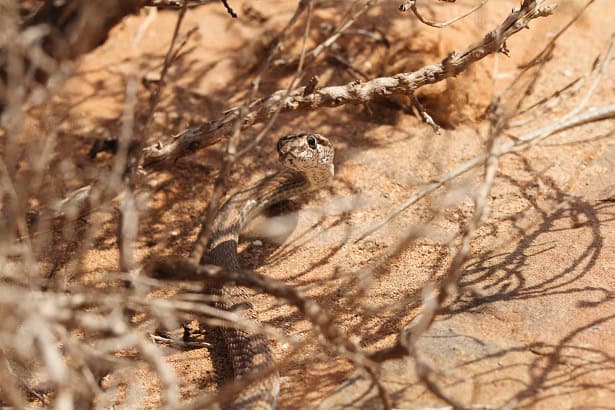
Maximum length: 148cm.
A North African species, which possesses a mild venom, but tends to flee at high speeds when confronted by humans. This species inhabits multiple African nations, including Egypt, Libya, Morocco, Algeria, Tunisia and more. Its southernmost point in Africa lies in Ethiopia, and it also has a strong presence in the Middle East.
The Forskal sand snake’s colours are optimised for blending with parched dry soils. This species generally appears in drier Mediterranean habitats, including hillsides with plenty of shrubs and cultivated areas. Its speed is exceptional, aided by a thin, whippy body.
Forskal’s sand snakes (Psammophis schokari) aren’t believed to be dangerous to humans, but a three week old mouse was reported to have been immobilised within 60 seconds. Camouflage is another skill of this snake, allowing it to blend with dry environments. The Forskal sand snake can either flee at high speeds, or remain still and hope to not be seen at all. Its plans seem to be succeeding, as this species covers a vast area in North Africa.
| 3 | Battersby’s green snake |
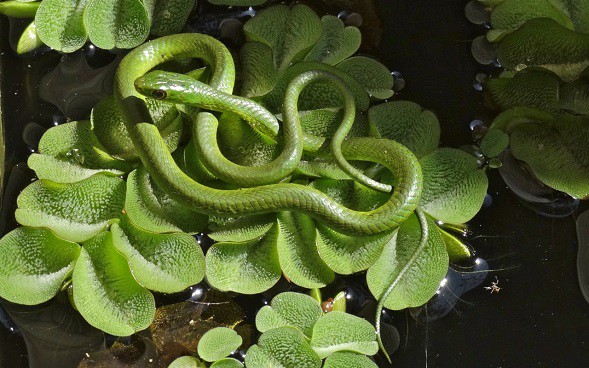
Maximum length: 90cm.
The Philothamnus snake genus has 25 members in Africa, the vast majority of which have a hyper-green colour. Battersby’s green snake is no exception, with an almost purely green body from head to tail. This is a species of eastern Africa, ranging from Ethiopia in the north to Tanzania in the south.
Battersy’s green snake (Philothamnus battersbyi) is particularly common in Nairobi, probably the most abundant species within the city limits. Wherever it lives, this species has the gift of camouflage, allowing it to blend not just with leaves on trees, but lilypads and floating vegetation in water bodies. This is a semi-aquatic species, spending much of its time in ponds and small pools of water.
Battersby’s green snake is only mildly venomous, so there’s no risk if you happen to be startled by one. Many residents of southern Kenya will have walked past this species without realising. Your only task is to resist picking them up, as Battersby’s green snakes can be aggressive if manhandled.
| 4 | Puff adder |
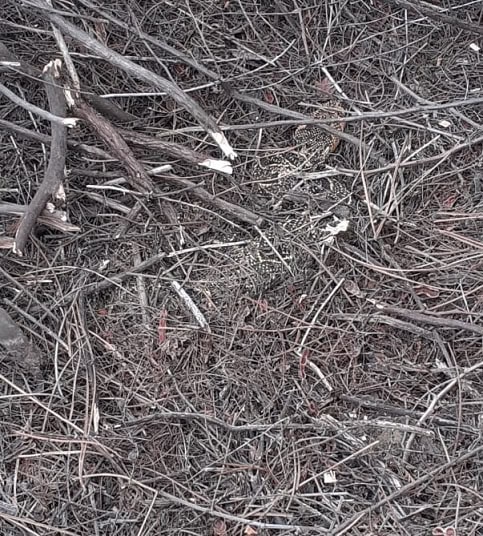
Maximum length: 191cm.
The puff adder is the master of several lethal qualities when it comes to sub-Saharan Africa. Firstly, it’s the most widespread venomous snake. Secondly, it causes the highest annual bite total, and finally, its camouflage is immense, which is one reason behind its immensely high casualty rate.
Rather than green and bright yellow, the puff adder is dull in tone. It has various morphs, including brown, grey and beige, but these are always non-flashy, and perfectly optimised for blending with overgrown grasses or the edges of dry game trails rather than green forests. The image above is a great example, and just one photo of many where the puff adder seems to have chameleon-like powers.
Even worse, the puff adder has the ability to camouflage its own smell, according to an experiment where dogs were trained to sniff out various snake scents. The puff adder’s venom isn’t the most lethal ever, lacking in neurotoxins, but is still regularly fatal, due to a high quantity injected.
| 5 | Peringuey’s adder |
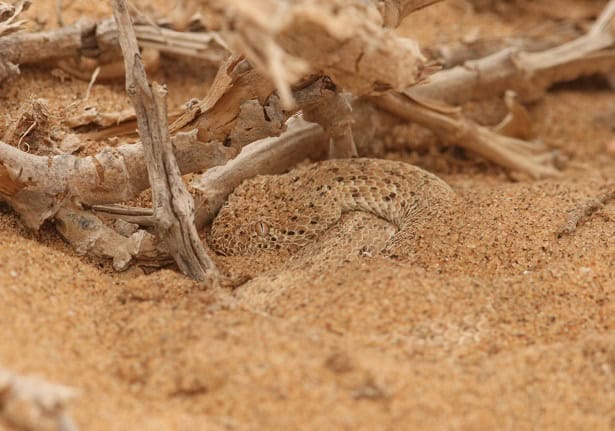
Maximum length: 32cm.
Part of the same Bitis clan as the puff adder, but far smaller, and adapted to living in sand deserts instead. Peringuey’s adder (Bitis peringuey) lives in the southern half of Namibia, which is the most deserted region of Africa south of the Sahara. It lives a harsh lifestyle, gliding up sand dunes, hoping to ambush the few lizards brave enough to dare to survive in these lands.
One of these hunting methods involves burying itself in sand, in order to disguise itself, with just an eye or two peeking out. Consequently, Peringuey’s adder has done the logical thing and evolved sandy-coloured scales, to blend with the surrounding desert. Just a couple of green scales would be enough for a lizard’s alarm bells to start ringing, and so, Peringuey’s adder has eliminated any bright patches that could give it away.
Peringuey’s adders are dangerously venomous, but bites are rare in humans. One reason is that they live in such remote areas, where humans rarely tread, including sand dunes themselves.
| 6 | Madagascan tree boa |
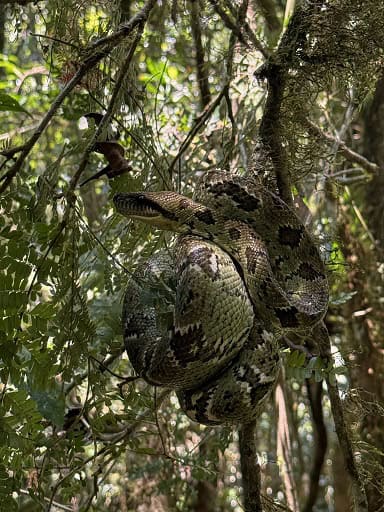
Maximum length: around 2 metres.
The Madagascan tree boa is one of 4 boas found on Madagascar, and one of 2 members of the Sanzinia genus, both of which are found exclusively in Madagascar. This is a fairly large species, which preys on warm-blooded prey such as rats, and is mainly found in the north and east of Madagascar, where it sticks to forested environments.
This species somehow combines dull brown tones and greenness into one. It’s able to blend with leafy green foliage and the forest floor simultaneously, giving it a great survival advantage in the moist forests it calls home. Some forest snakes are a bright neon green, but this species is subtler, giving it the best of both worlds.
This species has an interesting quirk with newborns as well: an intense red colour, which gradually transitions to the greenish-brown with age. Madagascan tree boas have immense tree-climbing skills, as you’d expect, but they also have a relatively thick body for a tree boa, making their agility all the more impressive.
| 7 | Horned adder |
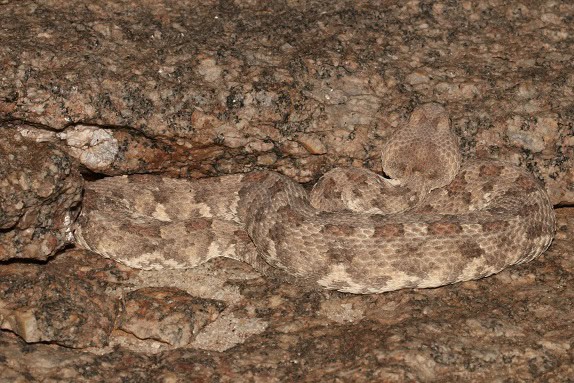
Maximum length: 52.3cm (wild), 60.0cm (captivity).
Another member of the Bitis adder genus (which has 18 members overall), and intermediate between the first two in habitats. The horned adder (Bitis caudalis) doesn’t appear in true sand deserts like Peringuey’s adder, but appears in more parched areas than the puff adder. This is a species of parched canyons, rocky hillsides and shrubby semi-deserts, and it has the parched beige tone to match.
Horned adders are found in 5 countries overall: Namibia and western South Africa, southern Angola, southern Zimbabwe and much of Botswana. They can be very common in certain spots, and their venom unleashes a swelling dosage of cytotoxins, but is rarely fatal. This species preys mainly on mammals, and often hides in their burrows as well.
While horned adders are typically beige, they vary in colour, with some being greyer, and others even red. This allows them to camouflage in different soil types, from reddish soils rich in clay to rocky gravel plains. Whatever the colour, this is a species to always be on the lookout for.
| 8 | Northern marbled nocturnal tree snake |
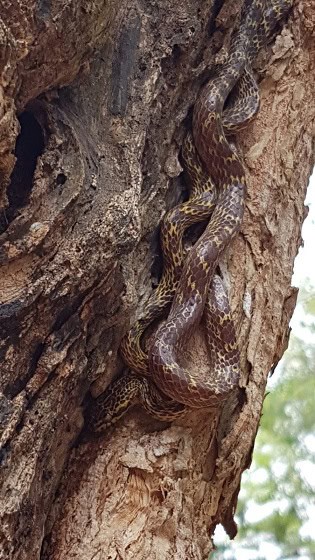
Maximum length: 63cm (female), 61cm (male).
A species of far eastern Africa, appearing in a grand total of 5 countries: Mozambique, Malawi, Tanzania, Kenya, and far southern Somalia. This is a very memorable-looking species, with cracked patterns alternating between brown and either bright yellow or white. Its eyes are richly patterned, and seem to bulge out of its head, with the finishing touch of a sharply vertical pupil.
Unfortunately, you probably won’t get to see all this. The northern marbled tree boa (Dipsadoboa flavida) is not only rare and difficult to find, but has excellent camouflage when you do (unknowingly) stumble across one. Its colours aren’t bright green for blending into leaves, but duller and optimised for blending into woody branches and thick gnarly tree trunks.
This is a fairly small species, with no records of over 65cm. Northern marbled tree boas pose no threat to human beings, and generally perform mock lunges when confronted. Their diet is known to include reed frogs, and they appear in several habitats, including woodlands and tree clumps in wet savannahs.
| 9 | Green mamba |
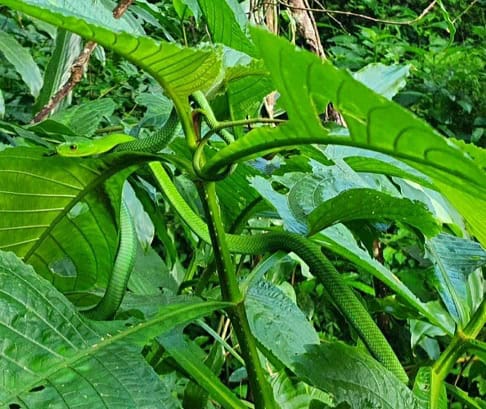
Maximum length: 230cm.
Part of the same 4-member mamba genus as the infamous black mamba. The green mamba obviously differs by being bright green instead, an all-consuming green which covers virtually its entire body. As the image above shows, this grants it effortless camouflage in thick areas of greenery.
Green mambas appear along the southeastern coast of Africa, including in South Africa, Mozambique, Tanzania and southeastern Kenya. They live in moist forests, but mainly in coastal areas, as they rarely appear more than a few dozen miles inland. Another difference to the black mamba is a stronger tendency to lurk in trees, and a relatively sedentary lifestyle.
The black mamba is no slouch when it comes to camouflage either. It effortlessly blends with dry savannah grasses, and crispy undergrowth, and even in woodlands, it can blend into the thick arm of a tree surprisingly well. However, the green mamba wins when it comes to particularly thick areas of greenery. This is a less lethal species than its cousin, but still powerfully neurotoxic.
| 10 | Eastern rufous beaked snake |
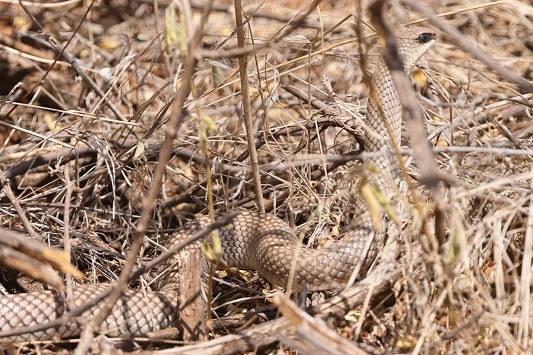
Maximum length: 160cm.
Parched savannah terrain with wispy grasses and dry thickets is a staple of Africa just as much as thick rainforest, and the eastern rufous beaked snake (Rhamphiophis rostratus) is one species to have adapted to these environments. This is a slow-moving, mostly harmless species which sticks to the ground, often taking shelter in dark mammal burrows and vacant termite mounds.
Eastern rufous beaked snakes are widespread in eastern Africa, occupying South Africa, Mozambique, Tanzania, Kenya, Ethiopia and more. Wherever they live, they have one special feature: excellent camouflage, which isn’t always active, but kicks in when slithering through dry thickets, as demonstrated above. Coupled with a relatively patient nature (unlike most Psammophis species), it’s easy to walk past this snake without ever detecting its presence.
This species is relatively ordinary in colour, but has one of the more interesting faces of an African snake, with a large eye, contrasting against its namesake beaked snout. The final ID is a dark stripe through the eye, separating the chin and upper head.