
| 1 | A stealthy African killer |
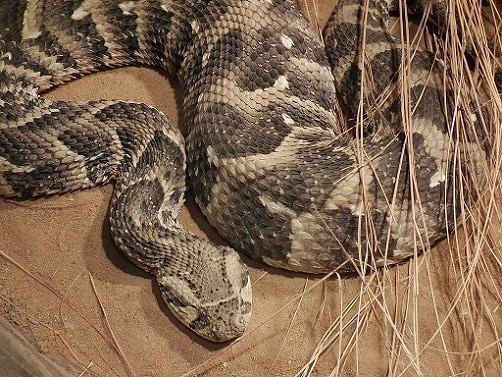
The puff adder (Bitis arietans) is a dangerously venomous snake species found in sub-Saharan Africa, which has an average length of 1 metre, and an all-time maximum of 191cm. It’s a murky snake in its colours, with a mixture of beige, black and brown shades, which are optimised for blending into dry foliage.
The puff adder is one of the most feared snakes in Africa, but for different reasons to its neighbours. Black mambas and cobras are feared due to their fast speeds, twitchy and nervous temperament, and high willingness to bite. Meanwhile, the puff adder is feared because it’s almost impossible to detect. This species is an ambush predator, and its colours are designed perfectly to blend with dry undergrowth near forest game trails or farmland.
The puff adder’s hunting strategy is to carefully select a spot and remain in place for many days while mammals walk past. This is great for capturing small rats, but it also makes this species incredibly easy to bump into by accident. Puff adders are almost impossible to spot while resting in a bed of overgrown thickets. It’s extremely easy to brush your boot against one by accident, and extremely hard to dodge, as its lunge is extremely quick (despite being lazy usually).
Consequently, few snakes inspire fear in Africa like the puff adder, except of course the black mamba. This species has a deadly venom as well, which is more than capable of killing human beings.
| 2 | Africa’s most widespread venomous snake |
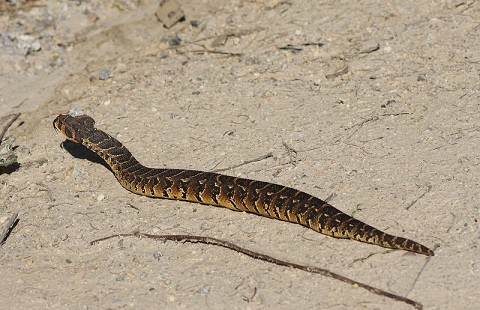
The puff adder is not only lethal and stealthy, but the holder of a great record: the official most widespread venomous snake in sub-Saharan Africa.
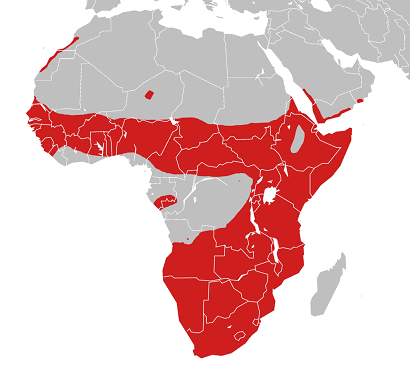
The puff adder inhabits virtually every country to the south of the Sahara Desert, with only a handful of exceptions. To the west, it’s found in Ivory Coast, Togo, Ghana and Nigeria. To the east, it’s plentiful in Ethiopia, Kenya and Tanzania, while on the southern tip of Africa, this species is a constant presence in South Africa and Zimbabwe, appearing in almost every region.
There’s only a few countries in sub-Saharan Africa where puff adders aren’t present: Madagascar (an island), the Seychelles (more islands), Equatorial Guinea (too jungled), and possibly Liberia. They’re much more widespread in Africa than the black mamba, which mainly concentrates in the southeast.
Puff adders also have an overseas outpost in Saudi Arabia, Oman and Yemen. Furthermore, they’re highly abundant wherever they do live, rather than scattered and spread out. In terms of raw headcount, this species probably numbers well into the tens of millions worldwide.
North of the Sahara Desert, this species mostly disappears. You don’t have to worry about puff adders in Egypt or Libya, but there is one exception: an isolated pocket in Morocco, which is separated from the main bulk of the species’ territory.
| 3 | Dominates African bite statistics |
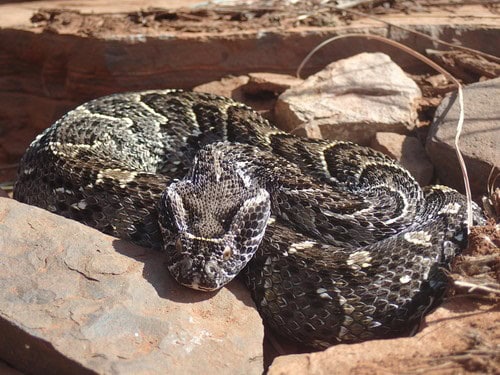
Being super widespread also gives the puff adder another unfortunate record: the highest annual bite total in Africa, even if its venom isn’t quite the deadliest drop for drop. Various sets of statistics reveal just how dominant this stealthy viper is. In 2022, a study analysed snakebite rates in Mozambique, and revealed the puff adder to be the number one perpetrator, just ahead of the stiletto snake, and well ahead of the infamous black mamba.
A study from Zimbabwe found that among 83 snakebite victims, puff adders were responsible for 75%. Another Zimbabwean study analysed 276 snakebite victims. In 40 cases, the actual species was identified, of which 25 were the puff adder.
Puff adder bites aren’t guaranteed to be fatal, but are more likely to unleash necrosis, sometimes to such severe levels that amputation is necessary. The only saving grace is that unlike cobras, they rarely invade people’s houses. Mozambique spitting cobras can slither through your bedroom window, while puff adders are more likely to lurk on farmland busy with workers.
Puff adders are part of the 18 member Bitis adder genus, which also includes the thick-bodied gaboon adder, famous for its 2.5 inch fangs. Puff adders have slightly shorter fangs, but are easily the most common Bitis member across the continent. It’s possible to find this species on beaches bordering both the Atlantic Ocean to the west and Indian Ocean to the east.
| 4 | Venom statistics |

In terms of raw venom potency, puff adders don’t quite make the top 20 snakes worldwide, but they’re still more toxic than around two thirds of vipers. With an LD50 score of 0.4-2.0mg, they’re more potent than the American cottonmouth (2.08mg), sidewinder rattlesnake (2.6mg), and European meadow viper (2.17mg). The two deadliest vipers worldwide are members of the Indian “big four”: the Russell’s viper (0.4mg) and saw-scaled viper (0.24mg), which the puff adder almost matches.
The puff adder’s brutal symptoms also come from its unusually high venom yield. A thick, stubby body can hold more venom, and puff adders inject an average of 150-300mg per bite.
According to some estimates, just 100mg can kill a human being, and the largest, most generous (if that’s the right word) puff adders can inject over 1000mg per bite. Contrast this against the asp viper, France’s main venomous snake, which is equally toxic, but injects only 9-10mg per bite.
Some statisticians rank this species in first for annual African snakebite deaths, but others point to the less widespread yet far more vicious black mamba. Puff adders undoubtedly cause far more actual bites than the black mamba, but are significantly less lethal. Only 15% of bites lead to death, and that’s untreated bites as well.
| 5 | King of the crushing pounce |
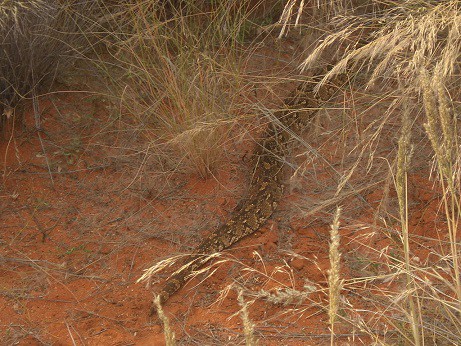
As they lurk in immobile ambush posture, puff adders may seem lethargic, but the reality is that they’re completely aware of everything around them. When a prey species wanders past absentmindedly, they can lunge extremely quickly, in complete contrast to their usual slow movements. Their Latin title is Bitis arietans, and arietans translates as “to strike violently”.
Puff adders have extremely large fangs which are capable of piercing soft leather. Some rodents die instantly because of the sheer weight and force of the puff adder’s body. These vicious strikes last for less than 2 seconds in total, yet the energy packed into them is immense.
As for “puff” adder, this has nothing to do with inflating its neck like a cobra. Instead, it comes from a strange noise this species makes when confronted by predators, in the rare case that they see through its camouflage. This noise sounds exactly like a puff of air, and can be surprisingly loud. It’s a similar noise to the leopard tortoise nearby, leading to a theory that the tortoise is mimicking the far deadlier puff adder to increase its own survival chances (Batesian mimicry).
| 6 | Diet: extremely flexible |
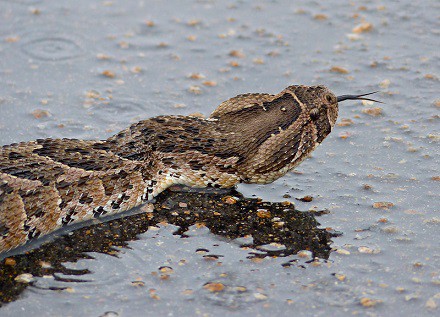
The next stage of the puff adder’s assault depends on the species. With shrews, small mammals, birds, toads, or lizards, it generally keeps a tight hold until the venom works its magic. With larger rodents or rabbits, it stands back instead, and waits for the prey to slowly succumb.
Puff adders are vulnerable to the gnashing, gnawing teeth of larger prey, and need to be cautious. Their diet is as unfussy as can be, leaning towards mammals, but also featuring birds, amphibians and reptiles. One of their confirmed prey is the four-striped grass mouse (Rhabdomys pumilio), an 11cm species with black and white stripes like a skunk. This small mouse inhabits most of southern Africa, particularly gardens, fields and shrublands, which regularly brings it across the puff adder’s path.
In the amphibian kingdom, puff adders regularly dine on the African red toad (Schismaderma carens), which looks like a strangely shaped clay brick when sitting still. Other meals include the rock mouse (Micaelamys namaquensis), pouched mouse (Saccostomus campestris), and globally ubiquitous black rat.
| 7 | Produces over 100 newborns |
The puff adder is the official holder of one record among snakes: the highest number of newborns at once. The puff adder is ovoviviparous, giving birth to live young, and a Czechoslovakian zoo captive from Kenya once gave birth to 156 at once.
The average is also high, at 20-40 snakes per batch, with 50-60 being perfectly normal, compared to just 2-13 for a scarlet snake in Florida. Supposedly, the puff adder pushes out plenty of unfertilised eggs as well, so if you’ve ever fancied boiled snake eggs for breakfast, then this is the species to track down.
Nobody’s certain how long puff adders live for in the wild. The record in captivity (where the species fares well) was 16 years, so the average in the wild is most likely 10 years. There’s another phenomenon in captivity as well: that the puff adder often gorges itself so full that it dies. This species has no breaks on its hunger; it just eats and eats and eats (and eats) until the plate in front of it is empty, sometimes forcing it to regurgitate whole animals.
| 8 | Lures frogs with its tongue |
Most snakes use their forked tongues for olfactory (smelling) purposes, sniffing out prey species or even subtle changes in atmospheric humidity. But the puff adder’s tongue waggling skills have evolved to a whole other level.
Starting in 2017, biologists gathered 4600 hours of puff adder footage, covering 86 individual snakes, using camera tripods placed in strategic locations around Dinokeng Game Reserve in South Africa.
What they saw amazed them. In multiple instances, they noticed puff adders sticking their tongues out and waggling them around, not briefly, but for extended periods of 30 seconds, after which they’d repeat the cycle again.
Slowly but surely, the biologists would notice frogs creeping into the frame. The puff adder kept up the act in the grainy footage, before the frogs strayed too close and were devoured. The puff adders were using their tongues to lure in prey, by mimicking the appearance of the frog’s own prey. It’s possible that they evolved this trick to compensate for their poor leap distance, which is only 5-10cm. Interestingly, the luring was only used on amphibians and not rodents.
| 9 | Camouflages its own smell |
Luring frogs isn’t the puff adder’s only special hunting technique, as it turned out in 2016 that they camouflage their own smell, as well as their appearance.
A few facts raised the scientists’ suspicions. Firstly, puff adders rarely take shelter underground, despite Africa’s many hungry predators. Secondly, they remain completely still when threatened by predators rather than fighting back. The most suspicious fact was that mongooses and meerkets often walk right past puff adders without noticing them, even stepping over their heads. Puff adders have fantastic visual camouflage, but this seemed to reach another level.
Therefore, the scientists gathered various snake species and gave dogs corresponding scents, in a “scent match” test. The dogs ran to the correct snake in almost all cases, but the puff adder was the exception. The smell left the dogs confused, despite their legendary noses, which are trained to smell illegal drugs and even the adrenaline of stressed criminals fleeing a scene. The puff adders were untraceable, despite only being a few metres away.
This chemical camouflage, known as chemical crypsis, has been detected in the harlequin filefish before, but never a land animal.
| 10 | Even invades beaches |
The puff adder looks like the lazy stoner of the snake world, sitting in a bush all day rather than on a sofa with pizza boxes everywhere. But it secretly has a variety of athletic skills, even if it rarely uses them. For one thing, puff adders are excellent tree climbers, which helps them to sniff out unguarded bird eggs.
They’re also excellent swimmers, as witnessed in a news story from May 2017 when a puff adder was spotted swimming across the vast Gariep Dam, near Norvalspont in South Africa. It was surrounded by water on all sides, and was quickly dubbed the Gariep Dam monster. Cameras captured the snake swimming for many kilometres without giving up.
Then in December 2020, a South African family spotted a puff adder floating along a sandy shore in the Western Cape. It was the Lundt family’s last trip to the beaches before they all slammed shut due to a new wave of COVID-19. Instead of pristine sparkling ocean, they were greeted by a snake slithering over the water like it was as solid as glass. Puff adders can even curl up into a ball and fall asleep while floating on water.
| 11 | Haemorrhaging rather than paralysis |
Scientists have identified several rare toxins in puff adder venom, including Ba100, bitiscetin, and bitanarin, a post-synaptic neurotoxin. The thrombin-like enzymes (TLEs) have some of the most visible effects. These deactivate fibrinogen in the bloodstream, an important blood-clotting agent, causing watery blood to gush from the bite wound. This is generally a snake of blood chaos, rather than neurotoxic symptoms like drooping muscles (despite containing a few neurotoxins).
Blood blisters are common in victims, as is random spontaneous bleeding. The entry grade systemic symptoms include nausea and vomiting. Puff adder bites are also notorious for causing swollen limbs, due to toxins that massively increase vascular permeability, sending a rush of blood to the bitten body part.
The mildest bites produce only redness and pain, but the unluckiest suffer from necrosis, and the sloughing off of dying tissue, sometimes down to the whiteness of bone. Sometimes, the necrosis is severe enough to cause amputations, changing the victim’s life forever.
Fortunately, antivenom is easily available for puff adders, unlike the secretive hairy bush viper of Kenya, a rare species to have no antivenom developed. As usual in Africa, the main problem is getting the antivenom out to remote villages. This is a snakebite of two halves: the consequences can be dire if untreated, yet at the same time, treating them is quite easy.
| 12 | Eaten by other snakes |
Though equipped with various deadly weapons, puff adders aren’t even close to the top of the serpent pecking order. Fellow snakes often feast on them, including the following confirmed species:
- Black-necked spitting cobra – extremely common in western and central Africa.
- Cape cobra – found mainly in southwest Africa (South Africa, Botswana). See a cool puff adder showdown here.
- Anchieta’s cobra – relatively uncommon, found in northern Namibia and Angola.
- Snouted cobra – a species of southeast Africa (Mozambique, Zimbabwe, southern Namibia).
- Mozambique spitting cobra – the spitter of southeast Africa.
It appears that cobras have a particular liking for puff adder flavours, and this is because of the security granted by their highly neurotoxic venom. Only a cobra can be confident of paralysing a puff adder rapidly enough to not be bitten in the process. It also helps that cobras are particularly fast and nimble as a group.
A cornered puff adder will attempt frantically to escape, accelerating way beyond its usual speed, and sometimes succeeding. But if a cobra lands one bite, then it’s too late, and the puff adder’s fate is inevitable. See this brutal video of a snouted cobra hunting a relatively small puff adder, which went viral in 2020. Other confirmed predators of puff adders include tawny eagles and southern ground hornbills.
| 13 | Colour variation |
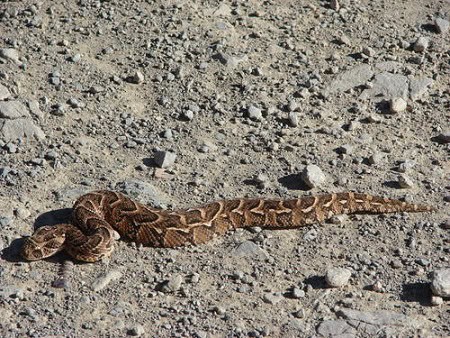
Puff adders have a relatively low variation in appearance, unlike their cousin the horned adder (Bitis caudalis), which has loads of colours. Generally, the image above is as close to a “standard” puff adder as you’ll ever see. However, there are occasional rare morphs, such as this grey speckled version found in Bloemfontein, South Africa.
Puff adders have a slight variation in colour, while generally keeping the same rough patterns. A large chunk are dark grey with paler grey markings, but others can be virtually black contrasting against bright yellow markings. Others have varying shades of beige – these individuals are the ultimate in camouflage. Some puff adders have faded and less distinct markings, while others are vivid and sharply contrasting.
What are the best ID signs for a puff adder? As with most vipers, search for a triangular, bulky head, which is far thicker than the preceding neck. A brutally thick body might be the best ID sign for this snake (see the image above). Another is two large stripes on its face, which cross each eye and make some members look like they’re wearing goggles.