| 1 | Motuo bamboo pitviper – can’t bite itself |
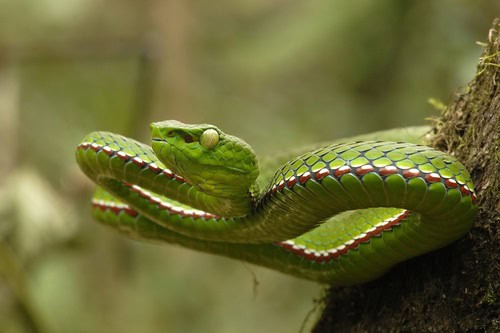
Maximum length: 67.7cm.
The Motuo bamboo pitviper (Trimeresurus medoensis) is a dangerously venomous snake found in a narrow area of northeast India and southern China, in hilly regions. This species is a relatively small member of the Trimeresurus pitviper clan, and has clean velvety green colours, with thin white and red stripes on its flanks. It’s a nocturnal snake which is found mainly in wet montane forests, surrounded by dozens of other lethal creatures.
Being fairly uncommon, little is known about this species’ venom, except for one unfortunate fact – it seems to lack self immunity.
In 2011, a Motuo bamboo pitviper was collected from a garden in Meghalaya, India. Rescuers bagged it up, and scheduled a release in the nearby forest for 24 hours later. But when they reopened the bag, they found the pitviper dead.
Its fangs were embedded in its own mid-section, and in the area below the bite, there was clear disintegration of tissues. There were no other clear signs of wounds or disease. This species has to be careful not to bite itself, even if there’s an itch that needs scratching (maybe a swarm of ants running up its back).
Other snakes are luckier, as eastern coral snakes have been observed biting themselves in captivity and suffering no ill effects. But a juvenile of the Costa Rican coral snake (Micrurus mosquitensis) died after biting itself at a point 3.5cm behind the head. The scientists speculated that self-immunity to venom might develop with age in certain snake groups.
| 2 | Large-eyed pitviper – temperatures |
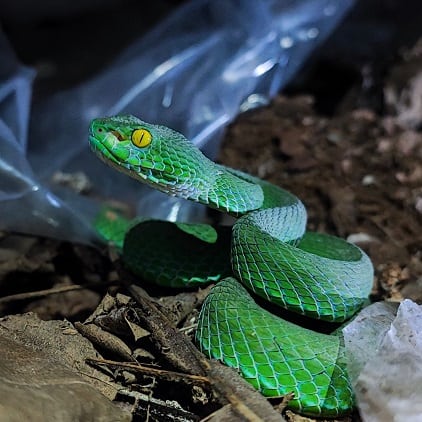
Maximum length: 74.1cm.
Large-eyed pitvipers are a staple in Bangkok, and in nature reserves like the Sakaerat Biosphere Reserve in northern Thailand. They’re similar to white-lipped pitvipers except shorter, and with much larger eyes (which are yellow).
Large-eyed pitvipers rest on branches for hours, days or even weeks, and lunge at people who pass. Bites rarely kill, but unleash necrosis, and thrombocytopenia, when the platelets that glue red blood cells together in wound healing severely decrease.
This snake is the master of all it commands in Thailand… but it has one weakness. Large-eyed pitvipers have a very narrow ranges of temperatures they can operate in.
According to a 2018 study from Sakaerat Biosphere Reserve, which tracked the species for 73.6 days, they only had an 8 degree temperature range. Above 31.2C and below 23.2C, the large-eyed pitvipers completely ground to a halt and ceased all movement.
This is already a lazy snake, as the large-eyed pitvipers moved an average of just 3.2 metres per day. One snake went 21 days without moving. If it’s an unseasonably chilly 20C day fuelled by an injection of Mongolian air from the north, the jungles of Thailand might be slightly safer than usual.
| 3 | Pacific rattlesnake – Cali kingsnakes |
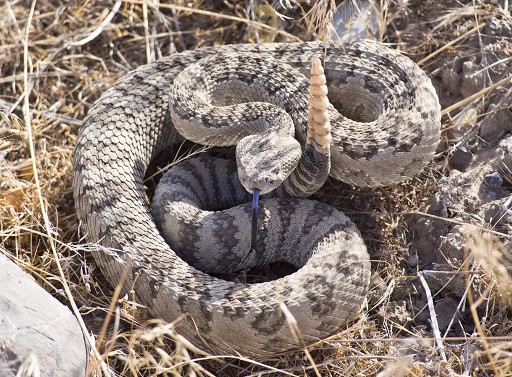
Maximum length: 162.6cm.
The Pacific rattlesnake is the main venomous threat facing ordinary Californians. In 2023, a 7 year old boy was airlifted away from Mount Diablo State Park after being bitten, while in 2015, a San Diego man was forced to pay $153K for antivenom after a Pacific rattlesnake bit him while posing for a selfie. Its venom lacks neurotoxins and is usually survivable, but can require skin grafts due to a bounty of cytotoxins.
The Pacific rattlesnake is a dangerous snake which anyone from outer Los Angeles or the San Joaquin could bump into. But it has one weakness – the California kingsnake. This black and white constrictor is the Pacific rattlesnake’s nemesis, the mortal enemy to which it still hasn’t worked out a solution.
California kingsnakes get a large proportion of their diet from fellow snakes. A 2018 study analysing 2662 individual kingsnakes discovered 31 snake species in total, and the Pacific rattlesnake ranked first among venomous snakes. 17 were eaten, versus 3 for the next ranked, the sidewinder rattlesnake.
California kingsnakes have natural immunity to rattlesnake venom, something that the Pacific rattlesnake failed to factor into its plans for west coast domination.
| 4 | Montpellier snake – small mouth |
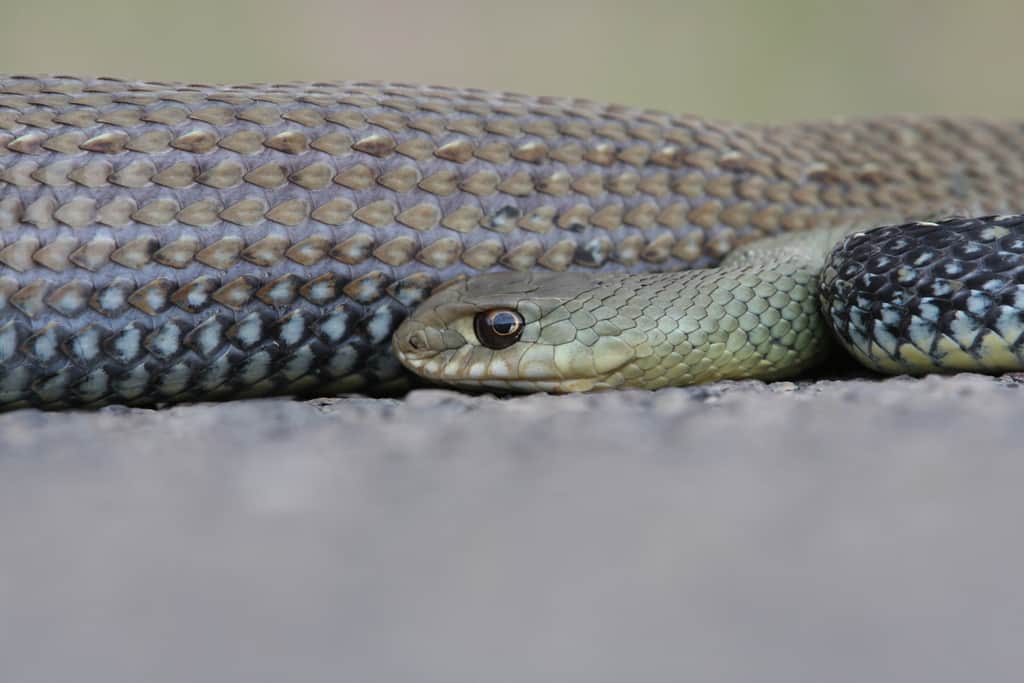
Maximum length: 216.2cm.
It’s no good if there’s a neurotoxic venom pulsating through your fangs, but you can’t even open your mouth wide enough to deliver it. The Montpellier snake is one creature with this unfortunate problem. This is the 2nd longest snake in Spain, at a maximum of over 2 metres. It’s also found in North Africa, where it’s a staple of snake-charming shows in Marrakesh.
If Montpellier snakes inject their venom, it seems to be powerful even in humans. A death was recorded in Libya, and one male victim experienced ptosis and ocular paralysis. Difficulty swallowing and trouble focussing have also been recorded. However, the key point is that the latter victim stuck his finger all the way into the snake’s mouth before getting bitten, probably in an overconfident dare.
Montpellier snakes combine two unfortunate features into one. Firstly, their mouth is small, and secondly, their fangs are located at the back of their jaw.
The only hope of this snake is to lull victims into a false sense of security. If you held out your hand and allowed the Montpellier snake to carefully position itself, it could deliver a venomous bite, but you definitely don’t need to fear this neurotoxic snake if you see it staring at you from a stone wall near a Portuguese beach trail.
| 5 | Central American coral snake – poor yield |

Maximum length: 115cm.
The Central American coral snake (Micrurus nigrocinctus) lives in all 7 Central American nations plus far southern Mexico. It has the usual red-white-black patterns, with especially long red sections, and sticks to forests, slurping up fellow snakes like the Costa Rican worm snake.
Like most of the 82 member Micrurus coral snake genus, its venom contains three finger toxins with primarily neurotoxic effects, which begin with poor coordination and muscle weakness, before progressing to full-on paralysis and respiratory failure. The local swelling is mild, and secondary to the lethal neurotoxins.
The stage is set for a serpent terror to make Central America completely uninhabitable, but what holds Micrurus nigrocinctus back is a small venom yield of just 8mg per bite. If the bite injected 200mg like a black mamba, then the victim would be paralysed within minutes. As it is, Central American coral snake victims easily have time to phone an ambulance and receive antivenom en route to hospital.
Central American coral snakes are also relatively slow, with a proper S-shaped slither rather than a blinding charge. Per drop, their venom is an elixir of dark arts and death, but nature has decided to take mercy on us humans for once.
| 6 | Tiger snakes – they’re tasty! |
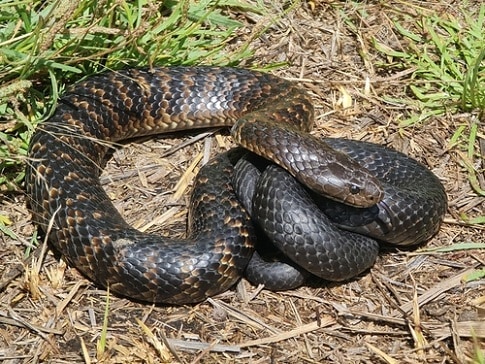
Maximum length: 180cm (mainland), 240cm (islands).
Tiger snakes cover the majority of southern Australia, where they’re feared by most living creatures. They have the ability to deliver 65mg of venom per bite, and this venom contains neurotoxins, myotoxins (muscle-assaulting toxins) and haemotoxins alike.
Bite victims can expect spontaneous bleeding, swelling, nausea, headaches and vomiting. Yet tiger snakes also have another feature: the highest rate of broken tails among Australian snakes. A study from the south found that 56% had incomplete trails and 14% had over two thirds missing.
There’s only one conclusion we can draw – tiger snakes taste damn good. The local birds cannot resist their flavour, whether it’s brown falcons, goshawks, or laughing kookaburras. These tiger snakes were in the clutches of an eager predator and had to detach their own tail to save themselves. Many of their fallen brothers became meals for real.
If it wasn’t for predatory birds and the tiger snake’s possibly exquisite flavour (if you’ve tried it let us know), this species would probably be way more numerous in Australia. Tiger snakes aren’t the most lethal ever, but caused 17% of venomous Australian snakebites from 2005 to 2015, with 4 deaths in that time. The most recent death occurred in 2020, with the victim being a 78 year old man. Beware – we still don’t recommend trying to take a bite out of one.
| 7 | Shedao Island pitviper – poor accuracy |
Maximum length: 99cm.
Everyone knows that venom potency and venom yield vary between snakes, but so does strike accuracy. Fer-de-lances and their Bothrops pitviper relatives are extremely accurate, approaching a 100% success rate if you’re within reasonable range. This is one reason why the fer-de-lance is Central America’s most dangerous snake (plus western Colombia’s), accounting for 80% of venomous snakebites in Costa Rica.
At the opposite end of the spectrum, you have the Shedao Island pitviper of China. This snake is found exclusively on the island, where it feeds on birds and numbers almost 10,000.
Its venom is rich in coagulants and cytotoxins, yet the Shedao Island pitviper’s movements are totally uncoordinated. It’s erratic and jerky rather than focused and disciplined, like it’s letting the heat of the battle get to its head. According to a 2002 study, this pitviper performs a failed strike 46.7% of the time.
That said, you’re still in grave danger if you stumble across a Shedao Island pitviper, so close that you can stare into its vertical pupils. This species has a disturbing tendency to climb trees, to hunt its bird prey. Back off quickly, and your odds are relatively decent.
| 8 | Many-banded krait – vampire tendencies |
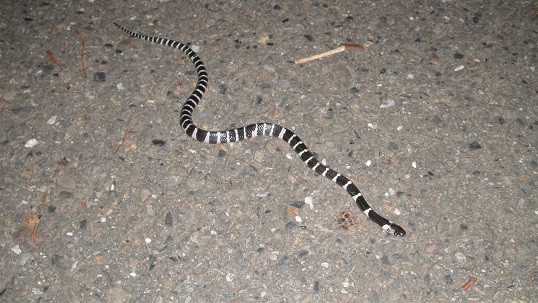
Maximum length: 180cm.
Many-banded kraits are found in southern China, Laos and Thailand, and are similar to a vampire in personality. They cannot suck your blood, and don’t wear capes, although they do blend into the night well with their black-white stripes. They don’t live in gloomy castles, although they do occasionally invade village huts and bite people while sleeping. They have no issue with garlic, although nobody has ever tried to rub a garlic clove over them.
Instead, the vampirism is in their dislike of daylight. Many-banded kraits are extremely dangerous, producing a venom loaded with three finger neurotoxins such as beta-bungarotoxin, which easily cause death in humans via respiratory paralysis. They have the special skill of causing muscular pains and aches across the entire body, like the aftermath of an über-intense workout.
Many-banded kraits are not to be approached, but during daylight, they become way more lethargic. During night, they’re aggressive and focussed on biting people. During daylight, their energy is sapped away, and they sometimes don’t respond when humans walk past.
Sunlight is the enemy of the many-banded krait, where it loses some of its deadly powers. You shouldn’t approach this snake in any circumstances, but you’re more likely to survive at midday compared to midnight.
| 9 | Copperheads – they’re wimps! |
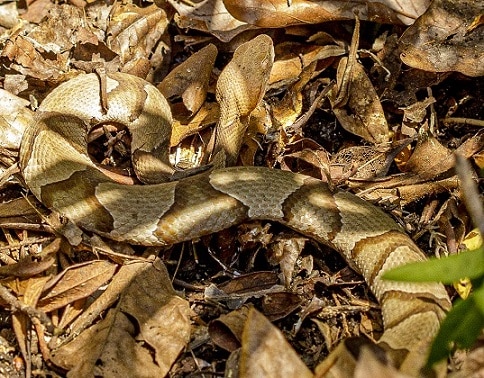
Maximum length: 134.6cm.
Copperheads have a demonic reputation among residents of the eastern USA. For some, they’re sufficient reason to not enter the local woods altogether, particularly those with a leafy floor where their camouflage can activate.
It’s true that copperheads can inject 75mg per bite and cause skin necrosis requiring skin grafts, yet they also have a pretty cowardly personality. Consider this 2020 study. Scientists entered US woodlands and encountered 69 copperheads, which they subjected to tests like stepping on their tail using a boot on a stick, and picking them up using tongs with a glove attached to the end.
In 15 of the 69 encounters, the copperhead fled into the undergrowth instantly. These copperheads vanished so quickly that they were “not available for any further trials“. Some others fled after initially vibrating their tail. The copperheads only attacked the scientists in 2 out of 69 encounters, mainly when actually gripped. The copperheads were not the aggressive warmongers portrayed. They were skittish, even while relaxing in the undergrowth, on a cosy bed of leaves.
If you bother a copperhead, you may not notice that you even encountered one. If you see a copperhead flee, it might be the last you ever see of that snake.
| 10 | Small-eyed snake – hates wildfires |
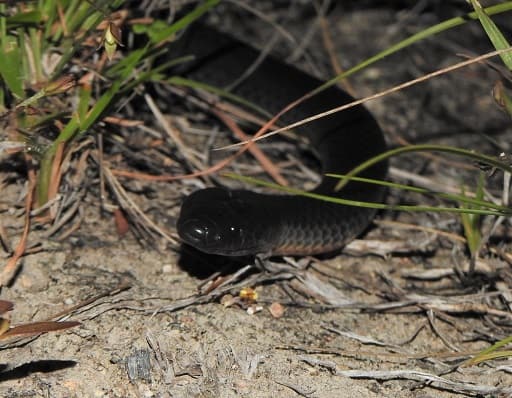
Maximum length: 120cm.
The small-eyed snake kills less people than the eastern brown snake (1 death since 1960), but is the undisputed king of Australian serpents when it comes to muscle tissue damage. Its venom is packed with myotoxins, meaning that post bite, your muscles enter involuntary tension and you’re forced to uncontrollably clench your abdominal muscles.
Myoglobia is a classic symptom, resulting in dark brown urine. The strangest thing is how slowly the venom acts – the muscle tissue damage can take 3 or 4 days to manifest, and worsen for weeks afterwards. Some victims have been sent home from hospital only to stagger back in later.
That said, small-eyed snakes have one mortal weakness – wildfires. If a spark lands in dry bush and spreads to the rest of the forest in a furious inferno, the local small-eyed snake population can fall by 48%. A study compared them to broad-headed snakes in the same area, and the broad-heads easily survived, while small-eyed snake numbers plummeted.
The reason is probably that broad-headed snakes are stationary ambush snakes, which stick to rocky crags, and can disappear into dark cracks at will. Small-eyed snakes are active foragers which search for skinks, and can be caught on open ground by rapidly travelling flames. That said, don’t flick a cigarette butt down as a small-eyed snake is about to bite you; you’ll probably incinerate yourself in the process.