
| 1 | Copies branches to survive |
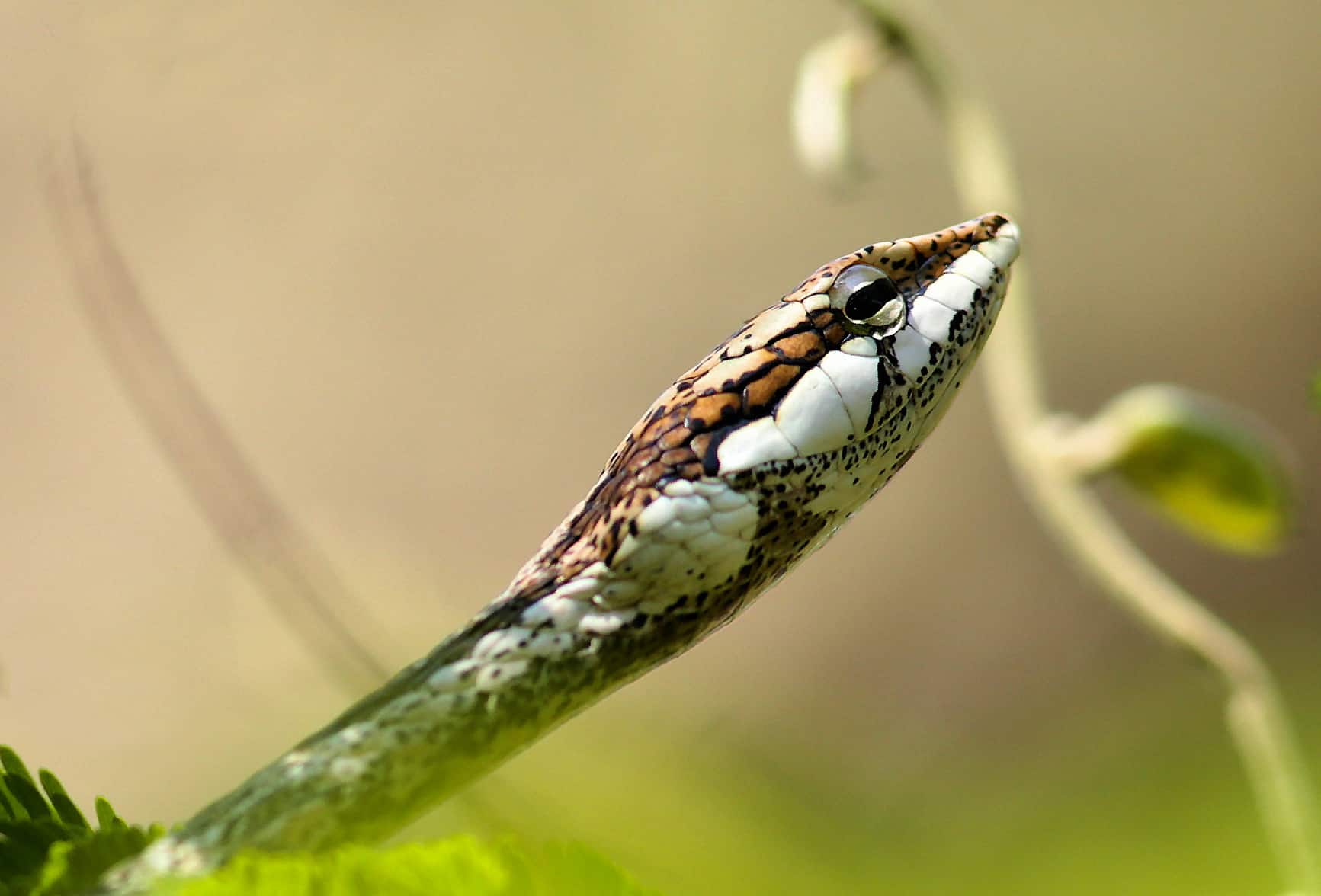
The southern twig snake (Thelotornis capensis) is a moderately venomous snake found in southern Africa, which is one of 7 members of the Thelotornis vine snake/twig snake genus, all found in Africa. This is a medium length species, with a record length of 168cm, and an average of 80-120cm. Regardless of length, it’s an easy species to walk past, for one reason: its immense camouflage.
In South Africa, the green mamba has fantastic disguise in tree canopies due to its green, completely unpatterned body. The southern twig snake is equally effective, but for a different reason, swapping bright neon for an immensely complex colour palette. Its body is tree bark brown or grey, mottled with ever-varying shades. The top of its head is leafy green, while the sides of its head have subtle orange patches.
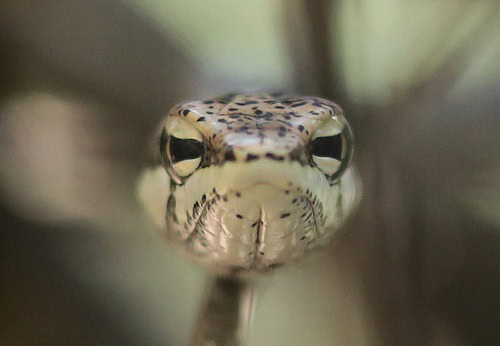
The end result is that the southern twig snake blends with clumps of trees in savannah better than any snake in South Africa. Another odd feature is horizontal pupils, unlike the round or vertical pupils of most snakes. The exact function of these strange eyes is unknown.
| 2 | An inflatable snake (danger) |
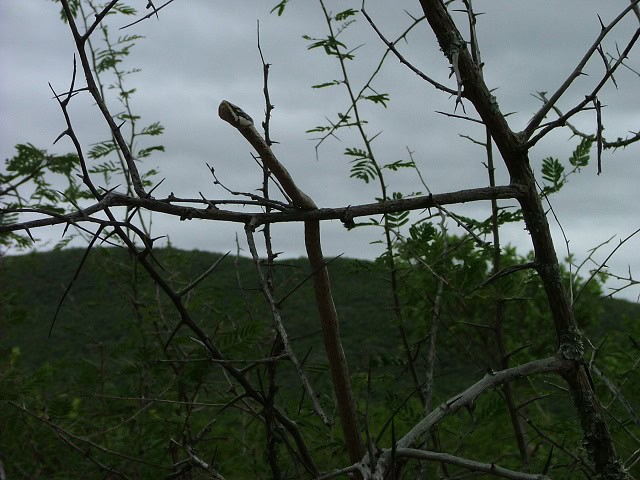
The southern twig snake is a species of trees and low bushes, preferring a mixture of gnarly bark and juicy green foliage. It avoids rainforests, with its favourite locations being woodlands, trees near villages, or clumps of trees within savannah. This isn’t an isolated snake, and is encountered regularly in South Africa.
If you bump into this snake, you may be treated to a rare intimidation trick: grotesquely inflating its throat. The southern vine snake is ordinarily thin, to minimise its weight on thin branches, but when confronted with an aggressor, it can dramatically expand its throat outwards, similarly to a pelican. This produces an illusion of size, and is startling enough that some predators may be intimidated regardless of size.
While its threat is inflated, the southern vine snake produces an orange tongue, and waggles it around rhythmically. This is part of the intimidation display, although the exact function remains a mystery.
| 3 | Mainly found in South Africa |
The Thelotornis vine snake genus has 7 members in sub-Saharan Africa, including three only recognised in 2026, such as Oates’ vine snake. The most widespread is the bird snake (Thelotornis kirtlandi), found in central African countries such as DRC, Uganda and Equatorial Guinea, to as far west as Sierra Leone. The Usambara vine snake lives solely in the protected Usambara Mountains of Tanzania, while the eastern twig snake lives mainly in Mozambique, Tanzania and eastern Zimbabwe.
As the name suggests, the southern twig snake (Thelotornis capensis) is the most southerly of the 7 species. The bulk of its range lies in eastern South Africa, which is significantly moister than the west. Here it appears in various tourist hotspots such as Kruger National Park and Moditlo Game Reserve.
The bulk of this snake’s range is concentrated in South Africa, but it also spills into southern Mozambique, southern Zambia and far eastern Botswana. The southern twig snake is generally a lowland species, even appearing close to the Pacific coast.
| 4 | Venom of the twig snake |
The southern vine snake has a procoagulant venom, accelerating the conversion of fibrinogen to fibrin, the backbone of blood clots. This process is called venom-induced consumption coagulopathy (VICC) – when clot production is accelerated so far by toxins that no supplies remain for genuine wounds, which could be a bloody gash or as minor as a papercut. The venom also activates plasminogen – the enzyme which creates plasmin, which itself breaks down existing clots as part of the “fibrinolytic cascade”.
One menacing characteristic of the southern vine snake is that no antivenom exists. When antivenom for the infamous boomslang was used, it failed to neutralise the vine snake’s toxins. Yet oddly, the boomslang (one of Africa’s most notorious snakes) has a similar profile of symptoms to the vine snakes. Their venom profiles have evolved independently from each other, yet differently enough that their remedies aren’t interchangeable.
Deaths are confirmed from Thelotornis vine snakes, including one patient who was bitten on the tongue. One fatality was caused by cerebral haemorrhaging.
| 5 | Case study |

One detailed bite report involved a 42 year old man of African ethnicity, who was handling the snake when it sank its rear fangs into his hand, before chewing for a sustained period. The whole event was filmed and uploaded to social media, and 56 minutes later, the man arrived at hospital. The paramedic confirmed it as a southern vine snake, and herpetologists reviewing the video made a double confirmation.
The doctors drew a blood sample from the man, and found it to be completely incoagulable. Yet the real world result was more mixed.
The man experienced no accelerated bleeding from the bite wound, nor spontaneous bleeding from the gums or nose (typical in haemotoxic snakes). However, there were noticeable red dots of blood in his urine. This was visible to the naked eye rather than requiring a microscope. The man’s self-reported symptoms included a headache and excess sweating, while there was no swelling or pain near the bite wound.
The man’s bloody urine continued after he left hospital, reverting to normal after 4 days. The whole report was relatively mild, but hinted that the haemotoxic properties of twig snakes are concentrated on the inside of the body rather than externally (spontaneous bleeding), and therefore just as worrying.
| 6 | Leaves mammal meals to mambas |
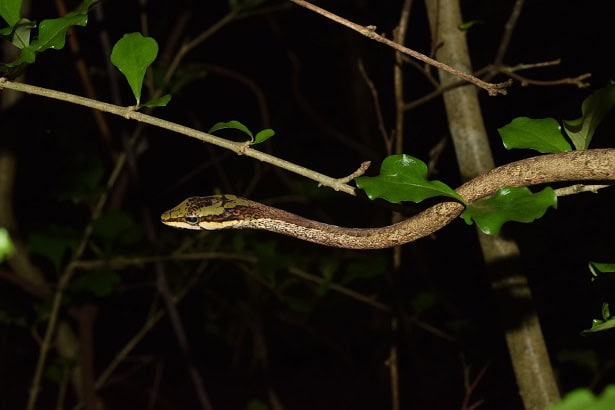
A 1996 study analysed the diet of the southern twig snake, examining preserved snakes from the Transvaal Museum and Port Elizabeth Museum, both in South Africa.
The scientists discovered 56 meals across 50 Thelotornis capensis individuals. The diet was fairly diverse, but with a massive bias towards reptiles. Not a single mammal was found, and only 1 bird. The scientists found termites in one snake but disregarded them as accidentally ingested meals.
The breakdown of prey was as follows: 63% reptiles, 27% amphibians and 8% fellow snakes. Snakes under 50cm (excluding the tail) ate lizards exclusively. The twig snakes were flexible, as they ate both slow-moving tree reptiles like chameleons, and fast-moving ground species such as Nucras sandveld lizards.
Overall, the most popular meal was the Cape dwarf gecko (Lygodactylus capensis), recorded 6 times. Setaro’s dwarf chameleon (Bradypodion setaroi) was recorded 4 times, with one twig snake containing 2.
The southern twig snake seems to have a taste for chameleons, as the flap-necked chameleon (Chamaeleo dilepis) was recorded 3 times. This is a vivid green species, whereas Setaro’s dwarf chameleon is a murkier mixture of green and brown – much like the twig snake itself.
As for other tree snakes of eastern South Africa, the green mamba has a wildly different diet: 42% birds and 58% mammals in one study.
| 7 | An occasional snake-eater |
Four snakes were found in the southern twig snake’s diet, with one being an unidentified colubrid. The three others were harmless species:
Common slug eater (Duberria lutrix) – an abundant species in Africa, which derives most of its meals from snails and slugs, and lacks any venom. Curls into a tight ball to protect itself.
Green watersnake (Philothamnus hoplogaster) – a bright green snake found commonly near ponds and lakes, in thick overgrown vegetation along the shores. Mildly venomous, but no threat to humans or a hungry twig snake. Likes bushes, similarly to the twig snake.
Common brown watersnake (Lycodonomorphus rufulus) – a completely harmless semi-aquatic snake, which appears near rivers and ponds, and lacks any trace of green scales. Feared by Zulus, but defenseless against an aggressive twig snake. Common in over 50% of South Africa.
6 of the southern twig snakes had multiple meals in their stomachs, one of which contained two chameleons. Despite dwelling in bushes, the twig snakes managed to eat fossorial (underground) species, like the common rain frog (Breviceps adspersus). Female and male twig snakes had no noticeable differences in their diets.
| 8 | Prefers bushes to tall trees (mostly) |
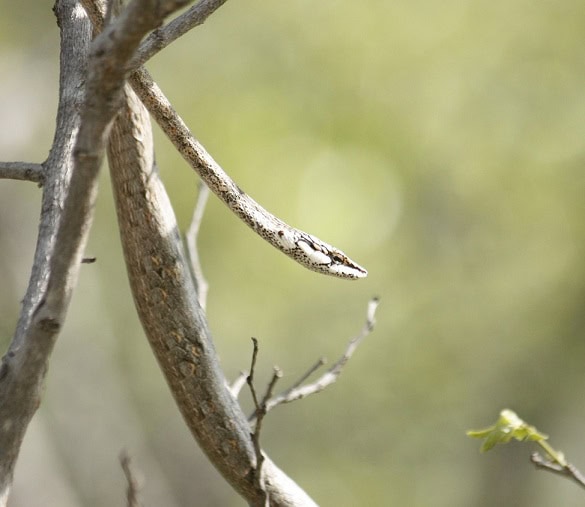
Southern twig snakes have virtually no difference in length based on gender. However, there are differences in body shape: 1) males have longer tails, but also 2) narrower heads than females. This is an egg-laying species, with mothers producing 4-13 per clutch. The eggs average at 30 by 12mm.
Generally, twig snakes are observed in bushes rather than tall trees. This was confirmed in a study from 1980, which found that while active, most twig snakes appeared in bushes and shrubs at 1.5 metres in height or less. This might explain its different colouration to the green mamba, which tends to appear much higher in trees, amid the endlessly overlapping green leaves.
Likewise, the green watersnake (Philothamnus hoplogaster) is another bright green South African species, and favours overgrown grasses on the edges of ponds and lakes. Twig snakes often appear in drier, twiggier bushes in tree clumps within savannahs, explaining their brown-green colour mixture.
There’s a strong possibility of meeting a twig snake not long after the black mamba, as eastern South Africa is a hotspot for both species, including Kruger National Park.
| 9 | Twig snake versus a dog |
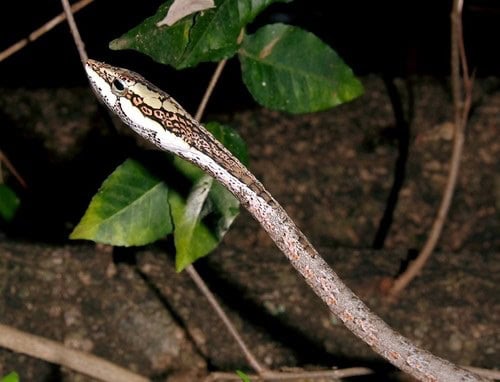
Despite their toxic venom, southern vine snakes are docile, and rarely attack unless touched. They face their own threats in life, as they’re commonly mobbed by flocks of birds upon detection, despite only eating birds occasionally.
You could be bitten by a southern twig snake if foraging in bushes for berries, or after noticing a strange flicker of movement in a bush and approaching to investigate. Dogs are occasionally bitten by twig snakes as well. One faithful pooch was bitten on the nose in a backgarden, which continued to bleed for 4 days afterwards.
The vine snake measured 90cm and was killed, and the dog had the same haematological destabilisation as humans, with blood samples failing to clot on the 2nd day. The dog’s bleeding eventually stopped, with no lasting injuries.
The same report detailed two deaths in humans, with the first succumbing after 36 hours, and the 2nd perishing after 18 days due to multiple organ failure. 9 human cases were documented, including 3 patients who experienced no bleeding, and 4 patients who began bleeding immediately from the fang punctures. One patient’s marks didn’t cease spewing blood until 15 hours later.
| 10 | Another bite report |
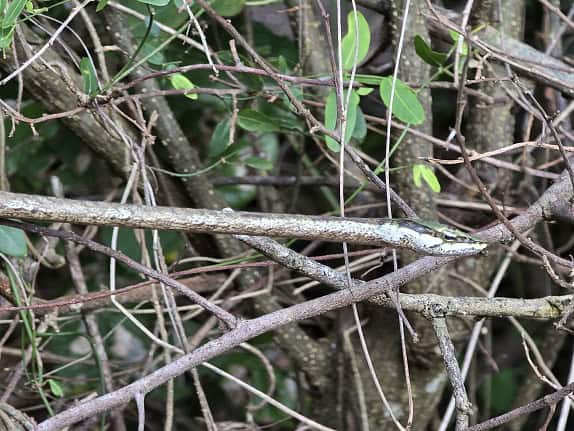
Another case study involved a 13 year old boy in South Africa, who was bitten on the back of the left index finger after attempting to catch a mysterious snake perched on a bush. His finger had 3 separate puncture wounds, but with minimal local symptoms, as pain and swelling were surprisingly lacking. Instead, the boy began hyperventilating, and complained of a painful, cramped sensation in his abdomen, with tingling in the hands.
After 5 hours, most haematological values were normal, but the boy now had prolonged bleeding times. Like the 42 year old man, blood samples were completely incoagulable, with no clotting action whatsoever.
With no antivenom in existence, the doctors began to administer stored plasma, infused slowly. 20 hours post bite, the boy wasn’t bleeding, but his blood was still incoagulable.
This time, there was no blood noticeable in the urine. However, the boy had another attack of painful, cramped abdominal muscles at 29 hours post bite.
The boy’s thrombin time was particularly out of whack. This is the time it takes for a fibrin clot to form after the enzyme thrombin is added to a sample of fibrinogen. A standard value is 10.5-15.6 seconds, but at 112 hours post bite, the boy’s thrombin time was 60s. The venom seemed to have a slow onset, as at 80 hours, the thrombin time was 10.4 seconds.
After 6 days, the boy was released from hospital with no lasting effects.
| 11 | Split into 2: evolution timeframe |
For years, there were just 4 Thelotornis species. These were the bird snake of central and western Africa (Thelotornis kirtlandi), the Usambara vine snake of Tanzanian mountains, the eastern twig snake of wider Tanzania, Mozambique, and eastern Zimbabwe, and the southern vine snake. 2026 was the year 3 new species were discovered, bring the total to 7.
The first new species was found on a single island – Vamizi Island in Mozambique. The 2nd was the dagger-tooth vine snake, an extremely rare species from Tanzania, which was previously known but now reassigned to the Thelotornis genus. The third led to an Earth-shattering division in the empire of the southern vine snake, which originally had two subspecies.
The subspecies Thelotornis capensis oatesi existed in Angola, Botswana, Zimbabwe, Zambia and northern Namibia, but was found to have diverged from the southern populations 0.67 million years ago. Coupled with mitochondrial DNA analysis, this led to an official separation, and the birth of Oates’ vine snake (Thelotornis oatsei), a new species.
Because of this split, the southern vine snake lost a significant amount of territory. As of 2026, the vast majority of its territory lies in South Africa. In fact, some of the information here might apply to Oates’ vine snake as the research was conducted before the split.
The study also identified an origin point for the Thelotornis genus as a whole. It was estimated to have diverged from all other snakes 16.6 million years ago, with the first divisions within the genus appearing 8.3 million years ago (approximately).