
| 1 | Most southerly – cape cobra |

Maximum length: 231cm.
The southernmost point cobras reach in Asia is West Nusa Tenggara, Indonesia. The Americas don’t have any cobras at all, and Antarctica definitely doesn’t (we think). So it falls to Africa to have the most southerly cobra in the world, and the winner is the cape cobra (Naja nivea).
This species inhabits Namibia, Botswana, and over 50% of South Africa. It’s sometimes dark, but sometimes sulphurous yellow or even bright orange. It has an amazing ability to raid birds’ nests, climbing sheer trees and entering nests even through tiny entrances on their undersides.
This cobra reaches the extreme southern tip of Africa: the southern Cape, including Cape Town itself. It’s a common species too, and encountered often, moving around in hot conditions, in open habitats like savannahs and hillsides.
To the north, this cobra reaches as far as northern Namibia, before other species like Anchieta’s cobra take its place. Another South African species is the Mozambique spitting cobra, but this mainly inhabits the east and doesn’t reach the southernmost areas like Cape Town.
| 2 | Northernmost/deadliest – Caspian cobra |

Maximum length: 175cm.
The Caspian cobra (Naja oxiana) holds two records. Firstly, it has the highest LD50 venom potency figure of any cobra alive. It scores 0.14-0.20mg, just a hair ahead of the Philippine cobra at 0.18mg, and the Egyptian cobra at 0.19mg. The cape cobra is slightly weaker at 0.4mg.
The LD50 figure simply measures the quantity of a substance required to kill 50% of the test subjects receiving it, and the Caspian cobra’s venom can take effect in minuscule dosages. The reason for this is a high level of neurotoxins. Caspian cobra bites can lead to twitching muscles, slurred speech and ultimately respiratory failure.
This species also targets the heart, and has an estimated 75% fatality rate for untreated patients. One redeeming feature is that this snake tends to make sham strikes before baring its fangs and unleashing the real thing.
Secondly, the Caspian cobra is the northernmost cobra on Earth, reaching its maximum latitude in central Uzbekistan and far northern Turkmenistan. No cobra on Earth reaches Europe, but this species comes closest, reaching central Iran. The second most northerly is the Egyptian cobra, in its Tunisian enclave, but this doesn’t come close to the Caspian cobra’s maximum latitude.
| 3 | Easternmost – Samar cobra |
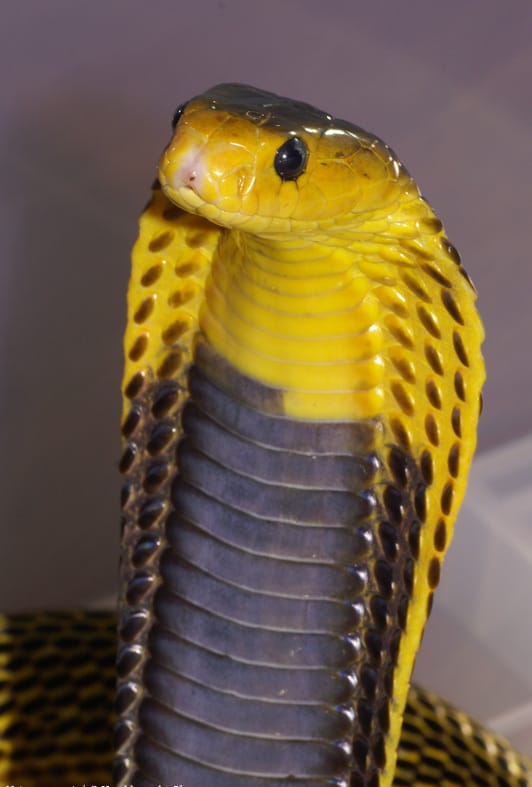
Maximum length: 140cm.
Our next geographical extreme is the east, a realm which is controlled by the Samar cobra (Naja samarensis). This is one of the most recognisable cobras, due to its sharply contrasting black-yellow patterns.
The Samar cobra is the fourth deadliest cobra when it comes to the LD50 scale, beaten only by the Egyptian cobra, Philippine cobra and Caspian cobra. It’s a medium species in size, and some time over the last few million years, it learnt how to spit, releasing two bursts of venom in pressurised jets.
The Samar cobra rules the Philippines alongside the Philippine cobra (Naja philippinensis), but the latter covers Luzon, Mindoro and Masbate, while the Samar cobra inhabits the southern islands of Mindanao, Bohol, Samar and Biliran, which reach slightly further eastwards. No cobras inhabit Australia or Pacific islands such as Fiji and New Caledonia, so the Samar cobra represents the last stop, the final extreme end of the cobra empire before the Earth ends and all people daring to venture further fall off the map into oblivion (or at least that’s what people used to believe).
This species is always black and yellow, but the exact proportions vary, with yellow and black pushing back the other depending on the individual. Samar cobras are particularly common near Davao City, the Philippines’ third largest.
| 4 | Westernmost/most widespread – black-necked spitting cobra |

Maximum length: 240cm.
The black-necked spitting cobra is a dangerous African species which not only aims for the eyes, but produces some of the densest spitting globules of any species, with each weighing 9.75mg, versus 2.64mg for the red spitting cobra further east. This species has two cool records, the first being the westernmost cobra. Black-necked spitting cobras are common in West Africa, slithering freely through open fields, farmlands and villages, avoiding rainforests. Their westernmost point is simply the westernmost in Africa – the far west of Senegal, AKA the Cap-Vert peninsula, home to Dakar, the country’s capital.
This species covers virtually all West African countries, such as Togo, Burkina Faso and Ivory Coast. Another extreme westerly species is the West African banded cobra (Naja savannula)
Secondly, the black-necked spitting cobra dominates all 40 cobras worldwide when it comes to raw territory covered. This species ranges from Senegal and Gambia in the west to Sudan in the northeast and Zambia in the southeast. It covers over 20 countries, and beats other widespread species like the monocled cobra and Indian cobra with ease. Its main barrier is the Sahara, as this species avoids true deserts.
| 5 | Most eggs – Indian cobra |
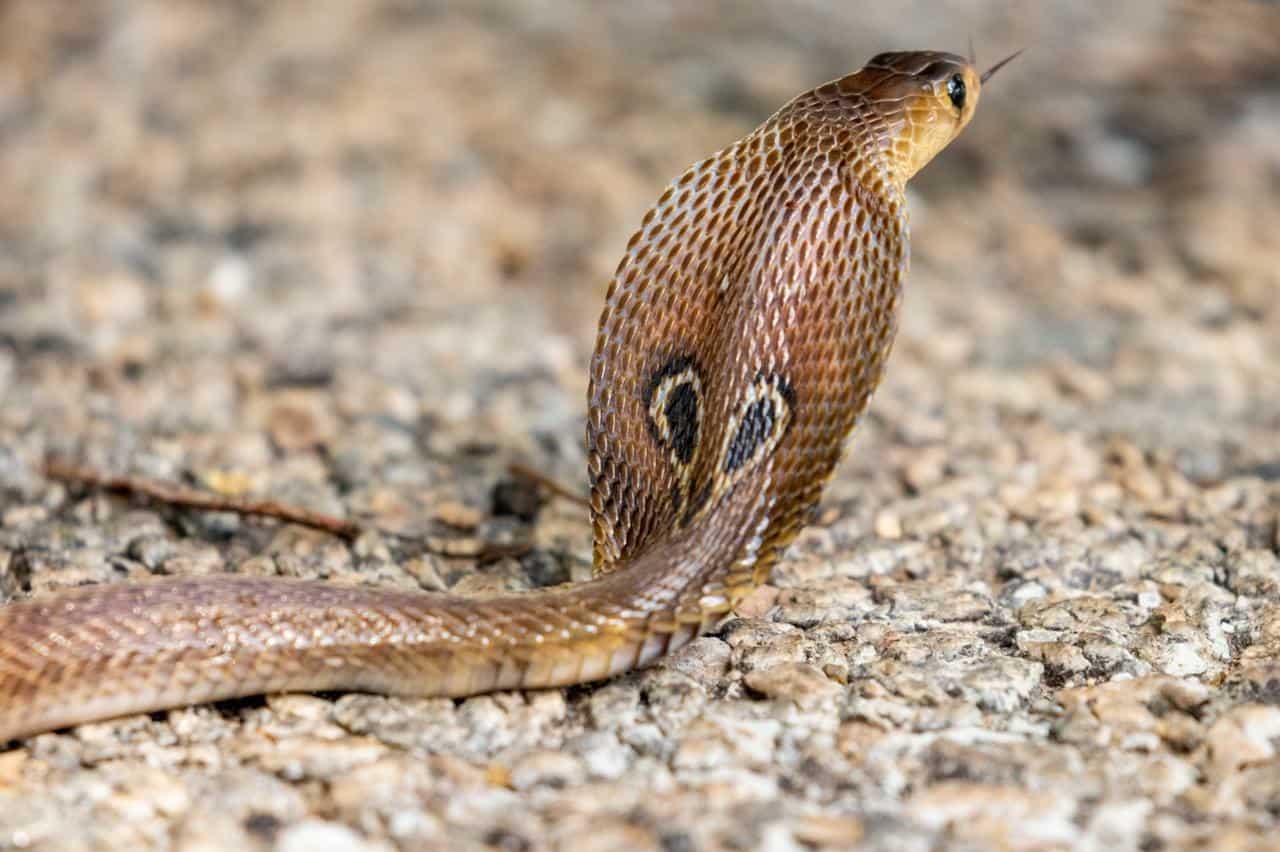
Maximum length: 2.2 metres.
In 2021, scientists were summoned by distressed villagers to Alappuzha district, Kerala state (southwest India). They cautiously entered the vicinity, hoping that a cobra wouldn’t lunge from a roof or even gap in the brickwork.
They eventually found what the residents were frightened of – a menacing Indian cobra measuring 1.5 metres, sitting on a pile of eggs. They had found their opponent, but they soon made a more interesting discovery – the largest egg clutch ever discovered in a cobra.
The cobra’s throne contained 45 eggs, 42 alive and 3 dead. This dwarfed the previous record for the Indian cobra, of 32 eggs, but also defeated any other cobra egg total.
All cobras lay eggs rather than live young (unlike vipers), and other totals include 33 eggs for an Egyptian cobra and 26 for a forest cobra. The monocled cobra (Thailand) was also documented laying 42 in a 2026 study. The king cobra has been recorded laying 56 in captivity, but isn’t a true cobra, belonging to the offshoot Ophiophagous genus instead.
| 6 | Most purely neurotoxic – Philippine cobra |

Maximum length: at least 160cm.
The Philippine pitviper is the most widespread viper of the Philippines, but isn’t that deadly at all. Its venom is mainly haemotoxic, weakening blood clotting by destroying thrombin, yet no confirmed deaths have been recorded in recent times. Then you have the Philippine cobra, which is the exact opposite.
The Philippine cobra (Naja philippinensis) is widespread, with a northerly bias, appearing on the islands of Luzon, Mindoro and Masbate. According to a 2019 study, this species regularly kills rice farmers, and the reason is that it’s the most purely neurotoxic cobra on Earth. It’s only a tiny way behind the Caspian cobra in sheer potency, and of all cobras, it contains the most dramatic bias towards brain signal disruption and away from local symptoms.
According to the same study, “Complete respiratory failure has been noted in almost 100% cases of N. philippinensis bite“. Less than 10% experienced any tissue necrosis or even swelling.
Lung failure is a classic neurotoxic symptom, and an analysis of the venom constituents revealed that almost 45% consisted of short neurotoxins (SNTX). While the venom did contain cytotoxins (typically responsible for local symptoms), these had little effect in human tissues compared to mouse (murine) samples.
| 7 | Longest – forest cobra |

Maximum length: 320cm.
Most cobras are lengthy, with many exceeding 2 metres, but one species spent millions of years embedded in the rainforests of Africa, absorbing frogs, fish and other meals, and gaining centimetres every million years, until it strode out into the bright sunlight one day and declared itself as the longest cobra on Earth. That species is the forest cobra (Naja melanoleuca).
This species is confirmed to reach 3 metres, and tends to have black scales contrasting against a salmon or creamy beige chest. Forest cobras are found in central and west Africa, with their heartlands including Nigeria, Benin, Equatorial Guinea and Gabon. They overlap with the black-necked spitting cobra in much of their range, but are cleanly separated in habitat, in order to coexist. The black-necked spitter inhabits open areas like fields, farms and villages, while the forest cobra sticks to dense forests, almost never entering towns.
The forest cobra is also one of the most heavily fish-eating cobras, despite dwelling on land. One of its hotspots is Musambwa Island in Uganda, where fishermen have learnt to coexist with them.
| 8 | Smallest – Mali cobra |

Maximum length: 106.8cm.
The smallest cobra on Earth is the Mali cobra (Naja katiensis), which appears in numerous West African countries: Nigeria, Benin, Burkina Faso, southern Mali, and more.
This cobra overlaps with the black-necked spitting cobra and West African banded cobra (Naja savannula). It’s much yellower than its two neighbours, but is adorned with thick black bands, which sometimes blend gradually with the yellow (as seen above). Other physical features include a short head, a tail of medium length, and relatively small eyes.
This species is far shorter than the black-necked spitting cobra, but its venom is similar. It has the ability to spit, and is relatively non-neurotoxic compared to the Caspian or Philippine cobra. One of the few bites resulted in no serious systemic symptoms, just an area of necrosis surrounding the bite mark.
Wherever this species lives, it’s rarely observed, and not just because it’s small. It’s the smallest cobra on Earth, yet the Mali cobra still exceeds 1 metre. This species seems to be naturally rare and sparse, never appearing in high numbers.
| 9 | Most extinct – Naja romani |
Maximum length: unknown.
Europe lacks any cobras, unless there’s colonies in the sewer systems like those fabled alligators in New York. However, there was a native cobra in prehistoric times – Naja romani, which went extinct at least 5.3333 million years ago.
Remains of Naja romani have been found all over Europe, from southern France to southern Russia. Other locations include Austria, Germany, and Ukraine. Using isolated vertrabrae alone, scientists were able to extrapolate a length of 1.8 to 2 metres.
Scientists believe that this cobra went extinct in the Late Miocene, which lasted from 5.3333 to 11.63 million years ago. Some of the latest fossils come from Solnechnodolsk in southern Russia, which is believed to have been a refuge for reptiles in prehistoric times when Europe gradually cooled.
Eventually, the continent cooled to the point where even these last stragglers couldn’t cling on. The European cobra died for good, unless it had secret colonies elsewhere. Something similar is happening today with the Aesculapian snake, which once lived further north in Europe, but is now restricted to the south, except for a couple of unusually warm wooded valleys in Germany.
Scientists have found remains of cobras less than 5 million years old in Europe as well. However, these are thought to have been African species which migrated over as the Mediterranean dried, and not Naja romani fossils. The European cobra’s influence may still be felt today, as grass snakes occasionally flare a false neck hood, mimicking a cobra, despite there being no current cobras to mimic.
| 10 | Most aquatic – banded water cobra |
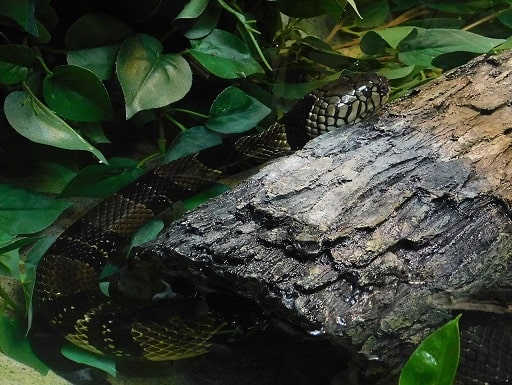
Maximum length: 2.7 metres.
The Congo Rainforest holds many secrets, possibly dozens of unidentified snakes, and dozens more which are barely researched, like the thirteen-scaled green snake. It’s also home to a relatively poorly researched cobra – the banded water cobra (Naja annulata).
As an inhabitant of a humid, lethal jungle which is barely accessible to westerners, and sometimes surrounded by impoverished countries in conflict, expeditions to observe this species have been surprisingly few. However, we know a few facts: this species is highly neurotoxic, it’s relatively shy rather than aggressive, and it spends the majority of its life in water. Banded water cobras dwell in rivers, and have a thinner hood than usual, to reduce drag as they swim underwater.
Banded water cobras tend to flee into the water when spooked, rather than leap forward in a determined rage with all guns blazing. That said, deaths are confirmed, including one man from Gabon who received a bite to his thumb, and felt a sensation of extreme coldness before dying. Being neurotoxic is common in aquatic species, most notoriously in sea snakes, and the goal is to immobilise fast-moving fish.
| 11 | Least widespread – São Tomé cobra |
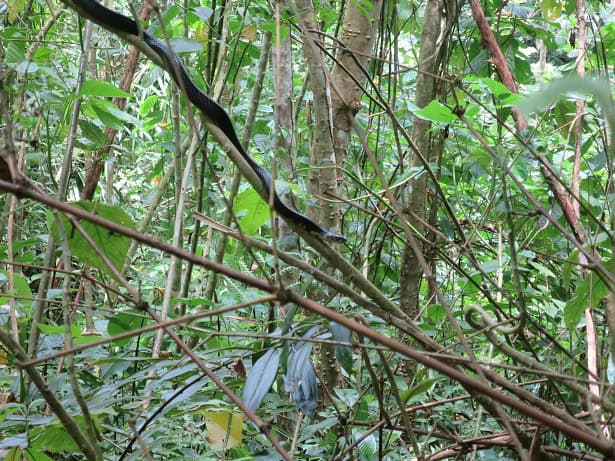
Maximum length: 260cm.
One relatively rare cobra within Africa is the Nubian cobra (Naja nubiae), found in a narrow belt of land in central Egypt, but there’s also a cobra found on one island: the São Tomé cobra (Naja peroescobari). This is found exclusively on the volcanic island of São Tomé, which lies 155 miles off the west coast of Gabon.
This species is part of a sub-group within Naja containing the forest cobra and brown forest cobra. It was only identified as a unique species in 2017, as it was originally believed to be a forest cobra population introduced by westerners to swallow up rats. It’s now believed to have been native all along.
Early European colonists wrote horrific tales of this snake, including peoples’ eyes exploding out of their head followed by immediate death. The island was mainly colonised by the Portuguese, who used it as a prison colony, and a sugar plantation hub.
Despite its small kingdom, the São Tomé cobra is very common in its territory, inhabiting all corners of the island. Locals fear it greatly, believing that a bite brings immediate death, which might actually be true – its venom is still poorly researched.