| 1 | Children’s python |
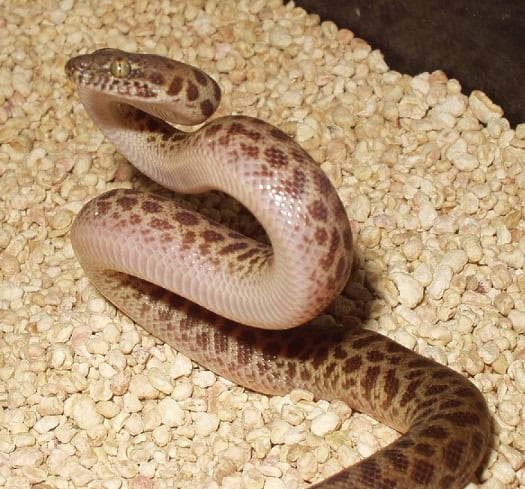
Maximum length: 100cm.
The most widespread python on Australian soil overall. Children’s pythons inhabit every mainland Australian state except for Victoria (plus Australian Capital Territory). Their territories include virtually all of Northern Territory, Western Australia and Queensland, and decent portions of South Australia. They’re also found in New South Wales, though in sparser numbers, and always away from towns and cities.
Children’s pythons (Antaresia childreni) are completely harmless to humans. They’re mainly found in drier habitats, though not fully fledged deserts. Dry woodlands, shrublands and hummock grasslands are all top habitats, where they hang out in vacant burrows, hollow trees and rocky outcrops. Children’s pythons are easy to recognise, with a smaller body size, and dozens of small, tightly packed blotches.
One reason for this species’ massive territory is its flexible diet. The children’s python can eat rats, skinks and frogs alike, as shown by a 1990 study which found a dietary breakdown of 36% mammals, 26% reptiles and 33% amphibians. Consequently, the children’s python is wildly popular in captivity as well, as it’s so easy to maintain.
| 2 | Carpet python |
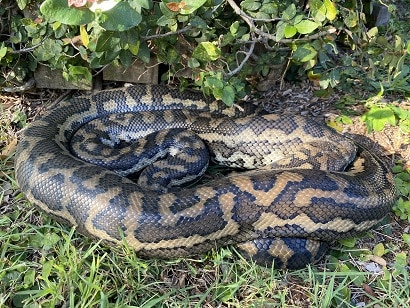
Maximum length: 4.2 metres.
The most abundant python on Australia’s east coast, and the most likely to appear in towns and suburbs. While the children’s python appears in drier natural areas, carpet pythons are much more likely to lurk in a Sydney garden or appear on the edge of a football pitch in Brisbane.
Carpet pythons are much more tolerant of cooler conditions than children’s pythons, appearing in Victoria as well, where they become the official most southerly python on Earth. They have a far larger body size, sometimes exceeding 4 metres, quadrupling the length of their rival. Across Australia, they appear in New South Wales, Queensland and South Australia, but are missing from Western Australia, with a strong east coast bias.
Carpet pythons are non-venomous like all pythons, but can be aggressive if manhandled, leaving a pair of U-shaped bite marks. They tend to be calm unless harassed, and prey mainly on mammals, including rats in people’s gardens.
| 3 | Black-headed python |

Maximum length: at least 3 metres.
The official third most widespread python in Australia when judged by raw territory covered, although not necessarily a species that ordinary people will encounter. The black-headed python (Aspidites melanocephalus) is the most recognisable species on our list alongside the green tree python. The name isn’t false, as this species has an olive body overlaid with thin stripes, contrasting against a jet black head, which kicks in suddenly and sharply rather than gradually tapering in.
Black-headed pythons are strong burrowers, enabled by a modified snout shape (which is difficult to make out). They’re capable of shifting decent quantities of soil aside, and generally inhabit drier areas where digging is easier. It’s possible that the black head evolved to blend against the night sky as they poke their heads out of burrows, allowing them to scan their surroundings while staying hidden.
This snake has a strong northern bias; no presence in South Australia, Victoria or New South Wales, but a vast territory in Queensland, Northern Territory and Western Australia. Its territory generally follows the north coast, but spreads far inland as well, potentially bringing this species into contact with both freshwater and saltwater crocodiles.
Of all snakes in Australia, the black-headed python might be the most poorly researched in comparison to how common it is.
| 4 | Spotted python |
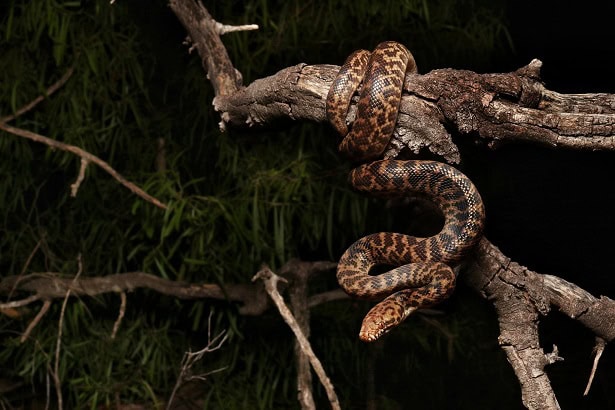
Maximum length: 180cm.
The children’s python is massively widespread in Australia, but tends to avoid the actual east coast. The spotted python (Antaresia maculosa) is its close relative, which has adapted to living on the populated coasts of Queensland and far northern New South Wales. This species inhabits virtually the entire coast of Queensland, including near major cities such as Brisbane and Cairns (though not inside human areas).
Spotted pythons appear in similar habitats to children’s pythons, preferring slightly drier areas like grassland and shrubland. They love areas with rocky outcrops, particularly those with caves, where they lurk outside the dark entrances and wait for colonies of roosting bats to fly out.
Captive keepers have debated for years how this species differs to its cousin. A technical difference is that the children’s python has far more loreal scales, located between the eye and nostril. However, spotted pythons grow significantly longer, and according to these keepers, their striking blotches are present all their lives, whereas in children’s pythons, they slowly fade with age.
| 5 | Olive python |
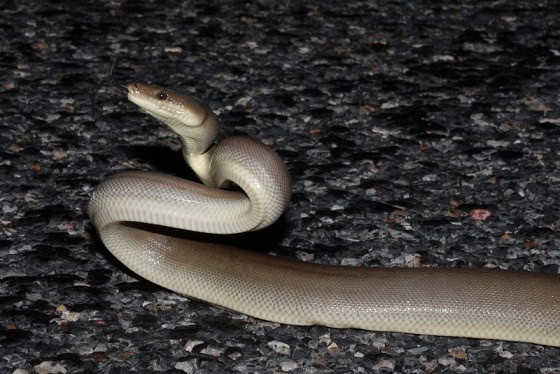
Maximum length: at least 4 metres.
A python species famous for duelling freshwater crocodiles in sight of horrified tourists. Despite their scaly armour, and despite their powerful snapping jaws, olive pythons constrict crocodiles without hesitation, including in one famous incident in Lake Moondarra in 2014. Fortunately, they’re much less aggressive towards people.
Olive pythons are found in the northern half of Australia, where they’re very widespread. Their bodies have no patterns, and are smooth like a worm. This is one of Australia’s longest pythons, exceeding 4 metres, and is sometimes found on roads, blocking human traffic, without realising the hold-up it’s causing.
More widely, olive pythons feed mainly on mammals, with a sizeable chunk of reptiles and birds as well. They’re not averse to slithering into human structures, but are less likely to simply because they live in drier northern Australia. Their territories include Western Australia, Northern Territory, and Queensland, but only in relatively remote areas of each. Olive pythons have no presence in South Australia or New South Wales.
| 6 | Woma python |
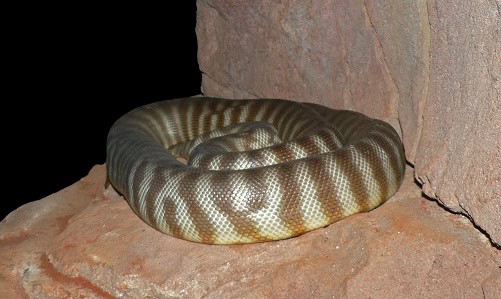
Maximum length: 2.7 metres.
A close relative of the black-headed python, one of two members of the Aspidites genus worldwide. This species lacks the black head, and instead has a striped body, with outback colours of pale beige contrasting against soil light brown.
Like the children’s python, this species inhabits every mainland Australian state except Victoria. Yet the woma python is far more rarely seen, for two reasons: 1) being naturally sparser, and 2) its strongly underground habitats.
Woma pythons spend a large portion of their time underground, both resting and swallowing prey. Their hunting style is brutal, as woma pythons follows tantalising scent trails to the dens of sleeping mammals, where they swallow up a sleeping mouse family, sometimes pinning attempted escapees against an underground wall.
Despite these brutal ways, woma pythons pose little treat to humans, in the unlikely scenario that you meet one. To aid in their digging lifestyle, woma pythons have a modified snout with a spade shape, allowing them to forge tunnels in the vast Australian outback, or enlarge those made by other animals.
| 7 | Water python |
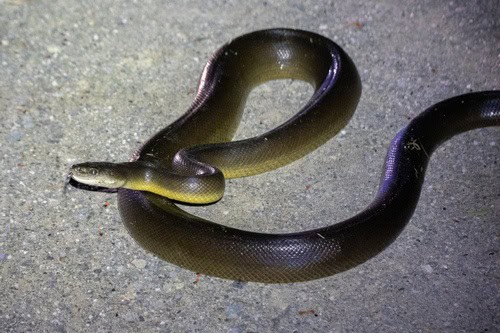
Maximum length: 3 metres.
The other Liasis member living in Australia, this is the olive python’s closest relative, but tends to inhabit moister areas overall. Whereas olive pythons can appear in truly arid rocky areas on occasion, water pythons (Liasis fuscus) always need a permanent year-round water source nearby. Top hideouts include hollow logs and spaces under vegetation near river banks.
This species is similar to the olive python in its smooth scales and lack of patterns, but has a much greener tinge, particularly the belly, which is much brighter than its back. Some water pythons have an iridescent tinge as well, while others reflect light brightly.
Because of its liking for water, this is another species to prey on young crocodiles. However, the tables turn as well, as young rainbow pythons find themselves in a pair of snapping crocodilian jaws. Their other predators include dingoes and foxes.
This species sometimes lives alongside the children’s python, but within each area, the children’s python is always more abundant. Water pythons are docile and only bite humans if greatly agitated.
| 8 | Southwestern carpet python |
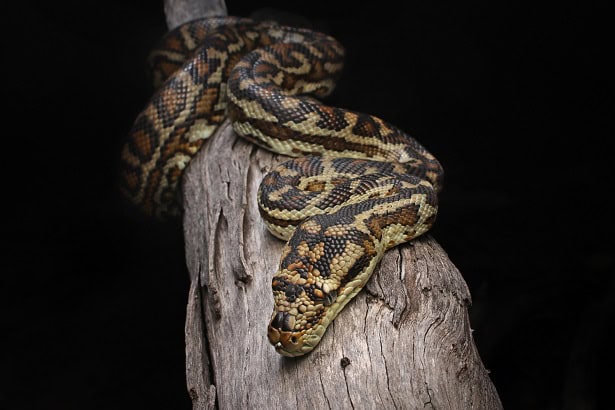
Maximum length: 250cm.
A close relative of the eastern carpet python, which was once a subspecies, but elevated to a full species in 2006. The southwestern carpet python went from Morelia spilota imbricata to Morelia imbricata, adding yet another python species to the Australian continent.
Southwestern carpet pythons appear in Western Australia, including near Perth, and a small area of far western South Australia. Physically, the southwestern carpet python has very few clear differences to its eastern cousin, but the two species have no area of geographical overlap, and have therefore become genetically distinct over time.
One slight trend is that southwestern carpet pythons are often darker, but this isn’t consistent. There’s also a trend for super-sized females. In carpet pythons generally, females average at larger than males, while the absolute largest individuals tend be males. One survey on Garden Island close to Perth found that the local female southwestern carpet pythons were ten times heavier than the nearby males.
According to captive keepers, this species is extremely reluctant to bite. Hissing is the most you’ll get out of this docile snake, unless you severely manhandle it.
| 9 | Scrub python |
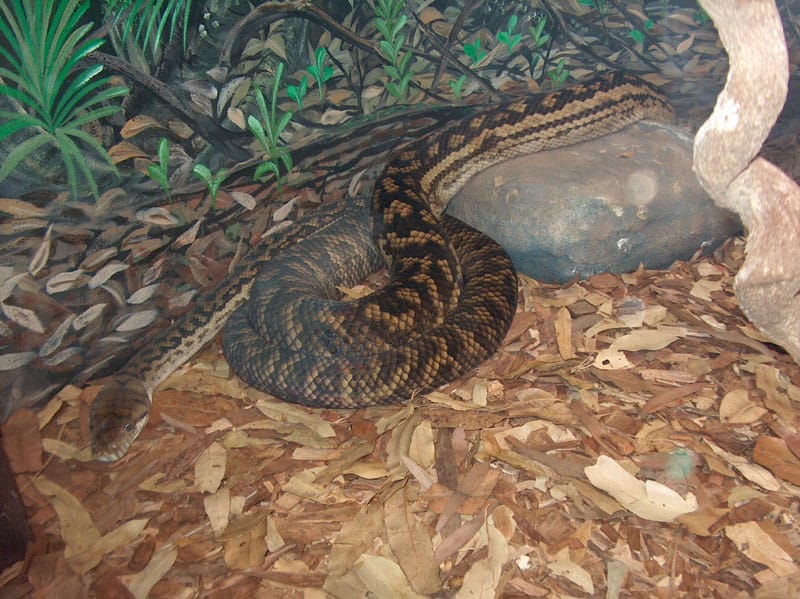
Maximum length: 565.1cm.
The longest python and longest snake overall on Australian soil. This is also one of the ten longest snakes in the world, after the likes of reticulated pythons, green anacondas and African rock pythons.
Scrub pythons are found exclusively in Queensland, meaning that they don’t cover a vast territory, but their populations are dense where they do appear. They have a tendency to block roads, and a disturbing tendency to feed on wallabies, which at least fight back against their aggressors, clawing brutally at the python’s neck and often winning the battle. Scrub pythons often climb roofs in villages, and also have a tendency for brutal male wrestling.
This species is more flexible than the green tree python, but still most common in untouched areas. A study implanted radio-transmitters into numerous scrub pythons, and found that 67% of transmissions were received from rainforest areas, 15% from forest regrowth areas, and 10% from nearby grasslands. The scrub pythons never ventured to more than 30 metres away from the nearest forest.
| 10 | Pygmy python |
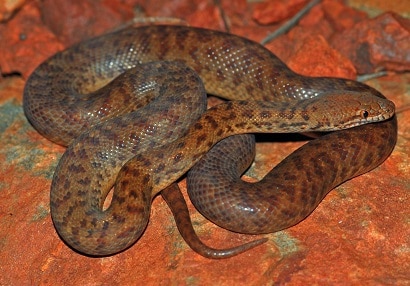
Maximum length: 60cm.
Next, we have the exact opposite: the shortest python in Australia, and perhaps even the world. The python family has several of the most massive species worldwide, but the pygmy python can only scrape to a measly 60cm in the record individual. Fortunately, this species knows exactly what it’s doing: its small size is an adaption to surviving the roasting Australia outback, where it spends all its life.
The pygmy python is the most adapted to high temperatures of all Australian pythons. Its territory is Pilbara in Western Australia – a former gold mining hub of parched orange landscapes and dried-out termite mounds. Pygmy pythons often spend time in those termite mounds, sheltering against the sun. They also appear in caves, like their spotted python relative much further east, where they hunt bats as they activate at nightfall.
Pygmy pythons almost never encounter humans, due to their remote lifestyle. Another tendency is to curl up into a ball alongside several other species like mulgas and black-headed pythons. Because they live in such isolated locations, it’s believed that pygmy pythons have various patches of undiscovered territory across Australia.
| 11 | Centralian carpet python |
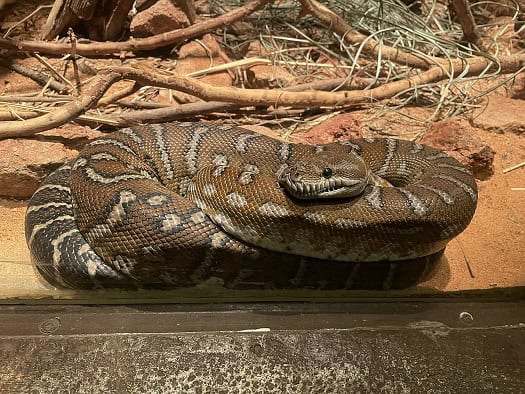

Maximum length: around 3 metres.
Another carpet python relative, but this time found in Central Australia, in dry, punishing terrain. The Centralian carpet python appears exclusively in the southern areas of Northern Territory, specifically in the MacDonnell Ranges to the west and east of Alice Springs. It appears in areas which consistently reach over 40 degrees Celsius, including dry slopes, rocky ridges, dry forests, woodlands, shrubland and even semi-deserts.
Like the southwestern carpet python, this species was once a subspecies of the main carpet python, before genetic differences led to a full-species elevation. However, this species is clearly more physically distinct, with a reddish tone which enables it to blend with parched outback soils. This contrasts against grey stripes or blotches. Its pupils are vertical as usual, while its tongue is purple.
According to keepers, this species requires a dry enclosure, and happily feeds on rats. Its other wild meals include rock wallabies, birds and possums. Supposedly, this species can lay up to 47 eggs at once, making it a prolific breeder.
| 12 | Green tree python |
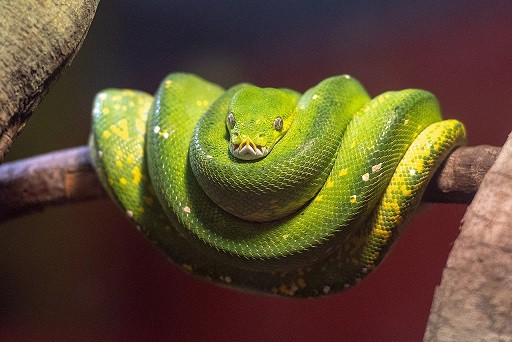
Maximum length: 220cm.
The greenest python in Australia, and the greenest snake in Australia overall. This species has a highly restricted range, appearing only in Queensland, only on the Cape York Peninsula, and even then, only in rainforests, with its absolute favourite being notophyll vine forests.
Green tree pythons are beloved in captivity due to their lazy lifestyles. As a sedentary ambush predator, this species spends virtually all its life in tree branches. There it waits patiently with its chin resting on its coils, hoping for a Cape York rat (its favourite meal) to wander past, after which it will spring to life with extreme speed and seize its future meal in its jaws.
This species has an extreme ontogenetic colour transformation – a colour shift from birth to adulthood. Juveniles are banana yellow, until the length of around 55cm, when scales of green begin to appear, before eventually taking over fully. While technically part of the Morelia genus like the carpet python, this species has diverged wildly from the rest.
| 13 | Oenpelli python |
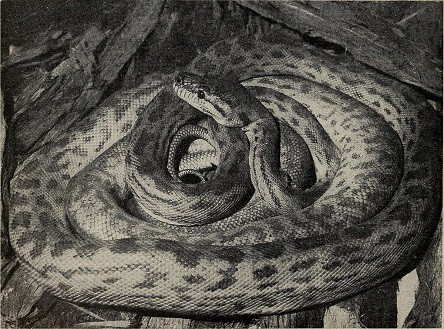
Maximum length: 5 metres.
One of the rarest pythons on Earth, and an extremely difficult species to find even today. This is despite being the largest python in Northern Territory, at a maximum size of around 5 metres.
The Oenpelli python appears only in sandstone areas of Arnhem Land, where it spends its days lurking in caves, rocky outcrops, and shady trees. Compared to the olive python, this species seems much more determined to stay hidden, perhaps because it relies more heavily on ambush. Though research is lacking, it’s believed that Oenpelli pythons prey more heavily on birds than other Australian pythons, ambushing them by lurking in trees.
Oenpelli pythons are experts at vanishing into shady hideaways. It’s estimated that less than 10,000 individuals exist, partly because they were rare to begin with, but nobody knows for sure. In captivity, they happily eat mammals as well as birds.
This species belongs to the unique Nyctophilopython genus, with no other members worldwide. A physical feature of the Oenpelli python is its unusual thinness, which makes it easily identifiable in the 1 in a million chance that you meet one.
| 14 | Rough-scaled python |
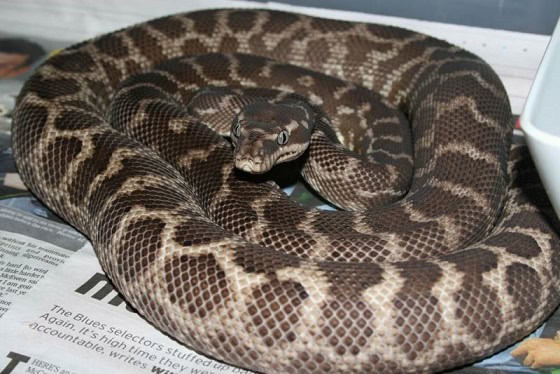
Maximum length: 2 metres (so far).
Another carpet python relative, but this species was always fully independent, and never a subspecies. One obvious difference is the namesake rough scales, which are believed to be an adaption for climbing up jagged rocky outcrops.
Rough-scaled pythons (Morelia carinata) have an extremely narrow range. They appear only in the far north of Western Australia, including Mitchell River National Park. This species is often spotted near fruiting trees, which may be an ambush strategy, as frugivorous creatures approach hopefully and later get devoured.
Another feature of this species is a large head relative to the neck. Judging by the few images available, its eyes also appear to be larger than its carpet relatives in more civilised areas.
Rough-scaled pythons were mysterious until only recently, as until 1993, just two preserved individuals were stored in museums. Later, John Weigel was granted permission to seek out more individuals, and after gathering a few in remote terrain, the species turned out to breed well in captivity. Consequently, despite being rare in the wild, this species is now available to buy as a pet.