
| 1 | Reticulated python |
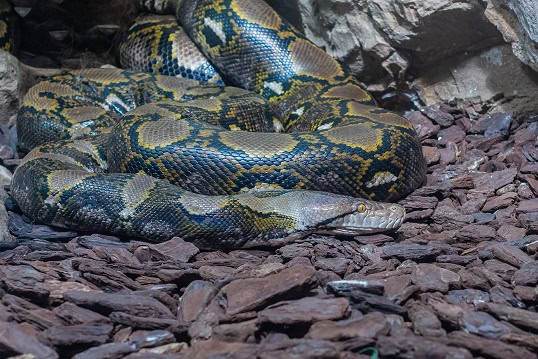
Maximum length: 695cm.
The longest snake in the world, as well as Thailand. The reticulated python belongs not to the true Python genus (10 members), but the offshoot Malayopython genus (2 members). However, it’s still a python true and true, and capable of all the usual python feats, such as unhinging its jaws massively wide and swallowing leopards, wild boar and even sunbears.
Speaking of sunbears, the largest reticulated python in the wild of all time was spotted eating a sunbear, after which it lay in a hollow log to digest its prey. Scientists carefully measured the snake, and found a length of 6.95 metres, after which they released it into the wild. The longest captive individual measured 7.67 metres, and belonged to a Kansas City horror attraction.
Reticulated pythons aren’t shy about inhabiting human areas, even appearing in the Thai king’s palace one time. Slithering into supermarkets is normal, as well as lurking in storm drains further south in Singapore. Reticulated pythons are flexible in their habitats in the wild, though they tend to avoid the densest rainforests.
| 2 | King cobra |
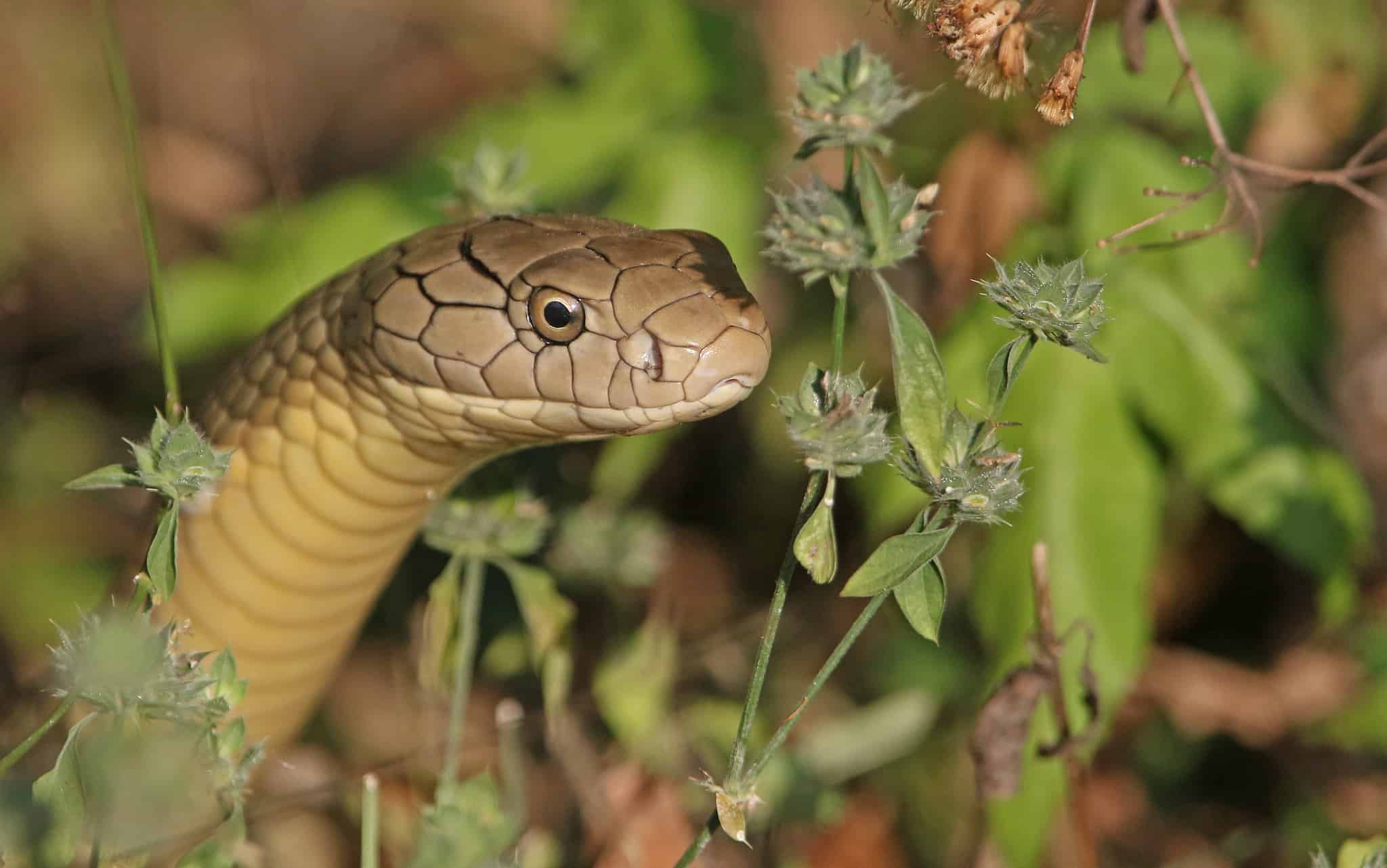
Maximum length: 585cm.
The longest venomous snake in Thailand, Asia, and the world overall. King cobras are so large that they achieved the longest snake-on-snake prey meal of all time – a king cobra which swallowed a python measuring 279.4cm (possibly a reticulated python).
King cobras exceed 5 metres with age. They’re neither thick nor thin, as they never use constriction, dispatching their prey with a paralysing venom, but they also prefer the forest floor to tree branches, meaning that they don’t need to be particularly thin. King cobras have a tendency to lurk in hollow tree trunks, and even construct their own nests, which can reach a human being’s chest height.
Encounters with king cobras are much rarer than with the monocled cobra, which causes the most annual snakebite deaths in Thailand. Nevertheless, king cobras can be lethal when they do bite, partly because they inject hundreds of milligrams of venom. This is due to a mixture of their jumbo body size, and a tendency to latch onto victims’ arms and inject multiple pulses of venom, as they attempt desperately to shake them off.
Worldwide, king cobras range from southwest India to the Philippines. Thailand lies at the centre of their range, and they inhabit most of the country, though they’re always sparse in numbers.
| 3 | Burmese python |
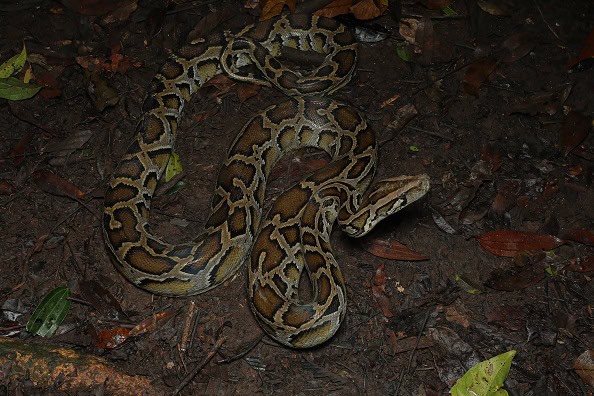
Maximum length: 579cm.
A species better known for invading the Florida Everglades sometime in the 1990s, multiplying to 500,000 individuals, and swallowing up 90% of the native mammals, to the dismay of conservationists. Efforts to eradicate the invaders are underway, but the Burmese python has a completely natural home in Asia, which Thailand lies at the centre of. Whereas reticulated pythons prefer dry land, this species sticks to marshes and lakes, allowing the two to live in the same country peacefully.
Burmese pythons are well-researched due to their status as an invasive species. Their maximum length ever in the Florida Everglades was 5.79 metres, just under the king cobra. Their hunting strategy involves ambush, and if bothered by humans, they can be aggressive. They might be record-breakers, but measuring them isn’t easy.
Burmese pythons have immense camouflage, and a thicker body than the reticulated python, despite being shorter. They have a green tinge, but not grassy green, more a murky green which blends perfectly with swampy grasses.
| 4 | Keeled ratsnake |
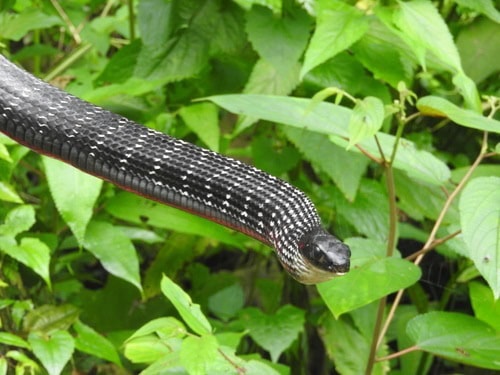
Maximum length: 400cm.
The longest ratsnake in the world, and the longest of the colubrid group of snakes, which encompasses over 50% of snakes worldwide. This species preys heavily on reptiles such as blue-eyed anglehead lizards and striped kukri snakes, and is non-venomous, with no ability to kill a human being.
Like the king cobra, this species is found across the vast majority of Thailand, but is always sparse in numbers and difficult to observe, in spite of its large size. This is a fast and whippy snake, rather than slow and patient. Another feature of this species is a bluish tongue, and a steadily darkening colour as the tail approaches.
The keeled ratsnake is common in woodlands and forest edge areas, where it appears on the ground. Most photographs show it slithering over a thick bed of leaf littered interspersed with fallen twigs and rocks.
One skill of this snake is inflating its throat to intimidate enemies. A cobra enlarges its neck sideways, but this species enlarges its throat forwards. Keeled ratsnakes are diurnal rather than nocturnal.
| 5 | Oriental ratsnake |
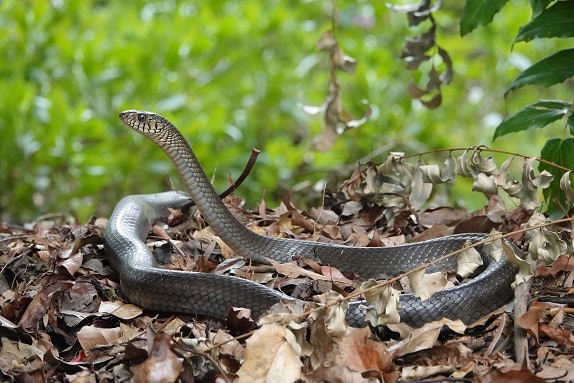
Maximum length: 370cm.
Part of the same Ptyas ratsnake genus as the keeled ratsnake, which has 18 members, this being the 2nd longest. Oriental ratsnakes are fast moving and energetic, exploring the Thai countryside, slithering up walls and trees, and through drainage ditches, investigating any tantalising scent they come across. Their confirmed meals include house sparrows, wart frogs and Asian common toads.
Oriental ratsnakes inhabit virtually all of Thailand. Unlike the keeled ratsnake, they’re exceptionally common, appearing in towns and villages, as well as grassy open areas and woodlands. This species is far less bothered about manmade objects, tarmac and speeding cars than its slightly longer cousin. However, it possesses the same ability to enlarge its throat forwards in intimidation.
The oriental ratsnake also produces an odd growling sound when cornered, rather than the traditional hiss. It lacks any venom, but locals regard it with fear, believing it to be the king cobra’s wife, which has a poisonous tail capable of causing an entire crop field to wither and die.
| 6 | White-bellied ratsnake |
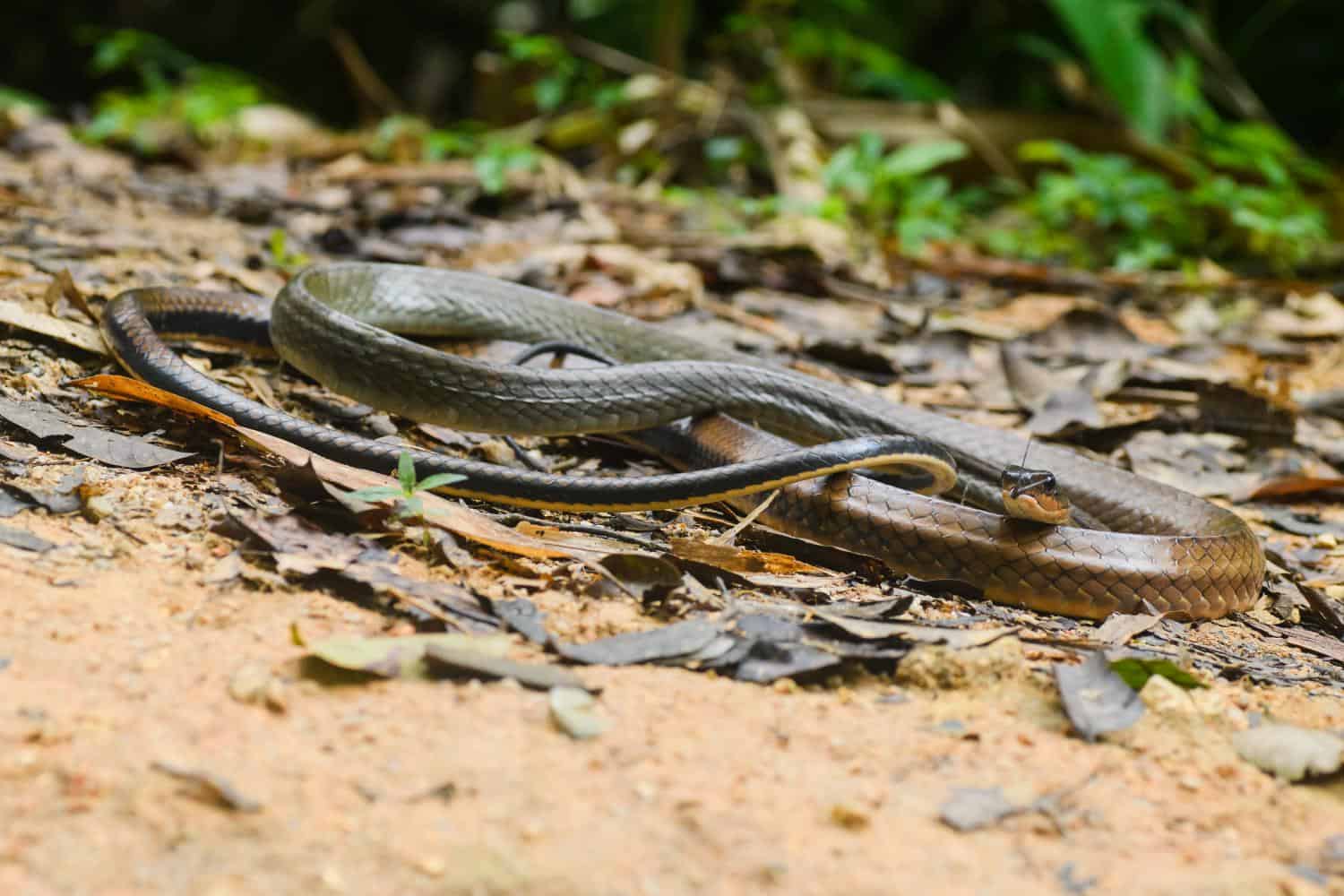
Maximum length: 290cm.
Another member of the Ptyas ratsnake genus, which is easily the consistently longest group in southeast Asia after the pythons.
White-bellied ratsnakes are secretive rather than confident, hiding away in forests, where they spend time on the ground and on branches. They also stray to roads and forest trails where they encounter human beings. When they do, their “strategy” isn’t to flee, but to freeze, and remain completely still. They can remain in the same position for a full minute before reactivating and slithering on their way again.
White-bellied ratsnakes only appear in the southern half of Thailand. They don’t exist near Bangkok, northern Thailand or the border areas with Cambodia. Don’t bother searching for a pure white belly, as their underside is merely far paler than the body, sometimes yellow or beige rather than pristine white.
This species tends to appear near streams within forests, hunting lizards and amphibians, but its diet is more poorly researched than its cousins. This species reaches 290cm, but is just as shy as many snakes which reach just 50cm.
| 6 | Elephant trunk snake |
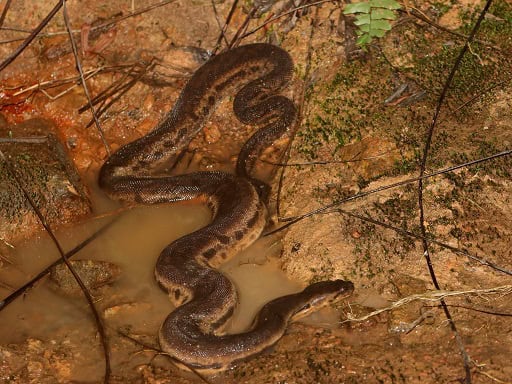
Maximum length: 290cm.
One of the oddest snakes in the world. This is a semi-aquatic species commonly found in estuaries and shorelines, which preys heavily on fish. Its weird feature is its skin, which is extremely loose, almost hanging off its body, which gives it the name. This species begins life looking relatively sleek, but its skin grows more dishevelled with age, creating the elephant trunk image.
These characteristics have fascinated snake enthusiasts worldwide, but a lesser known feature is that this species is very long, one of the longest in southeast Asia, exceeding all rattlesnakes, all sea snakes and all coral snakes in length.
Elephant trunk snakes mostly avoid dry land as adults, but can be common in estuaries near coastlines. They’re expert hunters, gripping fish using studs on each scale which resemble multiple tiny jewels. They were once subject to a weird rumour as well: that they were the first herbivorous snake, after fruit was discovered in one individual’s stomach.
Like any aquatic snake, this snake can hold its breath underwater for at least 40 minutes. It lays up to 52 newborns, and its body grows far thicker from the head onwards.
| 8 | Beauty ratsnake |
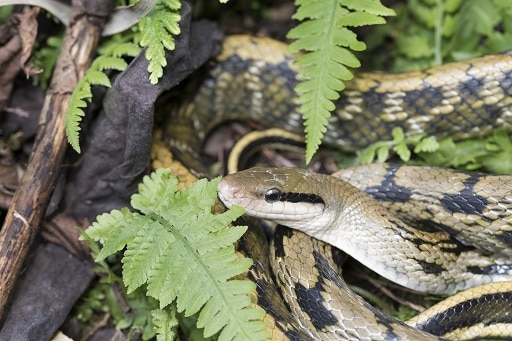
Maximum length: 280cm.
Another ratsnake, but part of the large Elaphe genus instead, which reach as far west as Italy. Generally, Elaphe ratsnakes live further north and in cooler spots than the Ptyas clan, but this is the southernmost species. In Thailand, it has a speciality, hanging out in dark caves, where it lurks in dark crevices and pokes its head out in order to grab bats.
Beauty ratsnakes are non-venomous, but potentially aggressive, jabbing at villagers’ faces aggressively. Their climbing skills are excellent, slithering vertically up the brick walls of farms and cold stone sides of caves alike. As well as the southernmost Elaphe ratsnake, this is the largest of the lot, exceeding the four-lined snake of Italy (2.5 metres) and the king ratsnake of Taiwan (2.4 metres).
Beauty ratsnakes can swallow 150-200 rats per year in villages and farmland. They have 8 subspecies, and Thailand hosts 3: the Yunnan beauty ratsnake, Ridley’s cave race (the cave form), and Helfenberger’s beauty ratsnake. This snake is also an invasive species in Belgium, where it lurks near warm railway tracks.
| 9 | Yellow sea snake |
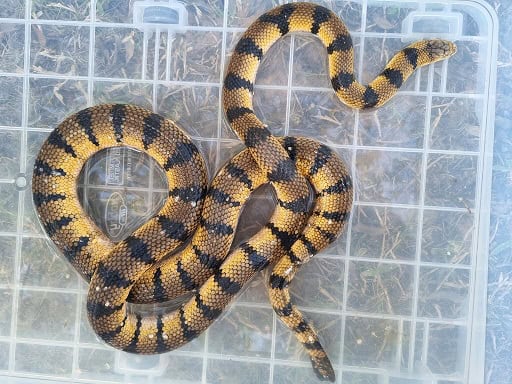
Maximum length: 275cm.
The longest member of the true sea snake group of Hydrophis, which has over 40 members. This species is truly aquatic and never strays onto land its entire life. It hugs the coastlines of Indonesia, Malaysia and Thailand alike, meaning that encounters are rare, but this species still covers a large area of the western Thai coastline, and paying a small fishing vessel for a few sunny hours on the water could easily lead to an encounter.
That encounter could be fatal, as yellow sea snakes (Hydrophis spiralis) have a powerful neurotoxic venom used to disable small, flapping fish. Fortunately, they rarely attack human beings, and are more likely to swim past while taking no notice of you.
As the name suggests, this species is bright yellow, covered with black bands. Another ID sign is a jet black tail, which is probably designed to distract attention from the head. Its face is bright yellow, and its eyes are yellow as well, although this is almost impossible to see.
You’re most likely to meet this snake on a beach, washed up by the force of tidal currents. It could even wash around your feet in shallow water.
| 10 | Dusky wolf snake |
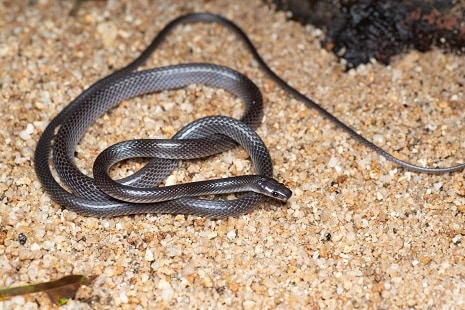
Maximum length: 270cm.
Wolf snakes are plentiful in Thailand, and are all non-venomous, though with aggressive personalities. There’s an estimated 79 species in southeast Asia overall, but this is the longest species, and the 10th longest in Thailand overall.
This snake is harmless to humans as long as you don’t touch. Its diet is poorly researched, but believed to consist heavily of lizards and frogs. One great sign is an exceptionally long and thin tail.
This species is dark and dusky, with no white bands or chocolatey brown tones like the rest of Thailand’s various wolf snakes. There are virtually no patterns at all except a slight pale edge to each snake. Then there’s the round pupils, and a tendency to stay on the ground rather than climb trees.
The dark wolf snake’s eyes are large as well, protruding from the side of its head. One caveat is that its body is so thin, and it’s so fond of coiling up, that it might be difficult to realise its true size.
| 11 | Indo-Chinese ratsnake |
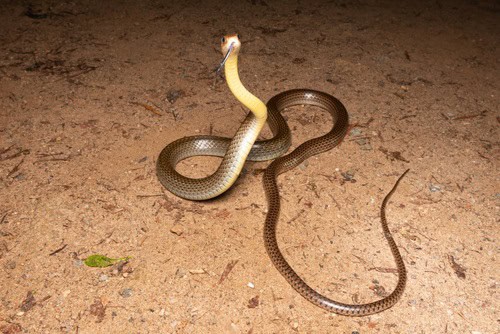
Maximum length: 268cm.
Yet another Ptyas ratsnake member, the fourth of our list so far. This species is extremely common, and not shy in the slightest. It covers most of Thailand, like the oriental ratsnake, and is just as adventurous.
Nevertheless, there’s a few physical differences: 1) being slightly smaller, never exceeding 3 metres, 2) a cleaner face, with no black markings, and 3) a brighter, almost fluorescent belly. Indo-Chinese ratsnakes also tend to appear closer to water bodies than oriental ratsnakes.
This species is thin-bodied rather than thick. It’s fast-moving rather than slow and grinding, and it climbs trees easily, but doesn’t spend much time in them. Trees are simply another place where prey or females could be lurking, and its diet mainly consists of anything it bumps into, including Asian grass frogs, Malayan field rats, and common house geckos alike.
Indochinese ratsnakes even eat fellow snakes, namely the common mock viper. They’re the subject of a massive trade in southeast Asia, as Chinese people are fond of cooking them in soup.