
| 1 | Capybara |
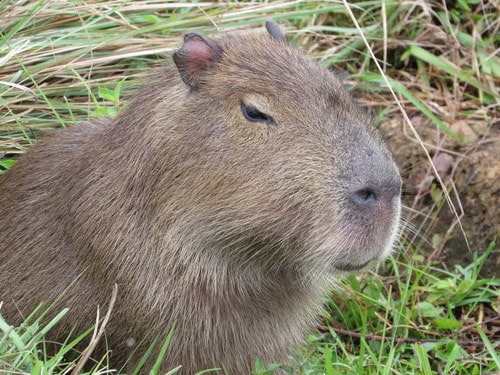
It’s the largest living rodent on Earth, and an object of cuteness for many admirers in Western countries. To the green anaconda, the largest snake in the western hemisphere, the capybara is simply a source of calories.
The green anaconda lives in the Amazon rainforest and the marshes and rivers of the surrounding region. The capybara lives all over South America, including the Amazonian countries of Brazil, Venezuela, Colombia and Guyana. The two species regularly meet, and the green anaconda doesn’t hesitate if it sees a bulky ball of fur walking cautiously along its river shore.
A 2000 survey analysed the green anaconda’s diet in detail, and recorded the capybara as prey 5 times. More positively for capybaras, many living anacondas had vicious claw marks on their bodies. These were identifiable as capybara claw marks due to their unique shape. Capybaras regularly fall victim to this giant constrictor, but are able to fight back and escape.
This 2007 study observed a juvenile capybara succumb to an anaconda’s crushing grip. The anaconda measured 401.3cm, and couldn’t be denied, but before it was swallowed, the capybara got its preemptive revenge and inflicted a grisly wound on the anaconda’s body.
| 2 | White-tailed deer |
.jpg#/media/File:Eunectes_murinus_(1).jpg)
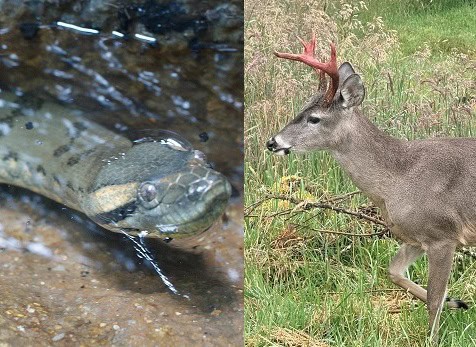
A less aggressive meal for any hopeful anaconda, but a larger, bulkier one which may be trickier to swallow down. White-tailed deer are extremely common in the western hemisphere, covering most of the USA, and spreading as far south as northern South America. The local anacondas have taken notice, as the 2000 study above recorded 5 instances of white-tailed deer becoming anaconda meals.
This might be the largest known meal of the green anaconda. According to the study, green anacondas have been recorded eating capybaras weighing up to 55kg, spectacled caimans up to 55kg. Impressive stuff, but the white-tailed deer had the most gut-busting record of all: 70kg.
This comes with a risk, however. A group of researchers wrote about stumbling across two female anacondas, which had recently eaten large meals. The researchers didn’t interfere, but the anacondas regurgitated two huge meals, each a white-tailed deer, and died shortly afterwards. White-tailed deer may be unable to scratch green anacondas to death, but they can get their revenge from beyond the grave.
| 3 | Spectacled caiman |
Like any creature, the green anaconda’s main goal is to avoid death in the competitive Amazon rainforest. Death can come in many forms, from the slow agony of starvation, to the sudden shock of a snapping pair of crocodilian jaws. Sometimes, the line between the two is very thin, and the anaconda must make a choice: attempt to hunt those crocodilians, or die.
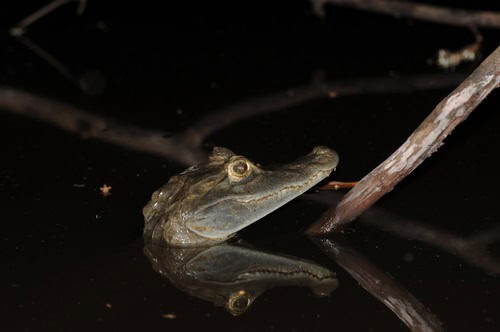
The spectacled caiman is one crocodilian the anaconda is confirmed to eat. In the large diet study above, it was recorded as prey 5 times, identically to the capybara and white-tailed deer. The spectacled caiman covers 17 countries, making it the most widespread caiman in the world. It commonly exceeds 2.5 metres, and has a bulky body like all crocodilians.
Despite a scaly armour, and despite a cunning, aggressive personality, anacondas regularly attempt to prey on spectacled caimans, and regularly succeed. The largest meal weighed 55kg in the study above. Their tough armour is no obstacle to the anaconda’s immense digesting abilities.
The tough part is hunting the caimans in the first place. Capybaras may inflict wounds, but caimans regularly kill. From 1996 to 1997, a researcher explored the Venezuelan Llanos. He found 12 dead anacondas in that period, and determined that all 6 males and 2 of the females were killed by spectacled caimans.
Spectacled caimans have excellent camouflage, and are often confused for logs by humans. They can even be stepped on and not react at all. The anaconda may bypass these visual defenses using its keen scent apparatus, but nothing can protect them against the spectacled caiman’s snapping jaws.
| 4 | Side-necked turtles |
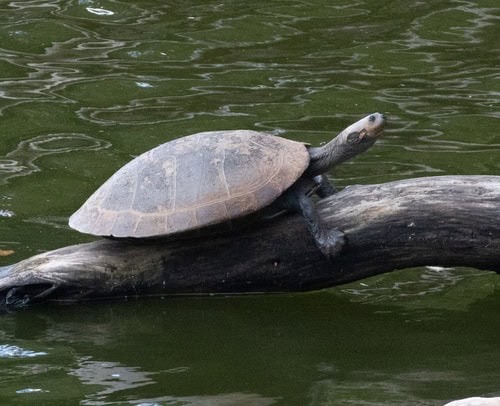
Turtles are officially on the green anaconda’s menu, and multiple species too. The side-necked turtles (Podocnemis genus) are particularly popular. The image above shows an arrau turtle (Podocnemis expansa), the largest of the group. This was recorded once in the anaconda diet survey from 2000. More abundant was the savannah side-necked turtle (Podocnemis vogeli), which was recorded as prey 10 times.
Turtles not only have tough leathery skin, but a shell. Irrelevant – the anaconda’s digestive juices are more than a match for the tough keratin the shell is made from. Nevertheless, they’re not completely invulnerable, as shown by a report from the Venezuelan Llanos.
In February 1993, some researchers found a side-necked turtle on a road. Shortly afterwards, they spotted a 485cm anaconda on the same road. Two days later, that anaconda died, as a result of a large tear in its throat and neck.
The researchers then discovered remains from a savannah side-necked turtle, which indicated a shell length of 20.3cm. It was clear that the shell had ripped open the giant snake’s neck. Anacondas can digest turtles, but rearranging them before swallowing may be the key to surviving.
| 5 | Scarlet ibis |
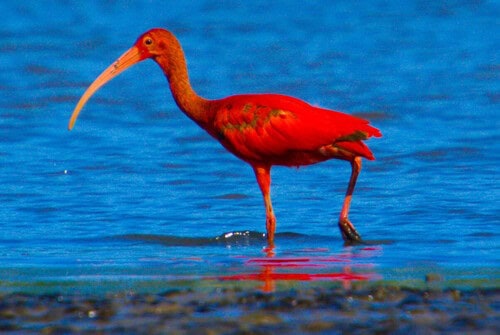
Wading birds are a staple prey of anacondas, including green anacondas further north and yellow anacondas to the south. The anaconda is essentially a wading snake, with a much more aquatic lifestyle than other large snakes. African rock pythons prowl around savannahs menacingly, while reticulated pythons (the world’s largest) routinely invade towns, and prefer dry land. The green anaconda is a creature of marshes and shallow river tributaries, which even has eyes positioned further upwards on its head, to allow superior vision while the majority of its body is submerged.
With such an aquatic lifestyle, the green anaconda would be an idiot not to swallow South America’s various wading bird species, and one example is the gorgeously coloured scarlet ibis (Eudocimus ruber). This is an easily recognisable species due to its fiery red colours and its long, dagger-like beak, which curves forwards towards the water.
Scarlet ibises aren’t found within the Amazon rainforest, but are abundant in northern areas of South America, including Colombia, Venezuela and Guyana. This species was officially documented as green anaconda prey in the 2000 study from the Venezuelan Llanos, with one scarlet ibis meal being recorded. The single top bird prey was the jacana, AKA Jacana jacana, with 7 meals being recorded.
| 6 | Boa constrictor |
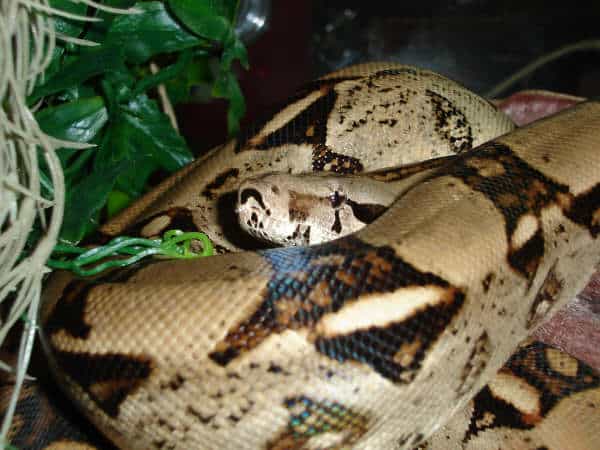
The boa constrictor is the most widespread constrictor in South America, and the most flexible, but it’s not the largest, nor even the 2nd largest. The yellow anaconda has it beat in Argentina, Paraguay and southern Brazil, while the green anaconda is significantly longer in most of Brazil, Venezuela, Colombia, Guyana and Suriname.
Boa constrictors therefore find themselves eaten by the green anaconda as well. Their constricting powers are stronger when it comes to pounds per square inch squeeze force (PSI), but somehow, this doesn’t save them, or maybe it does occasionally, if the boa constrictor is particularly alert, and the green anaconda is particularly overconfident.
Either way, a 2021 review covering the diets of all 4 anaconda species confirmed the boa constrictor as prey. Specifically, a juvenile green anaconda was recorded eating this meal. Other snakes mentioned as prey included the brown-banded keelback (non-venomous), while the yellow anaconda was recorded as eating the Brazilian smooth snake, a large species measuring up to 3 metres.
As boa constrictors can appear in almost any habitat, the marshlands and rivers inhabited by green anacondas are just another landscape they might slither into, oblivious to the cunning eyes watching them stealthily from the murky water surface.
| 7 | Jabiru |
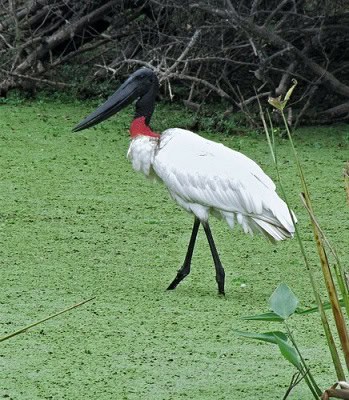
Lying in a Venezuelan marsh, wallowing in the humid waters, the green anaconda noticed a winged shape descend from the sky and approach the shoreline. It had a black beak and head, snowy white feathers, and a distinct red neck, contrasting against the two. It was the jabiru, and the green anaconda decided to sample its flavour. Since that day, the jabiru has been a regular staple in the green anaconda’s diet.
Jabirus (Jabiru mycteria) are very common in the Americas, and Venezuela and Colombia lie roughly at the centre of their range. They prey heavily on fish, including dead and alive fish, which they acquire by moving around in shallow water, using their long thin legs.
Jabirus also hunt small rodents such as mice, and are never particularly common in any area, but they’re far from endangered, as they’re so widespread. In the 2021 review above, jabirus were confirmed as green anaconda prey. One obstacle anacondas face is that this is the tallest flying bird in South America. There’s also a more annoying quality: the ability to fly away.
| 8 | Brown-banded watersnake |
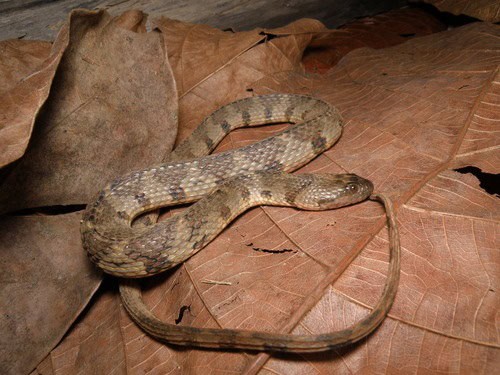
Another confirmed snake meal. Green anacondas have no special affinity for serpent flavours, but if they see a snake in their line of travel, they will open their jaws wide, with a blank stare, and allow the snake to enter their mouth, before swallowing it whole. The brown-banded watersnake (Helicops angulatus) was confirmed as a green anaconda meal in the same 2021 review as the boa constrictor.
Unlike the boa constrictor, this species has absolutely no way to defend itself. Its only survival chances lie in rapid escape, or not being noticed in the first place, by blending with smothering shoreline mud, which is one of Helicops angulatus‘s main survival strategies.
This species is like a mini-anaconda in several ways, as it’s heavily aquatic, and has the same eyes angled upwards in order to see properly while submerged in water, or sometimes mud. Its diet consists heavily of earthworms, dwelling on muddy shorelines. This species has a similar territory to the green anaconda, covering a large swathe of the Amazon and its marshy outskirts.
| 9 | Great egret |
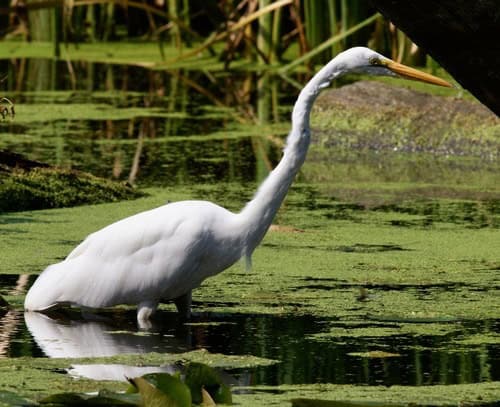
The great egret is one of the most widely distributed wading birds in the world, covering North and South America, Europe and Asia alike. Its feathers are entirely white, with a yellow beak and dark legs. It’s a tall bird, reaching 1 metre high while walking, and this makes it a tempting meal for green anacondas, which seem to prefer occasional large meals over multiple smaller ones.
The great egret was officially confirmed as green anaconda prey in the diet review from 2000. Only one meal was recorded, likely consumed by a female anaconda. This species is a relatively uncommon meal, but for a hungry, aggressive female anaconda, it could provide enough calories for a year.
Great egrets aren’t solitary birds; they live in colonies along lake shores near trees. Therefore, there’s a chance that anacondas may be swarmed by neighbours if they attempt to eat this meal.
Many birds worldwide use “mobbing” to defend each other, cawing and squawking to attract fellow birds into battle, against snake predators such as Jamaican boas, oriental ratsnakes (India) and Lichtenstein’s green racers (Brazil). A great egret/anaconda battle hasn’t been observed yet, but could be very soon.
| 10 | Two more caimans |
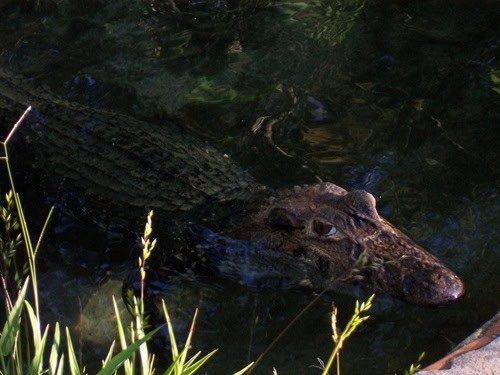
The spectacled caiman is the most widespread caiman in South America, and the most commonly documented prey of green anacondas. However, two others are also known as prey: the broad-snouted caiman (Caiman latirostris) and yacare caiman (Caiman yacare), which were documented in the 2021 diet review study.
Another caiman is the black caiman (pictured above), but no meals of this are known. The reason: this is the largest caiman species in existence, and the largest of the Alligatoridae family which also contains alligators.
Black caimans can exceed 6 metres, which is beyond even the largest female anacondas, although it’s possible that they hunt juveniles. Instead, black caimans regularly hunt green anacondas, as documented in several viral videos. Their snapping jaws are more than a match for the green anaconda’s flimsy scales.
One study from 2007 analysed green anacondas from Venezuela’s Llanos region, a vast area of marsh adjacent to the Amazon rainforest. The anacondas had decent populations, but not without cost; a huge proportion had old scars and wounds on their bodies. Females seemed more prone, with 35/38 female anacondas having wounds versus 25/56 male anacondas.
The scientists speculated that as females are larger, they’re more likely to eat larger meals, which are more likely to fight back. Capybaras were specifically blamed, rather than caimans, but there’s a good reason for that: caimans are more likely to rip their victims to pieces, or swallow them.
| 11 | Yellow tegu |
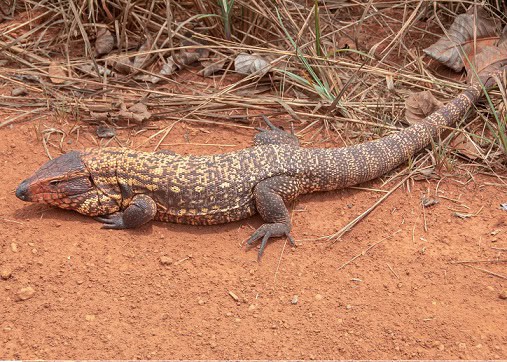
The yellow tegu (Salvator duseni) is a relatively rare lizard with a thick body, which appears in central areas of Brazil, rather than Venezuela or Colombia further north. The yellow tegu looks permanently pregnant or obese, but this is simply its natural body shape. One of its tendencies is to hide in armadillo holes.
This species was discovered as an anaconda meal for the first time in September 2007. Scientists were near a hydroelectric plan in Mato Grosso state, Brazil, when they found a large green anaconda constricting a yellow tegu. The anaconda measured over 2.5 metres, and the tegu was firmly in its grip. However, the scientists’ presence spooked the anaconda, causing it to flee, and allowing the tegu to survive.
One way to recognise this species and other tegus is the large “jowls” below their chin. Despite their bulk, tegus are fast-moving; the Argentine black and white tegu can hit 30km/h, and while the yellow tegu is a smaller species, it’s probably still a tricky meal for the green anaconda to catch.