
| 1 | Saharan sand viper |
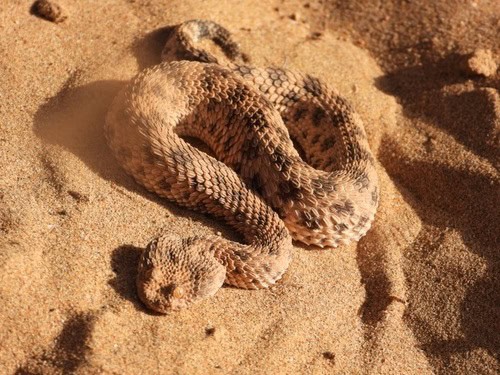
Maximum length: 50cm.
This venomous species is found across the Sahara Desert, in Egypt, Libya, Tunisia, Algeria and Morocco. This is one of the most desert-adapted snakes on Earth, as the Saharan sand viper can survive even in rolling sand dunes, which receive mere millimetres of rain per year.
This species is beige to match the sand, and has a relatively thick body. Another physical feature is extremely rough, craggy scales, which look like they would be painful to touch. These enhance the camouflage further, matching the roughness and coarseness of the Sahara Desert’s endless sand particles.
Cerastes vipera also has a particularly triangular head, even for a viper. All this combines to make it look like a fragile structure made from sand, which could crumble into a million individual particles the moment you touch it, as though it was a desert apparition summoned up by your own hallucinating mind. Unfortunately, that isn’t the case; touching a Saharan sand viper will lead to a cytotoxic bite which could cause severe swelling, and might even kill.
The venom of this species is poorly researched. However, its close relative the Saharan horned viper (Cerastes cerastes) is unusually cardiotoxic, sometimes creating a strange sensation as though your heart is being clasped with a fist (a rare symptom in snakes).
| 2 | South American bushmaster |
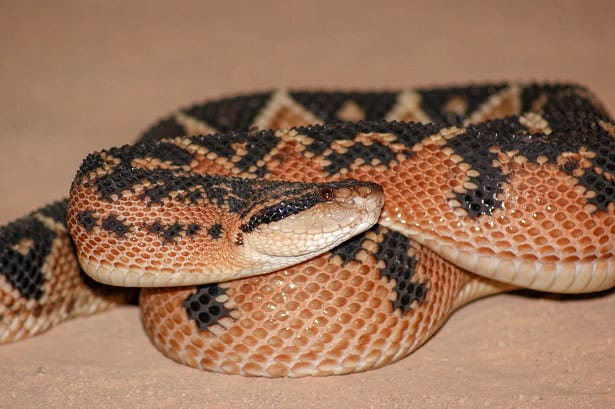
Maximum length: 3.65 metres.
The longest venomous snake in South America, and a potentially lethal one. The South American bushmaster (Lachesis muta) injects a venom containing neurotoxins, haemotoxins, and cytotoxins, which arrives in a gigantic dosage of up to 500mg. However, it encounters humans mercifully rarely, as it tends to lurk in dark underground burrows. These are typically within humid rainforests receiving thousands of milligrams of rainfall yearly, and littered with poisonous amphibians and aggressive crocodilians, adding another layer of elusiveness.
The bushmasters’ signature feature is their huge size, as collectively, they’re the longest vipers on Earth, and the longest venomous snakes in the western hemisphere. Compared to the nearby common lancehead, this species also has cleaner, more sharply contrasting facial patterns.
However, a less famous characteristic is their extremely rough, knobbly scales, which are clearly visible in the image above. As a group, vipers tend to have rough, craggy scales, and the South American bushmaster is a species which takes it a step further. The image above is the best view you’ll get, as South American bushmasters aren’t just elusive, but nocturnal, meaning that a shady, slithering mass is the best natural view you’ll get.
| 3 | Butterfly viper |
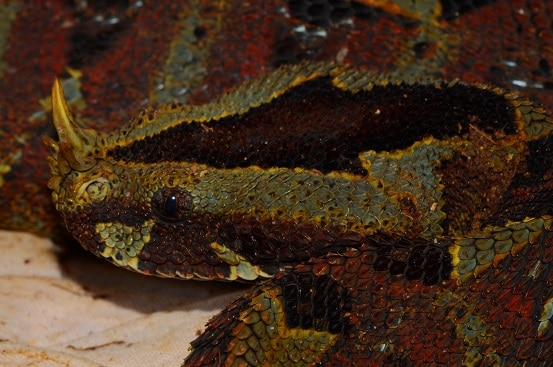
Maximum length: 120cm.
Back to Africa now, but to a completely different region: the humid, stifling rainforests of Uganda and the DRC.
The butterfly viper is a moderately common species, which also appears in Gabon, Cameroon and Equatorial Guinea. It inhabits dark rainforests in the Congo area, and never dry open plains like its relative the puff adder. It’s recognisable by its mesmerising, fungal colours and the sharp horn on its nose. While few deaths have been recorded, a pet owner died in 2002 in Missouri, and deaths have probably happened unrecorded in central Africa.
The butterfly viper almost certainly evolved its rough scales for sheer intimidation. The vertical pupils are already intimidating, and the sharp nose horn adds an extra jolt of fear. Add a series of jagged scales, and it becomes incredibly obvious that no-one in their right mind would touch this snake. Birds understand this instinctively, rats know to avoid them, and primates such as humans have evolved an instinctive, primitive fear of funky reptiles such as this.
Butterfly vipers mainly rely on mammals for their prey. Another top location is humid river shores within rainforests.
| 4 | Northern eyelash boa |
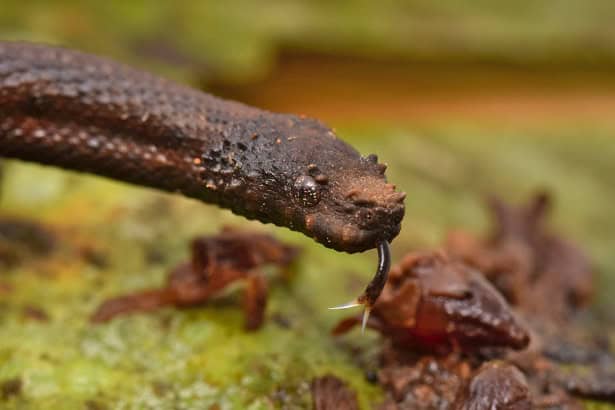
Maximum length: 35cm.
This species is completely harmless, and belongs to the small Tropidophis genus, also containing the Ecuadorian eyelash boa. Northern eyelash boas are found in rainforests in Ecuador and Colombia, and have some strange survival techniques. The first is camouflage, which is highly effective, but the second is spewing blood from their own mouths, to mimic the ghastly appearance of death.
Northern eyelash boas are mainly brown, and have very rough scales, which also includes the pair of extended scales above their eyes, AKA the “eyelashes”. Exactly why this snake is rough and craggy is a mystery, but we can guess. This snake often takes shelter on the rainforest floor amid puddles of rain and waterlogged rocks. Being jagged increases its chance of being mistaken for a rock, and ignored by hungry, determined predators.
The colour of this species’ scales even extends to its eyes, completing the camouflage, while its tongue is dark with a pale tip. Its diet includes small frogs and tadpoles.
| 5 | Cape file snake |
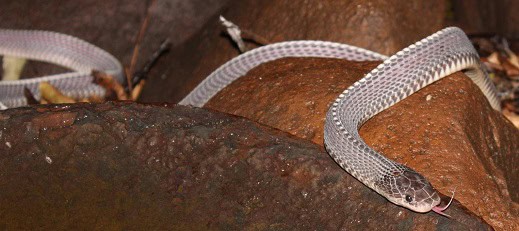
Maximum length: 175cm.
A medium-length species of southern Africa which poses no threat to humans. This snake dwells in termite mounds or underground burrows, before coming out to the surface to patiently follow scent trails. Cape file snakes are most common in eastern areas of South Africa and Zimbabwe.
This species’ characteristics include moving slowly through the countryside, being non-venomous, and deriving a huge portion of its calories from other snakes, including puff adders and red-lipped snakes. None of these explain why its scales have become so rough and jagged. The cape file snake was named for a reason, as its scales are so ridged that they’re easily visible in images.
This species is diurnal rather than nocturnal, and tends to live in open areas like savannahs. Therefore, you might get to see its jagged scales from the safety of a safari vehicle, unlike the South American bushmaster which is always cloaked in a stifling rainforest.
Another classic physical characteristic of this species is a sharp ridge down the spine, which is sometimes white. This species has a triangular shape, and never has any bright colours like green or orange.
| 6 | South American rattlesnake |
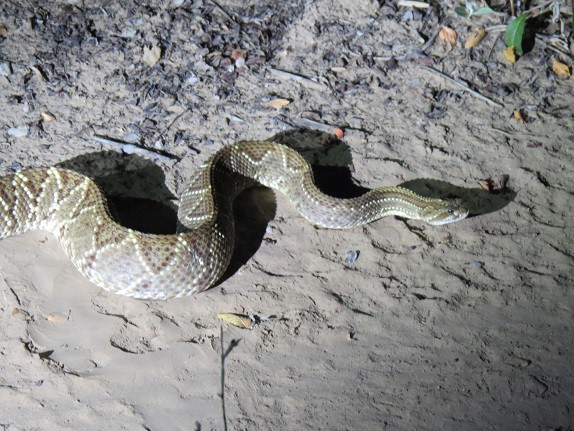
Maximum length: 180cm.
The most widespread rattlesnake in South America, and in fact the world. Hide on the southern tip of Argentina and you’ll be safe. Stay in Panama and don’t enter Colombia, and you won’t meet one. But anywhere between is the territory of the South American rattlesnake, where you could be injected with 500mg of eye-twitching, muscle-spasming, and lung-deactivating neurotoxic venom.
The South American rattlesnake is one of the most lethal of all rattlesnakes. It’s also fairly easy to recognise, compared to the various Bothrops pitvipers of South America. This species has diamond-shaped markings on its body, which gradually coalesce into a vertical stripe as the neck approaches (see above).
Meanwhile, its scales are sharp and coarse like most vipers. All rattlesnakes worldwide have somewhat rough scales, but the South American rattlesnake has evolved some of the most jagged.
Don’t run your finger over this snake’s scales, or it will run its fangs over your skin, and you will be injected with an instantaneous globule of venom, which spreads further around your body with every heartbeat, undone by the very organ that is supposed to be keeping you alive.
| 7 | Brown-banded watersnake |
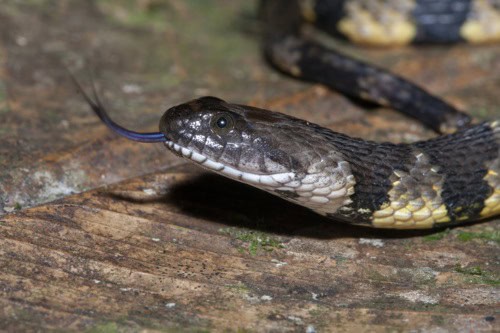
Maximum length: 113cm.
In the rainforest rivers of South America, you can find green anacondas, cunning caimans and aquatic coral snakes, but there’s also a few more peaceful creatures (only a few mind). One of these is the brown-banded keelback (Helicops angulatus), which lacks any form of venom, and preys mainly on earthworms.
This species has rough scales, not jagged exactly, but rough and knobbly, rather than sleek and smooth. This snake doesn’t need to weave smoothly through vegetation; its main goal is to bury itself in shoreline mud, staying hidden from predators like egrets or even anacondas. Another physical adaption is eyes angled upwards on its head, to provide superior vision while underwater.
Brown-banded keelbacks are common, despite their weakness. They can be found in Brazil, Suriname, French Guiana, Colombia, Venezuela and more, and always appear near or in water bodies. Their scales are murky, with the goal of camouflage in equally murky waters.
| 8 | Rough-scaled sand boa |
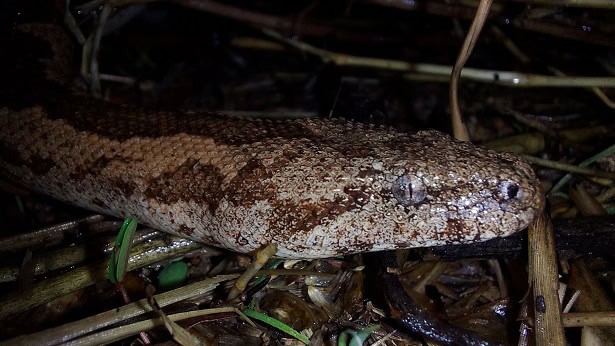
Maximum length: around 1 metre.
A non-venomous snake of India, which hunts using cunning ambush, followed by crushing constriction. The rough-scaled sand boa (Eryx conicus) preys heavily on mammals, and isn’t famous in the US or Europe, but is actually one of India’s most widespread snakes, appearing in every state except the isolated northeastern states beyond Bangladesh.
This species’ rough scales make even less sense than usual. This snake is a burrower, a snake which dives into loose soils and waits patiently for prey to wander close, before exploding upwards and surprising them. This makes rough scales disadvantageous, as it should cause soil particles to cling to them. Most burrowing snakes worldwide are very smooth, yet this snake has rough scales anyway.
The most likely explanation is that Eryx conicus is a viper mimic, as its colours closely resemble one of India’s (and the world’s) most dangerous snakes – the Russell’s viper. The grey and beige blotchy patterns are similar, and so are the vertical pupils. The rough, jagged scales complete the deceptive impression.
| 9 | Ringneck coffee snake |
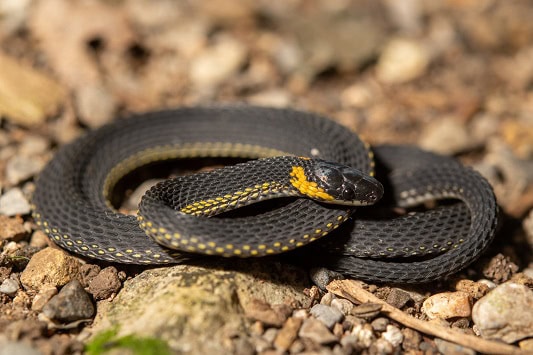
Maximum length: 42cm.
The Ninia coffee snakes have 12 members in the Americas, including Hudson’s coffee snake in Ecuador and the red coffee snake of Costa Rica. All are harmless, and none reach the USA, but the most northerly is the ringneck coffee snake. This species inhabits Honduras, Belize, Guatemala and southern Mexico, and has blue-black scales contrasting against a banana yellow neck.
This species dwells in rainforests, where it sticks to the ground, and is usually found hiding under protective layers of leaf litter. It’s an extremely shy snake, and one of its defensive methods is faking death, by becoming completely immobile when predators or curious scientists approach.
As for its scales, they’re rough and jagged, as visible above. There’s no obvious reason why, as this species lacks the complex blotchy colours to be a viper mimic. However, the rough scales do make this species fairly easy to ID, if you’re in the right location (a leafy rainforest), and you can combine the roughness with the bright neck. Central America has many small dark snakes, but the roughness makes this one more recognisable than average.
| 10 | Usambara eyelash viper |
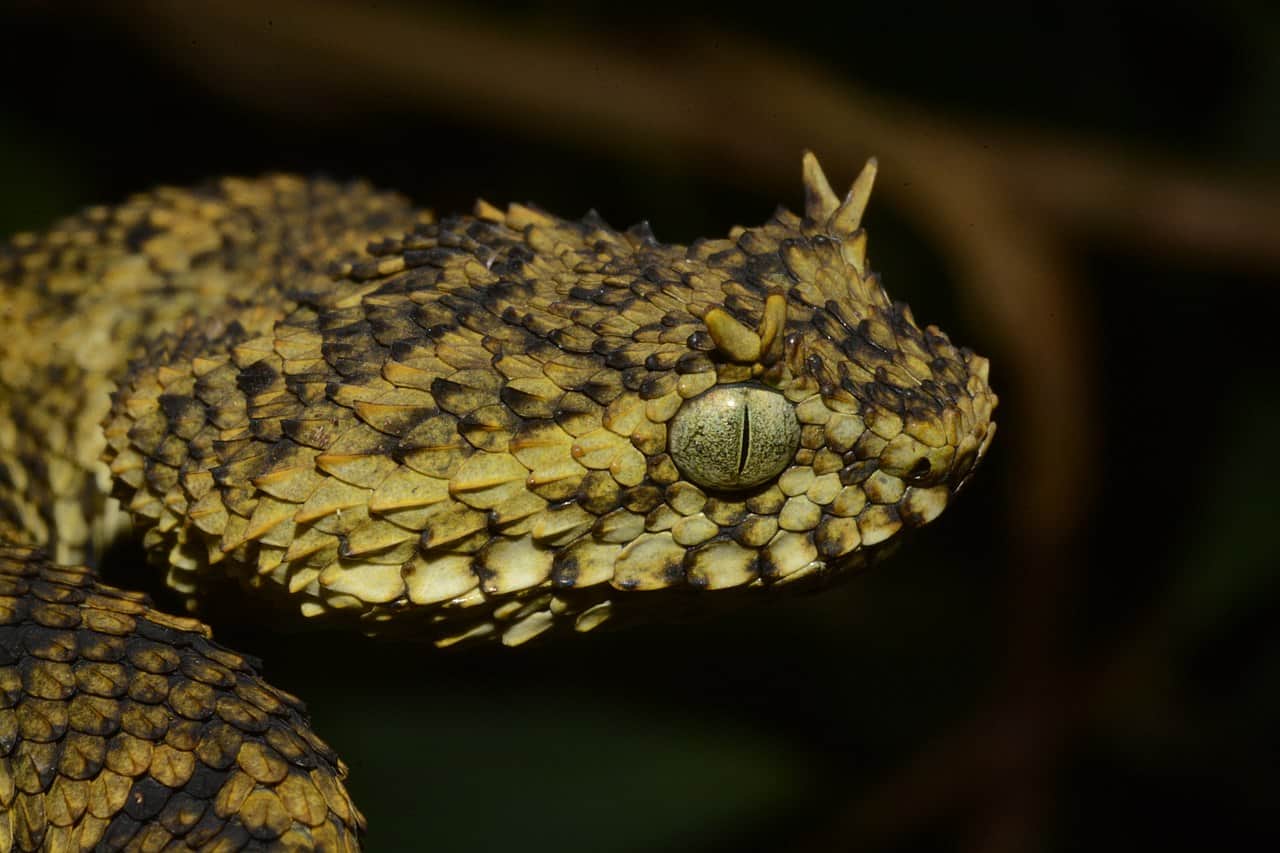
Maximum length: 54cm.
Tanzania is a snakepit on par with Costa Rica and Madagascar, and has a high amount of rare species. The reason is the Usambara Mountains in the north, a biodiversity hotspot, and the main venomous creature here is the Usambara eyelash viper, which is found nowhere else.
This species has a poorly researched venom. It’s a strikingly black and yellow snake, making it easy to recognise, and it generally resides on tree branches.
Like most vipers, the Usambara eyelash viper has vertical pupils, and like most Atheris bush vipers, it has extremely sharp scales. Out of all viper genera, Atheris may have the sharpest scales on average. Other sharp-scaled members include the African bush viper and the hairy bush viper (Uganda, Kenya), the master of all jagged snakes, with such sharpened scales that it almost looks a pineapple (see here).
Something you’ll notice is that no cobras are on this list. Almost no cobras of the 40 worldwide have rough scales. The majority are sleek and smooth, like the ultra-efficient, neurotoxic assassins they are.
Vipers are far more likely to have rough, jagged scales, although there’s still a few smoother species such as the Malayan pitviper. Another reason is that cobras rely on speed and agility more than vipers, slithering quickly, which makes smooth scales more advantageous.
| 11 | Pine snake |
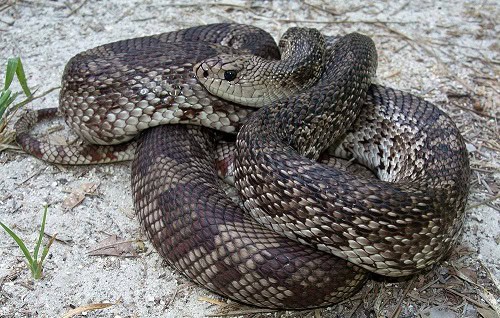
Maximum length: 228.6cm.
An elusive snake of the eastern USA. Pine snakes are non-venomous, and hunt using constriction. They mainly dwell in forests, and are found in Florida, Georgia, the Carolinas, Virginia and New Jersey.
The pine snake has a sharp contrast in its lifestyle: it’s very large, often exceeding 2 metres, yet it’s also very shy. Its size hasn’t made it any bolder, as its preference is to dig extensive underground burrows and hide in them all day. Pine snakes can dig burrows 6 metres long and 1 metre deep underground, and create huge mounds of earth outside the burrow entrances. They often take over existing burrows as well.
These digging tendencies should make rough scales disadvantageous, yet the pine snake still possesses them. Rough scales are common to all Pituophis members, including the gopher snake, which inhabits burrows, but lacks the burrowing skills. It’s possible that pine snakes are more evolved than base Pituophis members, which were already rough and jagged, but as it acquired its burrowing capabilities, the jagged scales didn’t have time to fade. Perhaps the pine snake will evolve further over the next few million years, becoming a sleek, smooth, finely-tuned burrowing machine.