
| 1 | Green anaconda |
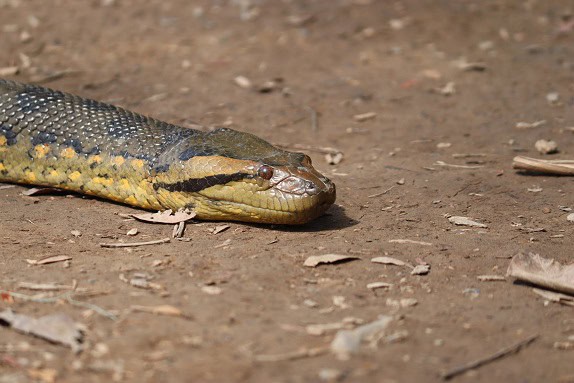
Maximum length: 5.21 metres (wild).
The green anaconda is known for many things. It can swallow capybaras and caimans, reaches 5 metres with ease, and is the longest snake in the western hemisphere. It’s commonly rumoured to reach 10 or even 12 metres. However, a subtler, less famous feature of this South American snake is eyes positioned unusually far up its head, due to its semi-aquatic lifestyle.
The anaconda’s hunting strategy revolves around stealth in water. When an egret, capybara or stork meal strays past near shallow water, the green anaconda must wait until its prey is within definite striking range. It can’t allow the future meal to notice its presence, and needs its body to be as submerged as possible.
Eyes higher up its skull make this possible, and when the creature is close enough, the anaconda performs a sudden lunge and grab. Occasionally, the capybara or even deer (an occasional meal) may dash away in time. Anacondas occasionally use this strategy to attack humans; large anacondas have lunged at the legs of small women before, seeing them as meals.
Meanwhile, the reticulated python and African rock python complete the 3 largest snakes on Earth. Those species have normally-positioned eyes, as they spend far less time in water. They can swim with ease, but by default, spend their time on dry land. The green anaconda doesn’t have particularly large eyes; the positioning is where the key lies.
| 2 | Southeast Asian bockadam |
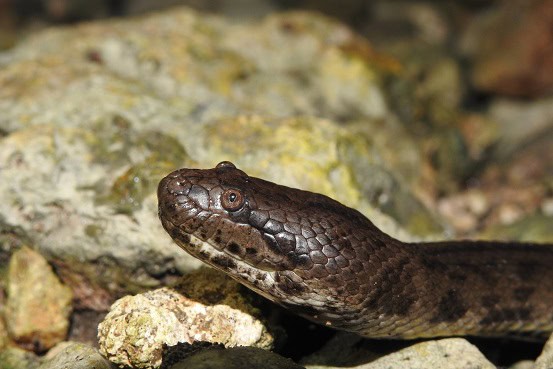
Maximum length: 127cm.
This species might have the most extreme eye positioning of any snake worldwide. The reason is similar to the green anaconda: to provide optimal vision while submerged in water, as this is a semi-aquatic species, which lives in the estuaries and coastal areas of southeast Asia. This species submerges itself not just in water, but thick layers of mud, where it achieves excellent camouflage using its mostly grey scales.
Southeast Asian bockadams (Cerberus schneiderii) reach as far north as Vietnam and Bangkok, and cover the majority of the Malaysian, Indonesian and Philippine coastlines. They’re also common near Singapore. Most of their diet consists of fish, and while they’re not dangerous to humans, they’re believed to be venomous, as they tend to chew fish repeatedly before swallowing.
Unlike the green anaconda, this snake mostly preys on species already in the water, namely fish. Therefore, its eye positioning may have evolved to protect itself from predators above, to stay hidden from their roving vision, whether it’s birds overhead, or prowling king cobras, which are a confirmed predator.
| 3 | Bocourt’s watersnake |
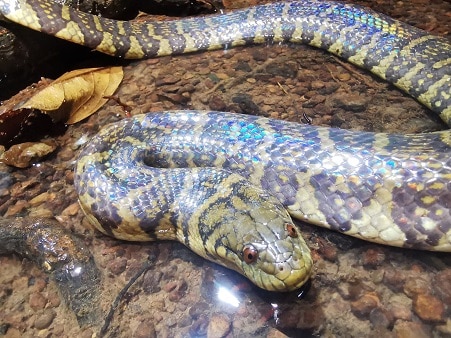
Maximum length: 122cm.
The bockadams control the muddy shorelines and estuaries of southeast Asia, but stray inland to humid swamps near villages, and you’re more likely to meet Bocourt’s watersnake, AKA Subsessor bocourti.
This unusual snake has many memorable physical features. Its body is very thick, and it has a bright iridescent sheen. Its body patterns are murky rather than one clean colour, which is perfect for blending with complex muddy swamp shores. It even deliberately covers itself with more mud to increase the disguise. Yet something was missing, and Bocourt’s watersnake finally achieved its swampy destiny by shifting its eyes upwards on its head by a few millimetres.
Bocourt’s watersnakes prey mainly on fish, meaning that their upwards-positioned eyes are probably for predator defence again. The one creature they don’t protect against is humans, as Bocourt’s mud snakes are often captured by villagers and sold on to crocodile farms as feed.
Bocourt’s mud snakes are found in Thailand, Cambodia, and are particularly common in southern Vietnam. This species virtually never attacks humans, yet there’s a suspicion that its venom may be dangerous. The reason: its venom gland is particularly large compared to its Homalopsidae snake relatives (a group of Asian watersnakes).
| 4 | Arabian sand boa |

Maximum length: 45cm.
Having eyes positioned upwards on your head is a great strategy for surviving in swamps and muddy estuaries. But it’s also a great way to survive scorched, barren deserts, with plenty of loose sand.
The Arabian sand boa is the single species on Earth whose eyes have adapted most to desert sands. This species lives in the Middle East, including Saudi Arabia, Oman, Yemen, and the UAE, where it appears in the deserts near Dubai and Abu Dhabi. It can survive in the harshest desert conditions, even thriving on sand dunes, and its unusual eyes are one reason why.
The Arabian sand boa hunts by burying itself a few centimetres deep in sand. With just its watchful eyes viewing the surrounding dunes, it can carefully monitor the landscape for any sign of prey approaching without being spotted itself. When an oblivious creature strays close enough, the Arabian sand boa lunges out and seizes the prey with its jaws, overpowering its shocked meal using the element of surprise.
Arabian sand boas eat any creature that is tough enough to survive desert conditions. They’re flexible about the exact type, eating gerbils, rock geckos, and sunbirds alike, but without their upwards-facing eyes, they’d just be eating sand.
| 5 | Aquatic coral snake |
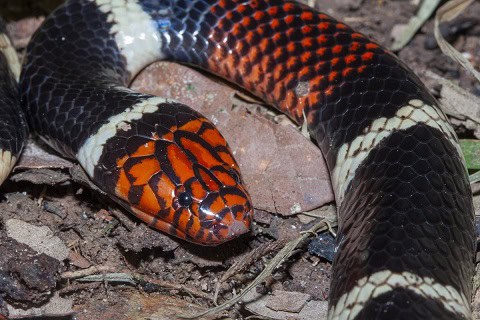
Maximum length: 139cm.
A severely neurotoxic species which is able to kill a human, but thankfully doesn’t often. Aquatic coral snakes (Micrurus surinamensis) are found in South America, essentially sticking to Amazonian regions such as northern and western Brazil, eastern Ecuador and Peru, eastern Colombia and Venezuela.
The eyes of this species are so small that they’re tricky to see. They also blend with its signature facial patterns: red scales with a thick black edge. However, they’re angled much further upwards compared to most coral snakes, which makes sense, as this is the single most water-dwelling coral snake of the 82 species in the Americas.
Aquatic coral snakes dwell in slow-moving rivers and marshes not far away, nearly always appearing in water bodies within forests, particularly rainforests. Like any aquatic species, their eyes have gradually shifted upwards on their head to allow superior vision while swimming.
Other weapons of the aquatic coral snake include a venom specialised towards fish. A 2001 study found that the venom was most active against banded knifefish and eels, and significantly weaker against snakes and mice.
| 6 | Rice paddy snake |
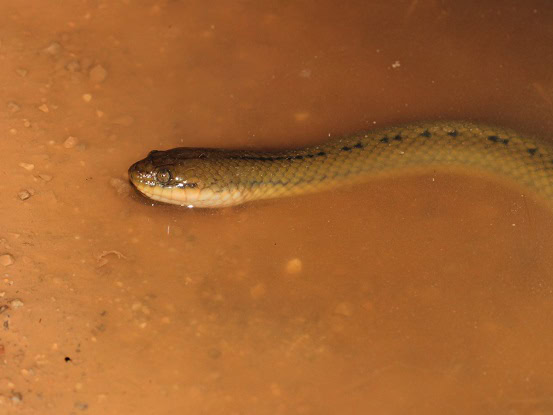
Maximum length: around 70cm.
A harmless snake of Vietnam, Cambodia and Thailand, which appears in swamps and lakes, similarly to Bocourt’s mud snake. Rice paddy snakes mainly prey on fish, and are low on the food chain in southeast Asia, with many predators. These include various snakes, such as sunbeam snakes, Siamese spitting cobras, and many-banded kraits.
Rice paddy snakes have eyes which are not just bulging, but positioned almost on top of their skull. Given their huge amount of predators, staying hidden is a likely motivation. Alternatively, they might position themselves in mud in the shallowest waters, and grab fish which stray to the very edges of ponds. The precise truth is still unknown.
Another survival skill of this snake is murky colours, without a trace of leafy green or snowy white. There’s also a strange ability to cartwheel over muddy surfaces. Each of these represents a layer of defences, in case the previous strategy fails, until all that is left is dodging the jaws of a cobra swinging in for the kill.
Rice paddy snakes become much more active after heavy rainfall, and venture to surrounding dry land, including villages and even university dormitories. On these adventures, their special eyes become useless, unless they intelligently decide to hop from puddle to puddle while travelling.
| 7 | Leopard keelback |
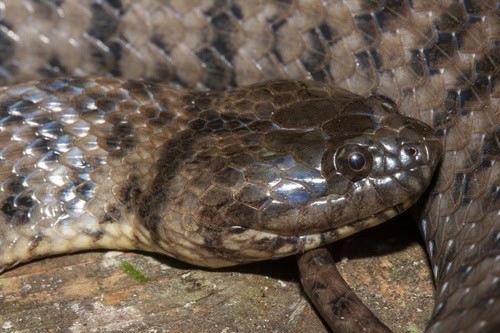
Maximum length: 92.5cm.
This semi-aquatic snake is found across the vast majority of Brazil, and is particularly common in French Guiana to the north, and Paraguay and Argentina to the south. It’s named due to its complex spotted patterns, and spends its life in marshes and rivers, where it overlaps with species like the yellow anaconda and Brazilian smooth snake.
This species eats fish such as mollies, as well as amphibians. One study found a diet breakdown of 62% fish and 38% frogs and toads. Leopard keelbacks pose no threat to humans, and spend decent portions of time on land as well, moving between rivers.
On these excursions, they’re more vulnerable, as they lose their complex boggy camouflage, and the power to disappear with only their eyes poking out. This species has eyes angled sharply upwards, just like the green anaconda, and just like its more northern cousin, the brown-banded watersnake (Helicops angulatus)
Having these evolved eyes makes the leopard keelback a very elusive snake. A brief glimpse of eyes might be all you see before it disappears into the murky depths again. If you swear to your friends that you saw a strange creature in a swamp, only to get laughed at, you probably weren’t imagining it.
| 8 | Eurasian blind snake |
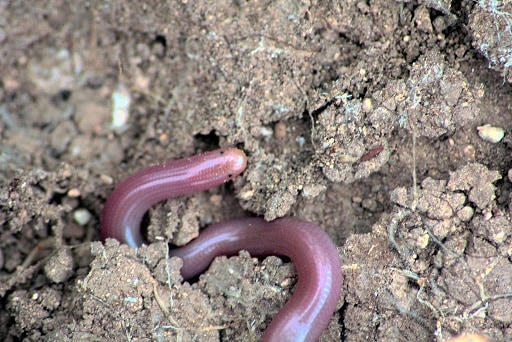
Maximum length: 47cm.
So far we’ve covered snakes which dwell in water and loose desert sands, and need eyes angled upwards to see properly. But there’s one last ecosystem where these eyes create an immense survival advantage – loose soils. These are the domains of Earth’s 200+ blind snakes, and one species with particularly noticeable eyes is the Eurasian blind snake.
This species appears in Greece, Turkey and Israel, and dwells on grassy rocky hillsides, with loose soils where it can establish subterranean bases. Eurasian blind snakes prey heavily on ants, and individual ants can even be seen through their transparent bellies. Staying hidden is their main survival scheme, as they lack any offensive weapons. Pupils angled upwards is a big part of this, as you can see from the image above.
Although blind snakes are “blind”, they can still make out vague shapes and distinguish night from day. It’s also possible that millions of years ago, blind snakes had more functional eyesight than they did today, and their eyes shifted upwards back then, and remained in place once they atrophied further to almost useless levels. Either way, the Eurasian blind snake possesses the upwards-angled pupils of its watery brethren.
| 9 | Mekong mud snake |
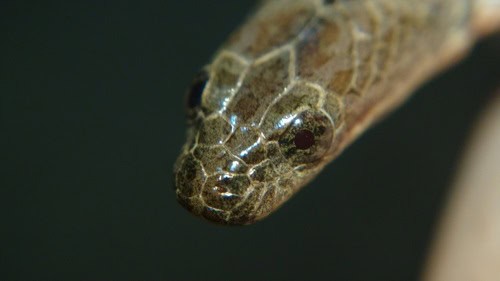
Maximum length: 87cm.
Another southeast Asian mud snake, which is related to Bocourt’s mud snake, but belongs to a completely different genus: Enhydris, which has 6 members. The Mekong mud snake lives in Thailand, Cambodia and Vietnam, and poses no threat to human beings. As the name suggests, it closely follows the line of the Mekong River, which meets the sea near Ho Chi Minh City.
This species has the advantage of camouflage, blending perfectly with mud, like the Bocourt’s mud snake. However, it has an advantage that species lacks: an eye colour completely matching the scales on its body. This enables seamless camouflage, with no interruptions. It also helps with its main eye adaption, a high position on the side of the head, allowing for upwards vision while submerged.
Mekong mud snakes have a darker upper body as well, compared to a paler underside. This is a common adaption in aquatic snakes, with a classic example being the plain-bellied watersnake of the USA, which has a dark back but a yellow or even orange underside.
| 10 | Viperine watersnake |
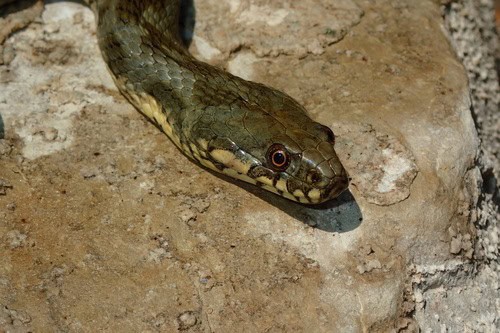
Maximum length: 96cm.
A common species in Spain, Portugal, and southern France, where it reaches huge numbers in certain lakes. This species is mildly venomous, and is closely related to the common grass snake (the UK’s most common snake), but even more aquatic.
The viperine water snake (Natrix maura) has various skills, including diving into the depths, and more disturbingly, triangulating its own head, in order to mimic a venomous snake. The goal here is disturbing predators into flying away, not wishing to be envenomated. But this is a mere backup in case the viperine watersnake is detected in the first place. The viperine watersnake’s main strategy is more basic: staying hidden in its home lake, and with eyes positioned higher on its head, this is very easy.
The viperine watersnake sacrifices no visual ability by submerging 90% of its body, with just the upper reaches poking above water, like a scaly iceberg. This species also possesses excellent murky camouflage, with no green or bright red on its body. Compared to its grass snake cousin, its patterns are less striking, and this is by design.
Viperine watersnakes prey heavily on fish, and are the most widespread and abundant snake in Spain alongside the land-based Montpellier snake.