
| 1 | Coahuila black-headed snake |
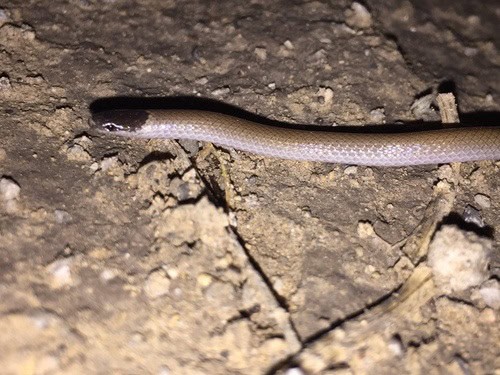
Maximum length: 23.2cm.
The smallest species in the US is one which has only ever been discovered twice. It’s a rare species which is begging to be rediscovered on US soil, but is so rare and shy that this could be decades away.
The Coahuila black-headed snake (Tantilla atriceps) is a harmless species which belongs to the huge Tantilla genus, which has 69 members, and 9 on US soil overall. All are non-venomous burrowers which survive by staying under cover objects, such as logs in forests, or rocks and shrubs in drier environments. The plains black-headed snake (Tantilla nigriceps) is the most common in the USA, but the rarest by far is Tantilla atriceps. This has only ever been discovered twice in the US, in Duval and Klegerg counties in southern Texas, and those observations were made over 100 years ago.
No photos even exist of this species in Texas; there are plenty from Mexico, but as of 2026, none from north of the border. In Mexico, this species is much more common, and therefore we have a maximum length – just 23.2cm. Assuming it’s equally small in the USA, the Coahuila black-headed snake is officially the smallest nationwide.
If a rare rattlesnake inhabited a couple of zones in deep Texas, it would be easier to find, but this species is a shy burrower, and therefore a nightmare. First you must choose the correct parcel of dry, parched land, and then pray that the snake you’re seeking appears. It may be another 100 years before this snake is rediscovered on US soil, if it still exists.
This species is tiny, but what about its other physical features? This snake has a brown or toffee body, with a paler underside, and a black head, which changes in colour sharply from the body. Its pupils are round, and its head barely enlarges from the neck, if at all.
| 2 | Florida crowned snake |
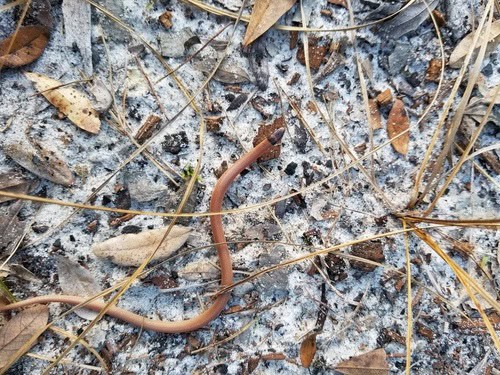
Maximum length: 24.1cm.
The second shortest snake in the USA is another Tantilla member, and another completely harmless snake. This species is found exclusively in Florida, focussing on the north and centre, disappearing in the south and before the Georgian border arrives.
Florida crowned snakes are most common in sandy environments such as grassy dunes and pine flatwoods. They possess a venom, and have enlarged rear fangs, but pose no threat to humans.
As a tiny snake, which has never been recorded to reach 25cm, the Florida crowned snake has a tiny diet: beetle larvae. Mice are impossible, and lizards are just a fantasy. Centipedes and snails have also been found in its diet. Being tiny also make you easy to hunt, and the Florida crowned snake is a regular meal of the short-tailed snake (Lampropeltis extenuata).
This species is much easier to find than our 1st snake. While it’s only found in Florida, it can be very common in certain sandhills and longleaf pine woodlands, becoming one of the most common reptiles. One study found that wildfires actually benefit this species, increasing its populations.
| 3 | Flat-headed snake |
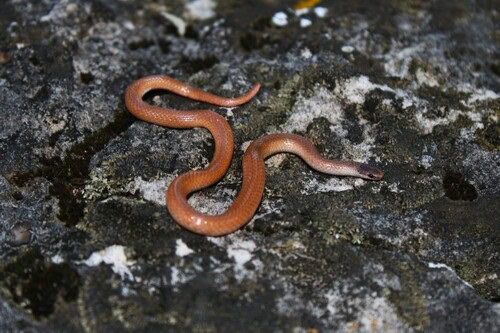
Maximum length: 25.1cm.
A shy, mildly venomous species of the central USA. This is another member of the 69-strong Tantilla genus, one of 9 on US soil. The flat-headed snake (Tantilla gracilis) is the smallest snake in Kansas, Oklahoma, Louisiana and Missouri, and the 2nd smallest in Texas, assuming the Coahuila black-headed snake still exists.
This species possesses the same brown/toffee body and black head of its cousins. However, the black is often faded and fragmented on the head, rather than a solid colour. The contrast is far less sharp with the body; in some individuals the head is more like a smudgy grey.
Flat-headed snakes have smooth scales, and two rear fangs with grooves, used as venom channels. There’s also an active venom gland, but the target is centipedes, not farmers or hikers. You can find this species (though you probably won’t) in open woodlands and prairie hillsides, often hiding beneath rocks.
In the harsh natural world, being small and slightly venomous makes you a soft target, and the flat-headed snake has 3 confirmed snake predators: the copperhead, speckled kingsnake and Texas coral snake.
| 4 | Texas blind snake |
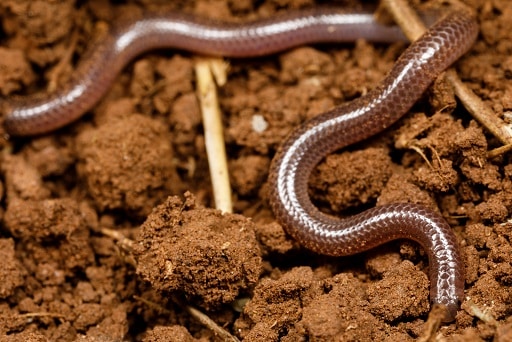
Maximum length: 27.3cm.
The Tantilla genus has the 3 shortest snakes in the USA sown up. The first from a different group is the Texas blind snake (Rena dulcis), one of two common blind snakes on US soil. The other is the western blind snake (Rena humilis), which lives in southern California and Arizona, and peaks at 38.9cm. The Texas blind snake is even shorter, never reaching 30cm, and is abundant in most of Texas, as well as Oklahoma and New Mexico.
Texas blind snakes are completely non-venomous, and prey heavily on ants, following their trails back to anthills. Their hatchlings are tiny as well, averaging at just 6.5cm. Their predators include the Texas coral snake and night snake, and they’re even tiny enough to become spider food, namely for the triangulate cobweb spider.
Compared to the Tantilla members, this species tends to be pinkish rather than brown/toffee. It lacks the black head, and then there’s the atrophied eyes, which are now mere pinprick dots, after millions of years of forgetting to use them. You can find Texas blind snakes in a variety of open areas, such as sparse woodlands, grassland, shrubland and even rural backgardens.
| 5 | Banded sand snake |
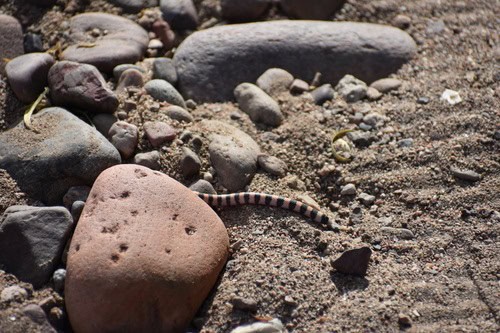
Maximum length: 28.5cm.
One of the best swimming snakes in the USA… but in sand, not lakes or rivers. This species never reaches 30cm, and like every snake on our list, poses zero threat to humans, though it does possess a weak venom.
The banded sand snake (Sonora cincta) is found in sandy semi-desert areas, interspersed with loose rocks and dry, hardy shrubs. Its entire lifestyle revolves around swimming through soft upper layers of sand, and for this it has various adaptions. Its scales are completely smooth, its abdomen has a concave shape. Its nostrils are positioned upwards on its head, similarly to semi-aquatic snakes like the plainbelly watersnake. Another physical feature is a recessed lower jaw compared to the upper.
This species preys on centipedes, grasshoppers and cockroaches. Within the USA, Sonora cincta is found only in Arizona, but it’s very common on the outskirts of Tucson and Phoenix. In Mexico, it’s found in Baja California, but there’s a mysterious gap in its territory between here and Arizona, so it doesn’t appear in US California.
| 6 | Rim rock crowned snake |
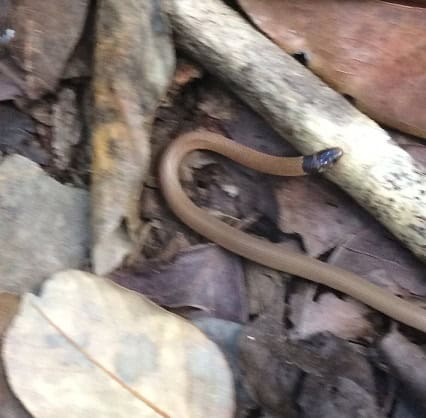
Maximum length: 29.2cm.
The 6th shortest snake in the USA is another harmless Tantilla member – the rim rock crowned snake (Tantilla oolitica). This is a rare species whose diet and predators remain a mystery. It possesses the usual toffee brown body contrasting against a black head and neck, but is a completely separate species to the USA’s 8 other Tantilla worm snake members.
In Florida, the centre and north are controlled by the Florida crowned snake, while the south is the territory of the rim rock crowned snake. But while the former can be very common in certain sandy woodlands, this species is very rare. In fact, Tantilla oolitica is one of the rarest snakes in North America, and definitely the rarest in the USA.
This species is restricted to Monroe County and eastern Miami-Dade County, and mainly inhabits pine rocklands and tropical hardwoods. It often takes shelter in holes in limestone formations, and when those rock formations are absorbed by housing estates and car parks, the rim rock crowned snake completely disappears.
A 2011 survey searched for 393.4 person hours, across 57 potential locations. Their reward was just 2 snakes. Over the last 10 years, almost no sightings have been made, and consequently, this species is listed as “endangered” by the IUCN.
| 7 | Yaqui black-headed snake |
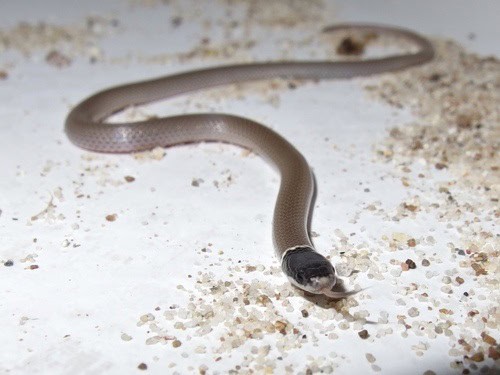
Maximum length: 32.5cm.
A species with enlarged, grooved rear fangs, showing that a venom is produced, but again, a snake which no human should fear. This Tantilla worm snake member is rarely above 30cm, and has a thin body as well.
The Yaqui black-headed snake (Tantilla yaquia) is mainly a Mexican snake, but crosses the border to appear in three counties of Arizona: Cochise, Santa Cruz and Pima. It also appears in Hidalgo County in extreme southwestern New Mexico. Its US range is small, yet within those areas, the Yaqui black-headed snake is fairly common.
This species sticks to medium to higher altitudes, appearing in Arizona from 1083 to 1830 metres. Its favourite habitats are oak woodlands, but desert scrubland and desert grasslands are also possibilities.
Compared to the flat-headed snake and other Tantillla members, Tantilla yaquia has the usual brown-toffee body and black head, but a distinguishing feature is a thin, snowy white stripe on the neck. This contrasts sharply against the black head. Additionally, its snout is much paler than the top of its head. With the largest individuals reaching over 30cm, this species is larger than the Florida crowned snake, but still the 7th shortest snake in the USA.
| 8 | Southeastern crowned snake |
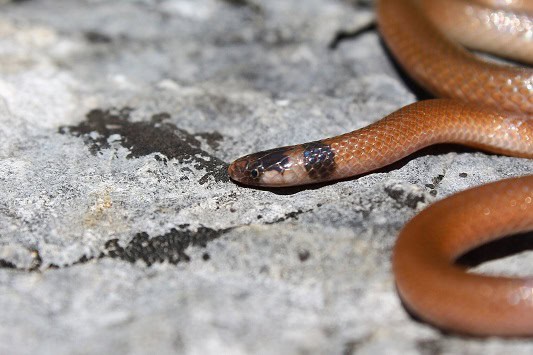
Maximum length: 33.0cm.
Yet another Tantilla member. This is the 8th smallest snake on US soil, and as the name suggests, it appears in various southeastern states: Georgia, Alabama, Virginia, Tennessee, Mississippi and the Carolinas. This snake is extremely common to the east of Nashville, and is found in Florida but only in the western panhandle.
Southeastern crowned snakes (Tantilla coronata) are most commonly found in dry pine-oak forests with many decaying tree stumps and logs. Soft soils are ideal for this species, as like the banded sand snake, it possesses the ability to “swim” in the upper layers of loose sediment.
This species has a weak venom, like all Tantilla members, but is incredibly timid, almost never biting if picked up. Its diet consists of all tiny creatures, with all sorts of creepie-crawlies: spiders, termites, centipedes, earthworms and beetle larvae.
Physically, this species has the black top of the head, and a black neck collar. However, compared to the Florida crowned snake, the white gap between the two is larger, and a tiny black line often connects the two in the centre. As a tiny species, the southeastern crowned snake has many snake predators, including common kingsnakes, milk snakes, black racers, and neurotoxic eastern coral snakes.
| 9 | Eastern worm snake |
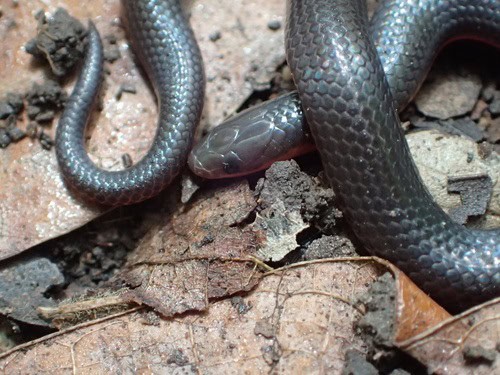
Maximum length: 34.2cm.
Something you may have noticed is that every single entry on this list is shy, and either a burrower or addicted to staying under safe cover objects. These snakes are weak, with no power, and staying hidden from the greedy eyes of coral snakes or black racers is their only chance of staying alive, not fighting back viciously. Yet another shy snake is the eastern worm snake (Carphophis amoenus), which has never reached 35cm on record.
This species is abundant in the eastern USA, skipping Florida, but inhabiting Tennessee, Virginia, the Carolinas, Georgia and West Virginia alike. It burrows less than Tantilla members, but constantly lurks under cover objects, such as rotting logs, leaf litter, rocks and tree bark. Its habitats include forests, woodlands and open fields.
Eastern worm snakes are named for two reasons. Firstly, they eat worms, with 61% of their diet containing earthworms in one study. Secondly, their consistently brown body patterns resemble an earthworm’s. Their underside is brighter, often bright pink, and occasional fully pink individuals have been found, where the neon underside breaks free and takes over completely.
Otherwise though, there’s zero patterns. Common worm snakes are harmless to humans, and simply swallow their earthworm prey whole.
| 10 | Rough earth snake |
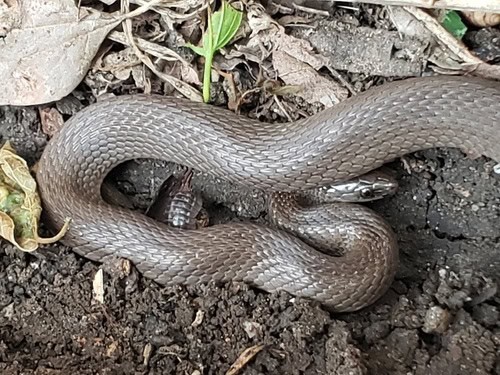
Maximum length: 34.8cm.
Another earthworm-eating snake, choosing one of the few prey items that will fit inside its tiny body and tiny belly. Rough earth snakes (Virginia striatula) live in the US southeast, and fail to reach 35cm by 2mm, in the largest individual ever recorded.
This is another dull snake, optimised for blending with forest floors. Juvenile rough earth snakes have a pale neck collar, while adults become a monolithic olive colour. Like the worm snake, the belly is usually brighter, usually white or beige, but sometimes greenish or even pink.
You can find this tiny species in the Florida panhandle, Alabama, Louisiana, Mississippi, Oklahoma, Texas (very common) and more. The smooth earth snake is the only other member of the Virginia genus, and this is slightly longer at 39.3cm.
While rough earth snakes naturally hide under rotting logs and stones, they’ve adapted to humanity’s sudden appearance over the last few thousand years, and even the industrial revolution, as they’re often spotted hiding under pieces of sheet metal and old farming machinery. This is a completely harmless snake, but they do have the power to release a disgusting smell, and a death-faking charade where they loll out their tongue and go stiff as though faking rigor mortis.