
| 1 | A funky but harmless Amazon snake |
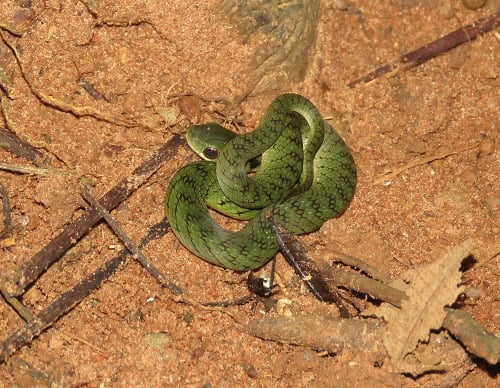
The Amazon rainforest is a realm of caimans, anacondas, and poison arrow frogs, which could prove fatal within minutes if you follow the wrong trail or put your foot in a particularly unfortunate location. It’s a place of savage extremes, but this has led to relatively harmless extremes as well, one of which is the velvet swamp snake (Erythrolamprus typhlus), one of the more quietly interesting snakes on Earth.
If the fer-de-lance is one of the most terrifying snakes of the Americas, then this species is surely one of the cutest. Rather than a snarling, scaly beast with menacing vertical pupils, the velvet swamp snake looks like a cuddly children’s toy, with round eyes and bright scales.
The reality isn’t too different, as velvet swamp snakes are either non-venomous or slightly venomous. They have no ability to kill or even hurt a human being whatsoever. They’re harmless even compared to other members of their Erythrolamprus genus (which has 55 members), as no swelling or even red hot pain has been recorded. By contrast, their relative the Aesculapian false coral snake (Erythrolamprus aesculapii) has the power to swell up a hand or arm.
Velvet swamp snakes are almost defenceless against predators and humans, at least in combat. But instead, they have a variety of stranger survival skills, which could have only evolved in the extreme pressure cooker environment of the Amazon.
| 2 | Skill 1 – flares a neck hood |
Cobras spread a hood when they’re about to attack, before injecting 100-150mg of neurotoxic venom. This is true in snake pits all over, from an Egyptian pyramid to a Thai rice paddy. Mimicking this hood is a logical solution for a non-venomous snake, and the velvet swamp snake has one of the most impressive non-cobra hoods of all.
The technical name is dorsoventral flattening. The result to the naked eye is a massively widened upper body, neck and even head, as the velvet swamp snake instinctively flexes its own bones to dramatically alter their shape.
The velvet swamp snake doesn’t always use this trick, as fleeing into a swamp is a possibility. But it’s easily one of the most impressive neck flares outside of cobras, alongside the eastern hognose snake of the USA.
One confusing fact is that cobras aren’t even found in South America, so how the velvet swamp snake evolved the trick is unknown. There are two possibilities: 1) South America once had an ancient cobra relative (an elapid), which had the ability to spread a hood, or 2) that birds landing from Africa or Asia recognise cobra hoods, and therefore the velvet swamp snake’s schemes still work. It’s also possible that cobras are uninvolved, and that the real goal is creating a false impression of size and bulk.
| 3 | Skill 2 – mysterious white droplets |
An injection of haemotoxic venom is perfectly ordinary, if nightmarish. The velvet swamp snake skips this, but has a much rarer skill – secreting a strange substance from its scales.
The story started in Amazonas department, Colombia on March 20th 2022. Herpetologists were walking through a forest admiring fauna with locals, when a jungle green velvet swamp snake (40cm long) slithered across the forest trail. After being captured, it began with the usual dorsoventral flattening – enlarging itself sideways like a cobra.
The scientists were wise to this primitive trick, and the velvet swamp snake failed to follow up its threat with a bite. But instead, it did something surprising – it secreted a white substance from its scales.
This came in small drops, mainly in the anterior (front) and centre of the body. After a few minutes, the substance hardened to become sticky like latex. This was completely new, and so the scientists placed the velvet swamp snake in a box to conduct further observations. 3 hours later, they touched the snake again, and it began producing the same white liquid.
Again, the white liquid came in tiny drops, released between the scales. The next day, the scientists released the velvet swamp snake unharmed.
| 4 | No answer to the mystery yet |
The story didn’t end there though. On March 30th 2022, 10 days later, the same herpetologists found a second velvet swamp snake, again in Amazonas department, Colombia. They were hoping for more strange white droplets, and they were rewarded, as the velvet swamp snake produced the same mysterious secretion when handled.
Again, it came in white droplets, which were small but visible due to a sharp contrast with the green-blue scales. It took just a few minutes of handling to begin releasing the secretion. The researchers then set the snake free. According to the team: “This appears to confirm that this behaviour is typical of the species“.
The Erythrolamprus genus has 55 members in South America, but this was the first member to produce such a substance. It was also the first South American snake full-stop.
The exact purpose wasn’t discovered in the study, but in southeast Asia, the Rhabdophis genus also releases a milky white liquid. This includes dangerous species like the red-necked keelback (Thailand, Malaysia) and tiger keelback (Japan), and the purpose of those species is to release bufotoxins acquired from amphibians, which they’ve repurposed as a weapon.
As velvet swamp snakes also prey mainly on amphibians, there’s a strong chance this milky secretion has a similarly dangerous purpose.
| 5 | Found in most South American countries |
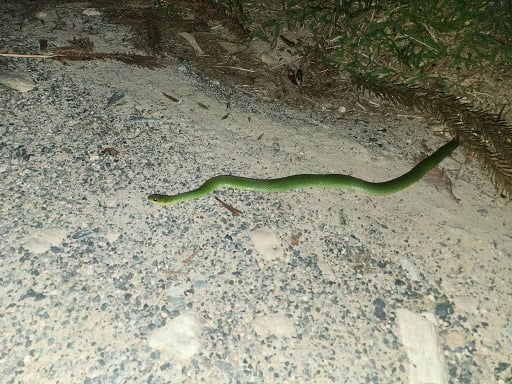
Velvet swamp snakes are found in most countries of South America. They’re abundant all over Brazil, in the Amazon rainforest of the northwest and Atlantic forests of the southeast alike. They cover all northern countries such as Suriname, Guyana, Venezuela and Colombia, with the exception of Trinidad and Tobago. They’re particularly common near the territory of French Guiana.
The one caveat is that velvet swamp snakes don’t appear anywhere to the west of the Andes mountains, as they’re strictly a lowland species, avoiding mountains. Consequently, they appear only in eastern Colombia, eastern Ecuador and Peru, not in the west of each.
Velvet swamp snakes also disappear further south, with no presence in Uruguay, and only a miniscule foothold in northeast Argentina. They’re also missing from Chile, therefore covering all but 3 South American countries.
| 6 | More defensive techniques |
Velvet swamp snakes are most common in rainforests and other primary forests. However, they cope decently with human interference, and can appear in degraded forests, or even standing clumps of trees near villages in territories with wet climates. They can even appear near plantations or pasture land. Moisture is key to this species’ survival, and forests are ideal.
Velvet swamp snakes are considered to be calm overall, but will flee if spooked. Another defensive strategy is releasing a vile snake smell. In 2006, yet another tendency was discovered, a relatively rare one: coiling into a ball, which was observed in Anavilhanas National Park, Amazonas state, Brazil.
The goal here is to protect the brain, and it’s a common tactic in ball pythons and grass snakes, but relatively rare in velvet swamp snakes. Another velvet swamp snake in this study triangulated its head, probably to mimic a viper.
| 7 | Many morphs |
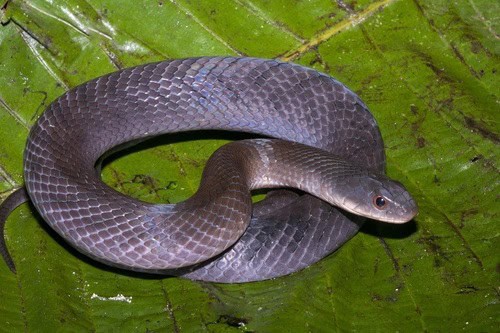
Velvet swamp snakes break no records for size, as their all-time record was just 85.3cm. Instead, their signature physical feature is their huge variety of colour morphs.
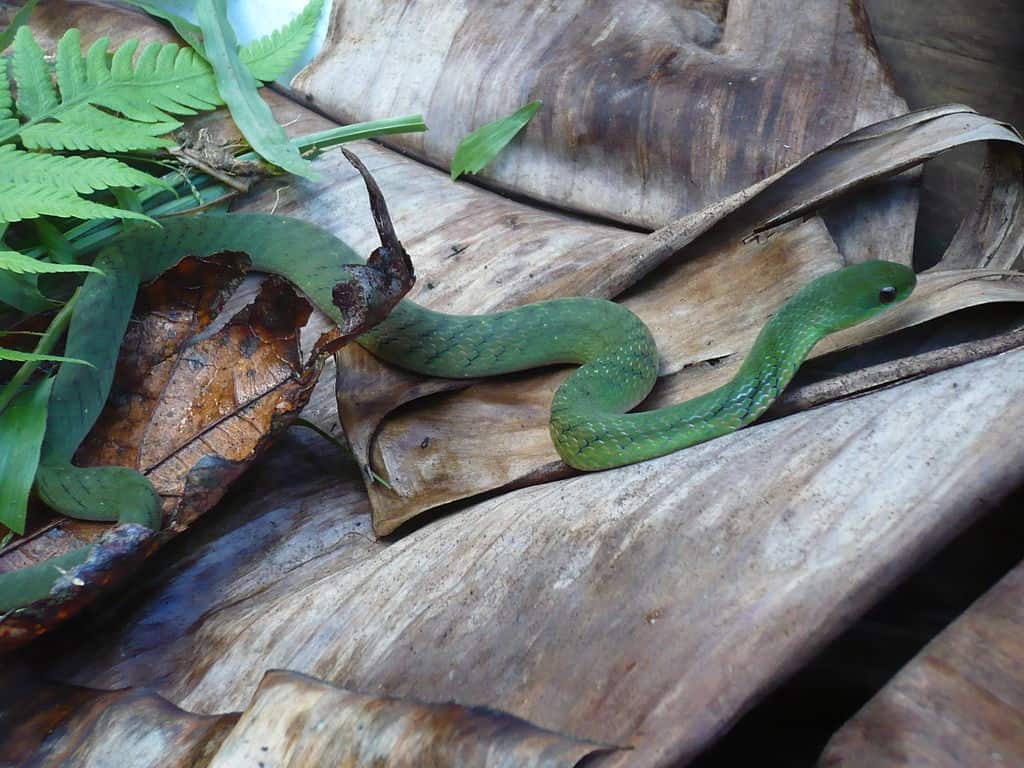
Green is the standard colour for the velvet swamp snake, blending superbly with the rainforest shrubs they move through. Even here, there’s an illusion of softness or plushness (hence the velvet name) that other green snakes lack, a shimmering quality. Then there’s the more unusual morphs, which include yellow, grey, and even reddish.
Then there’s the most spectacular morph of all: blue, an extreme rarity in snakes worldwide. No snake is consistently blue, and few have blue morphs. The Malabar pitviper and Sunda Islands pitvipers of Asia are two examples. A few species like the smooth green snake of the US turn blue post-death.
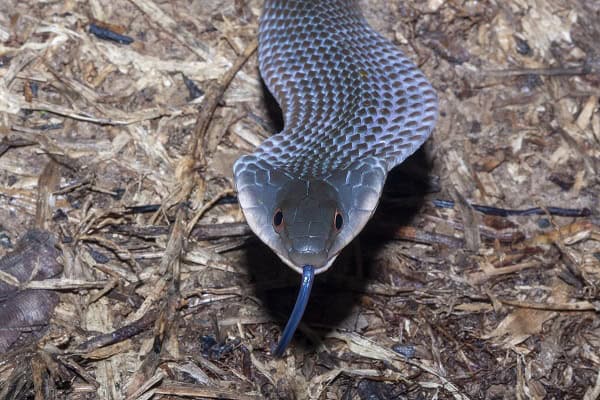
Meanwhile, the velvet swamp snake has bright, electric blue morphs which are occasionally found, like this image from further up. The scales are rich blue, while the skin between is even brighter, and its tongue is one of the bluest ever seen in the serpent kingdom.
| 8 | More physical signs |
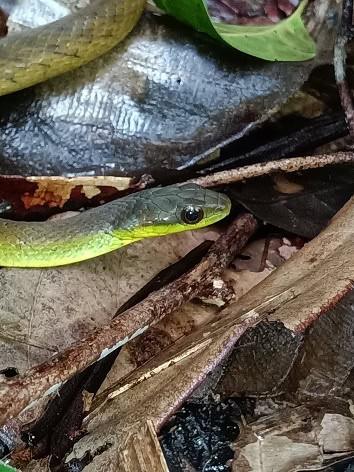
Velvet swamp snakes evolve with age, as juveniles tend to have much richer patterns. They take the form of streaks or dots, which gradually fade with age, resulting in a monolithic green, blue or red.
Some juveniles have a brown head with a greener body, and even the dots vary in density, from sparse to tightly packed. Their eyes are large at any age, almost bulging out of their heads. Their pupils are round rather than sharply vertical.
Another ID sign of the velvet swamp snake is its underside. This is completely clean, with no patterns whatsoever, which contrasts against its relatives like the royal ground snake (Erythrolamprus reginae). The belly is usually paler than the body – a green velvet swamp snake might have a yellowish or whitish belly, while in other morphs the belly can be reddish.
Velvet swamp snakes are intermediate in thickness. They’re not extremely thin and nimble, but nor are they crushingly thick, as they hunt prey manually rather than using constriction.
| 9 | Sleeps on bushes at night |
Velvet swamp snakes spend the majority of their lives on the ground. Unlike a green jararaca, they almost never appear on branches 10 metres high, and most of their meals such as grass frogs and oval frogs live near ponds and swamps.
Nevertheless, there’s one time you will find the velvet swamp snake above ground: while sleeping. This species is diurnal rather than nocturnal, and at night, it retreats to perches on bushes and plants roughly 30-70cm above ground, hanging in place.
The goal is probably to avoid ground predators while sleeping. With green camouflage in the average member (blue ones might struggle), this also helps them to vanish into the rainforest while unconscious and unable to defend themselves.
This tendency creates the possible spooky sight of velvet swamp snakes hanging in place in the dimming light, maybe under the glare of your torch. Their resting places can often be by the sides of scenic trails. A good time to spot them in active mode is on forest trails on sunny mornings.
| 10 | Diet: mostly amphibians |
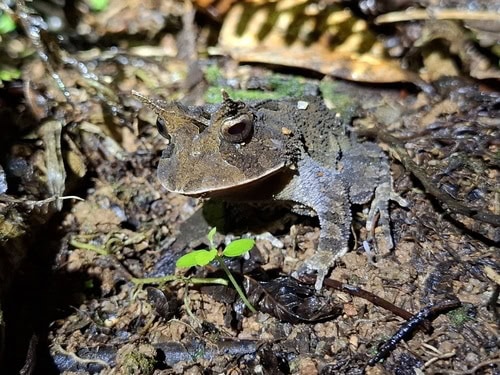
Velvet swamp snakes derive the vast majority of their meals from frogs and toads, with a few lizards sprinkled in. These include frogs from the huge Leptodactylus grass frog genus, but also the chunky, obese-looking oval frog (Elachistocleis) genus.
These species are harmless, if tricky to catch. But velvet swamp snakes are able to eat lethal toads as well, such as the snouted toad (Rhinella proboscidea). This species is riddled with heart-stopping bufotoxins, yet was observed as a velvet swamp snake meal in Amazonas state, Brazil in January 2009. If a human ate this toad meal, their heart would cease beating. It’s therefore likely that velvet swamp snakes have innate bufotoxin resistance.
Another confirmed toxic meal was the rusty toad (Rhinella rubescens). A velvet swamp snake regurgitated this meal in Ritápolis National Forest in southeast Brazil in November 2015. Also regurgitated were two Boie’s frogs, AKA Proceratophrys boiei, a species with huge horn-like protrusions above each eye, which has evolved to mimic leaf litter.
| 11 | Possible lookalikes (easy to separate) |
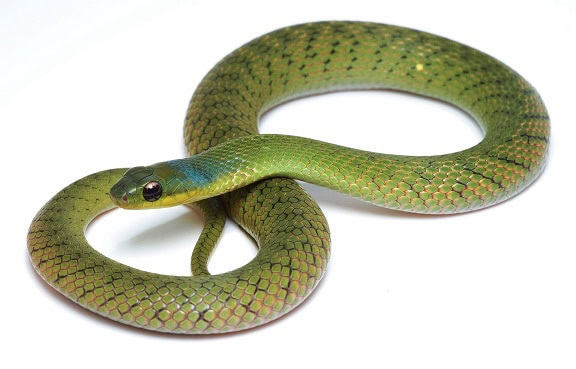
There are almost no venomous snakes the velvet swamp snake could be confused with. It resembles no coral snakes, and almost no pitvipers, with the slight possibility of a green jararaca, a leafy green lancehead which lives in rainforests. This species is nocturnal instead, and lives on branches rather than the ground. It also has a much thicker skull and vividly vertical pupils.
Another leafy green snake in South America is the common green racer (Chlorosoma viridissimum), but this is longer and thinner, and spends far more time in trees. The velvet swamp snake is probably the bright green snake in South America which sticks to the ground most consistently.
Velvet swamp snakes lay eggs rather than live young, so far in batches of 2-5 (more research is needed). Despite their greenness, they’re less focused on camouflage than some species, as they often forage for frogs in leaf litter where they easily stand out.