
| 1 | Grass snake |
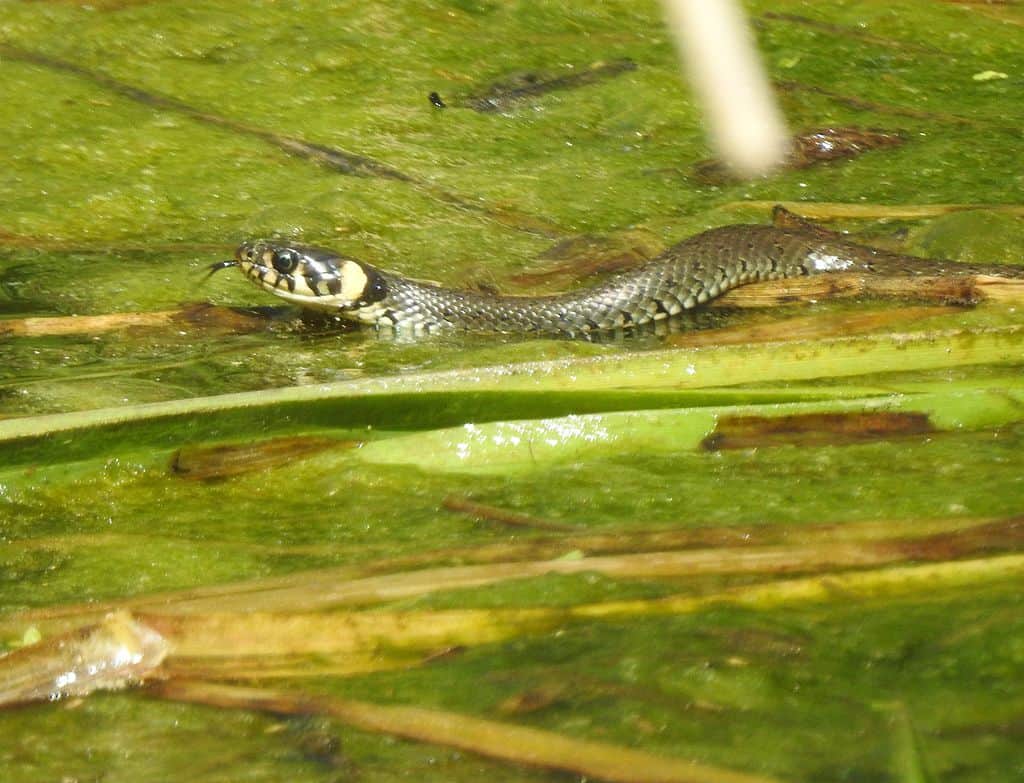
Maximum length: 205cm (usually 1 metre).
Snakes first appeared over 100 million years ago, and over 4000 species exist today, with scores more of extinct ones. In that time, snakes have diversified into endlessly varied and often alien forms, so bizarre that they barely deserve to be grouped together. The first step of our tour is the leafy shires of England, with the humble grass snake. This species poses no threat to humans whatsoever. It virtually never bites, even if picked up and manhandled.
Despite the name, grass snakes are closely associated with water bodies, including rivers, small streams, and especially ponds. They live in a scenic world of lilypads, moist grassy verges, mild drizzle and stashes of frog spawn which offer them clues that prey may be around.
Grass snakes primarily eat amphibians, with small doses of mammals and fish. They stick to their ponds in spring, before venturing to dry land in summer, particularly if it’s a classically damp British summer.
This mild-mannered snake is just another character of the English countryside, keeping frog populations controlled, and startling dogs as they flee across rivers at high speeds. This is a snake that schoolchildren are highly likely to meet on nature trips to the local river.
| 2 | Saharan horned viper |
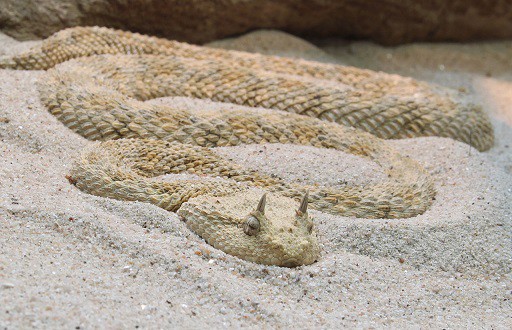
Maximum length: 85cm.
We next move to North Africa and meet the Saharan horned viper (Cerastes cerastes), primarily found in Libya and Egypt. Forget lush country streams; this snake is adapted to bone dry deserts and even rolling sand dunes, extending as far as the eye can see. It lives in regions receiving mere millimetres of rainfall annually, with few plants other than spiny succulents and the toughest desert shrubs. Saharan horned vipers have evolved to survive in this environment, where a grass snake would perish in mere days.
Saharan horned vipers have beige scales with subtle dark markings, to blend perfectly with the barren desert sands. Their horns block the sunlight, and they lick droplets off their own scales, in the rare case of rain.
In fact, Saharan horned vipers have gone beyond mere survival and are now exploiting their harsh desert world; they bury themselves in sand up to the eyeballs and spring at unsuspecting lizards walking past. This is believed to have inspired the nightmarish sandworms in books like Dune.
Cerastes cerastes is a dangerous snake to meet regardless of exaggerated mythology. This sand dune serpent has a cardiotoxic venom, and has killed numerous people, even if its sunny desert realms are a place that few visit.
| 3 | Turtle-headed sea snake |

Maximum length: 103cm.
If there’s an exact opposite to the Sahara Desert on Earth, then it may be Australia’s various coral reefs. These are home to the turtle-headed sea snake (Emydocephalus annulatus), one of 80-100 sea snakes worldwide.
This species has adaptions a viper couldn’t dream of. It has enlarged lungs which allow it to hold its breath for hours underwater, coupled with enhanced red blood cells which carry extra oxygen. Its nostrils are oriented vertically to allow for a rapid gulp of air at the surface (taking just seconds), while its tail is paddle shaped.
Emydocephalus annulatus is one of the truest sea snakes, never flopping onto a beach like a banded sea krait. Coral reefs are its home, an entire mini civilisation of colourful algae, bizarre fish and cunning eels.
Turtle-headed sea snakes have grown even more specialised than most, as they feed mainly on fish eggs. They have special instincts for sucking these gooey eggs up, and instincts for the locations of these stashes within the coral reef. This species occupies a strange niche within the snake kingdom, but is the logical outcome of its ancestors’ decision to enter the ocean 20 million years ago.
| 4 | Timber rattlesnake |
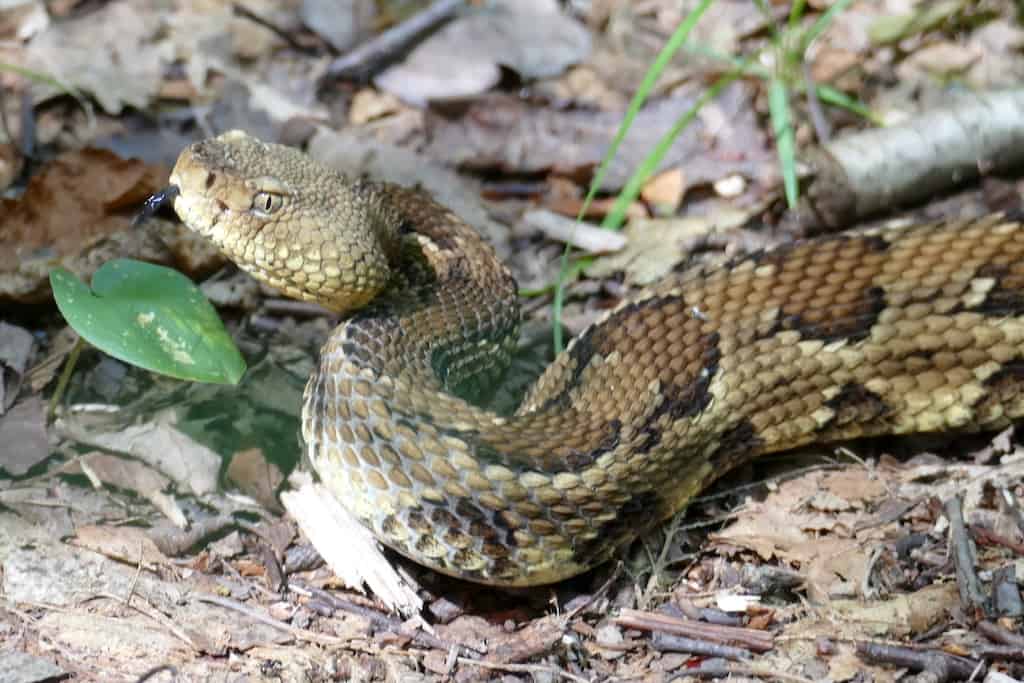
Maximum length: 189.2cm.
We now journey to the forests of the eastern US, a place where families enjoy days out on a Saturday, a perfectly harmless place for some fun. Harmless except for the rattlesnakes lurking, that is.
The timber rattlesnake (Crotalus horridus) ranges from Florida to Mississippi to North Carolina. This species loves to lurk amid fallen branches and chopped log piles. It rarely climbs trees, but mostly appears in thick forests, occasionally grassland.
The safest way to avoid this snake is to never enter your local dark forest. Timber rattlesnakes couldn’t survive a desert or coral reef. They’d even be sketchy about a local pond like a grass snake. Their safe havens are mainly forests, but they rule those forests completely.
This is a heavily mammal-eating snake, with a particular love of squirrels, with eastern grey squirrels contributing 45% of its meals in one study. Timber rattlesnakes lurk in coiled ambush posture amid fallen branches, and the standout trait is their signature rattle. Their tail features 8-10 segmented scales which grind and bash together in harsh musical tones, creating a piercing racket which no predator could fail to notice.
No other snake group on Earth has evolved a rattle. A few swish their tail against dry leaves to make noise, but only rattlesnakes have taken it to the next level.
| 5 | Annulated cat-eyed snake |
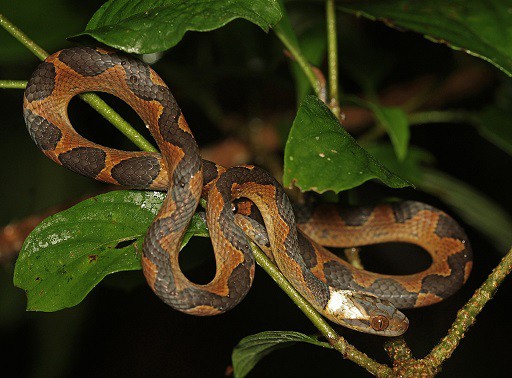
Maximum length: 103.8cm.
A tree branch snake of South America. Annulated cat-eyed snakes live in a completely different world to timber rattlesnakes, with a cast of characters including cackling monkeys, cunning caimans, poisonous rainforest frogs and greedy anacondas. Their territory spans from Colombia to southwest Brazil, and they spend over 90% of their time on branches. By day, they hide in dark tree trunk hollows, and when night falls, they poke their narrow heads out eagerly, ready for the evening’s activities.
This love of branches has moulded their diet, and even body shape. Annulated cat-eyed snakes are very thin in order to traverse even thinner branches. Their eyes are bulbous, to spot their tree frog prey.
Annulated cat-eyed snakes even lick up frogs’ eggs, locating secret stashes hidden in branch crevices. Some species, like the red-eyed tree frog, can sense the vibrations of this snake, and hatch from eggs prematurely and drop into ponds below.
This snake lives in an alien world of bizarre rainforest rules. Despite its tree branches being just 1-2 metres above ground, this snake might as well be in a different universe.
| 6 | Ridley’s cave racer |
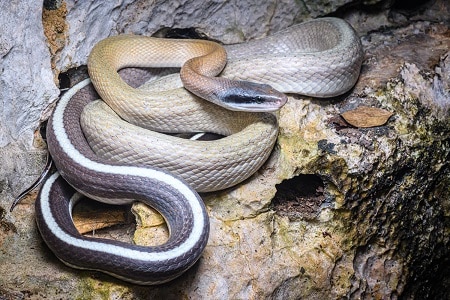
Maximum length: 2.8 metres.
Rainforests are an explosion of pure, unbridled nature, but our next snake lives in cold, almost dead worlds. It’s found in cool, dripping tunnels with stone walls and only glimmers of light, and a handful of fellow creatures hardy enough to survive. This is Ridley’s cave racer, a subspecies of the beauty ratsnake which has adapted to live in caves.
Ridley’s cave racers are ghostly white, and found in Thailand and peninsular Malaysia. They’re experts at climbing cold cave walls, searching for the bats they’ve grown to specialise in. A cat-eyed snake hears the constant chirping of insects, but all Ridley’s cave racer hears is the dripping drops of water, and maybe the distant murmurs of tourists. This is a classic snake for spooking amateur caving enthusiasts, and its pale colours stand out well in the darkness.
Ridley’s cave racers leave their caves at night to hunt, but nevertheless, if they found out that 4000 other snakes existed worldwide, they’d be astonished. Luckily, they’re docile and harmless; they face so few threats in their dark caves that they’ve lost their aggressive responses. This snake looks like the ghost of a jungle snake that ventured into the cave and got trapped.
| 7 | Ring-necked snake |
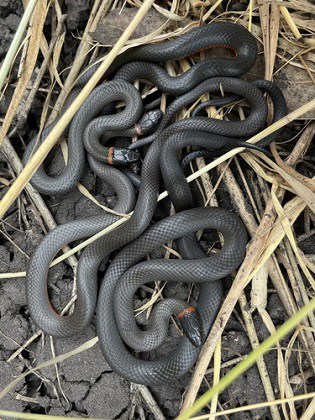
Maximum length: 85.7cm.
Our tour now returns to the USA, with a harmless snake which is addicted to hiding below shelter at all times. Like woodlice or beetles, you can reliably find this snake by ripping up old sheet metal or rotting logs, exposing a sheltering colony beneath. We’re talking about the ringneck snake, also one of the USA’s shortest species at an average of just 30cm.
Ring-necked snakes are common in gardens, woodlands, forests and mixed grassy areas like hillsides. It’s rare to find them striding confidently through open terrain, as they prefer to lurk in cluttered spots where they can eat small grubs like earthworms and ants, searching for rare creatures smaller than they are.
This species can be extremely abundant in certain areas of the US. In Kansas, herpetologist Henry Fitch found 279 in just 30 minutes, and in 1968, two researchers found 300 in under 1 hour, again in Kansas. Ring-necked snakes have the rare tendency of sheltering communally, sharing company with 5-10 fellow species members. There are many paths a snake can take, but unlike a reticulated python, ringneck snakes have completely embraced disguise and flying under the radar.
| 8 | Reticulated python |
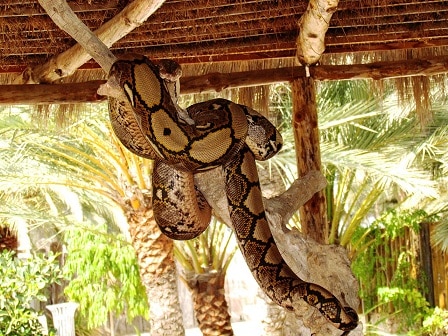
Maximum length: 6.95 metres (wild).
Ring-necked snakes average at 30cm, and they’re thriving all over the US. But in the humid forests of Thailand, their distant relative has grown to nearly 7 metres: the reticulated python, the longest snake species on Earth. Reticulated pythons can reach over 200 pounds, and are crushing constrictors which actually target the blood vessels and ruthlessly asphyxiate their prey.
Reticulated pythons are as confident as they are enormous. Rather than lording over a forest kingdom, they prowl the Thai countryside, entering villages, and even urban streets, particularly in Singapore. If a reticulated python is curious about the secrets of a Thai supermarket, it won’t hesitate to enter by the front door. The largest reticulated python ever (reliably tested) measured 7.67 metres. It was called Medusa, and was the well cared for star of a Kansas City horror attraction.
Reticulated pythons are great swimmers and even great climbers, sometimes convincing themselves that climbing a lamppost is necessary. It’s almost unfair that such a mammoth snake has so many bonus skills. Ring-necked and cat-eyed snakes live a challenging life, constantly dodging predators. But the likes of reticulated pythons are masters of their terrain.
| 9 | Cloudy snail-eating snake |
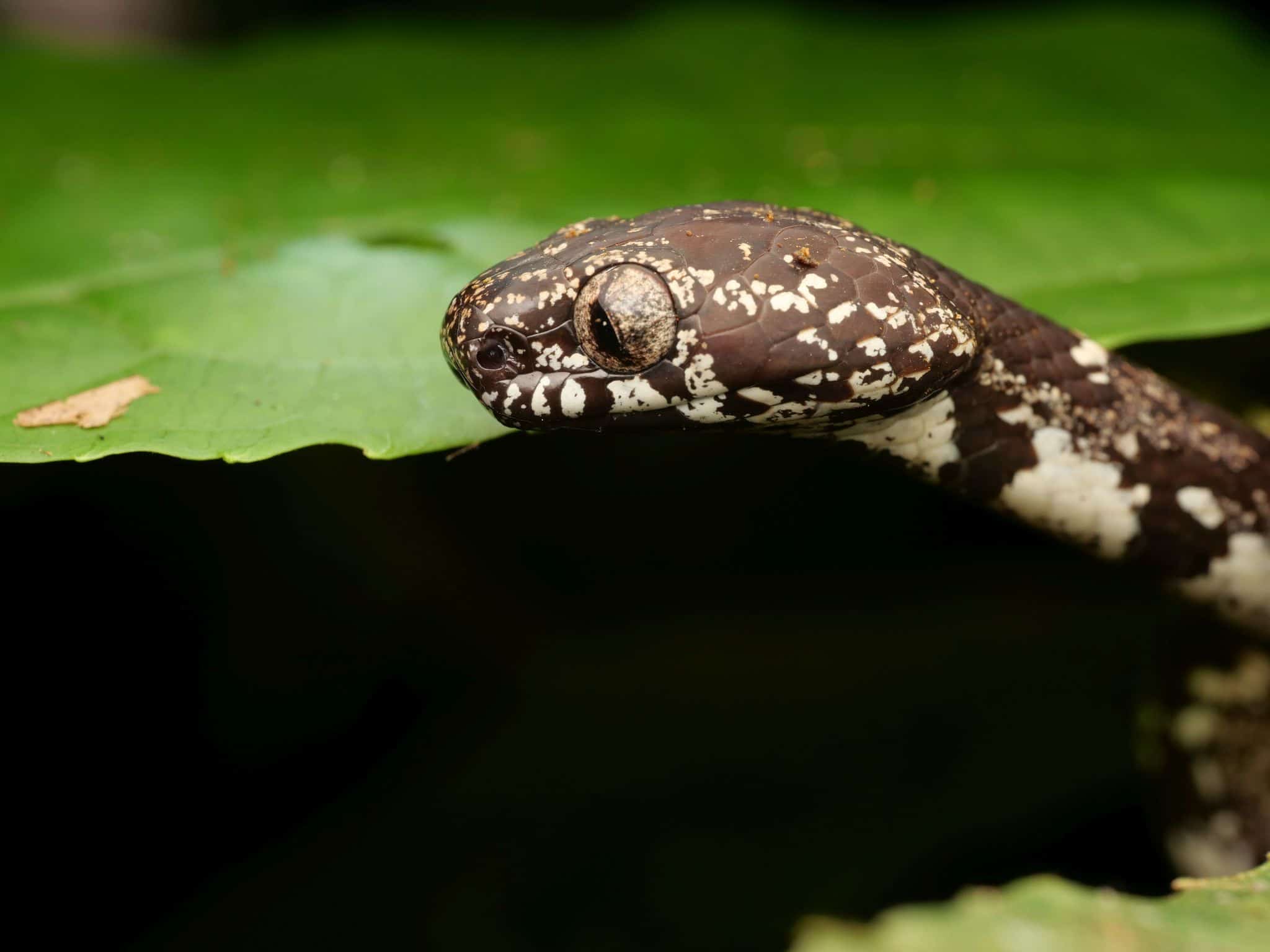
Maximum length: 101.3cm.
We’ve now reached one of the most niche corners of the snake kingdom: the slug and snail-eaters, whose jaws and bodies have been twisted into something barely connected to a boa constrictor anymore. Cloudy snail-eating snakes (Sibon nebulatus) are found in Costa Rica and Panama, and live mostly in forests. They cling to branches, scanning the ecosystem for hints of a calcified snail shell.
The eyes of this snake are incredibly optimised for camouflage, like a piece of bark. Sibon snail eaters rely on disguise, as they’re terrifying to snails, yet harmless to birds, with no venom. This species only pounces on a snail when 0.5-2cm away. Despite being no smarter than an average snake, its feeding methods are finely tuned, instantly identifying branch protrusions to snag the shell on, using them as leverage as it forcefully sucks the shell free.
Sibon nebulatus can remove a snail’s slimy body like a piece of spaghetti. It can also eat slugs, but its diet is incredibly narrow and specialised. At 50-70cm, this species could potentially eat small anoles and frogs, yet has backed itself into a small evolutionary niche. Despite this, cloudy snail-eaters are incredibly successful, ranging from Mexico to Ecuador.
| 10 | Texas blind snake |
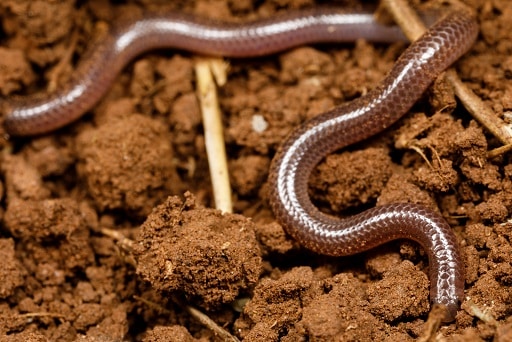
Maximum length: 29.3cm.
Finally, we have the opposite spectrum, the unluckiest snakes on Earth. It’s the blind snakes, whose eyes have withered to biro pen dots, after spending too long underground. Texas blind snakes (Rena dulcis) live in Texas and northern Mexico, and are abundant. Like their cousins, they’re not fully blind, but can distinguish basic changes in light intensity, to establish whether they’re underground or not.
This species is bizarre even among blind snakes, as 50% of its diet consists of ants. Its strategy is to slither into a writhing ant swarm, and rake them down its throat, using a specialised lower jaw which is semi-detached from the skull.
To a Texas blind snake, this is perfectly normal. This species wouldn’t even recognise a mouse or anole as food. Anthill invasions and raking are the only life it knows; the cosy country luxury of an English grass snake would be like another universe.
Texas blind snakes measure 15-25cm, and are encountered regularly in Texas, usually after disturbing upper layers of soils. Heavy rain is the main trigger that summons them to the surface. Otherwise, Texas blind snakes live underground, performing unknowable snake duties. Texas blind snakes have extremely weak teeth, and are virtually harmless to humans.