
| 1 | Asp viper |
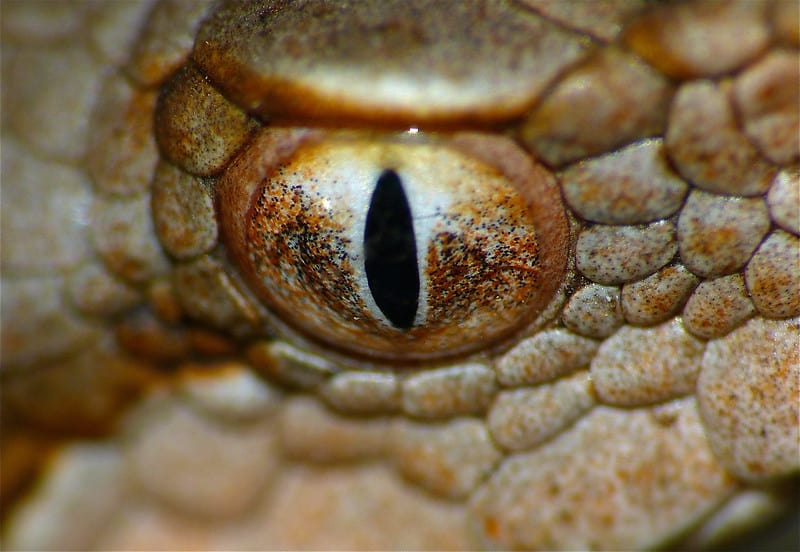
Maximum length: 82cm.
The asp viper (Vipera aspis) is the main venomous serpent of France, controlling the entire lower 80% of the country, with adders controlling the north. This dangerous snake averages at just 40-60cm, and is particularly fond of thick hedges on the edges of overgrown grassy meadows.
Asp vipers bite an estimated 300 French people per year. The initial symptoms include swelling and painful blistering, followed by vomiting, abdominal pain, and falling blood pressure. Deaths are rare, but several have occurred, including a 45 year old man in 2014.
Like most vipers, the asp viper has vertical slits for pupils. Up close, these evil eyes gain new layers of complexity. They’re largely yellow and orange, yet with a strange burnt look, like a cheese pizza left in the oven for too long. There’s also random dots of black, like sprinkles of pepper.
If you got this close to an asp viper in real life, you’d be doomed, unless you were incredibly lucky and received a dry bite. Asp vipers are also found in Italy and northern Spain, reaching up to 2100 metres in the Pyrenees mountains.
| 2 | Usambara eyelash viper |
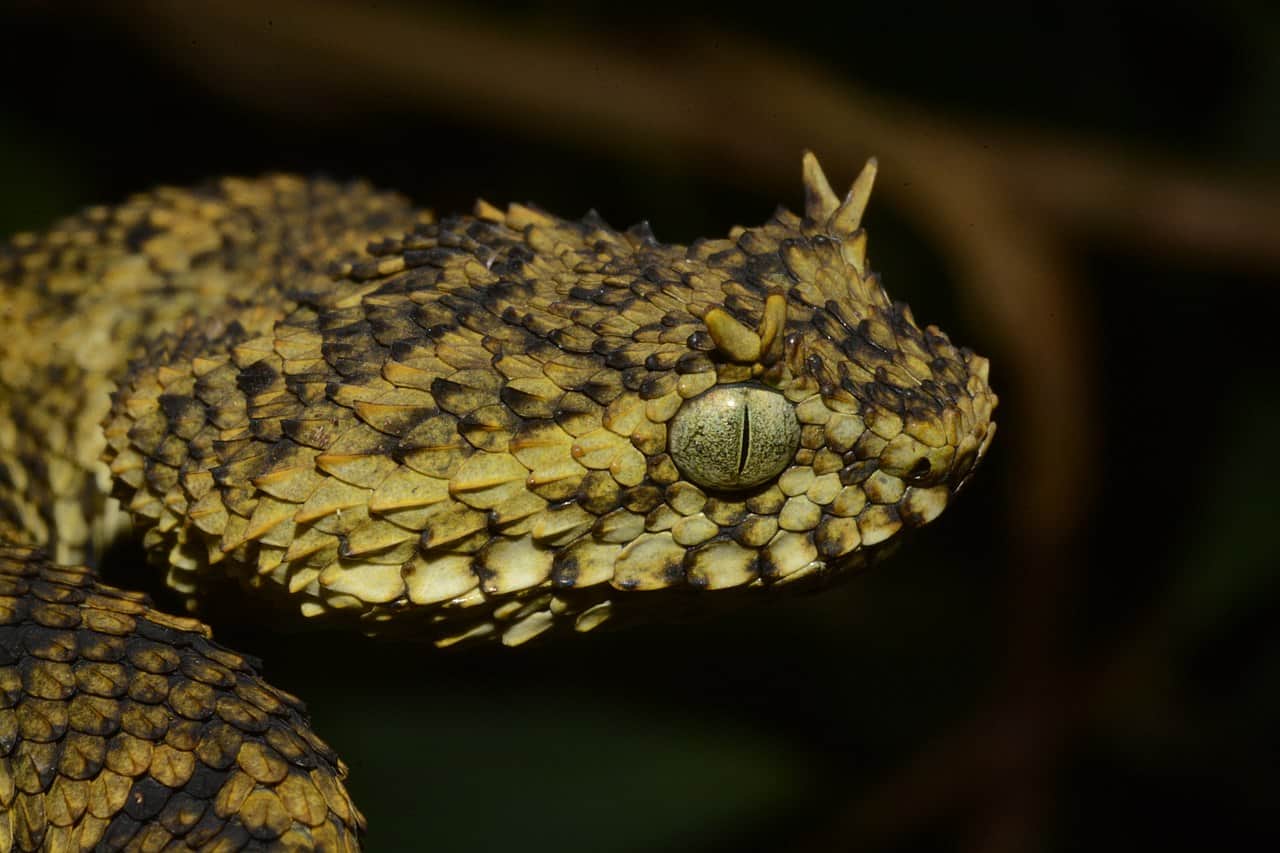
Maximum length: 54cm.
A Tanzanian ambush snake, with a moderately dangerous venom. Atheris is a genus of 17 vipers found across Africa in various enclaves and empires. The qualities that unite them are 1) sharply keeled scales, in some cases approaching pineapple territory, and 2) immensely detailed eyes, with vertical slits for pupils.
The Usambara eyelash viper (Atheris ceratophora) has vivid black and yellow scales, and a greenish eye dotted with black. Usambara eyelash vipers live in bushes and on low tree branches, where they rely mainly on ambush tactics. Their eyes are particularly large, and there’s little doubt that the photographer who took the image above was spotted.
This species has been isolated in the Usambara mountains for millions of years, alongside a host of rare creatures such as Usambara robin-chats and Usambara two-horned chameleons. This mountain range lies in northeast Tanzania, and reaches a maximum height of 2289 metres, at Chambolo Peak, amid constant rain and swirling mist. This viper lies hidden in a sweeping sea of neverending forest, where foraging villagers dare to tread, but few other people.
| 3 | Spotted dagger-tooth tree snake |
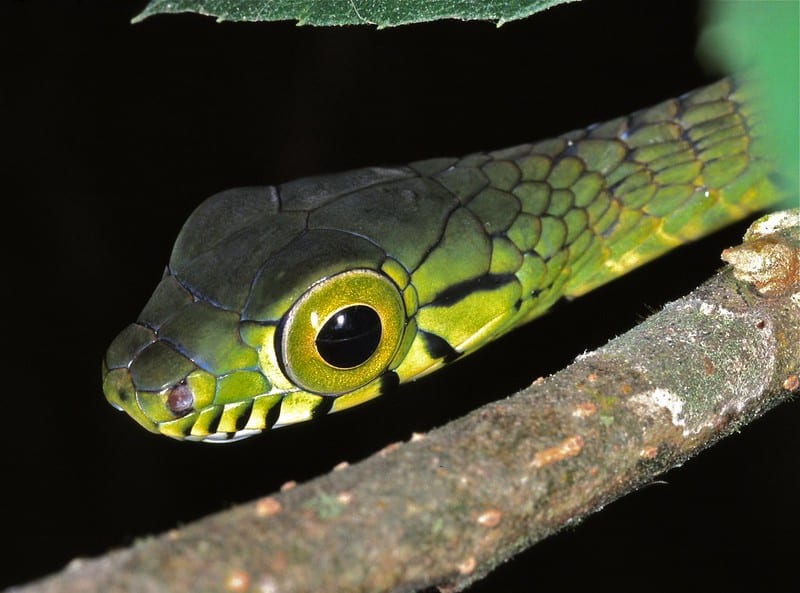
Maximum length: 150cm.
A moderately venomous species of central Africa, including Cameroon, Equatorial Guinea and Gabon. The spotted dagger-tooth tree snake (Rhamnophis batesii) lives mainly on tree branches, and has particularly bulbous eyes, which bulge out of its head on either side.
Up close, the eyes of this species are a complex green colour, not a flat pastel green, but rich and alive like foliage. There’s also a thin white ring bordering the pupil. The greenness has a clear purpose: impenetrable camouflage, as this snake lives exclusively in rainforests, at altitudes of 1000 metres or below.
Dagger-tooth tree snakes live in a sea of green, and therefore green is what they must become. Their eyes aren’t exempt (except the black pupils), as even the tiniest detail is important in the barbaric African wilds, where just a 0.5% reduction in performance could result in grisly death.
This species is also memorable for glowing blue patches it possesses on its body. When threatened, the spotted dagger-tooth tree snake inflates its throat, revealing these vivid blue scales below, which is supposed to be terrifying for some reason (maybe it works on birds).
| 4 | Emerald tree boa |
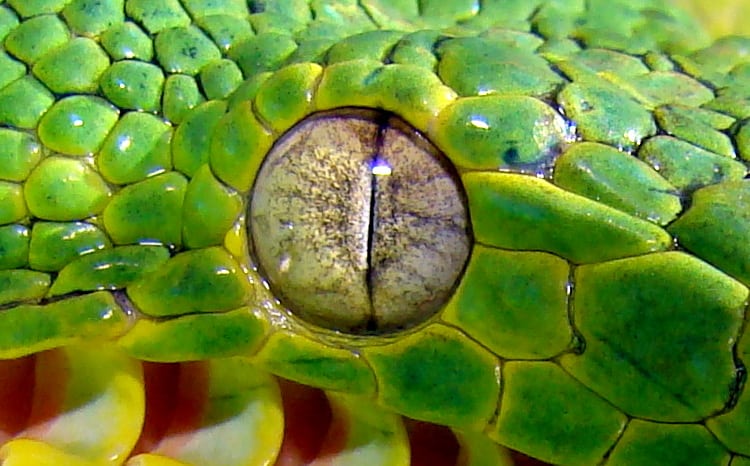
Maximum length: 210.8cm.
Once upon a time, the emerald tree boa was a normal snake. One fateful day, it decided to enter a thick jungle for refuge, and had no idea of the process it had just kickstarted.
Over millions of years, the emerald tree boa began to absorb the essence of the rainforest itself. It ascended high into the tree branches, and slowly became a bright sea of green, broken only by white markings. Soon, its entire head was green, its body was green, and eventually, even its eyes turned the shade of a juicy piece of jungle foliage.
Emerald tree boas inhabit a swathe of Brazil, and can exceed 2 metres. They’re closely related to the Amazon tree boa, but far greener and more restricted to branches. This species is a dedicated ambush hunter, which can go days without moving.
Emerald tree boas require relatively large eyes to survive, as they rely on spotting flickers of movement, which could be a bird or mammal prey approaching. One legend you might hear is that emerald tree boas have “42 eyes”, but in reality, they have 40 heat-sensing pits, plus 2 regular eyes, which effectively grants them night vision.
| 5 | White-spotted cat snake |
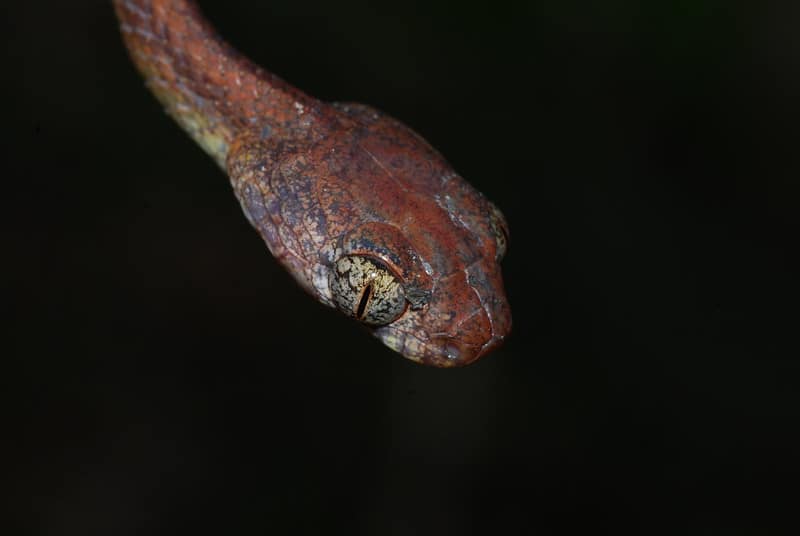
Maximum length: 2.1 metres.
The white-spotted catsnake (Boiga drapiezii) is a forest-dwelling species of southern Thailand, peninsular Malaysia, Singapore and Indonesia. It’s part of the 38-member Boiga catsnake genus, all of which are experts at navigating delicate tree branches, yet this species is particularly thin, with a particularly tiny neck.
Its large eyes are another cool feature, with a smorgasbord of rich forest colours. White-spotted catsnakes have rich orange and black patterns, overlaid with occasional white spots. These colours extend to their eyes with almost no break, surrounding the signature “cat-eyed” vertical pupil.
This species has such colourful eyes that it’s incredible they can see out of them. There’s blue-grey and brown, with subtle yellow tinges on the borders of each. If a human being visited hospital with eyes like this, the eye drop bill would be staggering.
White-spotted catsnakes are venomous, but rear-fanged, and must chew their victims repeatedly to make any headway. They require trees to survive, and are most common in lowland rainforests, below 1100 metres in altitude.
| 6 | Cloudy snail-eating snake |
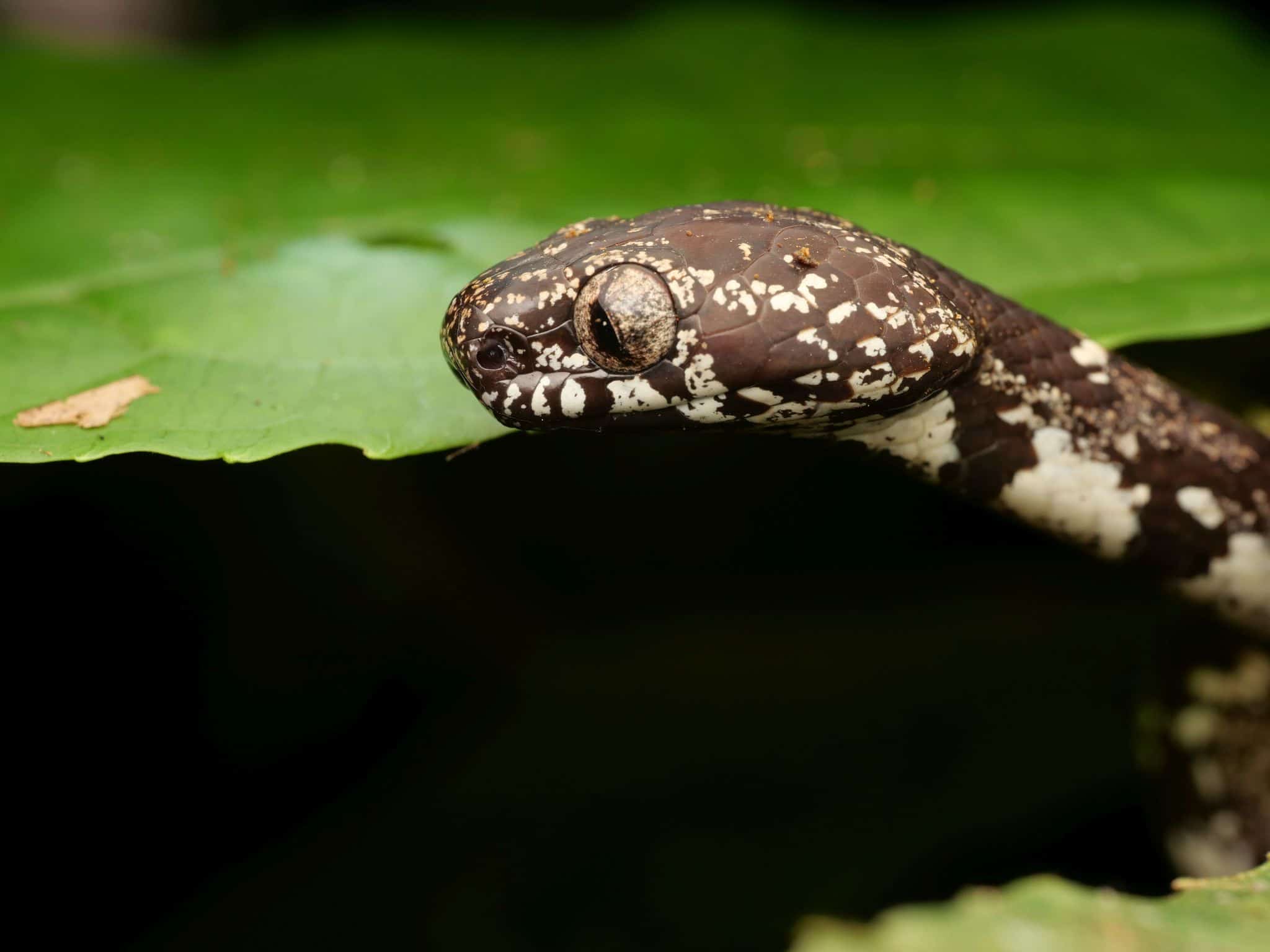
Maximum length: 101.3cm.
The Sibon snail-eaters of Central America aren’t particularly powerful. They’re thin-bodied, have no venom, and in a battle with a green anaconda, they would probably be swallowed whole. Yet they do boast two special features. The first is sucking a snail directly out of its shell, using special jaw movements. The second is some of the most fabulously detailed eyes of the snake kingdom.
Virtually all Sibon members have amazing eyes, and the cloudy snail eater (Sibon nebulatus) is no exception. This species lives in humid forests, and covers many countries, ranging from southern Mexico to western Ecuador. Snails comprise most of its diet, and its life is spent exploring branches in search of them, usually 1-3 metres above ground.
The massive size of this species’ eyes probably evolved to create super-enhanced snail vision. As for the massive detail, it’s probably related to camouflage, as cloudy snail eaters need to disguise themselves against not just birds, but the snails themselves. Cloudy snail eaters might look tiny to us, but to snails, they look huge, and they can’t allow their huge bulbous eyes to alert potential prey.
| 7 | Timber rattlesnake |
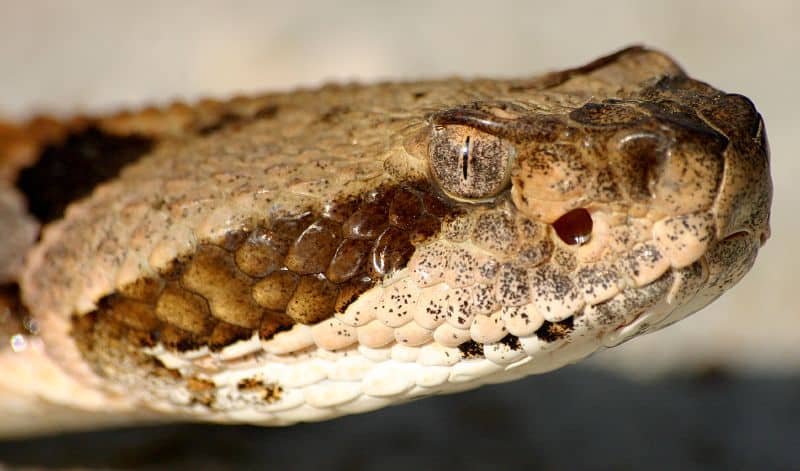
Maximum length: 189.2cm.
They are few people on Earth who have approached close enough to view a timber rattlesnake’s eyes in vivid detail (still living people anyway). The venom of this species causes haemorrhaging, and tears through living skin cells, while its menacing facial expressions have been terrifying Americans since the 1600s.
Technically, this isn’t the timber rattlesnake’s fault, as its brutal appearance is simply an evolutionary tactic designed to scare off predators. In reality, this rattlesnake is fairly docile, and thanks to the invention of the modern camera, we now know that it has highly detailed eyes.
These eyes are a mixture of parched orange and stone grey, largely reflecting its habitats, which are mainly spacious woodlands in the eastern US, with a thick coating of leaves. The timber rattlesnake’s eyes are framed by a viciously vertical pupil, which it would be far less intimidating without.
Timber rattlesnakes have incredible camouflage against a leafy forest floor, which these detailed eyes only add to. Their tongue, meanwhile, is an oily black.
| 8 | Common egg-eating snake |
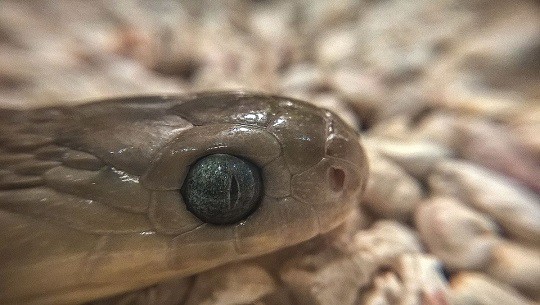
Maximum length: 116cm.
The common egg-eater (Dasypeltis scabra) is a species of South Africa, Zimbabwe and Botswana, which is completely harmless to humans. This species mainly preys on eggs, and to acquire them, it generally lives in areas with trees – never rainforests, but woodlands, sparser forests, and tangled tree clumps within savannahs.
Big eyes are another adaptive feature of this species, and these are extremely detailed up close. The exact colour varies – the individual above has blue eyes like the surface of a shimmering pool, while others have orange and crusty eyes. The body of this species is also variable, but not as richly coloured; mainly beige interspersed with brown blotches.
Among snakes, the Dasypeltis egg-eaters are renowned for the ease with which they find eggs. These snakes can find hidden egg stashes so effectively in the African countryside that it’s like they’re following a homing beacon.
Perhaps their massively detailed eyes provide a form of “egg vision”, where all eggs in the countryside suddenly start glowing. The less fun explanation is that they simply track massive accumulations of scent particles in nests, left behind by mother birds. Common egg-eaters have vertical pupils, as they’re mainly nocturnal hunters.
| 9 | Jararaca |
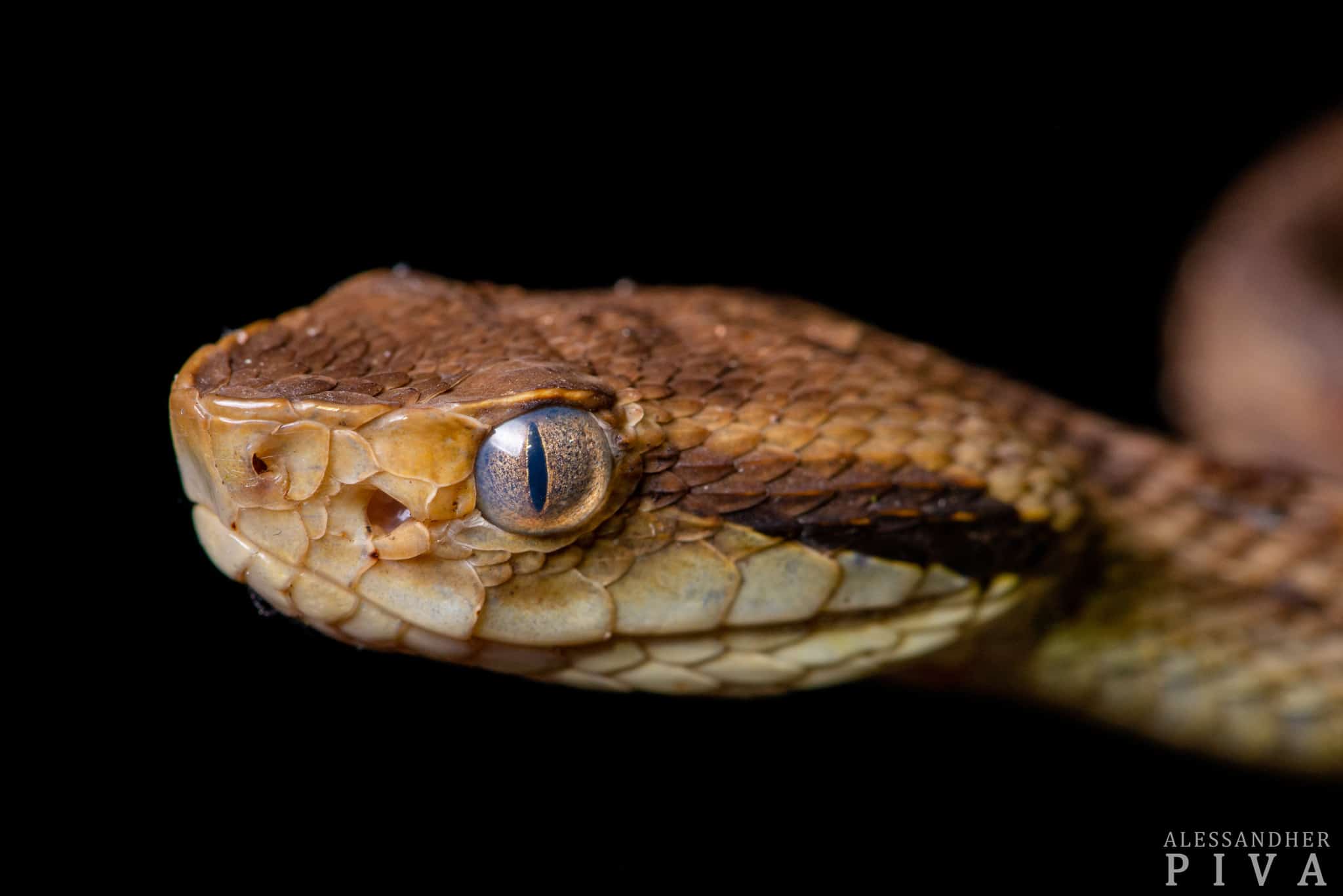
Maximum length: 160cm.
The jararaca is a dangerously venomous species of southeast Brazil, which appears in dark Atlantic forests, but also the bustling metropolis of São Paulo. This is a snake of many variable colours, as a large percentage are pale grey with dark brown stripes, while others possess yellow or green tinges. Its eyes vary, but are always fabulously detailed.
Jararacas also inhabit small areas of Paraguay and northern Argentina. At a distance, their eyes look basic and uninteresting, but up close, they gain many subtle details, like hints of deep sea blue. Their pupils are vertical, as this is mainly a nocturnal snake. Uses for a jararaca’s eyes include spotting its mostly mammal prey, as well as the looming mass of a human explorer drawing near.
This species is potentially lethal, but doesn’t default to attack, like a madman. One alternative move is to shake its tail furiously against a leafbed, to make a loud racket and scare people away.
Nevertheless, the best way to view a jararaca’s eyes is through a camera. This venomous snake has immensely accurate strikes, connecting with over 90% of targets according to a 2007 study.
| 10 | Collared catsnake |
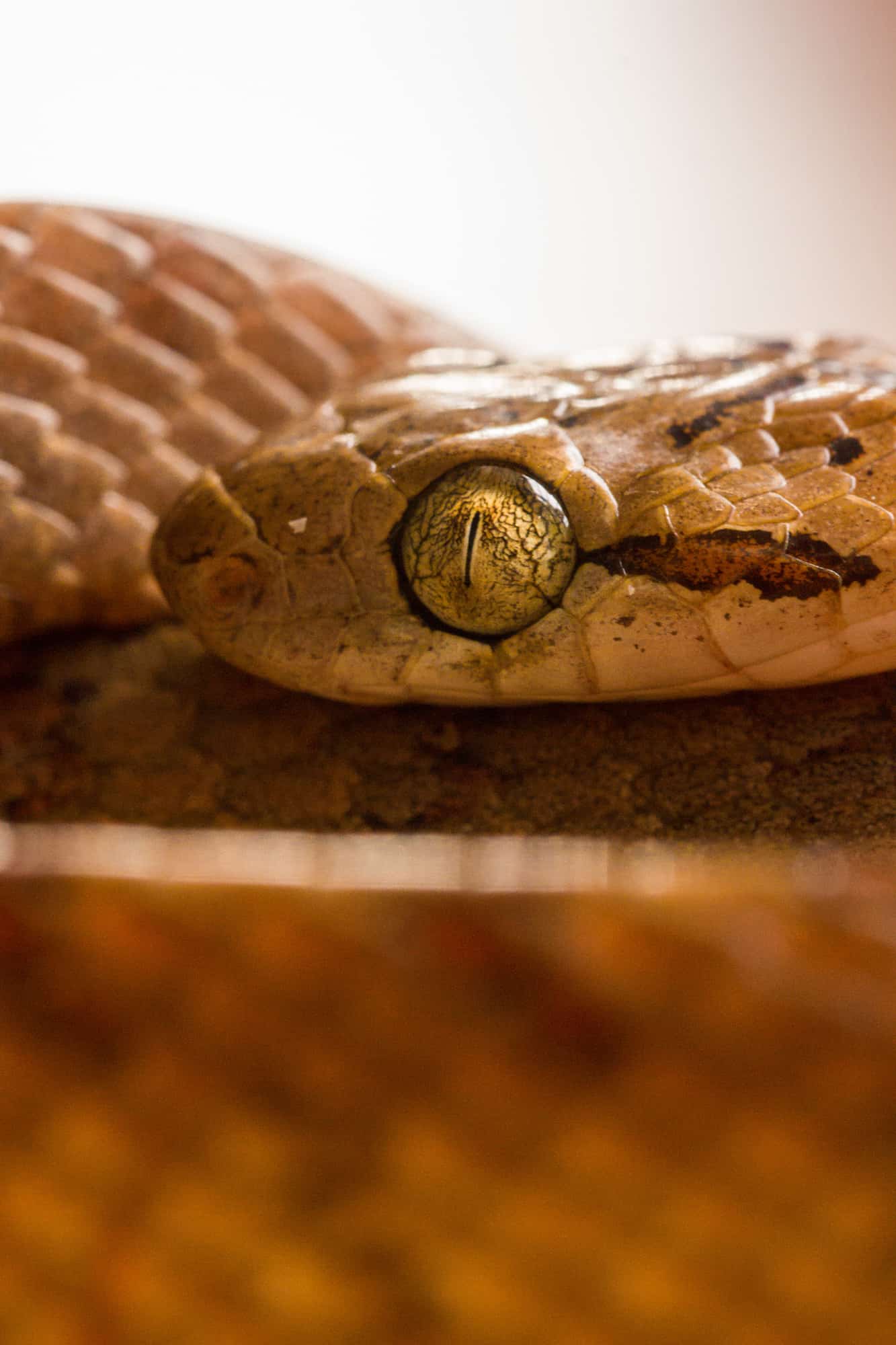
Maximum length: 120cm.
The most common catsnake in the Western Ghats mountains of southwestern India. The collared catsnake (Boiga nuchalis) has a mild venom, but poses little threat to humans, as it struggles to inject toxins due to its rear-fanged delivery system.
Collared catsnakes spend the vast majority of their time on tree branches. A yellow body overlaid with orange stripes is their calling card, but up close, their eyes are spectacular too. The yellow of their body is maintained in their eyes, but with black cracks, and in more sharply contrasting detail.
Collared catsnakes have many uses for these large eyes, such as fleeing from oncoming photographers, and capturing their favourite prey, the garden lizard. Their pupils, meanwhile, are sharply vertical, like all Boiga catsnake members.
Snake eyesight is generally a poorly researched subject. For example, we know that blind snakes have almost no vision, and we know that coachwhips have unusually sharp vision, yet there’s a big swathe of mystery inbetween. It’s perfectly possible that fabulously detailed eyes correlate positively with vision in snakes, including in species like the collared catsnake. For now, we can only guess.