
| 1 | A popular captive snake |

The western rainbow boa (Epicrates cenchria) is a large snake found in South America, which lacks any form of venom, and is medium in length, with a maximum size of just under 2 metres. It’s a widespread species, appearing all over the Amazon, and is a classic constrictor, engulfing its helpless prey (unless it dodges first) in an inescapable jail of coils before suffocating them to death.
Western rainbow boas are notable for two main reasons: 1) their intense iridescent shimmer, and 2) their popularity in the captive market. If you’ve wandered into your local reptile shop out of curiosity, there’s a high chance you’ve wandered past a western rainbow boa for sale, or perhaps its close relative the brown rainbow boa.
This species is not only sedentary, but easy to feed, as it has a highly flexible diet. Basic mammal meals such as rats or defrosted pinkie mice are acceptable; there’s no need to find more complex foodstuffs, making it a common beginner snake, joining the corn snake or boa constrictor.
Thousands of rainbow boas exist in captivity across the USA. This species is intermediate in aggression – not too vicious, but capable of delivering painful bites when agitated. Its other defensive techniques include creating a menacing S-coil, and coiling into a tight ball with its head in the centre (mainly witnessed in juveniles).
| 2 | Location: Amazon rainforest |
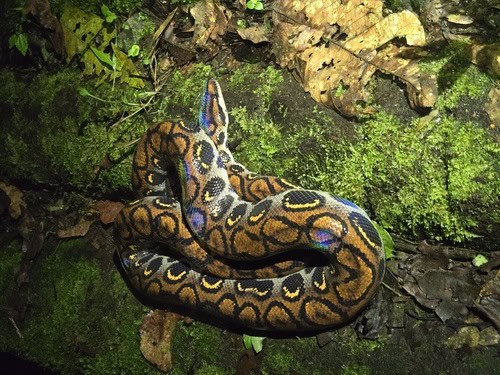
Western rainbow boas are found only in South America, not Central America. Their territory hugs the Amazon rainforest, but they also appear in the Atlantic forests of southeast Brazil, a separate ecosystem. You can find Epicrates cenchria in over 50% of Brazil, plus Bolivia, eastern Peru, eastern Ecuador, eastern Colombia, southern Venezuela, Suriname, Guyana and French Guiana. They don’t appear in Paraguay, Uruguay or Argentina to the south.
Western rainbow boas aren’t especially fast, like most boas. They move at a slow and steady crawl, and their camouflage isn’t ideal either. But they compensate by having an excellent instinct for dark hideaways where they can stash themselves. They lurk quietly in dark underground burrows, and in long overgrown vegetation. Their favourite location of all might be hollowed-out logs lying on the forest floor.
Another rainbow boa hideout is chambers at the bases of trees, perhaps within root clusters. One tree trunk chamber had 3 entrances, with maximum diameters of just 16cm, 20cm, and 22cm, about enough for a small human hand and wrist.
| 3 | One of 3 master boas |
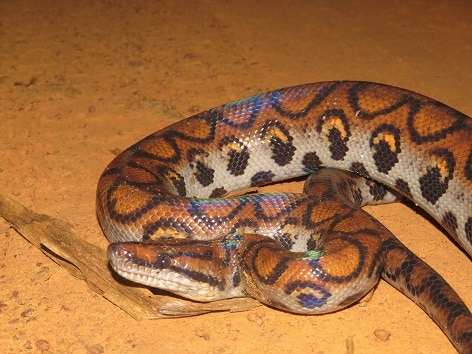
Rainbow boas belong to the Epicrates boa genus, with 5 members, and are only distantly related to the boa constrictor (Boa genus). In South America, this is the joint 2nd most widespread boa, alongside the Amazon tree boa, both beaten by the boa constrictor in 1st place.
These three are the dominant boas of South America, the most finely tuned evolutionary machines, which have confined all their relatives to narrower locations and taken over enormous swathes of territory. These super-boas overlap with each other in most of their empires… but how do they coexist?
It’s simple, as the Amazon tree boa is the most arboreal of the 3. It clings to branches most consistently, sometimes resting 25 metres high in the towering canopies on swaying upper branches. The boa constrictor in inbetween – comfortable on the ground, but with a strong tendency to climb trees to find birds, resting regularly on branches as an ambush perch.
Meanwhile, the western rainbow boa is the most terrestrial (ground-based) of the 3. It prefers the forest floor, climbing branches as a juvenile, but rarely ascending above 3 metres as an adult. This habitat segregation allows the 3 master boas of South America to coexist in the same locations without outcompeting each other.
| 4 | Prey: vampire bats |
The western rainbow boa has a cool claim to fame: the first snake ever recorded to hunt a bat in Ecuador.
Bat-hunting isn’t freakishly rare in snakes worldwide. Two of the top bat-hunters are the Cuban and Puerto Rican boas, which both dangle from cave roofs like stalactites and snatch up bats in their mouths as they fly from the caves in their thousands each night. The western rainbow boa’s observation was slightly different, as it hunted its meal from the ground.
The observation took place in 2016 in Cueva Castillo in eastern Ecuador. This is located near the city of Tena, an Amazonian city popular with western backpackers, due to its position in the heart of the rainforest. Cueva Castillo is a rich ecosystem, but actually lies just 60 metres from the main road, separated by patches of thick jungle. Hence, the scientists were able to enter the 450 metre long (so far) cave system, where they spotted a western rainbow boa in ambush position.
A common vampire bat flew into the cave, but was caught by the boa, positioned with its jaws 30-35cm above ground. It coiled around its prize, and squeezed for around 2 minutes.
| 5 | Acquires meals in dark caves |
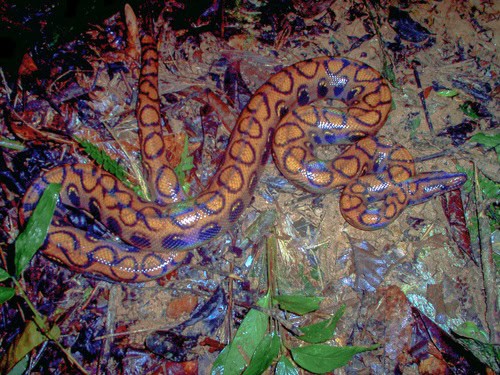
As the rainbow boa maintained its death grip, the vampire bat gave up the struggle. The rainbow boa was cautious, and didn’t relinquish its hold for 7 minutes. Then it began experimenting with different positions to get the huge bat down its throat.
One roadblock was the bat’s shoulder joints, which were particularly stiff. Finally, the rainbow boa began swallowing, which took only 4 minutes and 50 seconds. From start to finish, the predation took 25 minutes.
The rainbow boa measured 140cm, and the bat was one of the largest ever recorded as a snake meal. The species was the common vampire bat (Desmodus rotundus), found from Mexico to Argentina, one of 3 vampire bats in the world today.
This species has razor sharp teeth which are used to slash open victims, before drinking their blood as food. It feeds not on human but typically livestock blood, including horses and cattle (especially horses). Common vampire bats even have heat-sensing abilities which allow them to detect veins, the most fruitful blood sources. They can fly 5 miles from their home roost at night to find fresh blood. None of these powers protect them from the western rainbow boa.
| 6 | More bat meals |
Another bat-hunting observation took place in Pará state, far northern Brazil, in a cave called Canãa dos Carajás. The victim was a greater dog-like bat, which the western rainbow boa seized as it roosted. This time, the predation was far faster; the rainbow boa subdued and swallowed the bat meal in just 4 minutes.
Western rainbow boas hunting bats seems to be a common occurrence. They’ll stop at nothing to acquire these winged messengers of the night, as revealed by a third sighting in Pedra Branca cave, Sergipe state, eastern Brazil. This cave is 100 metres deep with an entrance just 0.63 metres high and 1.10 metres wide, tricky for a human to navigate but not a problem for a stealthy serpent.
The observation involved the constriction phase, as the rainbow boa was witnessed squeezing a Tomes’s sword-nosed bat for 4 minutes. During a later visit, a rainbow boa was observed by the cave’s entrance. Whether it was the same boa or a different individual wasn’t determined.
| 7 | How to recognise the western rainbow boa |
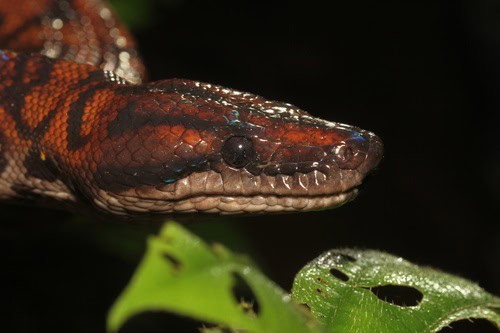
This species would be incredibly easy to recognise even if you could only observe its head. The western rainbow boa has an orange head, much like its body, but this is overlaid with five jet black lines. One lies on the upper jaw on each side, and another further up touching the upper eyes. The fifth stripe covers the top of the head, spreading to the neck, and contrasts vividly with the orange under-scales.
While various pitvipers have black stripes near the eyes (e.g. the lethal common lancehead), the western rainbow boa’s 5 black lines are unique, as is the sharp contrast with orange.
Beyond the head things get even easier, as the orange tone remains, contrasting against round circular patterns. The inner circle segment is still orange, but the border is black, contrasting sharply again. These rings are tightly packed, and resemble the patterns of no other Amazonian snake.
The belly of Epicrates cenchria is vivid as well, typically white, and always paler than the orange body. The black rings continue down the flanks, but gradually become smaller and tighter, before disappearing on the belly. The lower jaw is white as well. All this adds up to a serpent package which is unmistakable.
| 8 | More ID signs |
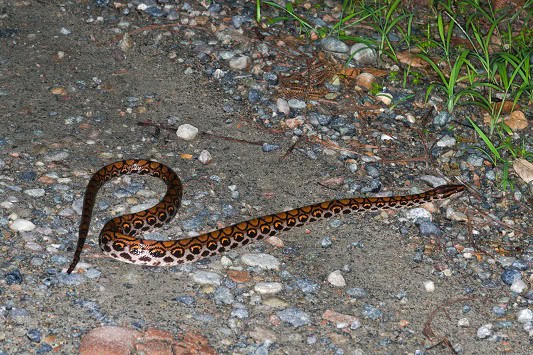
Another physical characteristic is a black tongue in adults, which you probably won’t get to see. Its tail is relatively short, but normal for a boa, at 10.0-15.2% of total body length. A species with a long tail in Brazil is the brown vine snake, at over 33% of total body length. The difference is habitat, as tree-dwelling species have proportionally longer tails (for balance), while ground-based species like the western rainbow boa veer shorter.
Western rainbow boas are slightly longer in females, with a maximum of 192.0cm versus 185.5cm in males. They’re much thicker-bodied than the Amazon tree boa they coexist with, again due to their lack of tree climbing. The highest western rainbow boas have ever reached is around 9 metres, but this is rare. Juveniles climb trees more often due to their lighter weight.
Another ID sign is a coppery brown iris, with the standard vertical pupils of boas. We haven’t even discussed the namesake iridescent sheen yet, and this rainbow shimmering is present in almost all individuals, and requires barely more than a torch beam to active. Boa constrictors lack a strong iridescent sheen, and other strongly iridescent snakes in Brazil like the big ground snake (Atractus major) are far smaller.
| 9 | Both nocturnal and diurnal |
Western rainbow boas have a massively varied diet in the wild, including spiny rats, and even chickens. Bird eggs have been recorded as well, and actual confirmed prey species include Tomes’s sword-nosed bat (Lonchorhina aurita), the greater dog-like bat (Peropteryx kappleri), and the southern Amazon red squirrel (Sciurus spadiceus).
Western rainbow boas aren’t ultra-sedentary, but they’re far from adventurous. They seem to stick to a comfortable forest zone, as one individual captured on January 26th 1992 had moved just 70 metres once it was recaptured on April 21st.
Although western rainbow boas mainly inhabit forests, they’re reasonably flexible, and can inhabit forest edges and disturbed forests altered by man. They’re also flexible about their daily activity, moving at night and during day under sunlight.
Like most boas, this species lays live young, which develop for 5-8 months before hatching within the mother’s body. They’re born at up to 50cm long, usually from December to March, and arrive in litters of up to 25.
| 10 | Porcupines and nest invasions |
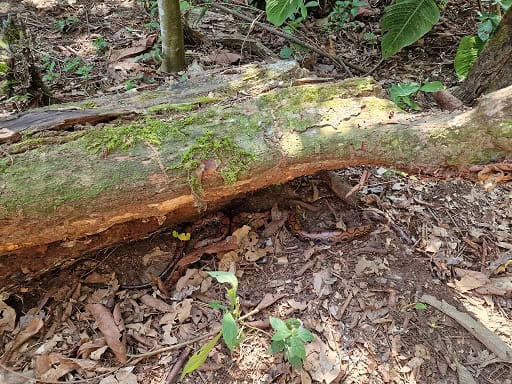
In March 2001, a researcher discovered a large western rainbow boa measuring 175cm crossing a trail in Minas Gerais state, southeast Brail. Inside its stomach was a sharp quill, proving that it had swallowed a porcupine. These can be risky meals for snakes; one infamous event occurred in 2015 when an African rock python swallowed a porcupine, tumbled off a ledge and was ripped apart from within.
Despite preferring the ground, the tantalising prospect of a feathery bird meal occasionally lures them upwards. In 2015, scientists were researching the fauna of a floodplain forest in Amazonas state, Brazil. At a fork in the water, they found a nest of a leaden antwren, perched in leaves 72cm above ground – well within rainbow boa range.
The date was May 14th, and the nest contained 2 chicks and 2 adults. It was a heartwarming scene. Unfortunately, the scientists returned 8 days later on May 22nd. The adults were still there, but replacing the nestlings was a western rainbow boa, coiled up comfortably in the nest.
No stomach examination was performed, but it wasn’t really needed. Western rainbow boas not only steal adult birds’ babies, but double the outrage by continuing to use the nest as a base.
| 11 | An occasional wrestling snake |
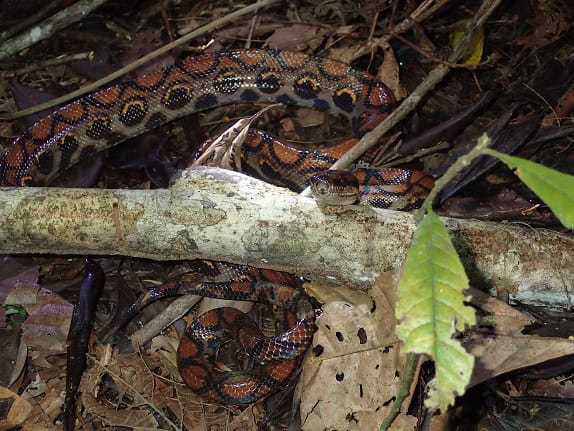
Western rainbow boas have prominent spurs on their lower bodies, the remnant vestiges of ancient hind limbs which haven’t fully disappeared. These are most common in boas and pythons; the carpet python of Australia is another species to possess them. Male western rainbow boas use their pointy spurs to woo females.
When two male rainbow boas meet, something different happens: they may start wrestling. Two males were observed in captivity intertwining their upper bodies, and forming a sharply vertical posture while in the presence of a female. After a few seconds, they released the posture, fell to the ground and slithered apart.
While brief, it was an unmistakable wrestling hold, similar to those in classic wrestling species like the California kingsnake and mulga (Australia). The boas didn’t wrestle again, but later, the 1st male (the larger one) began pushing the 2nd male around the enclosure floor. The eastern rainbow boa (Epicrates crassus) has also been observed to wrestle.
Rainbow boas also have semi-aquatic tendencies, as they’ve been witnessed submerging themselves in shallow pools of water, for mysterious reasons. They’re strong swimmers if necessary, crossing small rainforest streams with ease.
| 12 | The rainbow boa clan |
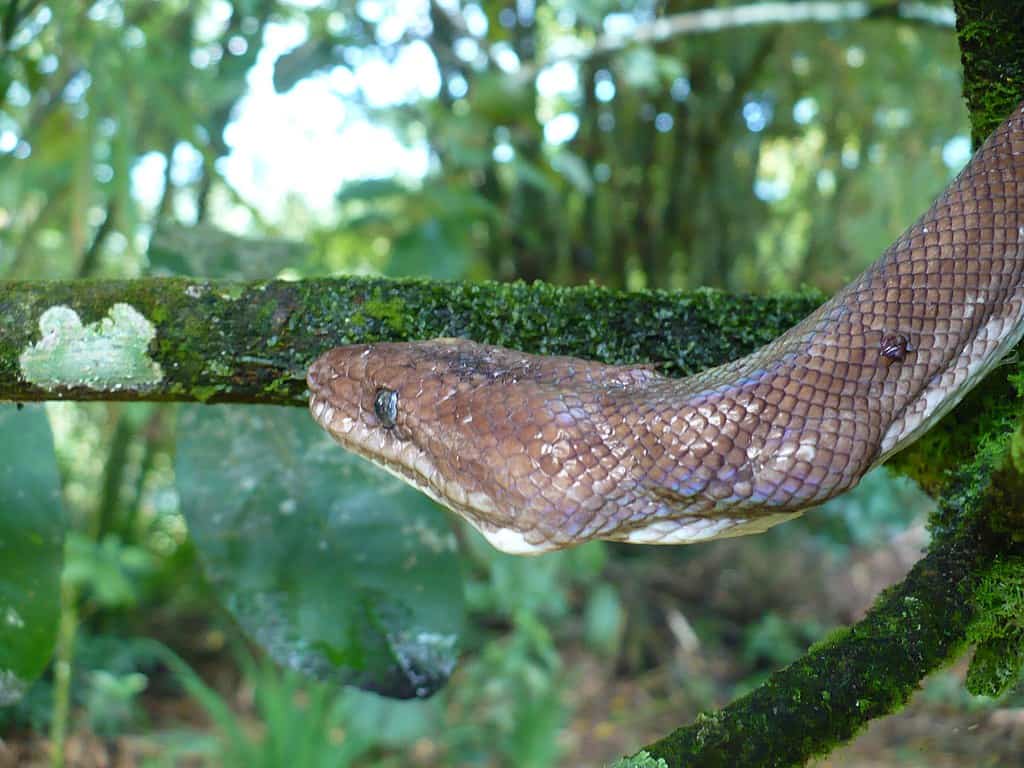
The rainbow boas number 5 in South America. Originally, the Caribbean boas were assigned to Epicrates, but genetic differences led to them being split into their own genus – Chilabothrus. The western rainbow boa is easily the most common, and overlaps with the other 4 in several locations. The other members are…
Brown rainbow boa – found in northern South America, including Suriname, Guyana, French Guiana and Colombia. Also the only member to appear in Central America (Costa Rica, Panama). The 2nd most widespread species, but much duller in colour, and therefore easy to distinguish, even if they overlap. Its patterns are more like fingerprint smudges than rings.
Campina Grande rainbow boa – this species is found in far eastern Brazil, including Paraíba state, the easternmost point in Brazil, and therefore the entire Americas. Has similar circular patterns to the western rainbow boa, but a browner base colour rather than bright orange.
Argentine rainbow boa – the most southerly species, replacing the western rainbow boa in Argentina, Paraguay and southern Bolivia. This species is brownish, not orange, and has a series of much smaller circles with sharply defined black borders. These circles sometimes merge at the spine.
Eastern rainbow boa – this species appears between the Amazon rainforest and Atlantic forests of southeast Brazil, which are both western rainbow boa heartlands. It occupies the drier cerrado savannah ecosystem, and is recognisable by messier circular blotches which converge into thin stripes along the neck flanks. Its body is a mixture of beige and light brown, and its facial stripes are far less vivid.