
| 1 | Feeble but common |
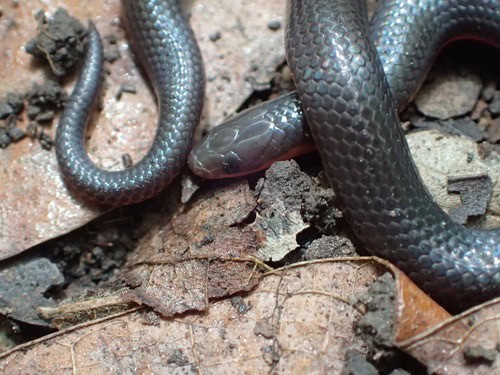
The eastern worm snake (Carphophis amoenus) is a tiny species of the eastern USA, which averages at 25-30cm and reaches a maximum size of just 34.2cm. It’s a completely harmless species, which closely resembles several neighbours like the rough earth snake, but belongs to the completely separate genus of Carphophis (2 members worldwide). This snake lacks any form of venom, or constriction powers.
Eastern worm snakes appear mainly in forests and woodlands, the more cluttered the better. If picked up, they have a few defensive techniques, including releasing a foul smelling liquid. One is “burrowing” in the palm of your hand, attempting to dive between your fingers. They sometimes press their sharp tail harmlessly against the palm of your hand, or thrash wildly, but bites are almost unheard of.
Despite being weak, the eastern worm snake is a highly successful life form. It’s dwarfed by several of its serpent neighbours, including the black racer (max 190.5cm) and pine snake (228.6cm), yet is actually much more common than the latter, with a shy, stealthy approach which enables it to exist out of sight from most Americans. Titanoboa went extinct 58 million years ago, yet the feeble eastern worm snake is here and thriving.
| 2 | Lurks under rotting forest matter |
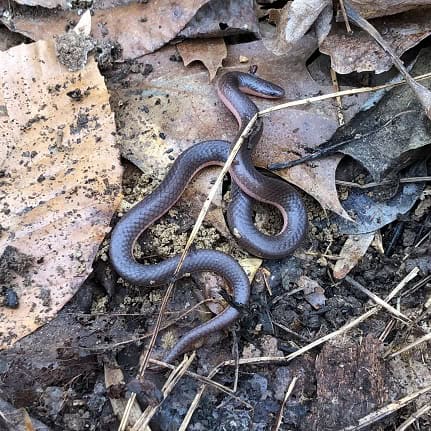
Eastern worm snakes are commonly mistaken for earthworms, partially because of their plain appearance, but also because they live in similar habitats. Compared to other soil snakes, the eastern worm snake is a poor burrower, with no ability to forge its own tunnels. It can shift aside loose mulch, but not excavate its own 6 metre long chambers like the pine snake.
Instead, the eastern worm snake lurks under assorted forest matter like leaves, twigs and detached tree bark. Most of its life is spent under shelter, rather than exposed to the elements. Occasionally, this species is found on roads next to forests, dead or alive.
This species sometimes gathers in groups of up to 5, lurking in hollow logs. But it’s mainly solitary in nature, except when males and females notice each other. Eastern worm snakes lay eggs rather than live young, in small clutches of up to 6.
Finding this species in grassland is rare, as it tends to avoid open areas. Cluttered forests with years or even decades worth of rotting fallen debris are its favourite habitat.
| 3 | ID: the pink underside |
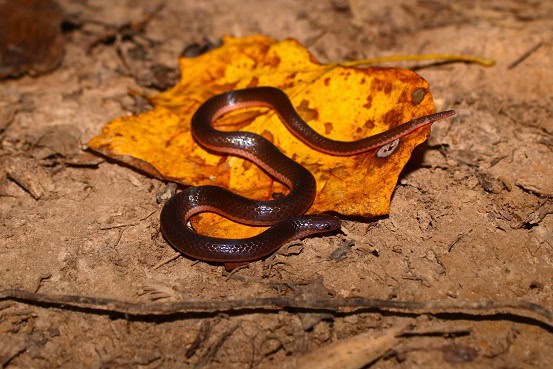
The eastern USA almost has too many shy woodland snakes to count. There’s several other non-venomous snakes Carphophis amoenus could be confused with, several of which lurk under old branches, twigs and leaves as well. The following three snakes inhabit the eastern USA, and also average at around 30cm…
Ring-necked snake – also appears in cluttered woodlands, including near swarming anthills. However, this species is easily distinguished by the namesake white neck ring.
Rough earth snake – more easily confused, due to its completely plain body. However, this snake tends to be bronzer, and has a creamy belly.
DeKay’s brown snake – this has the most patterned body of the three. It’s still a small brownish snake, but is covered with small black speckles as well, roughly arranged in broken parallel lines.
If all else fails, the best ID sign for the eastern worm snake is simple to remember. It’s a bright pink underside, which lacks any patterns. This vivid pink begins on the flanks and contrasts sharply with the brown body.
In Arlington, Virginia, an entirely pink individual was once found, but this is rare. Sometimes, worm snakes have whiter or orange underbellies, but there’s always a sharp contrast with the body.
| 4 | Earthworm meals |
The diet of this species consists of small grubs which it finds by rummaging around below mulchy forest matter. For example, one study found prey remains in 36 Carphophis amoenus, of which 61% were worms. Another study from George Washington National Forest found fly larvae and worms, and slugs, snails and salamanders are confirmed as well. Like most tiny, non-venomous snakes, and non-constricting snakes, its meals are swallowed alive.
Eastern worm snakes are experts at sucking earthworms from soil, using their narrow heads and pointed snouts to extract them. It’s likely that this snake prevents earthworm populations from exploding.
Feeding earthworms works for this species in captivity as well, although keepers have some odd observations. Rossi observed in a 1992 report that if an earthworm thrashes as Carphophis amoenus approaches, the snake will often give up on its meal. This species seems to prefer as little stress as possible.
| 5 | Correlates closely with ants |
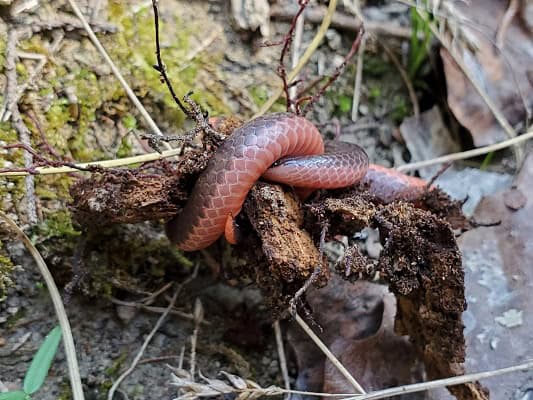
Various forest floor snakes have been documented using anthills as bases, including the ring-necked snake and smooth earth snake, both found in the eastern USA. However, the eastern worm snake may have the closest correlation of all. It seems to have a mutually beneficial relationship with ants, with the two coexisting peacefully without attacking each other.
A scientist analysed two forest locations: one in Anne Arundel County, Maryland and another in Fairfax County, Virginia. They tested coarse woody debris, a mixture of fallen twigs, shed bark and more.
The researcher found that ants and eastern worm snakes had a direct correlation. In areas of coarse woody debris where eastern worm snakes existed, ants were found 49.5% of the time. When eastern worm snakes were absent, ants appeared just 26.4% of the time. The two had a mysterious connection.
Eastern worm snakes were also observed following the lines of ant tunnels as escape routes. One theory was that appearing near ants makes up for their poor burrowing skills.
Strangely, there was an inverse correlation with earthworms in the coarse woody debris. One possibility is that their greedy presence had already reduced them. There was also no correlation with termites, only ants.
| 6 | Location: east of the Mississippi River |
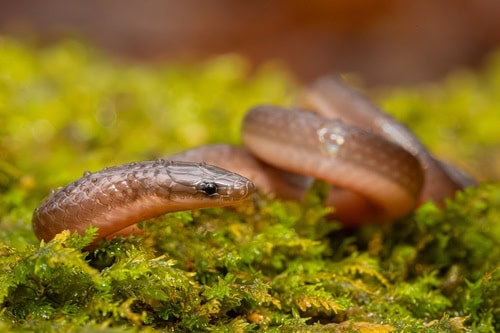
Eastern worm snakes are found across a gigantic swathe of the eastern USA, inhabiting 24 states overall. One state where they’re completely absent is Florida, avoiding even the panhandle, as they avoid the most tropical conditions. They only appear in northern Georgia as well.
However, on the eastern seaboard, they appear in southern South Carolina and don’t let up until Massachusetts. They avoid the far northeast as well, including Maine, New Hampshire and Vermont. Nor do eastern worm snakes have any presence in Canada, but in their heartlands like Mississippi, Kentucky, and Virginia, they can be dense in population.
To find the eastern worm snake’s westerly border, you just need to check the Mississippi River. As a small, shy rummaging snake, with no aquatic tendencies or exceptional muscular strength, the eastern worm snake lacked the ability to cross this natural border in ancient times, and so it remains today. Watersnakes can manage it, even a nimble coachwhip could cross the rapid waters, but eastern worm snakes remain stuck to the east. One exception is Arkansas, where they have a small colony to the west somehow.
| 7 | Many dangers in the wild |
As a 30cm species with no offensive weapons, the eastern worm snake has various predators, including other snakes. The subject of our tale was one of the greediest black racers ever encountered by researchers.
The black racer is the most widespread snake in the USA alongside the common garter snake, a non-venomous yet fast and agile species which simply grabs its prey in a loose coil and forces them down its throat. It eats a flexible diet, and this black racer was only a youngling, discovered dead on a road in Rutherford County, in March 2012. The snake’s stomach contained 3 fellow snakes: a common garter snake, a northern watersnake and an eastern worm snake.
Apparently this black racer was a master hunter, a bogeyman for the local snakes, despite only being young. Its rampage of destruction was only stopped under the screeching tyres of a car.
Other predators of the eastern worm snake include the copperhead, an infamous venomous snake, and numerous birds, including barn owls, American thrushes and robins. Even toads have been reported as predators.
| 8 | Prefers dry forests to damp areas |
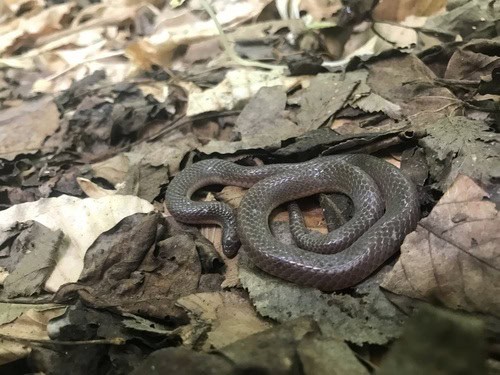
The ring-necked snake and eastern worm snake are both shy woodland dwellers which are extremely common in the eastern USA. One has a neck ring, the other doesn’t, but how do they coexist in peace?
Scientists explored forests in North Carolina from 1999-2002, attempting to detect 5 small species in Mecklenburg County and Iredell County. They recorded 116 eastern worm snakes and 44 ring-necked snakes, outstripping DeKay’s brown snake (24), the redbelly snake (20) and smooth earth snake (6).
Firstly, this shows that eastern worm snakes can be highly abundant in certain spots, outbreeding their neighbours. However, more interesting was the habitat differences. The ring-necked snake was most common in damp forest near a stream floodplain. Meanwhile, the eastern worm snake was more abundant in dry upland forests, 150 metres away from the nearest stream. The two existed in the same rough area, but were naturally segregating themselves.
Eastern worm snakes were particularly common on rights of way near power lines. Meanwhile, DeKay’s brown snake was the most likely to appear in human-disturbed zones.
| 9 | A non-adventurous snake |
The scientists also recorded the month of detection of all 5 snakes. For both the eastern worm snake and ring-necked snake, September was overwhelmingly the most common month for sightings. In second for the worm snake was October, and April, May, June, and July also had plenty of sightings. However, none came close to September’s explosion of activity.
The researchers noticed something else too; that males accounted for this population explosion. The logical theory was that the sudden influx of hyperactive worm snakes were males searching for female partners. September is the month to search for an eastern worm snake in your local forest, if the urge strikes.
The scientists discussed the home range of the species as well. The eastern worm snake has a home range of 253 metres², according to a separate study conducted in Kentucky. But the ring-necked snake’s was far larger, reaching 6476m² according to a study from Kansas, despite its similar size of 30-40cm. Eastern worm snakes would much rather stay put in their cosy, familiar corner of the forest if given the chance.
| 10 | Snowy white eggs |
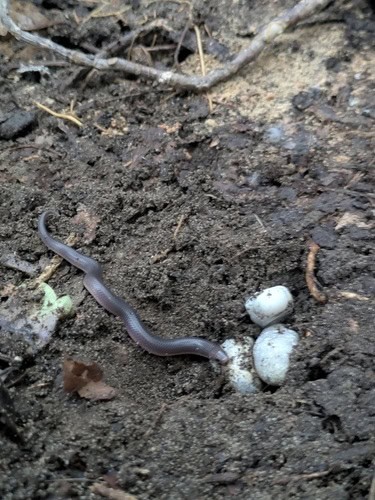
The study also recorded 8 egg clutches, among the 116 eastern worm snakes analysed overall. The sizes were two batches of 3, four batches of 4, and two batches of 5. Females are longer than males on average, although the body shape was identical in males and females.
Like all snakes, Carphophis amoenus lays its eggs in secret locations, away from the keen eyes of predators. Confirmed spots include rotting logs, hollows under rocks, and in manmade locations like old sawdust piles. The eggs are elongated, and white in shape, but much rougher-looking than the shiny smoothness of a chicken egg. The eggs above were found in the ring of an old campfire.
Eastern worm snakes are mostly slow and steady snakes. However, they’re capable of bursts of activity, with one individual moving 45 metres in 14.5 hours in a study from 1969.
Their densities vary too. One herpetologist managed to collect 108 in just an hour on one sunny afternoon, on a hillside overlooking the Kansas River. Eastern worm snakes are diurnal, and have been found to move most during late afternoon and early evening.