
| 1 | Non-venomous but irritable |
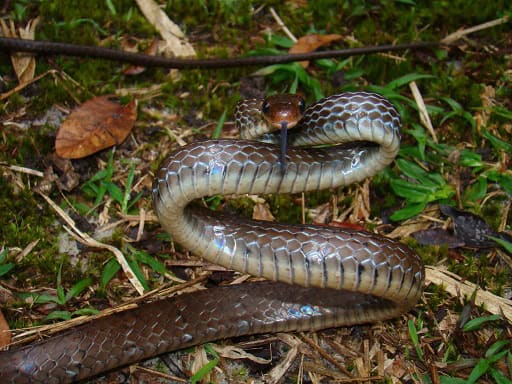
The brown sipo (Chironius fuscus) is a non-venomous snake found in Brazil and many other South American countries, which lacks any form of venom, but still has an aggressive personality if pushed. This is a very common species, appearing in virtually the entire Amazon region of South America, where it splits its time between the forest floor and tree branches roughly 1-3 metres in height.
Brown sipos are medium in length, with an all-time record of 151.4cm in females and 159.7cm in males. While most of your focus in the Amazon should be on avoiding lanceheads and coral snakes, this is still a species you’d be wise not to disturb.
Brown sipos have various defensive methods, including making aggressive mock strikes, real strikes, releasing a disgusting snake smell, vibrating their tail, and forming a menacing S-coil. They’re fast-moving and agile, and have the agility to strike before you can dodge.
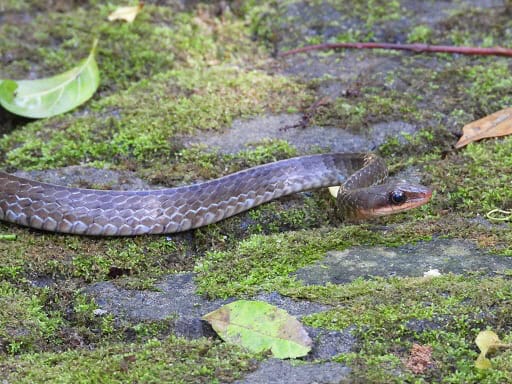
This is mainly a frog-eating species, and dull in colour, with typically brown scales. Juveniles have widely spaced bands on their bodies, but these fade with age, usually as the snake reaches 40cm in length. Adult brown sipos are plain and dull, but there’s a point to this, as these colours blend easily with loose twigs on the forest floor.
| 2 | Forests and possibly banana plantations |
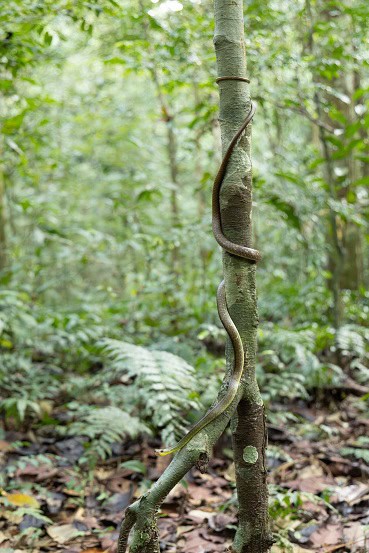
Brown sipos appear in primary, untouched forests, but also the edges of forests where large piles of timber are stacked in logs, or regenerating manmade forests. They can appear in villages, and even near banana plantations. Brown sipos are diurnal rather than nocturnal, sleeping on low branches at night.
This snake is found in eastern Peru, eastern Ecuador, eastern Colombia, Suriname, French Guiana, Guyana, Venezuela and northern Bolivia. It has no presence in Argentina, Uruguay and Paraguay, Chile, or Trinidad and Tobago.
Within Brazil, this species appears only in forested regions. It’s abundant in the Amazon rainforest, before a gap appears where the drier cerrado savannah biome lies in central Brazil. Then in the Atlantic forests of southeast Brazil, the brown sipo reappears, with a gap of several hundred miles from the Amazon colonies to the northwest. This is a common snake near São Paulo and Rio de Janeiro, but also the Amazonian city of Manaus, and the forested slopes of the Andes in eastern Ecuador.
| 3 | Diet: endless frog species |
Most animals have a key role in the ecosystem which might not be apparent, but would be very noticeable if you removed them. For example, caimans are needed in Brazil to prevent fish from clogging rivers, while blind snakes are necessary to control ants. The brown sipo has its own ecological role: preventing frog populations from exploding, and covering the whole of Brazil in a ceaseless chorus of croaking and ribbiting.
The brown sipo derives virtually all of its meals from amphibians, and frogs specifically rather than toads or salamanders. A 2013 study found 120 brown sipos in museum storage and analysed their stomach contents. This yielded 49 meals, and the result was 95.9% frogs and toads (47 meals). The exceptions were two lizards, one being a Trinidad gecko.
The brown sipo has one of the longest lists of confirmed frog prey in South America. Its known meals include veined tree frogs, rusty tree frogs, slender-legged tree frogs, Peter’s jungle frogs, basin white-lipped frogs, many-banded tree frogs, whistling grass frogs and Steindachner’s grass frogs.
| 4 | Hides comfortably in anthills |
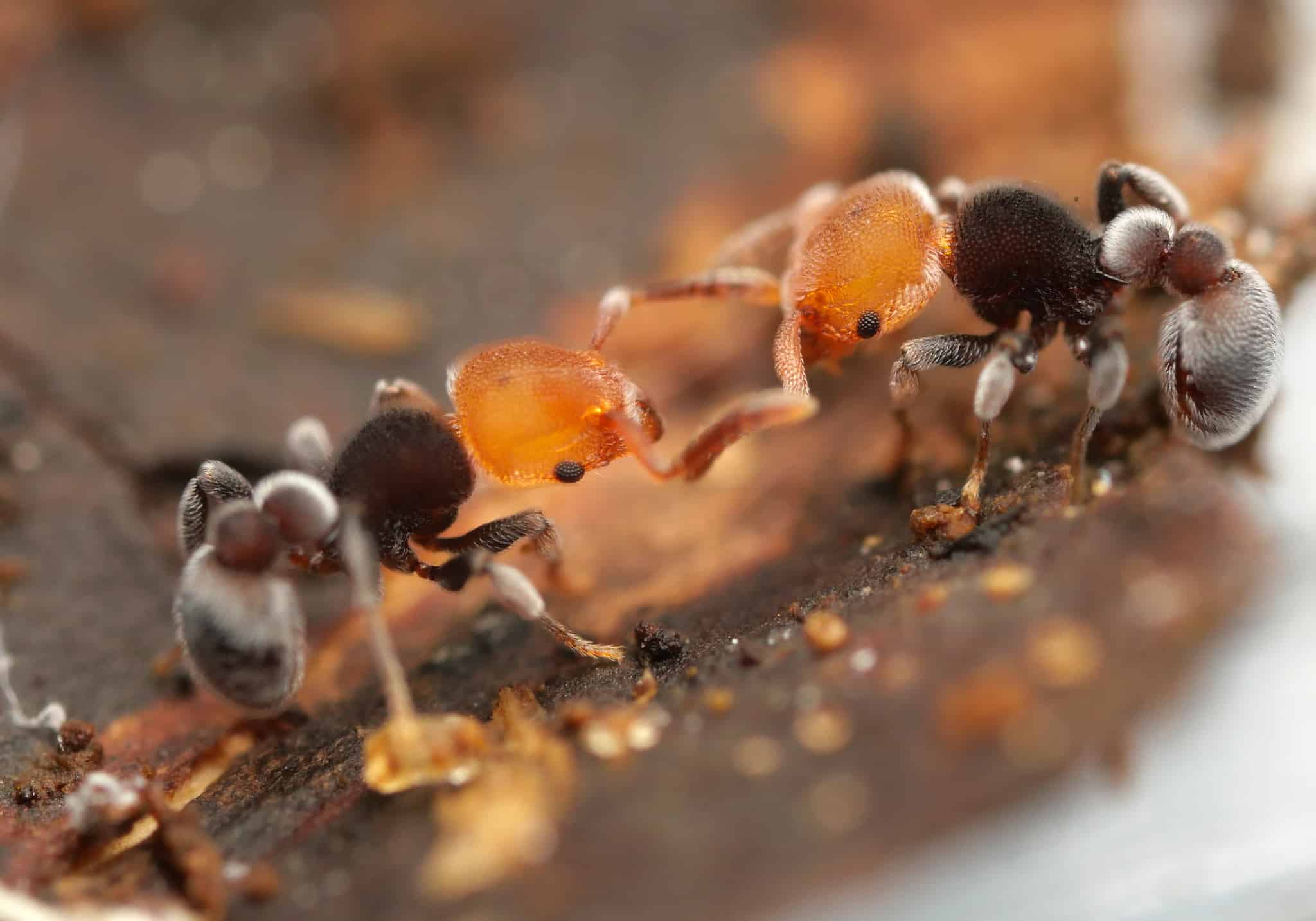
Ants and snakes are two worlds which are generally separate, but occasionally collide. Brongersma’s worm snake of Brazil feeds heavily on ants, but the brown sipo has occasionally been found stashed harmlessly inside swarming ant colonies, to the concern of neither.
The sightings were made in 2006, in Madre de Dios in southeastern Peru, near a biological research station. Researchers found a leafcutter ant nest 2 metres from a cliff and 2 metres from the forest. Leafcutter ants are relatively advanced ants, as they often build nests containing fungi, which they use as food, by dragging in certain forest substrates.
This anthill was shaded by vegetation, and larger than average, although they couldn’t accurately measure it due to its proximity to the cliff. But more interesting was a brown sipo found stashed inside the nest. The sipo was calm, and not moving. The ants not only didn’t attack the sipo, they moved calmly over its back while performing their worker duties.
This peaceful coexistence was observed on 3 separate occasions, in July, September and October 2006. Each time, the sipo measured 1.2 metres, and could have been the same snake, although it wasn’t proven. The strange thing was that with each observation, the snake was gone the next morning.
Brown sipos have never been recorded to eat ants, or insects in general. Frogs form virtually all of their diet, and some frogs eat ants heavily, so it’s possible that the brown sipo was benefitting the ant colony, and they therefore tolerated its presence.
| 5 | Versus an inflatable frog |
Brown sipos possess agility, speed, and accurate strikes. They lack venom, but these skills are enough to get them over the finishing line… unless the frog decides to inflate.
A detailed hunting report came from southeastern Peru in April 2019. An adult brown sipo was found attempting to swallow a rusty treefrog (Hypsiboas boans), a very common species. The scientists located the duelling pair using a loud distress call emitted by the frog, and the sipo already had its jaws wrapped around the slimy amphibian. The upper half of the frog’s body was in its mouth, and its prospects seemed black. However, the frog used one of its ancient weapons: inflating its body. It simultaneously began hopping, while still producing the distress call.
Combined with the newly inflated bulk, this proved too much for the brown sipo. After 1 minute, 40 seconds of observations, the frog loosened itself and hopped away. It had a severe laceration to its underside and ripped skin on its forearm, but it was alive.
The sipo fled into the vegetation, while the frog ended up in a ditch. The report proved that brown sipos aren’t infallible, and must fight for every meal.
| 6 | Versus a frog with toxic skin |
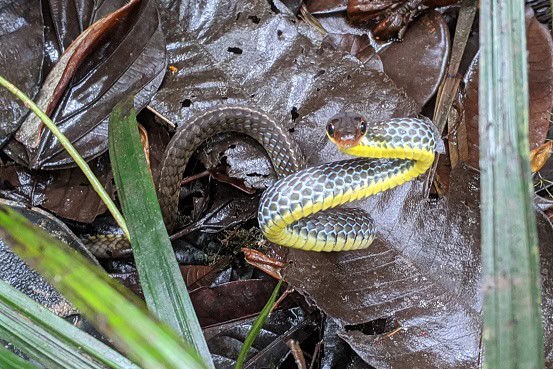
At the same time, brown sipos are hardy hunters which have endured for millions of years. Another tale from July 2013 showed how they resist some of the funkiest, most toxic amphibian survival strategies. The frog in question was the veined tree frog, AKA Trachycephalus typhonius, a common species which produces a toxic secretion from its skin, which is highly irritating to the skin and mucous membranes of anyone touching it.
The brown sipo approached the frog in a forest fragment in Amapá state, far northern Brazil. The frog initially tried to hop away, but the agile sipo caught it in its jaws. The frog responded by releasing its irritating secretion. The predator’s mouth (a mucous membrane) should have been badly inflamed, but the sipo didn’t relinquish its grip. The frog’s plan failed, and it was swallowed within 30 minutes.
The frog had also issued several loud distress calls, which failed to summon in any frog reinforcements. After swallowing was complete, the scientists inspected the sipo, and found no visible effects from the white secretion. It’s possible that brown sipos are so attuned to frog meals that they’ve developed resistance to this toxic liquid.
| 7 | A starving snake |
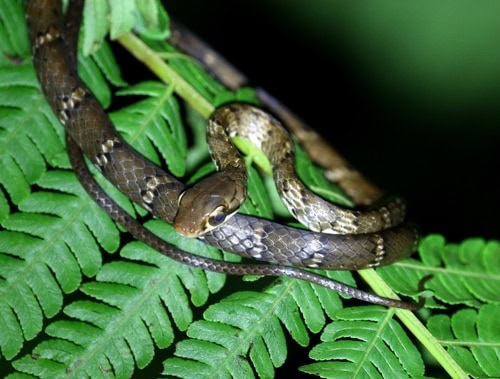
Anacondas lying by river shores digesting caimans isn’t an uncommon sight in Colombia or Brazil. Sometimes they can spend weeks digesting, releasing so many calories from its scaly body that they don’t require another meal for an entire year. But the brown sipo is the exact opposite of this – a starving snake, as proven by a 2021 study.
This study compared 5 sipo species – the brown sipo, plus the coastal sipo, two-headed sipo, Linnaeus’s sipo, and Brazilian sipo. It found that an extremely low percentage of snakes had food in their stomachs at any given time. For example, 95 brown sipos were analysed in this study, and just 5.3% had meals in their bellies.
This was the 2nd lowest of the five, as only 5.1% of the two-headed sipos contained prey. The highest was the Linnaeus’s sipo at 13.8%, but this was still very low.
Rather than digesting one huge meal over time, the brown sipo has a high metabolism. It’s a fast, speedy snake which is always moving onto the next hunt, with little patience, digesting meals relatively quickly, and sometimes struggling to find the next one. Its meals tend to be relatively small rather than show-stopping, stomach-bursting feasts.
| 8 | Sleeps on branches, hunts on the ground |
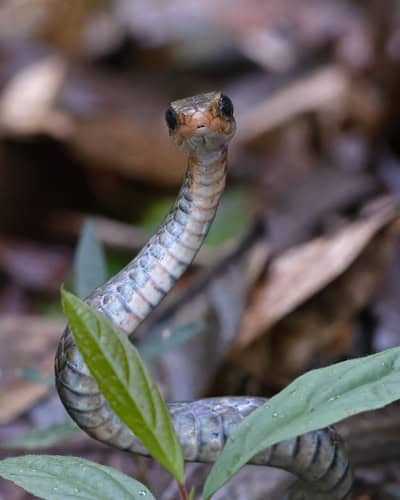
The same study revealed differences in habitat as well. All 5 sipos were analysed in the Atlantic forests of southeast Brazil, near São Paulo and Rio de Janeiro.
These forests are a fully separate ecosystem to the Amazon further northwest, separated by cerrado savanna. The Atlantic forests have less legal protection than the Amazon, and vast swathes have been slashed down. Nevertheless, large areas remain, which are ecological havens containing dangerous snakes like the jararacussu and Atlantic forest bushmaster.
The sipos, meanwhile, are part of the non-lethal snake fauna, but how do they coexist without outcompeting each other? The scientists revealed habitat differences between the 5 species: the brown sipo spent far more of its active hours on the ground (87.2%). This was similar to the coastal sipo (Chironius foveatus), at 81.8% of active observations. Meanwhile, Linnaeus’s sipo (Chironius exoletus) was the most arboreal, spending 40% of its time on vegetation when active.
When taking into account all observations, including non-active observations, there was a big difference – the brown sipo was observed on branches 31.0% of the time. When active, the total was just 12.8%. This is because of its tendency to sleep on branches at night, before dropping to the ground the next morning to begin its never-ending frog quest.
| 9 | Avoids higher branches |
South America is full of high-climbing species like the Amazon tree boa, which reaches 25 metres in the crowns of trees. Then there’s anacondas, which almost never climb trees. The brown sipo is somewhere in the middle – it ascends branches and bushes, but rarely reaches the upper canopies.
The study from southeast Brazil discovered clear differences between the 5 species. The highest climbing was the coastal sipo, which reached 16 metres above ground. Meanwhile, the brown sipo was less bold, with a maximum height of just 3.25 metres.
Another coastal sipo individual climbed to 14.7 metres, whereas Linnaeus’s sipo was intermediate at up to 5.87 metres. These close relatives coexist by occupying different levels of the forest.
The brown sipo has a survival strategy related to trees as well. When it sleeps at night, it retains some sense of awareness, as when spooked, brown sipos instantly drop from their branches onto the safer forest floor below.
| 10 | Secret ID signs |
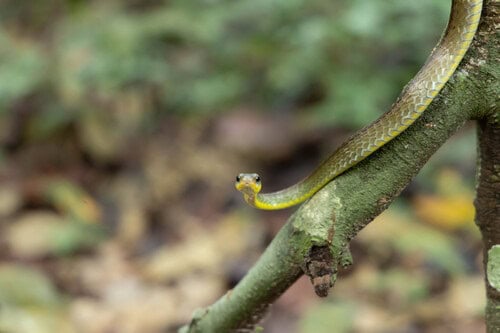
The brown sipo has another sneaky survival tactic as well: an underside which is much brighter than its brownish back. This aids in camouflage, taking advantage of the simple fact that the upper layers of forests are brighter and the leafy floor is darker. This camouflage comes into effect while the species sleeps at night.
Another ID sign is a sharp ridge down the spine. Brown sipos have large round eyes, with round pupils rather than vertical, like most diurnal (day-faring) snakes. They’re thin-bodied rather than thick, to aid with their agile, energetic nature.
The colour of this species varies significantly, with the caveat that the underside is always paler (darkening towards the tail). Brown sipos can be rich brown, tree bark grey or greenish.
One of this species’ rarer tendencies is inflating its own throat, as a defensive measure, to make itself look larger. Brown sipos expand their chest outwards rather than sideways like a cobra, puffing themselves up aggressively. This makes the white skin between their scales visible.
| 11 | Males exceed females |
Brown sipos have at least one confirmed predator in the wild: the laughing falcon, one of the most notorious snake-eating birds of the Americas. This species was named for its maniacal-sounding call, and is also known to prey on coral snakes, flame snakes and Aesculapian false coral snakes. The brown sipo has a nightmarish bogeyman to contend with, as this bird tends to decapitate its snake prey before flying off with the tasty body.
Brown sipos lay eggs, and in relatively small numbers. The maximum known is 11, while the 2013 diet study recorded a maximum of 6.
That study also measured physical characteristics, and found that males were longer than females, although females had a longer tail. A reason was speculated to be male wrestling. There’s 23 members of the Chironius genus overall, and although never observed in the brown sipo, several members like the machete savane (Chironius carinatus) are known to wrestle aggressively to secure female affections.
Generally, larger males win these wrestling contests, resulting in a trend towards larger male size. Consequently, the Chironius genus is a rare snake group where males consistently outstrip females for size. Anacondas are the opposite, as females dwarf males.