
| 1 | Steppe ratsnake |
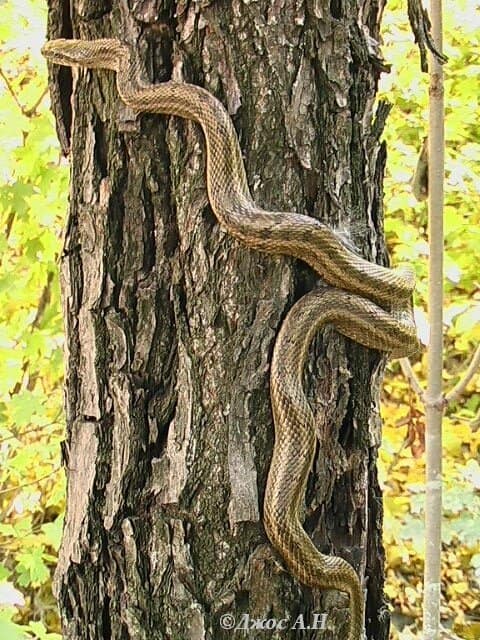
Maximum length: 160cm.
Part of the widespread Elaphe ratsnake genus, which has 18 members around the world, all of which are non-venomous. The steppe ratsnake (Elaphe dione) has the largest territory of all, despite few Westerners knowing its name. It occupies a colossal swathe of Eurasia, favouring hillsides, grasslands, steppe, sparse woodlands and traditional villages.
The empire of this species begins in southern Ukraine, and continues all the way to South Korea, without quite reaching Japan (where the Japanese ratsnake has entrenched itself). Steppe ratsnakes mainly prey on mammals and are unusually skillful at avoiding bird predators. They effortlessly vanish into dark holes or rock cracks, and are comfortable around human beings.
There’s a simple reason behind the steppe ratsnake’s dominance: its preference for rugged open landscapes. If this was a strict forest snake, facing pressure on all sides as its home was slashed down, it would struggle to find a corridor to migrate through. Instead, the steppe ratnake has a wide open horizon to explore, particularly the desolate realms of Kazakhstan and southern Russia. Like humans, ancient steppe ratsnakes were probably intrigued by the glimpses of distant hillsides, wondering what could be beyond them.
| 2 | Yellow-bellied sea snake |
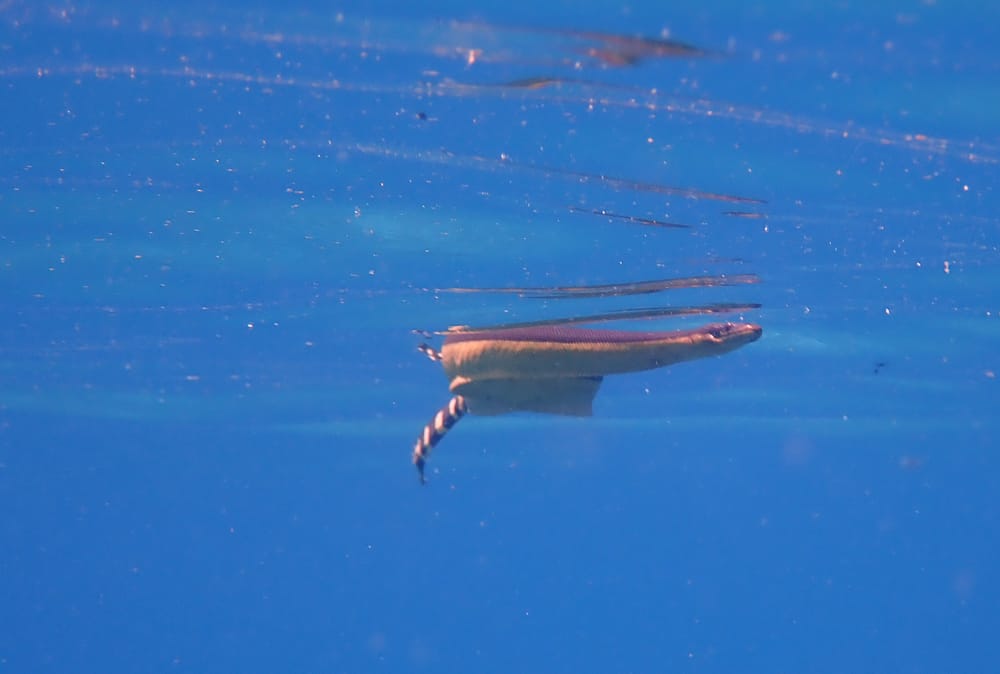
Maximum length: 113cm.
The yellow-bellied sea snake is a species of the open seas, with nothing visible but waves for miles around. This species doesn’t require land to survive, and even finding one in a coral reef is rare. It prefers to float aimlessly in sea currents, amidst lashing rain and storms, and this extreme lifestyle has given it the widest empire of any sea snake.
Yellow-bellied sea snakes are centred around the waters of Australia and southeast Asia, but are also found along eastern and southern Africa. This is the only sea snake to inhabit the Atlantic Ocean, just curling around the southwestern corner of South Africa, before being blocked by strong ocean currents near Namibia. 12,000km away, it’s abundant along the Costa Rican coast, and has even frightened laid-back Californian surfers occasionally.
With the entire ocean surface their playground, yellow-bellied sea snakes have no barriers to conquest except temperature. Their optimum is 25-30C, and at below 20C, most bodily functions grind to a halt. This is a fish-munching snake, which waits at the ocean surface motionless, until curious fish investigate the dark shadows.
| 3 | Puff adder |
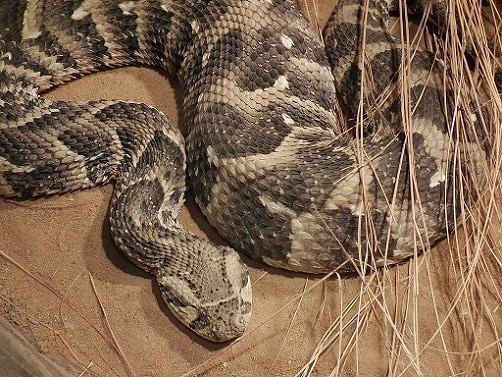
Maximum length: 191cm.
For thousands of years, this snake has been planning, plotting, scheming to cross the Sahara Desert, but has never quite managed it. Instead, the puff adder must be content with occupying virtually every country of sub-Saharan Africa, from tiny Togo to sprawling DRC.
The westernmost point of the puff adder’s territory lies in Gambia, adjacent to the Atlantic Ocean, close to Guinea and Senegal. To the east, it occupies Ethiopia and Somalia, adjacent to the Pacific Ocean, followed by a further 25-30 countries.
To top it off, puff adders have a colony in Saudi Arabia and Yemen, originating from tectonic movements 20 million years ago which ripped open the Red Sea. The only area they inhabit north of the Sahara is a small pocket in Morocco, probably a remnant from when the climate was cooler.
The puff adder’s range spans over 4000 miles from east to west, and the main reason for this success is habitat flexibility. Puff adders can happily inhabit savannah, forest, marshland, grassland and village outskirts with no worries, with only true deserts and rainforests being problematic.
This is a lazy species which doesn’t move for days, lying in ambush. The conquest of Africa probably happened slowly yet surely, gaining a few dozen miles each millennium, until before the local zebras and lions realised, puff adders controlled the entire continent. This species is powerfully venomous, and primarily unleashes skin tissue destruction.
| 4 | Grass snake |
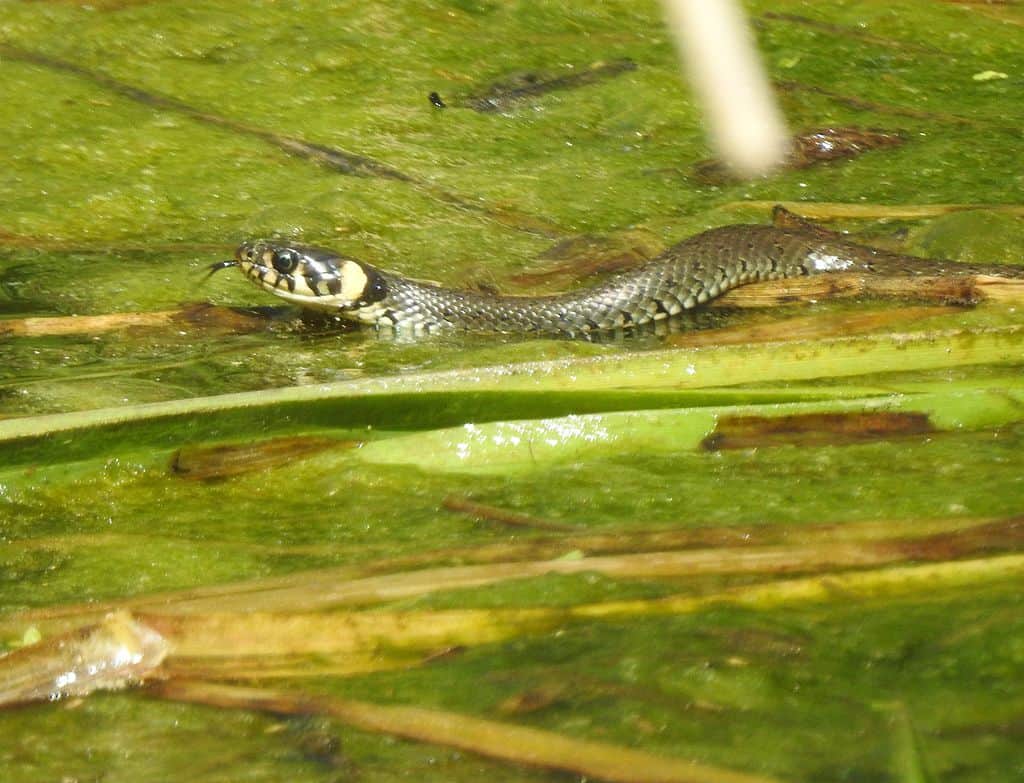
Maximum length: 205cm.
The ubiquitous harmless snake of the European countryside, a dweller of scenic ponds overflowing with tadpoles, lilypads and reeds. This species is non-venomous, and preys heavily on frogs, with the occasional mammal and fish.
The grass snake is actually slightly less common than it used to be. In 2017, genetic analysis revealed that it was two species hiding in one. Those in the UK, France and Italy were actually a distinct species, which was dubbed the barred grass snake (Natrix helvetica), while everywhere to the east kept the basic old title of grass snake (Natrix natrix). This division caused the main version to lose territory, yet it still remains one of the most widespread species in the world.
To the west, grass snakes cover all of Germany, Denmark, southern Norway and Sweden. To the east, they reach as far as Kazakhstan, central southern Russia, and perhaps Mongolia.
Grass snakes rear their humble green heads in Berlin, Vienna, Ukraine, and Ankara alike. Many superstitions have sprung up in each location, such as the Polish belief that grass snakes milk farmyard cows and bring good luck. Grass snakes can withstand lower temperatures in hibernation, and are smart enough to seek out warm compost heaps, meaning that humanity has actually helped them to spread.
The grass snake is proof that you can be humble and still be a success. The Talamancan palm pitviper of Costa Rica has a savage myonecrotic venom, yet is confined solely to mountains on the Panama border. Meanwhile, the grass snake has taken over via cold weather resistance and nimble swimming in woodland ponds.
| 5 | Tiger ratsnake |
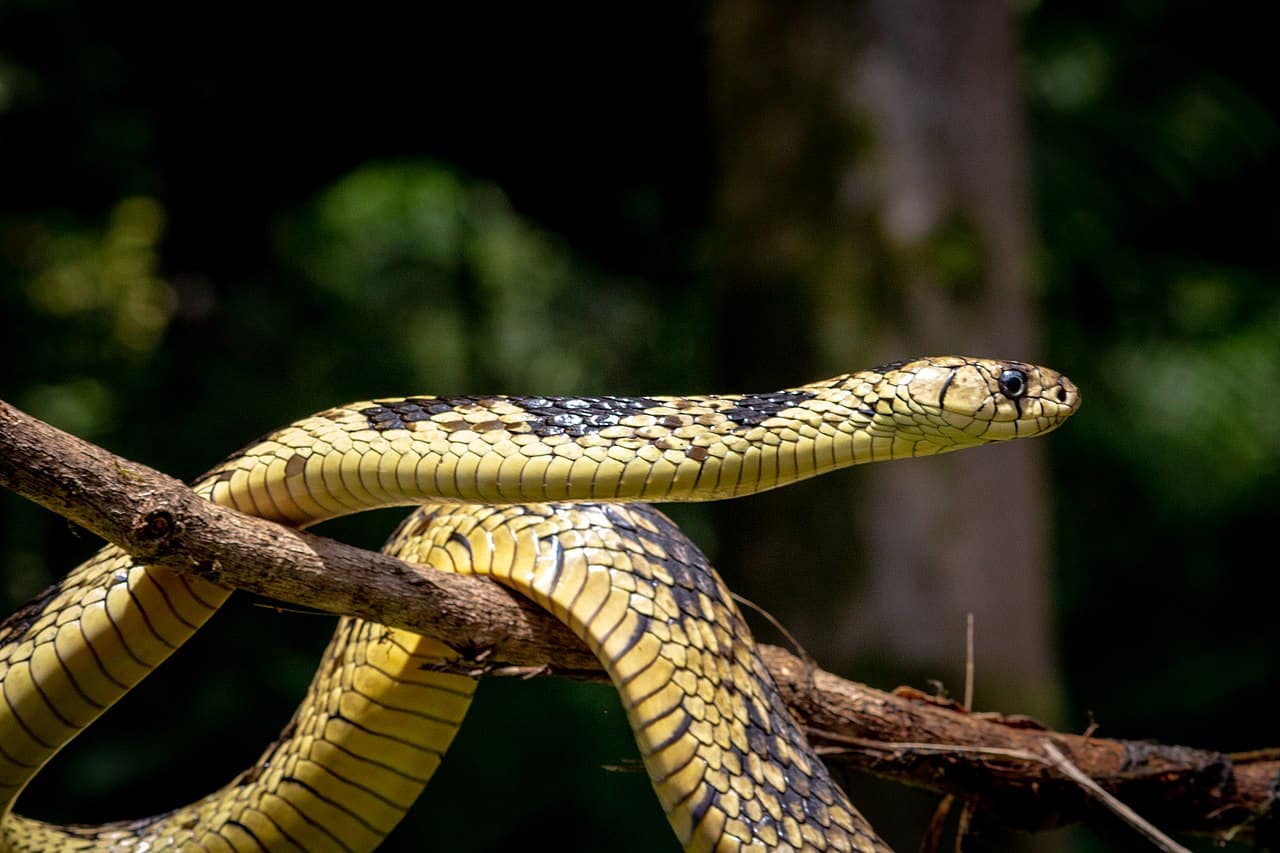
Maximum length: 2.7 metres.
A non-venomous snake of Central and South America, whose range spans several thousand miles. The tiger ratsnake (Spilotes pullatus) has a well-balanced set of skills which have allowed it to completely take over. It slithers along the ground, yet easily zips up trees to explore high branches. It has a varied diet, including birds and bats, and couldn’t care less about slithering past a front porch where shocked humans are sitting reading books.
Tiger ratsnakes are flexible in their habitats, ranging from villages and fields to forests and agricultural areas. They’re recognisable by their black scales contrasting sharply against vivid yellow. You could encounter this snake in a nature reserve near Rio de Janeiro, or on a forest trail in Guatemala.
This species’ defensive strategies are nothing unique, but it has a wide variety of them. Tiger ratsnakes can go limp, create a foul smell, thrash their bodies furiously, or produce a short sharp hiss with their mouth hanging half open. They also inflate their throat like a frog, making the yellow scales more visible.
| 6 | Adder |
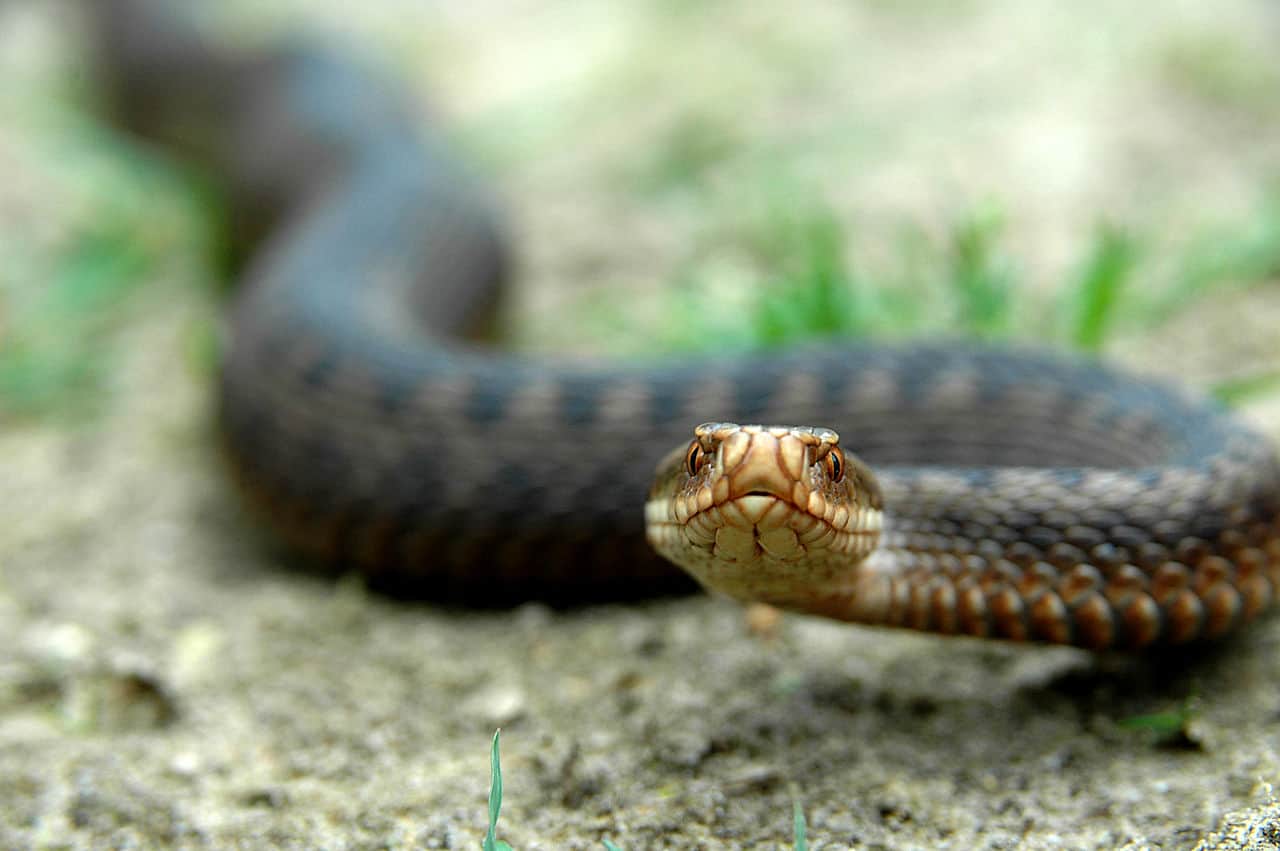
Maximum length: 93.5cm.
The adder is in the same boat as the grass snake, having taken over a giant swathe of Eurasia due to its innate cold weather resistance. The adder has the largest east to west span of any snake on Earth. Its territory begins in Sakhalin, off Russia’s east coast, continues for 8000 kilometres, before finally grinding to a halt in Wales (as Ireland has no native snake species).
This species has close relatives in Europe such as the asp viper and meadow viper, yet the adder is vastly more successful. It’s possible that because cold weather resistance is so rare in snakes, those which do evolve it face virtually no competition and can move into empty new landscapes at will.
Like the boa constrictor, the adder is one of the most flexible within its family. It eats a variety of small mammals scurrying through undergrowth, including voles, mice and shrews. Unlike the alpine meadow viper, which utterly loathes forests, adders can appear in woodlands, fields and overgrown bushland alike. All this gives them the skills required to take over the world.
| 7 | Common garter snake |
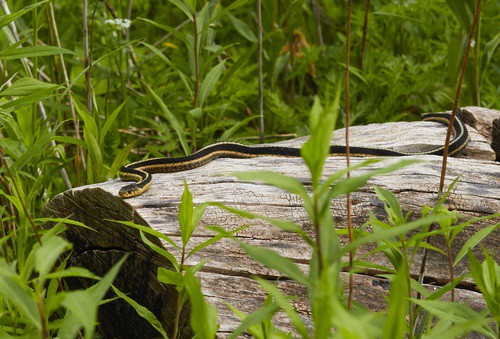
Maximum length: 137.2cm.
The common garter snake does what it says on the tin, as it’s the most widespread snake in the USA, and up there worldwide. Technically, it only occupies a feeble 3 countries, also spilling into northern Mexico and Canada. Yet common garter snakes reside in all 48 lower US states except Arizona, which is just one big desert.
Balance is where they shine, as they love water, yet aren’t as restricted to ponds and streams as the aquatic garter snake. They prefer amphibians and earthworms, but are capable of swallowing small mammals if necessary. Their high newborn totals have helped them take over, ranging from 18 to 40 per average batch, and occasionally over 80. They also dwell in communal winter hibernacula, huddling for warmth and ensuring each other’s survival.
Then there’s innate cold weather resistance – they can keep slithering when others would grind to thudding halt. There’s no huge gimmick, but combine these smaller advantages, and you have an extremely hardy and widespread snake. The last stop for the common garter snake is Chihuahua state, northern Mexico.
| 8 | Gopher snake |
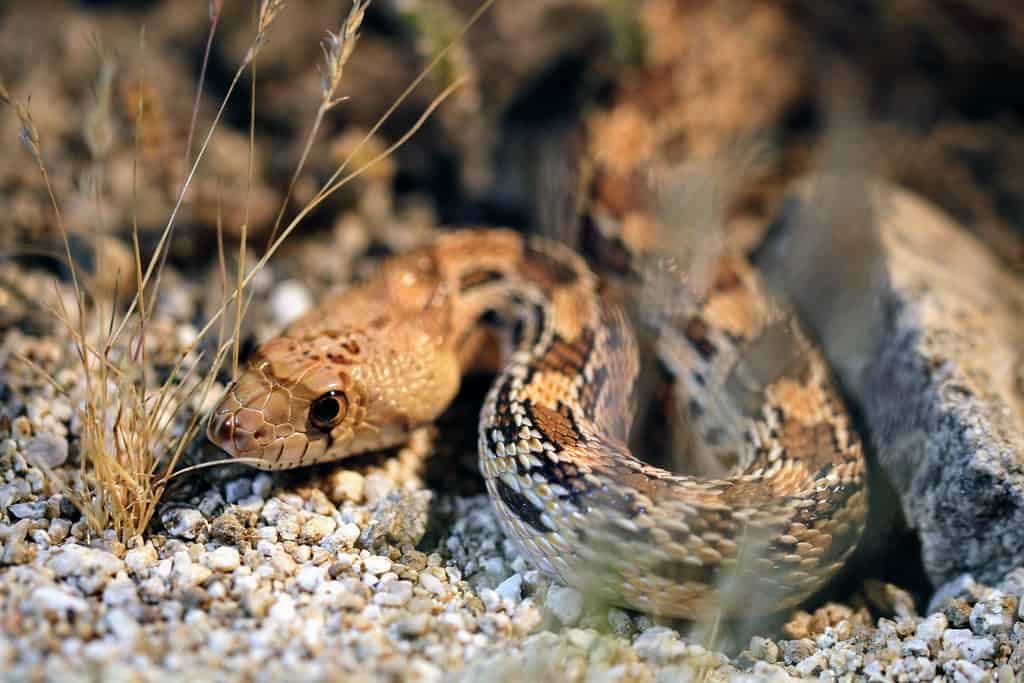
Maximum length: 267.7cm.
Probably the fourth most widespread snake of the USA, after the black racer, ringneck snake and common garter snake. Gopher snakes occupy virtually every western state of the USA, as well as southern Canada and a huge swathe of Mexico. They’re flexible, but prefer open areas, allowing them to colonise new areas with ease.
Humanity has helped this snake to spread its wings, by converting forests into agriculture. Gopher snakes love to hang out between the rows of crops and seize curious rodents hoping to nibble on produce like potatoes and corn. Fields and hillsides are perfect habitats, as are people’s front porches and rocky canyons – this snake copes well with dry conditions.
Gopher snakes have a tendency to hibernate communally, increasing their survival chances. They huddle in burrows not just with each other, but garter snakes, yellow-bellied racers, and Pacific rattlesnakes, which coexist peacefully, lying side by side with each other. It isn’t all plain sailing for gopher snakes, as they’re popular bird prey, particularly for the red-tailed hawk, which chooses them above all other snakes. Something about this reptilian mass of scales must taste particularly good.
Being delicious is their one flaw, but gopher snakes benefit from a flexible diet, complimenting their mammal mainstays with birds and eggs. With such a wide empire, several subspecies have evolved, after being separated by ridges or now-melted glaciers. The bull snake lives in Canada, and has more extensive dark patches than other subspecies.
| 9 | Blunt-headed tree snake |
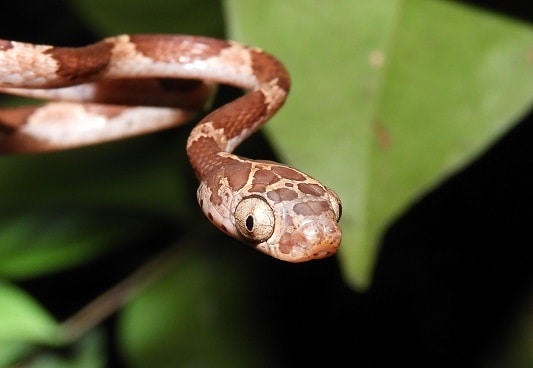
Maximum length: 155.4cm.
The blunt-headed tree snake might be the most widespread forest snake on Earth. It’s also the most widespread of the regular entries in online “craziest-looking snake” articles (including ours).
This species has a twig-like body with a head 5 times the diameter of its neck, and crystal balls of eyes making up 16-33% of its head. These aren’t gimmicks though, but finely-tuned survival tools. The thin body is for crossing between branches, while the large eyes are for scanning the jungle floor and spotting stationary anoles, when other snakes would require a flicker of movement.
Blunt-headed tree snakes (Imantodes cenchoa) begin in eastern Mexico, and thread through all of Central America. They don’t stop until southern Brazil, occupying over 15 countries.
Imantodes cenchoa is far more energetic than the likes of emerald tree boas, regularly investigating new branches and hollows. The precise reason for its vast empire is a mystery. But the huge eyes are a possible explanation, being so all-seeing and all-knowing that few snakes can compete. This is also a nocturnal snake, which creates a nice shield against bird predators (mostly).
| 10 | Boa constrictor |
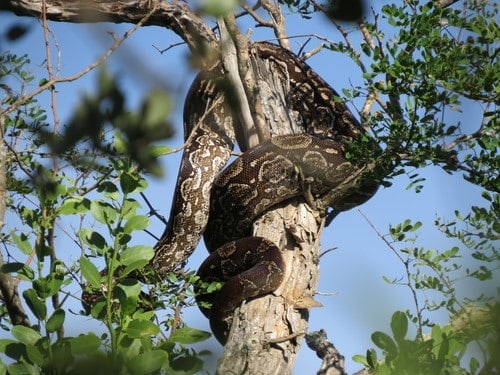
Maximum length: just over 4 metres.
The western hemisphere hosts approximately 38 boa species, but the iconic boa constrictor (Latin name: Boa constrictor) easily has the vastest empire. This hungry snake begins in Panama and occupies every South American country with the exceptions of Chile and Uruguay. It even occupies islands such as Trinidad and Tobago, due to now sunken Ice Age land bridges.
The reason for this staggering success is that the boa constrictor is quite simply the ultimate boa. It climbs trees effortlessly, but isn’t dependent on them like an emerald tree boa. It can eat virtually any land animal, from hawks and monkeys to rats and roosting bats. Boa constrictors are usually pictured in forests, but are just as comfortable in grassy plains. It’s as though the other boas were prototypes and this is nature’s finished model.
The boa constrictor’s most extreme point lies in central Argentina, on the outskirts of Cordoba. Beyond that, the cooling climate gets too much, as the Antarctic air influence begins filtering through.
In fact, its empire used to be even larger. Recently, the Central American colonies were split into an independent species, Boa imperator, which has subtly varying physical features, but a similar lifestyle and diet.
| 11 | Forest flame snake |
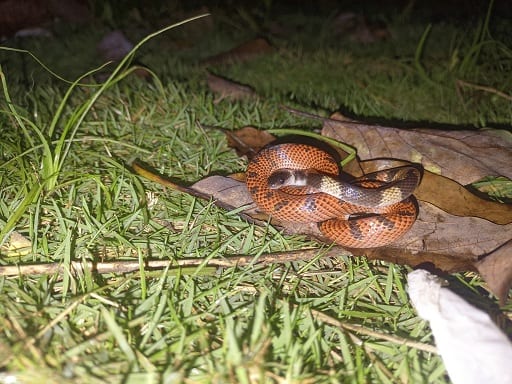
Maximum length: 132.7cm.
Of all entrants on this list, the forest flame snake (Oxyrhopus petolarius) is undoubtedly the most harmless and innocuous. This species has no defensive abilities whatsoever, as it possesses only the mildest venom, never attacks human beings, and lacks any miscellaneous abilities such as breathing fire (despite the name). The main survival skill of this snake is its rapid flight, as when approached, the forest flame snake darts away rapidly into bushes.
Forest flame snakes are found in habitats such as rainforests, cloud forests and riverside gallery forests. Their diet mainly consists of reptiles such as yellow-tongued anoles and forest whiptails. In a battle with a green anaconda or a common lancehead, this species would be brushed aside like a fly. Yet somehow, it has risen above to become more common than both with ease.
The humble forest flame snake is somehow one of the most common snakes in the world, even outstripping the boa constrictor. It occupies 6 out of 7 countries of Central America, with the sole exception of El Salvador. Further north, it covers a large area of southern Mexico, reaching just to the east of Mexico City. In South America, it appears in every country except for Uruguay and Chile, just edging into northeast Argentina.
The forest flame snake covers a truly enormous swathe of land, despite being a “weak” snake. This species proves that rapid escape and complete disappearance is just as great a survival strategy as a corrosive and heart-stopping venom.