
| 1 | Vipers have thicker heads |
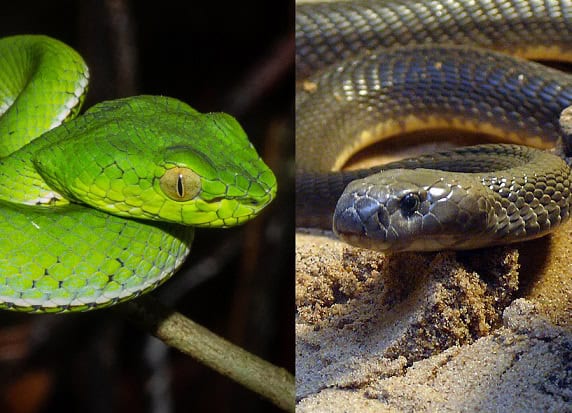
The most consistent physical difference between vipers and cobras. This difference is easily noticeable in photographs, on your front porch, on a desert highway, or wherever you happen to meet a deadly venomous snake.
The vast majority of vipers have a head significantly thicker than their body. This varies between species, as in some vipers, it widens moderately from the neck, while in some, like the Mojave rattlesnake or toad-headed pitviper, it’s a fully-fledged triangle. Virtually all rattlesnakes have bulky heads.
Cobras, meanwhile, have heads which are moderately wider than their necks, unlike some coral snakes. But they never reach the triangular proportions of a viper, and their heads can never be described as bulky.
Even the tiniest vipers such as Peringuey’s adder (Namibia) have sharply triangular skulls. Even the longest cobras like the forest cobra (central Africa) have a relatively narrow head.
| 2 | Vipers are far more nocturnal |
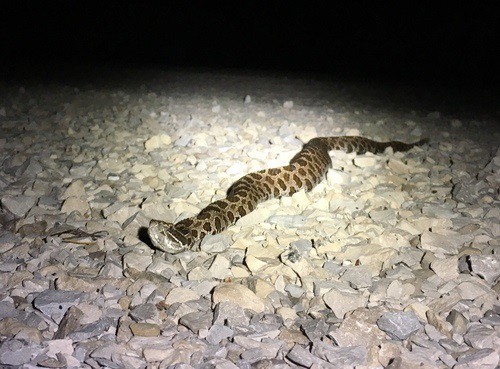
Rattlesnakes, green pitvipers, Bothrops lanceheads, European adders. These have something in common – they’re mostly nocturnal, with a small number of exceptions.
Vipers are adapted to move after sunset and before sunrise, with additional rods and fewer cones in their retina in order to maximise fleeting traces of light. There’s only a handful of diurnal vipers worldwide, with one strong exception being the night adders of Africa (ironically).
Cobras, meanwhile, have a more even split. There’s several nocturnal species such as the snouted cobra and Egyptian cobra, but a larger portion are diurnal. Species such as the cape cobra or Caspian cobra are adapted to move in the hottest of conditions, on burning open plains, while other snakes hide away in dark burrows.
Vipers prefer to prowl the countryside under pure darkness, with a menacing glare in their eyes, which of course is completely invisible. A cobra can lunge at your chest and inject venom within about 0.1 seconds, giving you no time to dodge, but at least has a sense of honour and gives you a warning by approaching in daylight. Unless of course it’s a spitting cobra, and a random globule of venom flies from a bush.
| 3 | Cobras have round pupils, vipers vertical |
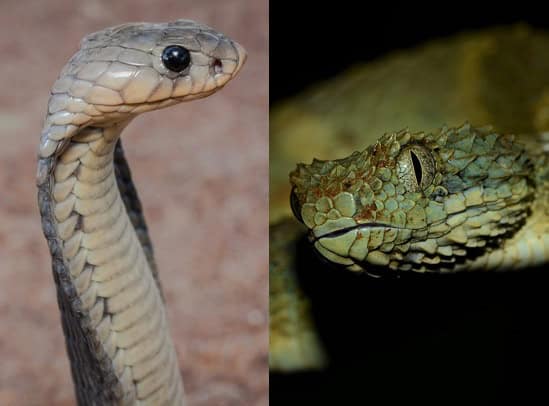
This relates directly to our previous difference. The vast majority of vipers have vertical, elliptical pupils, while cobras have round pupils like a human being. We don’t recommend getting close enough to witness these differences first hand, unless you’re in a zoo, and even then, snakes are crafty and may be able to weave through gaps in glass planes (see this venomous escapes article).
Generally, nocturnal species have vertical pupils, and diurnal species have round ones. The night adders of Africa aren’t just a rare viper group to move by day, but a rare viper group to have round pupils instead.
Another difference spawning from the day/night cycle is heat-seeking pits. Vipers are blessed with many of these pits, particularly those in the western hemisphere, such as rattlesnakes and Bothrops lanceheads. Boas and pythons also feature them (e.g. the emerald tree boa, which has 40), but cobras lack them completely. These natural IR sensors allow vipers to detect prey differences to the surrounding air to a fraction of a degree centigrade, but cobras must survive without this skill. Fortunately, they don’t seem too upset.
| 4 | Cobras eat more snakes |
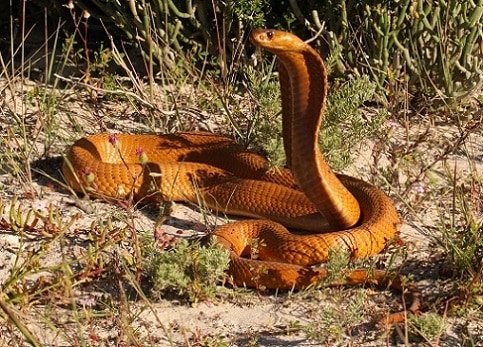
In all the diet studies conducted on the 200+ viper species worldwide, there’s a surprisingly rare occurrence – snake meals.
Ophiophagous (snake-eating) snakes are common worldwide. Top species include the king cobra, which derives 95% of its meals from other snakes. The California kingsnake eats Pacific rattlesnakes and gopher snakes constantly, while the majority of coral snakes prey heavily on snakes.
The true cobras also join this cunning, opportunistic crew. Cape cobras (southern Africa) have been witnessed in heated battles with puff adders, sub-Saharan Africa’s most common venomous snake, while Indian cobras are known to eat the infamous Russell’s viper. No cobra species is 100% reliant on snakes, but they consume them readily
Meanwhile, there are almost no vipers worldwide which focus heavily on snakes. A few exceptions include the massasauga rattlesnake of the northeastern US, and the Querétaro dusky rattlesnake of Mexico, but even these proportions don’t exceed 50% of their diet.
| 5 | Cobras are thinner and faster |
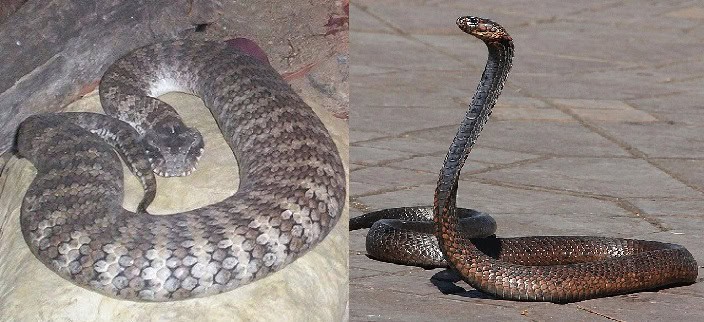


Vipers have many lethal powers, but charging at you down a hillside through a plume of dust is one they don’t possess. A cobra probably won’t do this either, but on average, cobras are far thinner and faster than the average viper.
Vipers prefer to move stealthily around the countryside, carefully investigating objects, while another large percentage are immobile ambush predators. Species such as the South American bushmaster can barely move for weeks; the Ussuri pitviper of South Korea can move just 3 metres from its original spot over 10 months.
Meanwhile, cobras are active, energetic beings, which have a naturally high speed. They can dart away into the bushes when frightened, which is preferable to them being enraged.
To aid this speed, cobras have significantly thinner bodies, and like the thinner head, this is easily noticeable from a distance. Relative to body length, vipers are much thicker and more muscular. The thickest non-constrictors in the world belong to the viper group, such as the puff adder, gaboon adder and eastern diamondback rattlesnake.
| 6 | Vipers are ambush predators |
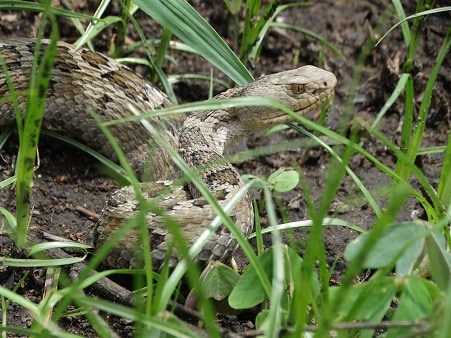
There’s a great reason for these body types – hunting strategies. Vipers are immobile ambush predators. They don’t need to move; they just need a mouse or rat to move, and come to their secret resting spot.
Tree vipers must choose green overlapping leaves and vegetation, while an African adder must choose dry wispy vegetation, or even desert sands. Then they wait patiently, until it’s time to strike, and this is when their muscular, thick bodies come into play, as more bulk equals a more brutish pounce. With species like the puff adder, this can kill a small mammal before venom is even injected.
This hunting strategy doesn’t rely at all on whippy speed or a thin body. Cobras are the opposite – they’re active foragers. Cobras prowl the savannah, rocky hillside, or Thai village actively and energetically, searching for any clues about potential meals. They fleck their tongues ceaselessly, attempting to detect prey objects. They have no need for crushing bulk, as when they find a mammal or fellow snake, their goal is to inject venom as suddenly and rapidly as possible, which makes speed preferable.
Of the 35-40 cobra species worldwide, none are ambush predators. Meanwhile, all 200 vipers are ambush predators, with some being lazier than others, and others changing position more regularly.
| 7 | Vipers can cope with more extremes |
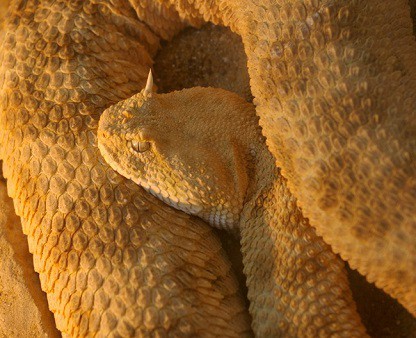
When you list the extremes of geography and climate and the snakes which hold their records, you may notice something – it’s almost always a viper. Vipers are not just far more adaptable in habitat than cobras, they’re the most adaptable group of snakes on Earth. Just look at the following records among the 4000 snakes worldwide.
Highest altitude – Himalayan pitviper (Gloydius himalayanus). Reaches 4800 metres in Nepal.
Most northerly – adder (Vipera berus). Reaches the Arctic circle in Norway and Sweden.
Most southerly – Patagonia lancehead. A viper which reaches central Argentina.
Vipers also occupy the most extreme habitats, including sand deserts, where the most adapted are the Saharan horned viper of Egypt and Libya and the sidewinder rattlesnake of the southern US. The adder is not just the most northerly, but occupies a large swathe of Siberian Russia.
While cobras are common in sub-Saharan Africa, none occupy true deserts. In Namibia, Peringuey’s adder occupies sand dunes, but the Cape cobra and Anchieta’s cobra stay away. Cobras are much more comfortable in moderately hot countries, failing to reach any cool, temperate climates at all. The furthest north they reach is Uzbekistan (the Caspian cobra).
| 8 | Cobras are more neurotoxic overall |
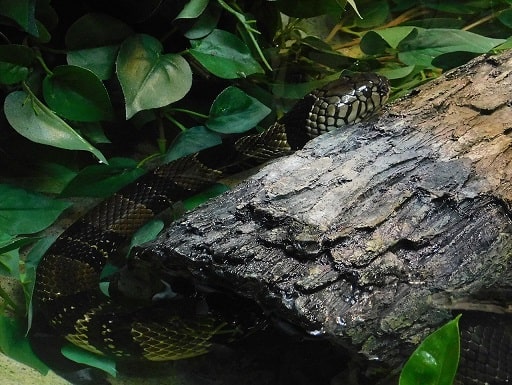
Vipers and cobras have an equal number of extremely deadly species, but one difference is that cobras are more neurotoxic on average. They have the ability to disable brain signals, resulting in slurred speech, blurred vision, dizziness, uncoordinated muscles, and finally death via respiratory failure.
The most neurotoxic of all are the Philippines cobra and the Caspian cobra of central Asia. One study from Iran found 118 confirmed Caspian cobra victims, of whom 51 died. 46 received no antivenom, but 5 victims received antivenom yet still succumbed.
There’s also a handful of neurotoxic vipers, including Wagler’s pitviper (Singapore), Fea’s viper (China) and the Central Asian pitviper. Yet generally, vipers specialise more in cytotoxins and haemotoxins, with effects such as severe swelling and spontaneous bleeding. They still have neurotoxins in their genetic code, waiting to activate in certain circumstances, yet they more often remain dormant. Of the 55-60 rattlesnakes, only a handful are neurotoxic, e.g. the tiger rattlesnake, Mojave rattlesnake and South American rattlesnake.
Vipers can still be extremely deadly without neurotoxins. The Russell’s viper (India) kills its victims via a massive cytotoxic assault on the kidneys. However, vipers rarely cause the neurotoxic lung failure of cobras.
| 9 | Vipers are more numerous |
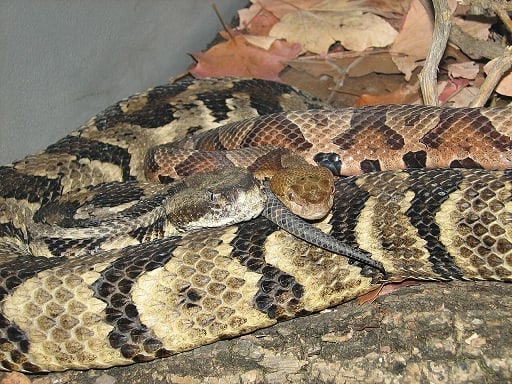
Another difference of vipers compared to cobras is that their plans for world domination are significantly further ahead. Vipers are far more numerous around the world – 200+ species versus 35-40.
Vipers cover far more territory around the world, including both the western and eastern hemisphere. They’re more comfortable in mountainous areas, and they reach significantly further north and south (though none have been found floating on icebergs yet).
Cobras are only found in the eastern hemisphere, and even within this territory, they have far fewer species that cover small, secluded valleys or mountain areas. Because vipers are lazy and move less distance, it allows them to sequester themselves in one scenic subregion of Thailand or Costa Rica and evolve into a new species, without re-mingling. Thailand alone has around 15 green pitvipers, including rarities like the limestone eyelash pitviper and Kui Buri pitviper.
Meanwhile, cobras are more energetic, and less likely to become separate. They may investigate an area, but are less likely to become stranded and separated, meaning that divergences occur less commonly. Cobras tend to have less species, but with each covering a large area.
| 10 | Cobras can spit! |
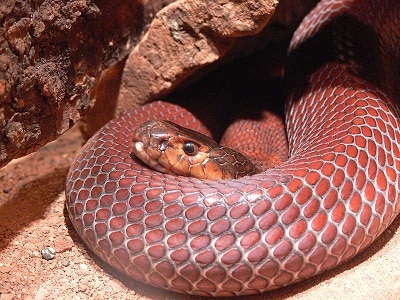
One tendency which vipers are mercifully free from is spitting venom in people’s faces. Meanwhile, around 15 cobras around the world have evolved the ability to spit, via tiny holes in the lower front of their fangs, which squeeze through globules of venom in pressurised bursts.
Cobras aim for the eyes, and have an extremely sharp ability to recognise human faces. It’s even believed that primates evolved their sharp eyesight in response to cobras, and spitting cobras seem to have done likewise with their aiming systems. One study on the red spitting cobra (Ethiopia, Kenya) found increased accuracy with age, as juveniles were wild and inaccurate, before becoming hyper-focussed in adulthood.
Even non-spitting cobras can occasionally perform a rudimentary spit, like the monocled cobra of Thailand, which uses a workaround method by angling its mouth upwards sharply and releasing a burst of venom. Vipers have no such tendencies, as there isn’t a single species of the 200+ which has been reported to spit. A spitting viper could be discovered one day, but for now, our planet is free from such a terrifying creature.
| 11 | Vipers give birth to live young (usually) |
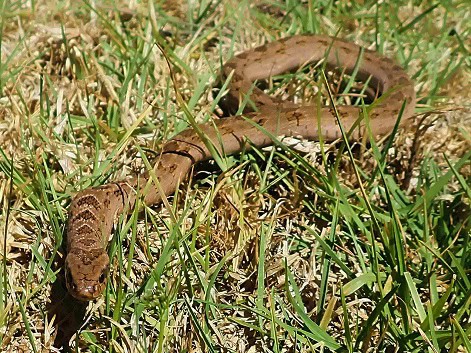
A cobra sitting proudly on a pile of white eggs is something you’re highly likely to see. Perhaps the cobra is staring at you intently, daring you, challenging you to come any closer. An Indian cobra was once spotted lying on a pile of 45 eggs, which is the current record for the cobra group…
Meanwhile, zealously guarding an egg stash is much less likely for a viper. The reason: they rarely lay eggs. The vast majority of vipers lay live young, with newborns appearing in thin, gelatinous sacs which they rapidly break out of.
Exceptions include the 4 bushmaster species of the Americas, the longest vipers on Earth, and the Causus night adders of Africa, the same anomalous vipers which have round pupils and move by day. All rattlesnakes lay live young, and all Eurasian vipers like the adder.
Cobras have no variety of all, as not a single species lays live young. All 35-40 species lay eggs. Vipers tend to be more protective of their young as well. While cobras have been spotted near their egg stashes, they tend to abandon them quickly. Vipers are more caring, and mothers will even remain with their young for several days after hatching, hissing angrily at any scientists or hikers who stray too close. Even male vipers remain with their female and young on occasion (e.g. the Arizona black rattlesnake).