
| 1 | Ruby-eyed green pitviper |
Maximum length: around 60cm.
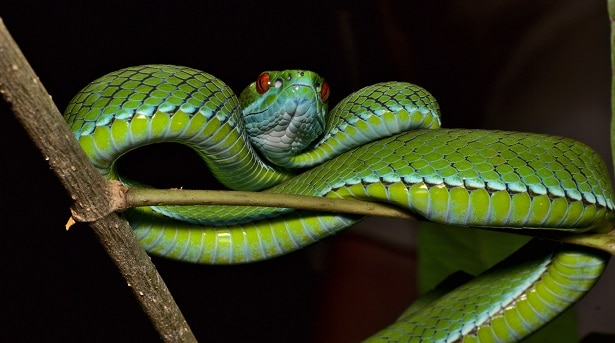
Only discovered in 2011, this species was found on the doorstep of Ho Chi Minh City, Vietnam’s capital. The ruby-eyed green pitviper (Trimeresurus rubeus) lives in woodlands, and was evidently part of the large green pitviper (Trimeresurus) genus, yet differed by its ruby red eyes, which weren’t filled with blood, but naturally a rich red.
The ruby-eyed green pitviper is an arboreal species, clinging to branches, without being completely restricted to trees. It has a dangerous venom, but being so new, little is known about its composition. Like other green pitvipers, it possesses two thin white stripes, one on each flank, which are slightly wider than in other members.
The ruby-eyed green pitviper covers a narrow area, including only eastern Cambodia and southern Vietnam. Specifically, this species was discovered in Cat Tien National Park, where it lives alongside its more common relative the white-lipped pitviper. This park hosts an estimated 45 snake species, and covers 719 square kilometres. Tourist trams drive through regularly, with strict instructions to look and not touch. Other animals here include gibbons and sunbears, which the ruby-eyed pitviper probably doesn’t attempt to eat.
The Trimeresurus genus has 44 members, but the ruby-eyed pitviper is mostly closely related to the large-eyed pitviper of Thailand (T. macrops), and Cardamom pitviper (T. cardamomensis) of Cambodia. These three form a small subgroup within the Trimeresurus clan.
| 2 | Laotian wolf snake |
Maximum length: 50cm.
Another resident of Cat Tien National Park, but also a flexible snake which regularly pays human households a visit. The Laotian wolf snake is common in southern Vietnam, where it can be found in gardens and on wooden porches, waiting patiently for geckos to walk past.
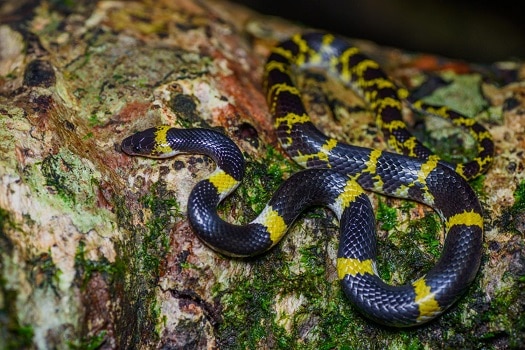
The Laotian wolf snake (Lycodon laoensis) is a harmless species, whose mouth is too small to land a consequential bite in humans. This species makes easy pickings for Vietnam’s many bird predators, as it possesses virtually no defensive weapons – neither a corrosive venom nor a fierce personality. Laotian wolf snakes are nocturnal, and slither along the ground rather than climbing trees.
This species is similar to the common wolf snake (Lycodon capunicus), but has a shorter and narrower snout. Another difference is that the white bars are usually yellow – hence the alternative name of “yellow-barred wolf snake”.
From afar, the Laotian wolf snake looks black, but it’s actually a deep bluish grey. At first, its barred patterns are tight and organised, but as the tail approaches, these bands get more and more disheveled, and sometimes transform into circles. The amount of bands varies significantly, from 13 to 26.
This species is fond of mountainous and hilly regions, but if you see one, never approach. The reason – Laotian wolf snakes bear a close resemblance to neurotoxic kraits of the Bungarus genus.
| 3 | Indochinese ratsnake |
Maximum length: 268cm.
This 2 metre snake has been witnessed slithering down the streets of Ho Chi Minh City itself, specifically the urban zone of District 7. Residents may have to step over this long, non-venomous, but occasionally vicious serpent on their way to buy milk at 9am.
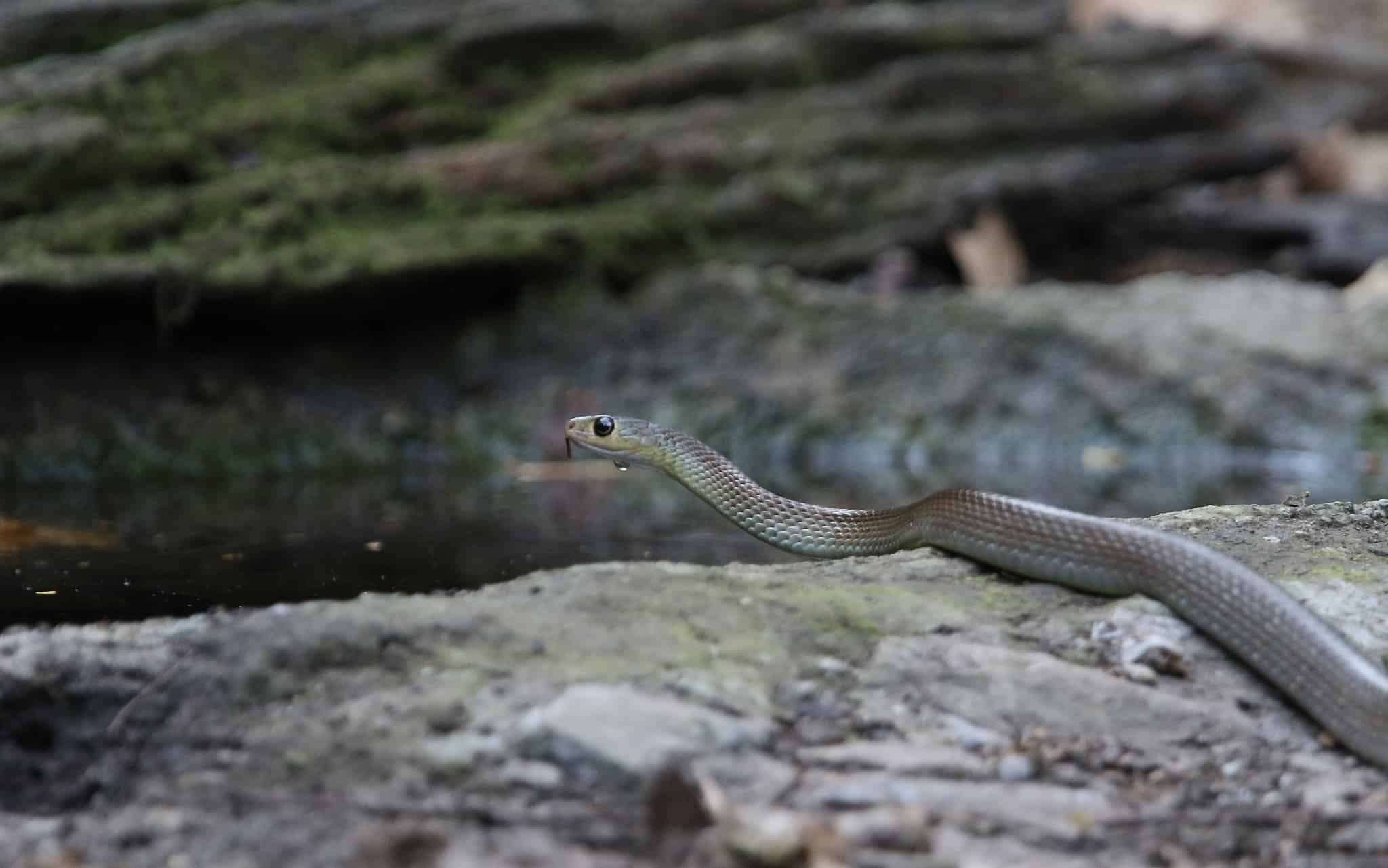
The Indochinese ratsnake (Ptyas korros) is a fast, energetic species which pursues its prey rather than waiting in ambush. It’s an abundant species in the southern half of Vietnam, with no shortage of sightings in parks and streets alike. This is the sister species of the oriental ratsnake, which also inhabits Vietnam, but has a far lower density of sightings (map, map).
In the wild, Indochinese ratsnakes appear in a variety of habitats, from forests to fields, typically favouring ones with a water source nearby. They’re particularly common near rice paddy fields and along the shores of rivers and reservoirs, perhaps in a grassy field not far from a river.
This snake is like a garbage disposal unit – its confirmed prey includes golden skinks (Eutropis multifasciata), Tanezumi rats, Malayan field rats alike. Chinese people eat this species in soup, and a vast trade exists. According to official records, Vietnam has 109 registered Indochinese ratsnake breeding farms, and an estimated 76,247 individuals were traded in 2014.
| 4 | Malayan pitviper |
Maximum length: 100cm.
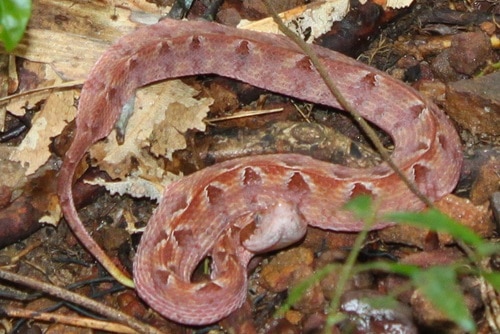
The species most likely to send you fleeing across the Vietnamese border with your tail between your legs, vowing never to return. The Malayan pitviper (Calloselasma rhodostoma) measures 0.5-1 metres, and has a venom rich in metalloproteinases and haemotoxins.
This species is abundant in southern Vietnam, including near the capital of Ho Chi Minh City. Malayan pitvipers favour forests most of all, but also palm oil and rubber plantations, and timber piles on the edges of villages. It’s this characteristic which makes them so lethal, particularly when combined with exceptional camouflage, which causes people to step on them.
One of the best studies yet gathered snakebite data from Cho Ray Hospital, Ho Ch Minh City (formerly known as Saigon). From April to June 2001, and from June to July 2002, 131 snakebites were recorded in this hospital.
93.1% of bites were venomous, and of those, the Malayan pitviper caused 30.5%. This was just ahead of the white-lipped pitviper at 28.2%, Siamese spitting cobra at 13%, and monocled cobra at 13% again. Of the 6 fatal cases, 4 were caused by Malayan pitvipers.
Swelling, haemorrhaging and necrosis are the standard symptoms of this snake, and gangrene is also a possibility. Malayan pitvipers stick to the floors of forests rather than branches, and their camouflage is strongest in beds of fallen leaves.
| 5 | Siamese catsnake |
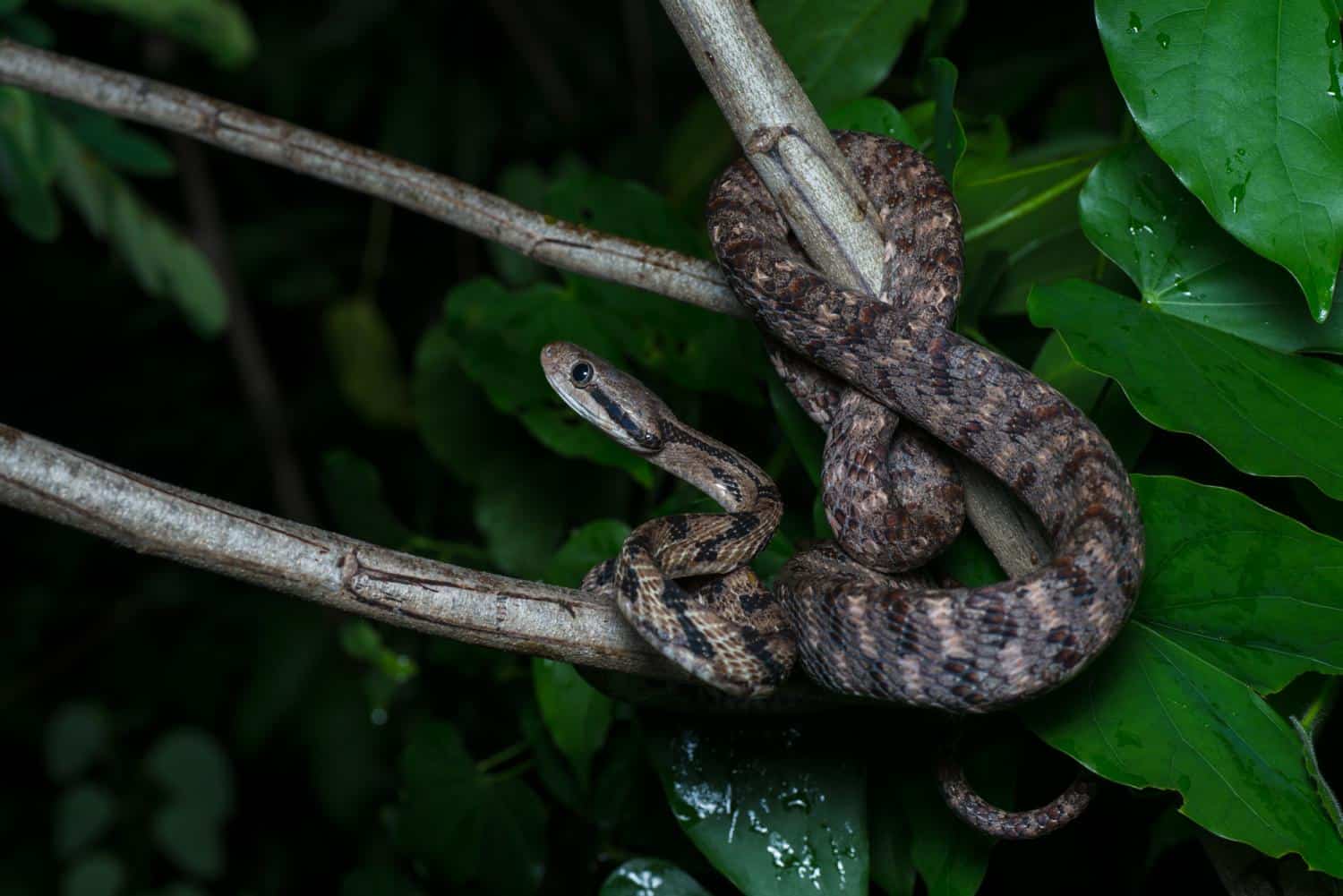
Maximum length: 170cm.
A tree-dwelling species with a greyish or beige appearance, and complex patterns like a rug. This thin-bodied snake loves to climb people’s wooden roofs, and reaches altitudes of 1700 metres above sea level. At a maximum of 1.7 metres, this is secretly one of Vietnam’s longer species.
Siamese catsnakes (Boiga siamensis) are common in southern Vietnam, as well as Cambodia and Thailand. They’re normally extremely slender, yet have a disturbing ability to inflate their neck, which looks like a meal is lodged in their throat, or like a pelican about to swallow a fish. They’re often spotted gaping their mouths open widely and striking in mid-air.
This species possesses venom, but the exact intensity is unknown – whether it’s mild like most catsnakes, or surprisingly intense like in the black-headed catsnake. There’s rumours of a herpetologist called Frank Cuesta who was bitten by a Siamese catsnake in 2014, and supposedly suffered a swollen arm requiring treatment for a month.
The Boiga catsnake genus is huge (38 members), but Boiga siamensis is easy to separate. It has a dark stripe beginning at each eye, combined with snowy white spots on its lower flanks, just adjacent to its belly.
This species could never be confused with the green catsnake or black-headed catsnake, which have very simple patterns. That said, Siamese catsnakes vary in appearance, as some are mottled like above, while others have much cleaner alternating brown and beige tones.
| 6 | Bocourt’s mud snake |
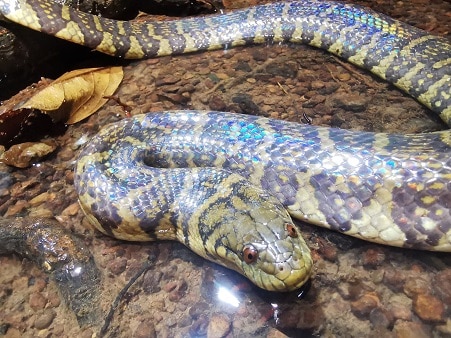
Maximum length: 110cm.
This semi-aquatic snake is the opposite to most snakes on our list. Rather than belonging to a huge group, this species is the only member of its genus, with no close relatives.
Bocourt’s mud snakes (Subsessor bocourti) live in Vietnam, Cambodia and Thailand, and spend much of their day wallowing in humid, stagnant water bodies. These can be marshes, shallow lakes, rice fields and ponds, sometimes close to human settlements. They normally stay in water, but travel overland during heavy rains at night, which grant them a moisture shield.
Bocourt’s mud snakes prefer to stay under cover, and often hide near logs on the borders of ponds. This species has a mysterious venom, with little information, other than that its venom gland is much larger than other semi-aquatic snakes in southeast Asia. Bocourt’s mud snakes also have large and brutal teeth, and picking them up isn’t advised.
At birth, this is a snake of brightly contrasting black and yellow. With age, these colours blur together and become less distinct. Bocourt’s mud snake has a naturally fat body, and an iridescent sheen when exposed to bright lights. This species has declined in Vietnam recently, due to overharvesting in the wild, sometimes by local villagers seeking a serpent meal.
| 7 | Vogel’s pitviper |
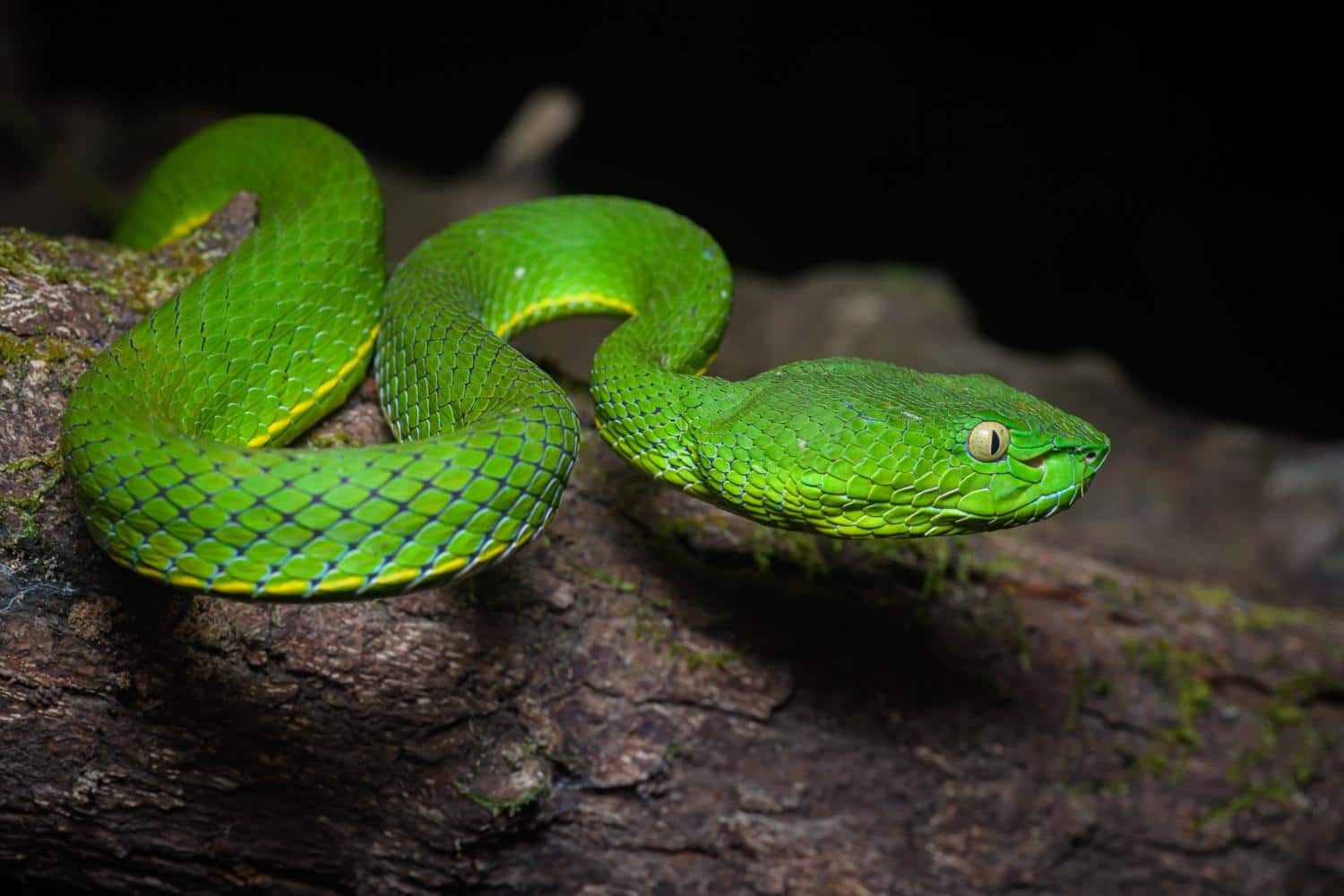
Maximum length: 112cm.
Another member of the green pitviper clan, and another snake you should stand well back from. Vogel’s pitviper (Trimeresurus vogeli) has the usual sharply vertical pupils, and an upturned snout with a hungry expression. This 80-110cm species inhabits evergreen forests, but also wide open grasslands, at altitudes of 200-1200 metres.
Vogel’s pitvipers are common in Vietnam, Cambodia and southeastern Thailand. Males of this species are different, with white spots running down their vertebrae which females lack. Females tend to be a denser, grassier green, while males are paler with hints of blue. Both have a sharply triangular head which is far wider than their neck.
Compared to other green pitvipers, Trimeresurus vogeli is easy to distinguish by the lack of red on its tail. The most you get is maybe a rusty brown tip. Unlike the ruby-eyed green pitviper, its eyes are a pale green or blue.
Vogel’s pitvipers prey on lizards, with one confirmed species being the Bidoup bent-toed gecko. They swallow these geckos tail-first, taking approximately 30 minutes to complete swallowing. Vogel’s pitvipers climb trees with ease, and prefer branch perches within 2 metres of the ground. They’ve even been found in the rafters of a restaurant before.
| 8 | Hampton’s slug snake |
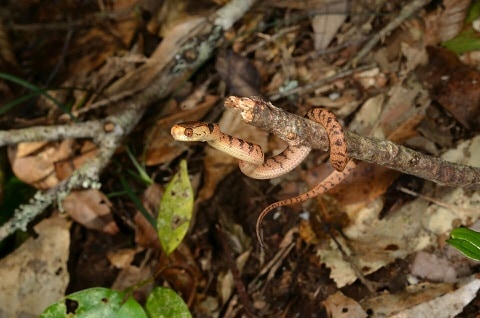
Maximum length: 70.5cm.
An obscure, poorly researched species. Hampton’s slug snake (Pareas hamptoni) was discovered in 1905, but is very rare in museum collections around the world. This species gets its name from its diet, which mainly consists of slugs.
Hampton’s slug snakes are mainly found in moist places, including monsoonal evergreen forests and peat swamp forests. Within Vietnam, streams within forests are their ultimate habitat, typically on a low bush.
Hampton’s slug snakes also exist in Thailand, but only in the extreme southeast (Chanthaburi province). Instead, their range begins north of Ho Chi Minh City, continues through Laos, and ends in southern China. This species is rare wherever it lives, and never swells to vast numbers.
Hampton’s slug snake has a brown body with black bars, and its scales are slightly keeled (sharp) to touch, despite this being hard to ascertain from a camera shot (unlike with the hairy bush viper). Like Berdmore’s slug snake found in Thailand, its head is far wider than its neck. Its tongue is a fleshy pale pink, and its eyes barely differ in colour to its body.
| 9 | Deuve’s kukri snake |
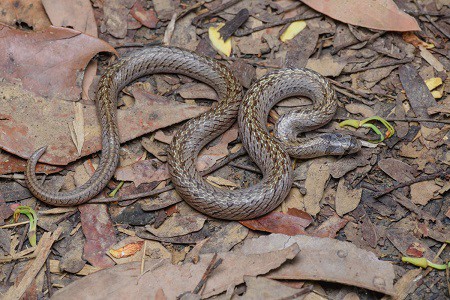
Maximum length: 53cm.
A non-venomous yet potentially vicious snake of the Vietnamese wilderness. Deuve’s kukri snake (Oligidon deuvei) is closely related to the striped kukri snake (Oligodon taeniatus), a widespread citizen of central Thailand. Its colors are similarly dull, but Deuve’s kukri snake has a bright stripe down its spine, with thinner (or non-existent) black markings on each side. This species also has a plainer tail, and is lacking the dark stripes on its lower flanks.
Deuve’s kukri snakes are common in forests, including bamboo thickets near rice paddies. They’re not averse to human settlements, as they often appear in gardens. This is a nocturnal species, which mainly sticks to the ground, but is mostly unresearched. In 2016, Deuve’s kukri snake was discovered in Thailand for the very first time.
The Deuve name refers to Jean Deuve, born in 1918, who was wounded in World War 2 and parachuted into Laos in 1945 to train the local anti-Japanese guerrillas. This little parachute excursion ultimately lasted 19 years, during which Deuve became chief of intelligence, and an advisor to the prime minister. He also became a renowned expert on the local snakes, eventually writing a 1970 book called Serpentes du Laos.
Like the ruby-eyed pitviper, Deuve’s kukri snake is abundant in Cat Tien National Park, located near Ho Chi Minh City. The park also host the extremely rare Cat Tien kukri snake, which has oranges patches down its spine.
| 10 | Nganson bronzeback |
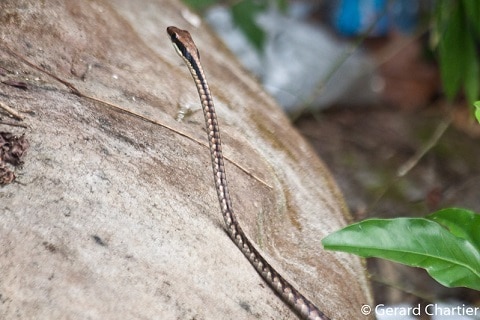
Maximum length: 150cm.
A harmless snake to humans, with large, bulging eyes and a red tongue with a black tip. The Nganson bronzeback (Dendrelaphis ngansonensis) is common in most of Vietnam, as well as southern China and parts of Thailand. Rather than a crushing constrictor, this is an acrobatic grappler, which acquires its prey through sheer determination.
This Vietnamese snake battles its prey on thin tree branches, and can maintain its hold even if the pair lose their balance and plummet to the hard ground. Its prey mainly consists of frogs, including the black-webbed treefrog, and in humid Vietnam, there’s plenty to choose from.
Dendrelaphis ngansonensis was originally a subspecies of the painted bronzeback (also found in Vietnam), but granted full species rights in 1999. The two look very different, as Nganson bronzebacks are far browner, and have no cleanly separated cream-coloured belly. A dense black stripe beginning from each eye is another ID sign.
Nganson’s bronzeback is relatively thick compared to its cousins, but that’s not saying much, as it still has a whip-like tail which looks like it might snap at any second. Living in forests and spending much of its time on branches, US soldiers almost certainly met this species without knowing its true identity.
| 11 | Bearded snake |

Maximum length: 39.5cm.
If the Indochinese ratsnake strides around everywhere, arrogantly rearing its chest up to show who’s in charge, then the exact opposite is the bearded snake (Fimbrios klossi). This Vietnamese species is almost never encountered by normal people, and stumbling across one is a very lucky event indeed.
This snake varies from steel grey to grey-blue, and never has any memorable patterns. Its scales are rough to touch similarly to the Javan dragon snake further south, and its pupils are round and innocent.
This is a mysterious, poorly studied snake, but we know just enough details to paint a picture. The bearded snake is an inhabitant of small streams in rainforests, typically at altitudes of 1000-1500 metres. It preys primarily on fish, and has a shy personality. In the obscure forest streams it inhabits, far from humanity, this shy snake often hides under fallen leaves, logs and in the water itself.
So far, the bearded snake is known from Vietnam and southeastern Laos. Nevertheless, this is a difficult species to notice, even while walking past, and may be more widespread than currently believed.
| 12 | Rhinoceros ratsnake |
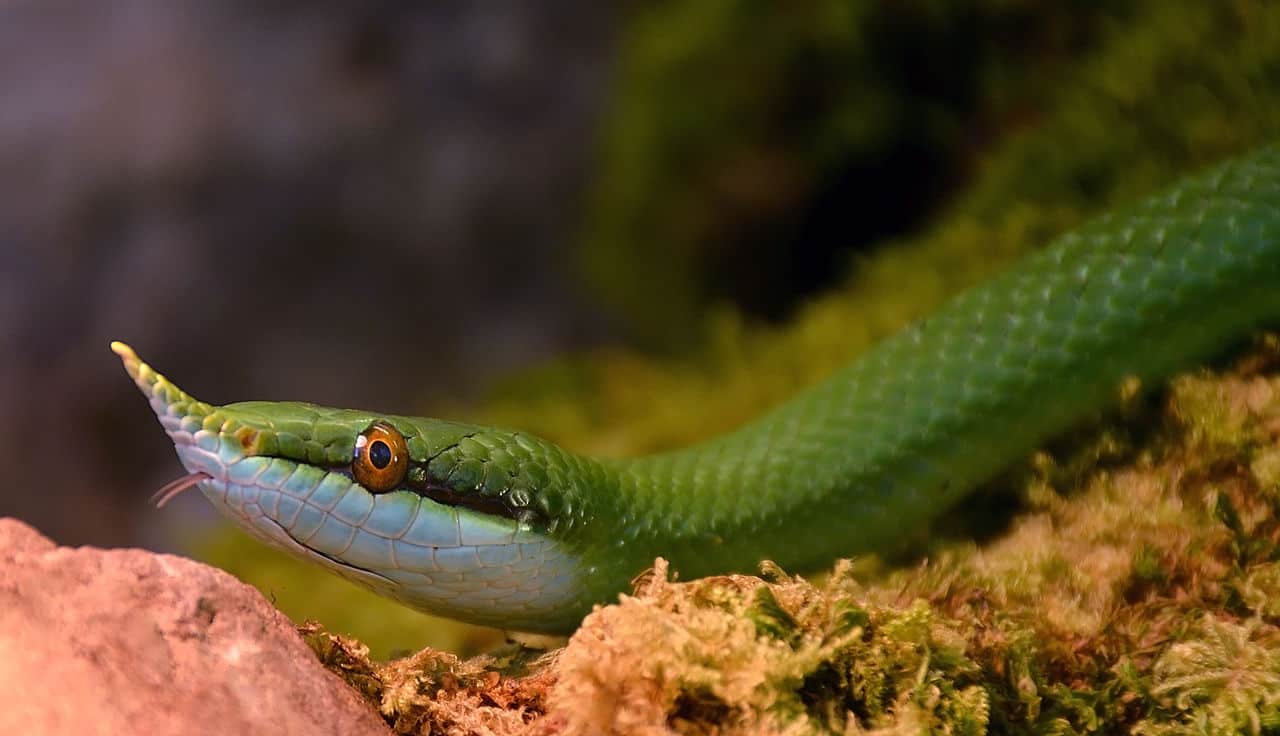
Maximum length: 163cm.
A species which nobody could fail to recognise. This non-venomous snake is found in Vietnam and southern China, and is identifiable by two features: 1) being extremely green, and 2) its namesake rhinoceros horn.
There are plenty of horned snakes around the world, but this is one of the few non-vipers to have sprouted one. Additionally, most other horns in snakes are located above the eyes, not on the nose.
The rhinoceros ratsnake (Gonyosoma boulengeri) is a rainforest species, which often dwells in rainforest valleys at altitudes of 300-1100 metres. This is a flexible species which appears on branches, the ground and in lakes, and has a varied diet. One individual was found on a tree branch 1.6 metres above ground with a small bird in its stomach. Captive individuals have swallowed up rodents and small quail chicks, although this species can be difficult to keep in captivity, becoming reluctant to feed.
Vietnam was actually where this species was first discovered, in 1897 in the Gulf of Tonkin. This species undergoes a drastic colour transformation. At birth, it’s a basic brown grey, with no hint of green. By 12 months, it matures to a steel grey, until month 24, when blue-green scales begin to appear all over its body.
By full adulthood, the rhinoceros ratsnake is almost fully green, except for a paler underside and chin, which is clearly demarcated just under the eye. Occasionally, you can find adults which have kept the duller brown colours of youth.